What Is a Reference Track in Music? Understanding Its Role in Modern Production
Learn what a reference track in music is and how producers use it for mixing, mastering, and inspiration.
What Is a Reference Track in Music?
In 2026, music producers and audio engineers rely on technology-driven workflows more than ever. Among the most fundamental tools shaping their creative process is the reference track in music. Whether you're composing a pop anthem, mixing a soundtrack for streaming content, or mastering an album, reference tracks remain essential for achieving consistent, high-quality results. This article explores what a reference track is, why it’s used, and how Soundverse’s Similar Song Generator helps producers leverage reference audio to create original, royalty-free compositions.
What is a reference track in music?
A reference track in music is an existing song or piece of audio that serves as a benchmark when creating, mixing, or mastering a new track. It represents the desired sound character — the tightness of the drums, the clarity of the vocals, the balance of frequencies, and even the overall sonic emotion. In essence, a reference track guides producers to sculpt their mix toward a professional sound. As Mastering.com points out, a reference track is a professionally mixed song used as a benchmark to compare your mix as you go along.
Producers use reference tracks in several stages of music production:
- Composition and Arrangement: A reference track helps define song structure and energy flow.
- Mixing: It provides a tonal balance check for midrange, bass, and treble frequencies.
- Mastering: Engineers use reference tracks to ensure their final master aligns with industry loudness standards and spectral balance.
From amateurs learning about audio engineering techniques to seasoned professionals in studio environments, the reference track acts as a roadmap for sonic excellence.

Why do producers use reference tracks in mixing and mastering?
When working on a mixing reference track, engineers compare elements like EQ, compression, and stereo width to those in the reference. This helps ensure that the new mix sounds cohesive across listening environments—from studio monitors to earbuds. As explained by Hyperbits, producers use a reference track from another artist to benchmark varying elements in their own productions.
In mastering, a mastering reference track is crucial for loudness comparison. During mastering, subtle details such as harmonic distortion, transient control, and stereo imaging define the final polish. Referencing a commercial-quality track ensures your master remains competitively loud but clean.
Mixing engineers sometimes use specialized tools to A/B test between their mix and the reference track. As noted by SoundGym, this frequent comparison helps achieve better sound consistency and balance. This level of critical listening allows immediate adjustments to match tonal balance, low-end depth, and dynamic range.

How do artists choose a song reference track?
Selecting the right song reference track depends on genre, mood, and production intent. A pop producer may choose a modern chart-topping single, while a jazz engineer might choose a vintage analog recording for warmth and authenticity. The goal is not imitation, but inspiration and sonic calibration. As Antares Auto-Tune describes, it’s the song that has the sound you aspire to.
Professional criteria for choosing a reference include:
- Genre Alignment: The reference should share stylistic similarities with your project.
- Production Quality: High fidelity recordings help accurately benchmark sound.
- Emotional Tone: The reference must evoke similar feelings or vibes to what you intend to capture.
- Instrumentation Similarity: Accurate comparison is possible only when the instrumentation matches your intended arrangement.
As music evolves through 2026, producers increasingly use reference tracks from multiple genres to create hybrid and cross-genre sounds. This blending approach aligns with current music industry trends emphasizing fusion-driven creativity.
The role of technology in modern reference analysis
In the past, referencing simply meant importing a favorite track into a DAW and trying to match its spectral profile manually. By 2026, advanced audio tools and AI now handle much of this work automatically. AI-assisted mastering tools can analyze reference profiles and apply matching curves, giving instant insight into loudness and tonal balance.
Platforms like Soundverse have taken this concept further by letting creators transform references into original music through intelligent audio analysis rather than imitation. This shift allows producers to rapidly prototype ideas, maintaining the emotional cohesion of a reference while producing unique content.
For more context on how AI reshapes creation, explore How AI-Generated Music Is Transforming the Music Industry and Soundverse AI Revolutionizing Music Creation for New Age Content Creators.
For a deeper dive, watch our guide on how to make music with Soundverse.
How to make music inspired by a reference track — ethically and creatively
Referencing is not copying. When using a music production reference track, the objective is to learn from a song’s sonic characteristics without violating copyright. In 2026, best practices emphasize:
- Analyze structure, tempo, and energy to identify the main production elements.
- Take note of emotional intensity and dynamic patterns.
- Create original melodies, harmonies, and rhythms inspired by those patterns.
- Use tools that model production aesthetic rather than duplicating audio data.
Tools like Soundverse provide an ethical way to generate sound-alike songs—replicating the stylistic feel without using any copyrighted material.
How to make reference-track-based songs with Soundverse Similar Song Generator
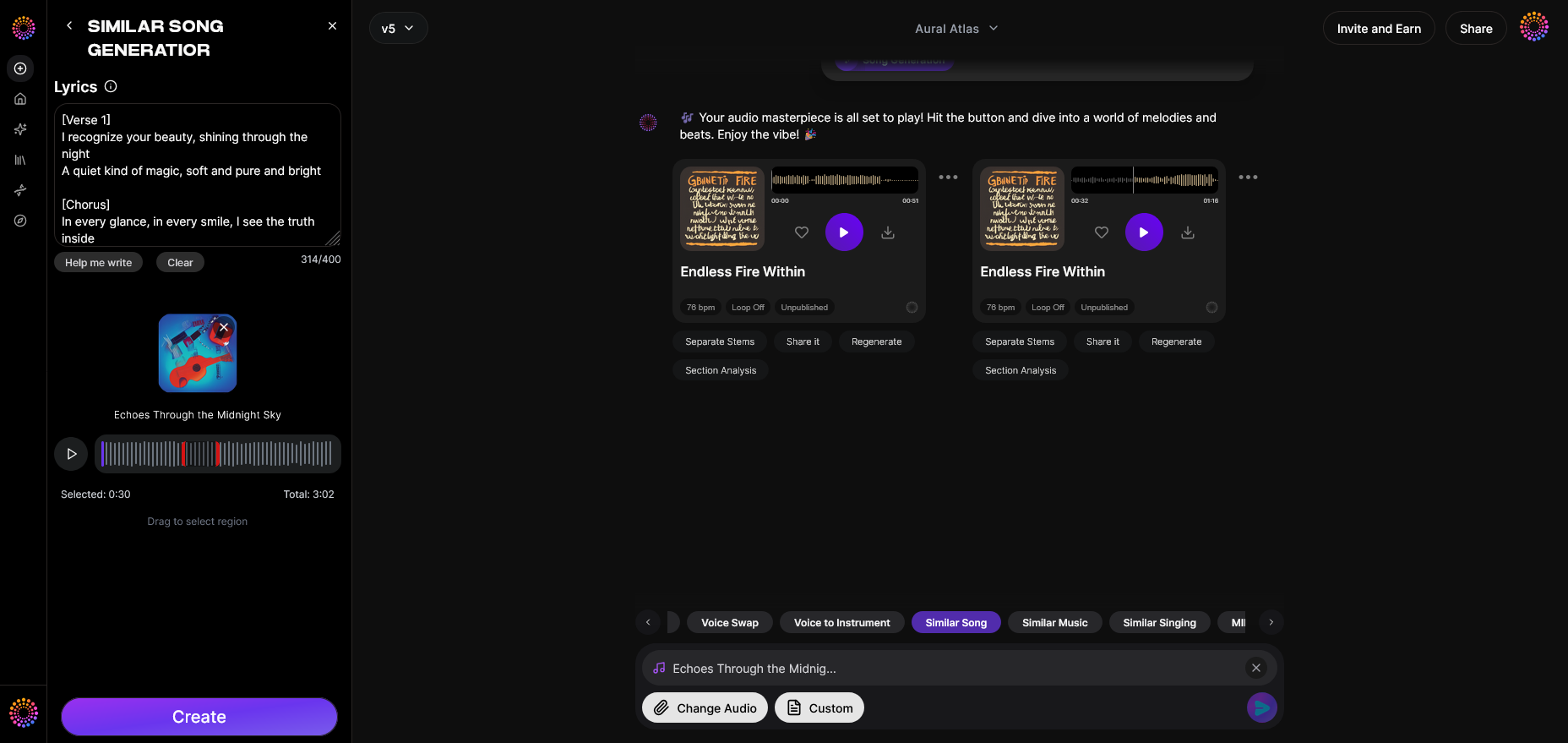
The Soundverse Similar Song Generator is designed to help producers create complete original songs inspired by their favorite reference tracks. Instead of merely comparing sound, this tool analyzes the genre, tempo, and energy of a reference song to produce new compositions that share the same aesthetic. This eliminates the risk of plagiarism while maintaining creative consistency.
Feature Highlights:
- Reference Audio Analysis: The AI scans your chosen reference track to understand its musical characteristics.
- Optional Lyric Input: Users can include custom lyrical phrases to shape the thematic mood.
- Style Transfer: The system applies the stylistic foundation of the reference track while generating a fully original composition.
Primary Use Cases:
- Creating royalty-free alternatives to temp tracks used in film or ad campaigns.
- Rapid ideation for producers who need compositions matching a certain vibe.
- Maintaining sonic coherence across multiple songs in an album or brand project.
The Similar Song Generator integrates seamlessly with Soundverse’s creative ecosystem, including the Similar Music Generator for instrumentals and the Similar Singing Generator for vocal tone matching. Together, these tools help creators maintain consistent production quality and emotion across projects. To learn more about building cohesive styles, see Soundverse AI Magic Tools: Create Content Quickly with AI.
For additional insights, explore our Deep House music creation tutorial.
Practical example of using the Similar Song Generator
Suppose you are producing cinematic background music for a brand campaign. You upload a reference track representing your target mood — energetic yet emotional. Soundverse analyzes this input, interprets the tempo, energy curve, and genre metrics, and outputs an original composition with the same sonic imprint. You can then adjust lyrics (if provided) or fine-tune instrumental arrangements before downloading your track.
This process enables professional music production without worrying about licensing issues, making it particularly powerful for agencies, YouTube creators, and independent artists seeking royalty-free consistency.
Benefits of using reference-driven AI creation
- Speed: Transform a musical idea into a finished track faster than manual composition.
- Consistency: Maintain sonic identity across projects.
- Originality: Generate new songs void of copyrighted material.
- Education: Assist beginner producers in understanding arrangement and tonal balance.
As producers transition into hybrid workflows combining AI and human creativity, tools like Soundverse empower efficient experimentation and collaboration between traditional expertise and machine learning. You can also read How to Create EDM with Soundverse AI for more genre-specific applications.
Start Creating AI-Powered Music Reference Tracks Today
Discover how Soundverse can transform your music workflow. Generate custom tracks in seconds, refine your sound, and elevate your production quality effortlessly.
Related Articles
- How AI-Generated Music Is Transforming the Music Industry: Explore how artificial intelligence is reshaping creativity and music production across the globe.
- The Benefits of Composing with an AI Music Generator: Learn how using AI tools like Soundverse can speed up composition and inspire new musical ideas.
- AI Music Generator and Human Composers: A Future Together: Discover how AI tools complement human artistry to create a collaborative future in music.
- Soundverse AI Magic Tools: Create Content Quickly with AI: Find out how Soundverse’s AI Magic Tools help creators produce music faster than ever.
Here's how to make AI Music with Soundverse
Video Guide
Here’s another long walkthrough of how to use Soundverse AI.
Text Guide
- To know more about AI Magic Tools, check here.
- To know more about Soundverse Assistant, check here.
- To know more about Arrangement Studio, check here.
Soundverse is an AI Assistant that allows content creators and music makers to create original content in a flash using Generative AI. With the help of Soundverse Assistant and AI Magic Tools, our users get an unfair advantage over other creators to create audio and music content quickly, easily and cheaply. Soundverse Assistant is your ultimate music companion. You simply speak to the assistant to get your stuff done. The more you speak to it, the more it starts understanding you and your goals. AI Magic Tools help convert your creative dreams into tangible music and audio. Use AI Magic Tools such as text to music, stem separation, or lyrics generation to realise your content dreams faster. Soundverse is here to take music production to the next level. We're not just a digital audio workstation (DAW) competing with Ableton or Logic, we're building a completely new paradigm of easy and conversational content creation.
TikTok: https://www.tiktok.com/@soundverse.ai
Twitter: https://twitter.com/soundverse_ai
Instagram: https://www.instagram.com/soundverse.ai
LinkedIn: https://www.linkedin.com/company/soundverseai
Youtube: https://www.youtube.com/@SoundverseAI
Facebook: https://www.facebook.com/profile.php?id=100095674445607
Join Soundverse for Free and make Viral AI Music

We are constantly building more product experiences. Keep checking our Blog to stay updated about them!