What Are the Main Differences Between Suno and Udio in 2026?
Explore the key differences between Suno and Udio for AI music creation in 2026.
What Are the Main Differences Between Suno and Udio
What Are the Main Differences Between Suno and Udio in 2026?
The battle between AI music platforms continues to intensify in 2026. Among the leading contenders, Suno and Udio stand out as two major names revolutionizing the way creators compose songs using artificial intelligence. When exploring this topic, most musicians and content creators search for a detailed Suno vs Udio comparison to understand which platform best suits their creative needs.
Both platforms help users transform ideas into music, but their approaches differ significantly. This article breaks down their core technologies, user experience, style flexibility, and integration capabilities, then concludes with how you can use Soundverse—a future-ready alternative—to create complete songs instantly.
What Is Suno’s Core Approach to Music Creation?

Suno focuses on simplicity in music generation through text input. It’s designed for creators who want to go from prompt to finished composition quickly. Users can enter short descriptions or lyrics, and the AI automatically generates melodies and vocal arrangements.
Suno provides intuitive tools for non-musicians who need ready-made songs for social media or video content. The platform works best with descriptive prompts—the more detailed the text, the closer the musical output aligns with the user’s vision. Its main strengths lie in its accessibility and speed, especially for creators who don’t require technical control over arrangement layers or mixing balance.
In 2026, Suno’s technology leans toward creating consumer-friendly results. It’s ideal for catchy pop hooks, minimal EDM tracks, and emotional ballads. However, its simplicity may limit users seeking deep customization options for professional songwriting or genre hybridity.
How Does Udio’s Music Generation Differ?

Udio positions itself as a more composer-focused AI music generator. Where Suno emphasizes text-driven simplicity, Udio provides structured tools for manipulating song sections, melodies, and rhythm layers. Udio’s appeal is particularly strong among musicians and producers who want fine-grained control over track progression.
The Udio AI music generator uses a modular workflow—allowing creators to experiment with different verses, choruses, and bridges. Users can iterate parts and refine transitions to produce more organic arrangements. This feature provides the sense of co-writing with AI instead of merely auto-generating songs.
Another distinct advantage is Udio’s audio fidelity. Many users in 2026 note that Udio tends to produce slightly more natural-sounding instruments, making it suitable for professional demos or short commercial jingles.
For a deeper dive, watch our tutorial on how to make music with Soundverse.
Which Platform Offers Better Customization – Suno or Udio?
Customization plays a crucial role in determining which AI music platform meets diverse creator needs. In the Suno vs Udio comparison, Udio generally wins on flexibility, as it allows deeper control over key musical parameters. Musicians can tweak tempo, song structure, and emotional tone more freely.
Suno, meanwhile, keeps customization minimal. While this simplicity benefits creators looking for fast results, it can limit those needing intricate arrangements. Suno’s charm lies in removing creative friction—users describe their idea, pick a style, and immediately get a full track.
Conversely, Udio suits professionals who prefer adjusting basslines, chord progressions, or even fine-tuning the vocalist’s phrasing. This more technical process fits producers creating EPs or refining compositions for digital release.
What Kind of User Experience Do They Provide?
Suno has built an interface that prioritizes rapid content generation. Upon logging in, creators see a minimal prompt box and style menu. A few clicks later, the AI delivers a ready-to-use song.
Udio requires a slightly longer engagement. Its interface resembles a simplified digital audio workstation (DAW): users can visualize song parts and make iterative changes. While less instant than Suno, it offers more depth for serious production.
Therefore, in the Suno vs Udio comparison, Suno appeals more to influencers, YouTubers, and social media creators who value speed. Udio, however, connects better with musicians aiming to craft detailed compositions or soundtrack-style music. You can learn even more by watching our Soundverse Explore Tab guide.
Which Is Better for Collaborations and Cross-Platform Integration?
In 2026, creators demand integration between AI music platforms and editing tools. Udio tends to perform better for collaborative work since its modular approach lets artists build and exchange song sections with others. It can integrate more naturally into professional workflows.
Suno, by contrast, works best as a self-contained experience. While creators can export tracks to DAWs, its primary purpose remains one-click song creation, not multi-artist collaboration.
For production houses or studio-level teams requiring consistent stem access or revision capabilities, Udio may hold a small advantage in flexibility.
How Do Their Output Qualities Compare?
Sound quality forms the essence of any AI audio technology. In comparison tests conducted by multiple creator communities in 2026, both platforms received praise—but with different highlights.
- Suno: Strong in pop and EDM production, where compressed vocals and synthetic harmonies complement energetic beats.
- Udio: Excels in acoustic, jazz, and cinematic outputs, offering more dynamic range and nuanced tone reproduction.
Ultimately, quality perception depends on each use case. Suno fits short-form content best, while Udio suits long-form musical storytelling.
What Are the Main Differences Between Suno and Udio?
We can summarize the Suno vs Udio comparison through the following key differences:
- Creative Focus: Suno optimizes user-friendly automation; Udio supports structured, iterative composition.
- Customization Depth: Suno offers basic style selection; Udio provides parameter-level tweaking.
- Output Nature: Suno emphasizes vocal-led AI songs; Udio leans toward balanced production.
- User Type: Suno attracts influencers and hobbyists; Udio aligns with musicians and producers.
- Workflow Speed: Suno is faster for immediate results; Udio requires more user engagement.
- Integration Level: Udio integrates better with production chains; Suno works best standalone.
In 2026, creators increasingly combine both platforms depending on project needs—Suno for quick drafts, Udio for polished results.
How Does Soundverse Fit Into the AI Music Revolution?
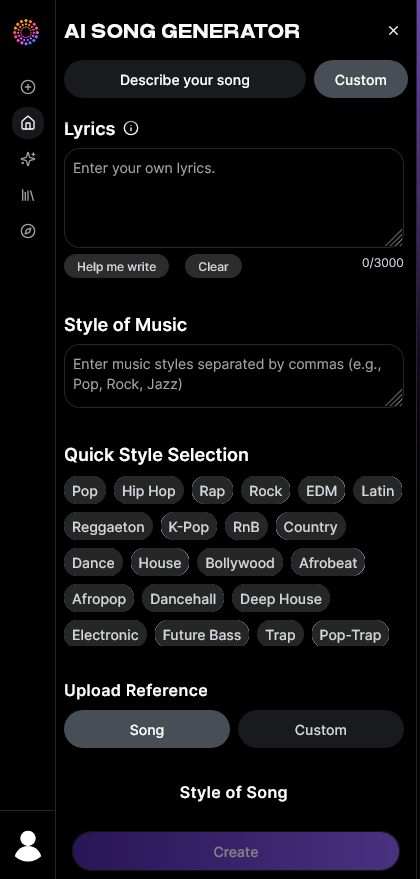
Now that you understand the technical and creative contrasts between Suno and Udio, let’s look at how you can achieve similar results—and more—with Soundverse’s AI Song Generator.
How to Make Songs with Soundverse AI Song Generator
Soundverse unifies simplicity and professional control, bridging the gap between Suno’s instant creativity and Udio’s modular refinement. Its AI Song Generator transforms lyrics or text descriptions into full songs, providing AI-generated vocals and instrumental backing using a multi-stage pipeline covering lyrics, melody, arrangement, and mixing.
Users can work in two major modes:
- Describe Your Song Mode: Enter a short description like “a chill pop tune about summer memories” and get a complete track.
- Custom Mode: Paste your own lyrics, choose vocal settings, and define creative direction.
Soundverse also supports Reference Audio, enabling creators to guide the AI using existing tracks or vocals. Unlike Suno’s limited prompt listening, this reference system helps maintain creative consistency.
To experiment with genres, users can apply Quick Style Selection options such as Pop, EDM, Rock, Jazz, or Acoustic. The feature set covers both demo songwriting and content creation, making it ideal for YouTube, TikTok, and multilingual projects across 10+ languages.
Soundverse stands superior in ethics and licensing. Through Soundverse DNA, artists safely train AI models on licensed catalogs, ensuring copyright-safe outputs—solving issues still discussed in AI music forums in 2026.
For hands-on genre work, see our Deep House Music tutorial.
Why Soundverse Is a Complete Alternative
When comparing to competitors like Suno and Udio, Soundverse offers a balanced workflow. It keeps creative freedom intact while allowing deep configuration. Instead of choosing between simplicity or complexity, users experience both.
Soundverse’s asynchronous generation process maintains production reliability—users upload lyrics/audio, the AI processes results, and final songs appear ready for export in multiple formats. It’s purpose-built for musicians and content creators looking to scale output ethically and efficiently.
For related reading on improvement strategies and platform alternatives, explore:
- Best Suno Alternative: Soundverse AI Free Sign Up
- Best Udio Alternative: Soundverse AI Free Sign Up
- How AI Generated Music Is Transforming the Music Industry
- Soundverse AI Magic Tools Create Content Quickly with AI
Create Music Smarter with Soundverse AI
Unlock next-level creativity using Soundverse’s AI-powered tools to generate, refine, and arrange music effortlessly. Whether comparing platforms like Suno and Udio or creating your own tracks, Soundverse gives you unmatched control and flexibility.
- Best Suno Alternative: Soundverse AI Free Sign-Up — Discover why Soundverse stands out as a powerful alternative to Suno for AI music creation.
- Best Udio Alternative: Soundverse AI Free Sign-Up — Learn how Soundverse compares against Udio and why it’s becoming a go-to platform for modern creators.
- Generate AI Music with Soundverse Text-to-Music — Turn simple text prompts into complete songs and soundscapes instantly using Soundverse tools.
- How to Download Songs from Soundverse and Udio — Step-by-step guide to saving and using your AI-generated tracks from both Soundverse and Udio.
Here's how to make AI Music with Soundverse
Video Guide
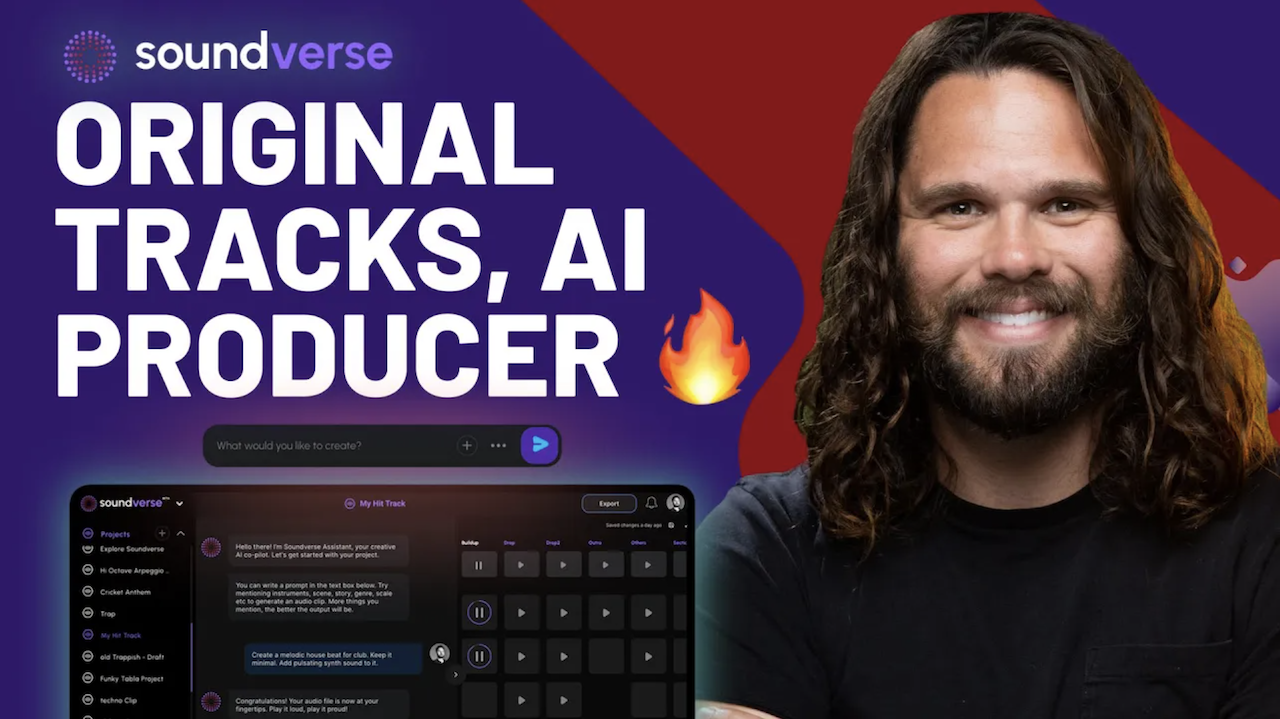
Here’s another long walkthrough of how to use Soundverse AI.
Text Guide
- To know more about AI Magic Tools, check here.
- To know more about Soundverse Assistant, check here.
- To know more about Arrangement Studio, check here.
Soundverse is an AI Assistant that allows content creators and music makers to create original content in a flash using Generative AI. With the help of Soundverse Assistant and AI Magic Tools, our users get an unfair advantage over other creators to create audio and music content quickly, easily and cheaply. Soundverse Assistant is your ultimate music companion. You simply speak to the assistant to get your stuff done. The more you speak to it, the more it starts understanding you and your goals. AI Magic Tools help convert your creative dreams into tangible music and audio. Use AI Magic Tools such as text to music, stem separation, or lyrics generation to realise your content dreams faster. Soundverse is here to take music production to the next level. We're not just a digital audio workstation (DAW) competing with Ableton or Logic, we're building a completely new paradigm of easy and conversational content creation.
TikTok: https://www.tiktok.com/@soundverse.ai
Twitter: https://twitter.com/soundverse_ai
Instagram: https://www.instagram.com/soundverse.ai
LinkedIn: https://www.linkedin.com/company/soundverseai
Youtube: https://www.youtube.com/@SoundverseAI
Facebook: https://www.facebook.com/profile.php?id=100095674445607
Join Soundverse for Free and make Viral AI Music

We are constantly building more product experiences. Keep checking our Blog to stay updated about them!