What Are the Differences Between Royalty-Free and Copyright-Free Music
Learn the key differences between royalty-free vs copyright-free music and how to use tracks legally online in 2026.
What Are the Differences Between Royalty-Free and Copyright-Free Music?
As digital media continues to thrive in 2026, content creators, marketers, and video producers are becoming increasingly conscious about how they use music legally online. Two terms that often cause confusion are royalty-free music and copyright-free music. Understanding the distinction between these two licensing types is essential if you’re creating commercial projects, social videos, or branded content.
Let's explore the key differences between these terms, their implications for licensing and commercial use, and how emerging AI music tools like Soundverse Trace ensure proper rights attribution and protection.
What Is Royalty-Free Music?
The royalty-free music definition refers to a licensing model where users pay a one-time fee (or sometimes use free tracks) to acquire rights to use a piece of music without paying ongoing royalties to the creator or rights-holder each time the track is used.
How Royalty-Free Music Works
When a creator purchases a royalty-free license, they gain permission to use the track in specific contexts—such as YouTube videos, podcasts, advertisements, or games. The key is that while the music is still under copyright, the license grants usage rights without multiple royalty payments.
For example:
- You buy a background track from a royalty-free library.
- You include it in your brand’s promotional video.
- You don’t need to pay each time the video is viewed or re-uploaded.
Royalty-free doesn’t mean free of cost or free of copyright. The track remains protected under copyright law, and the artist retains ownership. As explained in Royalty-Free vs. Copyright-Free Music: What's The Difference - Mubert, you are paying for usage rights, not ownership.
What Is Copyright-Free Music?
The term copyright-free music explained is often misunderstood. In reality, there is very little music that is truly free of copyright since copyright protection automatically applies upon creation. However, copyright-free music usually refers to public domain works—music whose copyrights have expired, or the creator has waived all rights.
This means:
- There are no restrictions on usage.
- No need for attribution or license fees.
- The track can be remixed, redistributed, or monetized freely.
Examples of copyright-free works include classical compositions by Bach or Beethoven, where the original works no longer have copyright restrictions. But be careful: modern recordings of those compositions may still be protected. According to Copyright-free music: All you need to know - Epidemic Sound, always check the specific recording rights before using.
How Are Royalty-Free and Copyright-Free Music Different?
Understanding music licensing differences is critical when selecting tracks for commercial or creative projects. Here’s a simple comparison:
| Feature | Royalty-Free Music | Copyright-Free Music |
|---|---|---|
| Ownership | Copyrighted by original creator | No copyright ownership – usually public domain |
| Cost | May require one-time license fee | Usually free to use |
| Attribution | Required in some licenses | Typically not required |
| Commercial Use | Permitted if covered by the license | Always allowed |
| Legal Risk | Low if license is followed | Minimal (public domain) |
In short: royalty-free means licensed but still protected; copyright-free means unrestricted. As Tracklib’s Guide to Royalty-Free Music notes, the original owners retain rights even in royalty-free systems.
Why This Distinction Matters in 2026
With the explosion of AI-generated content, the question of who owns music rights has become more complex. Content creators must navigate licensing carefully, especially as platforms increasingly use detection tools to monitor unauthorized audio usage.
Using music legally online depends on understanding the scope of your license. For example:
- A royalty-free license might cover YouTube or social media use but exclude broadcast television.
- A copyright-free track may seem safe, yet its recording can still have rights attached.
Staying informed about these licensing layers helps prevent takedowns, demonetization, or copyright strikes.
Common Misconceptions About Royalty-Free Music
- “Royalty-free means free.” Not always true. You may pay once to obtain usage rights.
- “It’s safe for any purpose.” Only if the license explicitly allows commercial use.
- “Creators lose rights.” Artists still retain copyright but license usage.
- “It’s unique.” Royalty-free tracks are often sold to many users—so it’s not exclusive.
For exclusive rights or custom audio generation, creators increasingly turn to AI tools like Soundverse that allow generation with transparency and attribution embedded.
The Rise of AI and Ethical Music Licensing
From 2024 to 2026, AI music generation evolved dramatically. Now, 2026 is seeing the rise of ethical AI licensing frameworks that maintain artist integrity while enabling scalable creativity.
Platforms following The Ethical AI Music Framework bridge music privacy, consent, and attribution. This ensures that even if AI creates compositions, the rights metadata flows transparently across production and distribution.
Popular articles like How AI-Generated Music Is Transforming the Music Industry and Soundverse AI Magic Tools Create Content Quickly With AI highlight how creators use automated workflows responsibly.
For a deeper dive into practical AI creation processes, watch our tutorial on how to make music with Soundverse.
Using Music Legally Online: Best Practices for Creators
Here are guidelines for content producers and marketers:
- Read the License Terms Carefully: Always check what your license includes—commercial use, attribution, distribution limits.
- Verify Copyright Ownership: Just because music is labeled “free” doesn’t mean it’s copyright-free.
- Keep Proof of Purchase and License: Document where you obtained the track and the corresponding usage rights.
- Use Trusted Libraries: Choose sources with clear policies, like Soundverse or legitimate royalty-free platforms.
- Attribute When Required: Some Creative Commons or royalty-free tracks require artist credit.
- Consider AI Attribution: Modern AI systems can embed copyrights directly, ensuring transparency.
Creators who understand these principles can produce music-driven content confidently without legal risks.
How to Make Royalty-Free vs Copyright-Free Music with Soundverse Trace
Now that you understand the foundations of royalty-free vs copyright-free music, let’s explore how Soundverse Trace empowers creators and rights-holders to ensure proper protection, attribution, and legal clarity across AI-generated tracks.
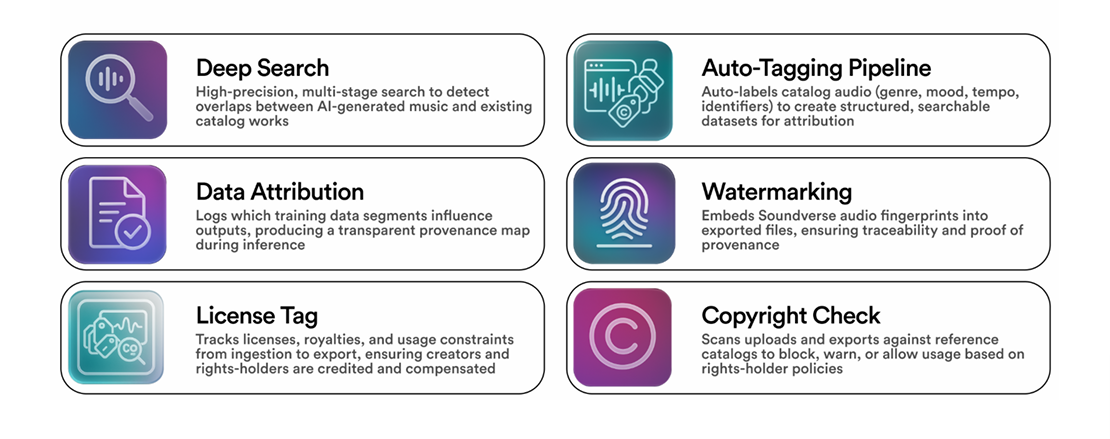
Soundverse Trace is a comprehensive trust layer for AI music that embeds attribution, deep search, and rights protection throughout the entire lifecycle—from dataset creation to final audio export.
Key Capabilities of Soundverse Trace:
- Deep Search: Performs high-precision 1:1 and 1:N scans to detect overlaps and ensure originality in AI-generated audio.
- Data Attribution: Logs exactly which training dataset influenced outputs, delivering verifiable transparency.
- Audio Watermarking: Adds tamper-proof but inaudible fingerprints for robust rights tracking and protection.
- License Tagging: Preserves licensing metadata from ingestion to export, ensuring creators never lose attribution.
Primary Use Cases
- Prevent copyright infringement in AI music outputs.
- Automate royalty payments or takedowns for rights-holders.
- Verify AI music provenance before publishing.
- Track catalog usage for transparent payout distribution.
By implementing Soundverse Trace, creators can turn complicated licensing into automated compliance. Combined with the Content Partner Program, rights-holders can contribute authorized datasets and earn recurring royalties whenever their material influences AI outputs.
This workflow aligns perfectly with The Ethical AI Music Framework—building a future where creators, AI developers, and brands collaborate transparently.
Create Copyright-Safe Music Instantly with AI
Discover how Soundverse lets you generate royalty-free tracks tailored to your projects — no licensing stress, no copyright worries. Start creating today and amplify your content effortlessly.
Start Creating with Soundverse
Related Articles
- Enhancing YouTube Content with Royalty-Free and Copyright-Free Music Using Soundverse AI — Learn how to enrich your YouTube videos using AI-generated music that’s safe for monetization, without worrying about rights or royalties.
- Copyright-Free vs. Royalty-Free Music: What Creators Should Know — Get a clear understanding of the differences between copyright-free and royalty-free music so you can choose the right tracks for your projects.
- Navigating the World of Royalty-Free and Copyright-Free Music Using Soundverse AI — Explore how Soundverse simplifies music licensing by generating royalty-free content suitable for videos, podcasts, and brand campaigns.
- The Role of AI Music in Film and Television — Discover how AI-generated music is transforming soundtracks and production workflows across the entertainment industry.
Here's how to make AI Music with Soundverse
Video Guide
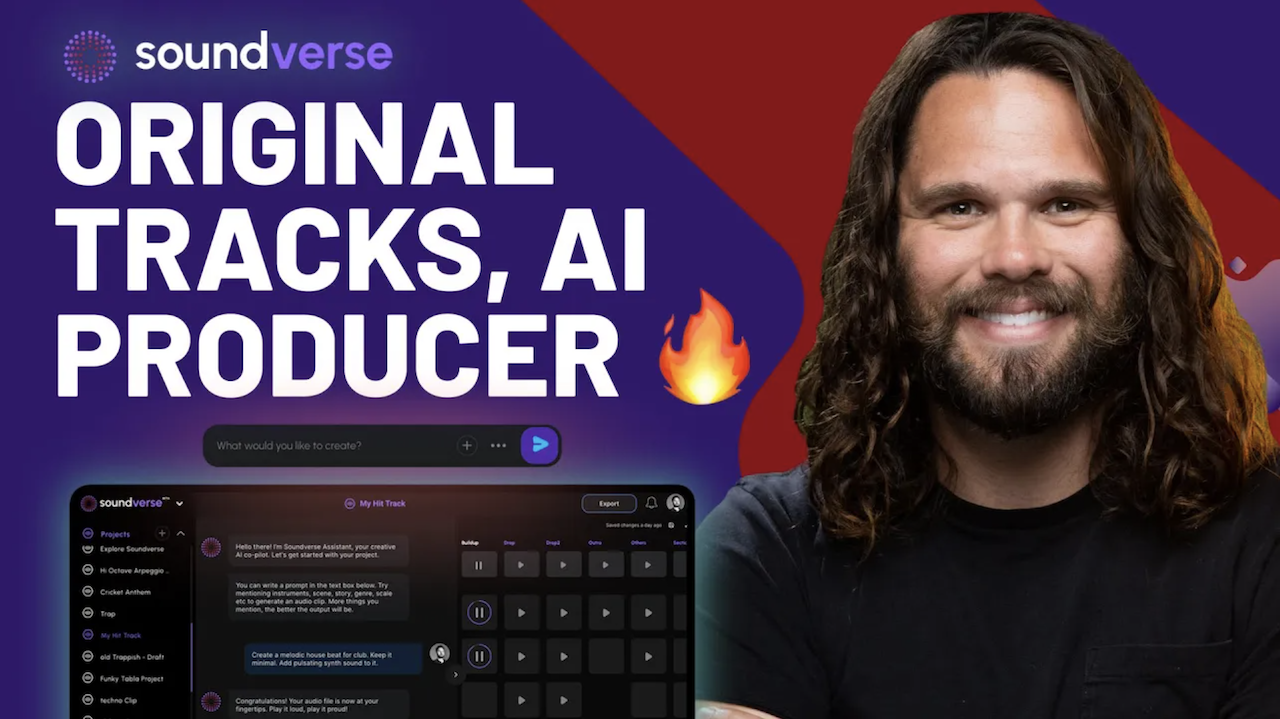
Here’s another long walkthrough of how to use Soundverse AI.
Text Guide
- To know more about AI Magic Tools, check here.
- To know more about Soundverse Assistant, check here.
- To know more about Arrangement Studio, check here.
Soundverse is an AI Assistant that allows content creators and music makers to create original content in a flash using Generative AI. With the help of Soundverse Assistant and AI Magic Tools, our users get an unfair advantage over other creators to create audio and music content quickly, easily and cheaply. Soundverse Assistant is your ultimate music companion. You simply speak to the assistant to get your stuff done. The more you speak to it, the more it starts understanding you and your goals. AI Magic Tools help convert your creative dreams into tangible music and audio. Use AI Magic Tools such as text to music, stem separation, or lyrics generation to realise your content dreams faster. Soundverse is here to take music production to the next level. We're not just a digital audio workstation (DAW) competing with Ableton or Logic, we're building a completely new paradigm of easy and conversational content creation.
TikTok: https://www.tiktok.com/@soundverse.ai
Twitter: https://twitter.com/soundverse_ai
Instagram: https://www.instagram.com/soundverse.ai
LinkedIn: https://www.linkedin.com/company/soundverseai
Youtube: https://www.youtube.com/@SoundverseAI
Facebook: https://www.facebook.com/profile.php?id=100095674445607
Join Soundverse for Free and make Viral AI Music
We are constantly building more product experiences. Keep checking our Blog to stay updated about them!
Image Steps: []