Was That Lie Created by AI? Understanding AI-Generated Misinformation in 2026
Explore AI-generated misinformation, ethics, and detection trends shaping digital truth in 2026.
Was That Lie Created by AI?
What is AI-generated misinformation and why is it alarming in 2026?
AI-generated misinformation refers to false or misleading content created or enhanced by artificial intelligence. In 2026, this phenomenon has reached unprecedented levels as machine learning models can fabricate realistic text, audio, and video materials that convincingly imitate human sources. Deepfake technology and automated content generation have made it easy for misinformation to spread faster, bypassing traditional editorial checks. Reports such as AI Experts Predict By 2026 90 Of Online Content confirm the accelerating growth of synthetic media and disinformation.
This trend threatens journalism, governance, and public trust. The growing sophistication of large-language and multimodal AI systems means misinformation can now appear in any format—voice recordings, video interviews, or social media posts—making verification one of the biggest ethical challenges in digital communication.

How does AI-generated misinformation spread?
AI-generated misinformation propagates through networks optimized for engagement. Social media platforms, recommendation engines, and automated message systems amplify content using algorithms that prioritize emotional reactions rather than factual accuracy. In some cases, AI itself is both the creator and amplifier—using reinforcement learning to identify what narratives trigger the most user responses. Many experts point to findings like AI-generated misinformation | How to minimize risks - Cloudflare that describe how such patterns intensify misinformation risks.
By 2026, misinformation isn’t just textual—it’s multisensory. Synthetic voices and counterfeit visuals circulate through channels like podcasts, news clips, and livestreams. As noted in reports from digital media analysts, even slight alterations in tone or expression produced by generative networks can manipulate audience perceptions. For creators seeking to understand this manipulation visually, check out our guide on creating Deep House music or how to make music to see AI synthesis in action.

What ethical issues arise from artificial intelligence’s role in deception?
Artificial intelligence ethics has shifted from abstract debate to practical urgency. There are three critical ethical dimensions:
- Attribution and transparency: Audiences must know whether a piece of content was generated or manipulated by AI. Lack of provenance causes confusion and erodes public trust.
- Consent and representation: Individuals may appear in deepfakes or synthetic audio without their approval. Ethical frameworks demand explicit consent and transparent data use.
- Accountability: When misinformation is automated, responsibility becomes diffused. Determining the liable party—developer, deployer, or algorithm—is complex.
Ethical standards in 2026 emphasize building responsible infrastructure, such as transparent training data logs and verifiable attribution mechanisms—a philosophy mirrored by Soundverse’s Ethical AI Music Framework, which ensures consent and attribution in creative AI systems.
What technologies detect fake or misleading AI content?
Fake news detection has evolved alongside generative AI. In 2026, detection systems combine semantic analysis, fact-checking bots, and deepfake detection models to identify content inconsistencies. In one study, Countering AI-generated misinformation with pre-emptive source explores how early identification can limit disinformation impact. For journalists and researchers, some of the most common approaches include:
- Cross-source verification: Comparing claims across verified data archives.
- Digital watermarking: Storing traceable signatures within content.
- Machine learning deception analysis: Recognizing patterns characteristic of model-generated text or voice.
- AI truth verification systems: Using neural networks to confirm data integrity by tracing back to original sources.
Deepfake technology has advanced so much that detection now often involves forensic techniques—evaluating pixel inconsistencies, acoustic distortions, or unnatural phrasing. These techniques align with new factual integrity methods seen in AI Statistics and Trends for 2026 | National University and reports like What the Numbers Show About AI's Harms - Time Magazine.
How are journalists and media analysts responding to machine learning deception?
Journalists in 2026 rely increasingly on hybrid verification workflows combining human expertise and automated AI truth verification tools. Digital editors deploy software that flags suspicious linguistic markers or metadata anomalies. Meanwhile, AI researchers collaborate with newsrooms to build ethically aligned detection algorithms. The insights reflect global findings such as How will AI reshape the news in 2026? Forecasts by 17 experts from ....
AI literacy has become essential in journalism. Analysts are trained to interpret machine learning processes to avoid false conclusions about algorithmic outputs. Public news agencies now partner with universities to publish reports on AI-generated misinformation trends, similar to how industry-focused tools like Soundverse Assistant explain technological transparency. For hands-on exploration, you can view our Soundverse Tutorial - Explore Tab.
Is there such a thing as “AI truth” in 2026?
The debate over AI truth has grown sharply. While some argue that AI can objectively verify data better than humans, others note that any model’s output reflects its training data and biases. AI truth verification systems must therefore include ethical oversight and diverse datasets. As reflected in studies like AI paradoxes: Why AI's future isn't straightforward, key aspects of AI judgment will continue to rely on human interpretation.
The concept of an "AI trust layer"—a system ensuring transparency at every stage of content generation—has become critical. This same principle drives creative platforms that track attribution and rights, as seen in music-generation tools reviewed in music industry trends and AI Music Revolution.
Now that these systems can produce sound and speech indistinguishable from reality, maintaining factual integrity requires auditable AI pipelines.
How is deepfake technology reshaping misinformation?
Deepfake technology has evolved far beyond facial swaps. In 2026, advanced diffusion models can imitate entire personalities, producing synthetic performances that are almost impossible to identify without specialized tools. While there are creative applications in entertainment and learning, its darker usage in misinformation campaigns continues to rise. The OECD’s Ability of adults to identify online disinformation highlights decreasing awareness about AI-altered content.
Governments and organizations now demand stronger authentication frameworks. AI provenance systems embed invisible identifiers in generated content, signaling authenticity when verified. Without these systems, society faces the risk of an entirely synthetic information ecosystem.
How Soundverse Trace helps verify truth in AI-generated content
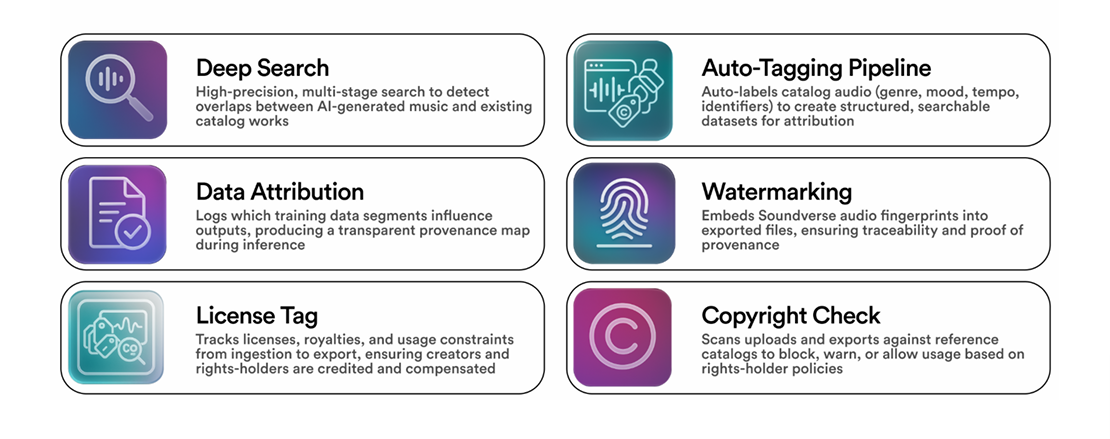
Soundverse Trace serves as a pioneering verification mechanism within sound and music domains. It embeds a trust layer throughout the AI creation lifecycle, ensuring every sound element has transparent attribution and rights metadata. For creators fighting misinformation or content misrepresentation, Soundverse Trace provides:
- Deep Search: High-precision scanning that detects overlapping material across datasets and outputs, allowing media analysts to confirm originality or source influence.
- Data Attribution: Explicit logs showing which training data influenced an AI audio result. This transparency discourages deceptive dataset manipulation.
- Audio Watermarking: A robust, inaudible fingerprint embedded within audio files to certify authenticity and enable efficient provenance checks.
- License Tagging: Rights metadata preserved from ingestion to export, ensuring correct ownership tracking for ethically produced AI content.
By integrating these capabilities, Soundverse Trace aligns with global calls for artificial intelligence ethics and transparency. It directly addresses misinformation by enabling traceable content provenance—an essential safeguard for journalists and digital music researchers.
Those exploring the boundaries between AI creativity and ethical transparency can see related innovations in tools like AI Magic Tools and the Stem Separation AI, both demonstrating how trust layers enhance the creative process.
Explore the Future of AI-Generated Creativity Unleash your imagination with Soundverse’s advanced AI tools for creating music, audio, and immersive content. Start producing intelligent compositions that captivate audiences while maintaining creative control. Get Started Free
Related Articles
- How AI-Generated Music is Transforming the Music Industry — Discover how artificial intelligence is revolutionizing creativity and reshaping the boundaries of music production.
- The Role of AI Music in Film and Television — Explore how filmmakers are using AI-powered music to enhance storytelling and emotional depth in media.
- AI Music Generator and Human Composers: A Future Together — Learn how human creativity and AI innovation are merging to redefine collaboration in the music industry.
- How an AI Music Generator Inspires Creative Fusion — See how AI tools empower creators to experiment, innovate, and blend genres for groundbreaking sounds.
Here's how to make AI Music with Soundverse
Video Guide
 Here’s another long walkthrough of how to use Soundverse AI.
Text Guide
- To know more about AI Magic Tools, check here.
- To know more about Soundverse Assistant, check here.
- To know more about Arrangement Studio, check here. Soundverse is an AI Assistant that allows content creators and music makers to create original content in a flash using Generative AI. With the help of Soundverse Assistant and AI Magic Tools, our users get an unfair advantage over other creators to create audio and music content quickly, easily and cheaply. Soundverse Assistant is your ultimate music companion. You simply speak to the assistant to get your stuff done. The more you speak to it, the more it starts understanding you and your goals. AI Magic Tools help convert your creative dreams into tangible music and audio. Use AI Magic Tools such as text to music, stem separation, or lyrics generation to realise your content dreams faster. Soundverse is here to take music production to the next level. We're not just a digital audio workstation (DAW) competing with Ableton or Logic, we're building a completely new paradigm of easy and conversational content creation. TikTok: https://www.tiktok.com/@soundverse.ai Twitter: https://twitter.com/soundverse_ai Instagram: https://www.instagram.com/soundverse.ai LinkedIn: https://www.linkedin.com/company/soundverseai Youtube: https://www.youtube.com/@SoundverseAI Facebook: https://www.facebook.com/profile.php?id=100095674445607
Join Soundverse for Free and make Viral AI Music
 We are constantly building more product experiences. Keep checking our Blog to stay updated about them!