Warner Music Group Udio Settlement Explained: What It Means for AI Music in 2026
Understand the 2026 Warner Music Group Udio settlement and its impact on AI music copyright and label deals.
Warner Music Group Udio Settlement Explained
The Warner Music Group Udio settlement has become one of the most defining developments in the music industry’s ongoing conversation about artificial intelligence, copyright protection, and the future of label partnerships. As the world of AI-generated music continues to evolve in 2026, this agreement bridges complex legal tensions around how creative data is used to train AI models and how artists, producers, and rights-holders can be appropriately compensated.
What is the Warner Music Group Udio Settlement?
The Warner Music Group Udio settlement refers to the resolution between Warner Music Group (WMG) and the AI music platform Udio following extended negotiations and disputes over copyright infringement claims initially emerging in late 2024. This settlement formally closed a high-profile udio lawsuit that questioned whether generative algorithms could legally learn from copyrighted recordings without permission. By 2026, the issue has become a template for how major labels structure relationships with AI developers. The agreement was publicly announced as part of Warner Music Group and Udio’s landmark collaboration designed to launch a licensed AI music creation platform in 2026.
WMG’s deal with Udio was significant because it redefined what a music label AI deal looks like. It represented the transition from reactive litigation to proactive collaboration—turning a copyright settlement into a forward-looking agreement governing data use, licensing, and revenue distribution in AI-generated content.

Why Was the Udio Lawsuit So Important?
When Udio first launched its music generation technology, it relied on large datasets that included both licensed and unlicensed content. This practice quickly triggered concerns from rights-holders, and Warner Music Group mounted a case alleging that Udio’s models had, directly or indirectly, learned from protected audio assets. Similar tensions were seen with other AI companies during 2025, but the Warner Music case ultimately forced the industry to confront the question of ethical data sourcing. The resolution was similar to other historic cases such as UMG’s settlement with Udio, further confirming that transparency needed to be the standard across the industry.
The lawsuit turned out to be a pivotal moment for AI music regulation for three reasons:
- Data Transparency: It highlighted the need for publicly auditable data sources used in AI training.
- Artist Compensation: It demanded recurring royalties when an AI-generated output referenced or resembled existing songs.
- Consent Frameworks: It made labels accountable for ensuring artists understood how their recordings could be used in AI systems.
By 2026, these pillars have reshaped how other companies operate, establishing a moral and financial precedent for future copyright settlements.

How Does the Settlement Shape AI Music Label Deals in 2026?
The Warner Music Group Udio settlement sent a ripple effect throughout the entertainment industry, forcing AI developers and record labels to adopt a consent-first approach to model training. The core takeaway was that AI innovation could coexist with artist integrity—if powered by transparent frameworks.
Most music label AI deals post-2025 follow similar structures to the Warner-Udio agreement. They require the developer to:
- Obtain explicit authorization for all training data.
- Embed attribution tracking in every generated audio file.
- Provide ongoing usage-based compensation to the rights-holders whose works are part of the dataset.
These clauses have made AI collaborations less about outsourcing creativity and more about expanding digital rights management. Industry observers, including entertainment attorneys and digital rights analysts, regard this as the first full-scale transformation of licensing standards for generative music. For further insight, see how AI licensing deals evolved after major settlements. For more background on how AI trends are shaping these partnerships, explore Music Industry Trends which covers 2026 developments in ethical music creation platforms.
What Legal and Ethical Lessons Came from the Udio Case?
The Warner Music Group Udio settlement illustrated the importance of integrating a transparent auditing mechanism for AI systems. Many early platforms lacked a method to trace exactly which files or artists influenced their models. This opacity exposed them to lawsuits and distrust among creators.
From a legal perspective, the settlement underscores that AI outputs are not exempt from existing intellectual property laws. Even if content is generated algorithmically, if the underlying data contains copyrighted material, the creators of that data legally influence the outcome.
From an ethical perspective, it reflects a growing understanding that data isn’t just technical—it’s creative labor. Singing samples, instrumental riffs, and production mixes are not merely numbers; they are artist expressions that deserve formal licensing in a digital economy driven by generative AI.
For a deeper dive into creating music ethically with generative tools, watch our Soundverse Tutorial Series - 9. How to Make Music, which walks through best practices for transparent AI creation.
How to make Warner Music Group Udio Settlement Approach Work with Soundverse The Ethical AI Music Framework
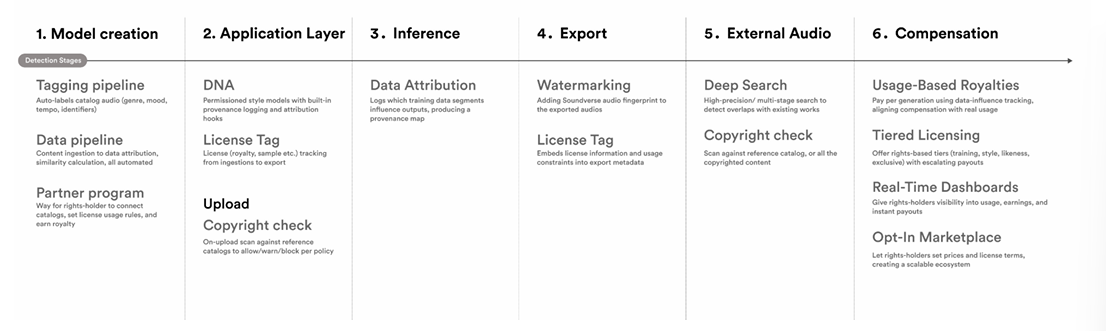
Soundverse’s Ethical AI Music Framework represents the industry’s most comprehensive response to the challenges revealed by cases like the Warner Music Group Udio settlement. Designed for enterprise-level compliance, this system bridges innovation with artist integrity through a six-stage transparent infrastructure:
- Licensed Data Sourcing (Stage 1): All datasets are created only through licensed or voluntarily contributed material. This ensures no scraping or unauthorized audio is used in AI training, directly addressing the root cause behind the udio lawsuit.
- Permissioned Models (Stage 2): Soundverse uses DNA-tagged models that maintain records of consent, proving authenticity and ownership of the data foundation.
- Explainable Inference (Stage 3): Every AI-generated track includes source mapping for attribution—labels and creators can see how and where contributions influence the output.
- Traceable Export (Stage 4): Soundverse embeds watermarking to ensure every AI-generated file carries a proof-of-origin signature.
- Deep Search (Stage 5): The system scans external datasets and production networks for potential unlicensed use, enabling proactive copyright protection.
- Recurring Compensation (Stage 6): Through the Soundverse Content Partner Program, rights-holders receive recurring royalties whenever their licensed assets appear in AI-generated material.
Collectively, these features make Soundverse not just compliant but ethical by design—offering solutions ideal for labels seeking transparent AI collaborations. More details on technology can be found in Soundverse AI Magic Tools Create Content Quickly With AI and Generate AI Music with Soundverse Text-to-Music. You can also explore a practical demonstration of this via our Deep House music creation tutorial on the Soundverse channel.
How Will This Settlement Influence Future Copyright Policies?
By 2026, the Warner Music Group Udio settlement has become a guiding case for international copyright clarifications. Legislative updates in both Europe and North America have begun to define how AI training data must be documented and compensated. Entertainment attorneys advise that any AI-to-label collaboration must adhere to traceable licensing frameworks.
Additionally, many startup music generators now adopt public ethical policies identical to Soundverse’s structure—ensuring rights, consent, and monetization transparency from dataset creation to export stage.
Analysts also predict that the next evolution of music label AI deals will involve cross-platform integration standards, where approved frameworks such as Soundverse Trace act as verification layers for all content distributed through streaming or sync platforms. These integrations will help AI developers avoid legal gray zones and build trust among rights organizations.
What Does This Mean for Artists and Producers?
For artists, the Warner Music Group Udio settlement represents reassurance that their creative contributions won’t vanish into algorithmic black boxes. With label-driven ethical frameworks, they can now opt into AI partnerships knowing they will receive recurring royalties and clear attribution.
For producers and composers who participate in AI-driven production workflows, transparency is becoming a competitive advantage. The capacity to trace influences, validate originality, and guarantee monetization creates a more equitable industry landscape. This is particularly beneficial for independent artists engaging with AI platforms such as Soundverse, which prioritize human creativity alongside generative technology.
Create Music Smarter with Soundverse AI
Unlock limitless creative potential using Soundverse’s AI-powered tools for music creation and editing. Join thousands of artists using advanced technology to produce original tracks quickly and easily.
Start Creating for Free
Related Articles
- Best Udio Alternative — Soundverse AI Free Sign-Up: Discover why Soundverse is a top alternative to Udio for AI-generated music that’s royalty-free and creator-friendly.
- Navigating the World of Royalty-Free and Copyright-Free Music Using Soundverse AI: Learn how to effectively use Soundverse to create and share music that avoids licensing headaches and copyright issues.
- How AI-Generated Music Is Transforming the Music Industry: Explore how artificial intelligence is changing music creation, distribution, and collaboration worldwide.
- AI Music Generator and Human Composers — A Future Together: See how AI platforms like Soundverse work hand-in-hand with human creativity to define the next wave of music innovation.
Here's how to make AI Music with Soundverse
Video Guide
Here’s another long walkthrough of how to use Soundverse AI.
Text Guide
- To know more about AI Magic Tools, check here.
- To know more about Soundverse Assistant, check here.
- To know more about Arrangement Studio, check here.
Soundverse is an AI Assistant that allows content creators and music makers to create original content in a flash using Generative AI. With the help of Soundverse Assistant and AI Magic Tools, our users get an unfair advantage over other creators to create audio and music content quickly, easily and cheaply. Soundverse Assistant is your ultimate music companion. You simply speak to the assistant to get your stuff done. The more you speak to it, the more it starts understanding you and your goals. AI Magic Tools help convert your creative dreams into tangible music and audio. Use AI Magic Tools such as text to music, stem separation, or lyrics generation to realise your content dreams faster. Soundverse is here to take music production to the next level. We're not just a digital audio workstation (DAW) competing with Ableton or Logic, we're building a completely new paradigm of easy and conversational content creation.
TikTok: https://www.tiktok.com/@soundverse.ai
Twitter: https://twitter.com/soundverse_ai
Instagram: https://www.instagram.com/soundverse.ai
LinkedIn: https://www.linkedin.com/company/soundverseai
Youtube: https://www.youtube.com/@SoundverseAI
Facebook: https://www.facebook.com/profile.php?id=100095674445607
Join Soundverse for Free and make Viral AI Music

We are constantly building more product experiences. Keep checking our Blog to stay updated about them!