Universal Music Group AI Licensing Framework Explained
Discover how Universal Music Group's AI Licensing Framework drives ethical innovation in music.
Universal Music Group's AI Licensing Framework Explained
Artificial intelligence has reshaped nearly every aspect of the music business, from content creation to rights management. By 2026, this evolution has reached a new threshold — transparency and fairness have become core demands of every label, artist, and technology provider working with generative music systems. At the forefront of this transition stands the Universal Music Group AI Licensing Framework, a bold initiative to construct an ethically compliant model for AI-produced music.
What is the Universal Music Group AI Licensing Framework?
The Universal Music Group AI Licensing Framework refers to a structured model that defines how Universal Music Group (UMG) collaborates with artificial intelligence developers and tech partners to ensure that the use of artist catalogues, recordings, and compositions within training data complies with consent and rights-management principles. It was developed in response to the explosion of unlicensed AI use seen across 2024 and 2025, when scraping and unauthorized dataset creation became widespread.

By 2026, UMG shifted its approach from traditional copyright enforcement to proactive licensing and ethical AI partnership development. Rather than blocking innovation, the goal became shaping it. The framework now serves as the backbone of how UMG engages with enterprise-grade generative models, offering a repeatable system of attribution, content tracking, and royalty collection.
Why Did Universal Music Group Launch Its AI Licensing Framework?
Throughout 2024 and 2025, the music industry witnessed cases of data scraping, unauthorized voice replication, and models trained without artist consent. UMG recognized that traditional copyright protections were ill-equipped to handle machine-learning scale, prompting the need for an AI-native licensing structure.

This framework was designed with three major goals in mind:
- Preserve Artist Integrity: Every piece of data used in model training must come from a licensed source with appropriate contributions logged.
- Enable Transparent Collaboration: Whether partnering with an AI music generator or a research lab, artists and rights holders have visibility into usage.
- Create Recurring Compensation Channels: Instead of one-time buyouts, the framework supports royalty-based remuneration tied to ongoing usage.
These ambitions positioned UMG not only as a rights protector but also as a creative enabler — encouraging legitimate innovation across emerging AI ecosystems.
How Does UMG’s Licensing Structure Work in Practice?
The UMG AI Licensing Framework operates as a layered system that integrates directly with AI technology partners. It outlines precise steps governing data handling and licensing. Here is how its lifecycle typically unfolds:
- Data Consent and Acquisition: Rights holders grant permission for datasets built from their catalogues to be included in training. There is no scraping or automated ingestion of unlicensed content.
- Attribution Mechanism: UMG partners deploy traceable watermarking and identification tags for any AI music generated from licensed sources.
- Royalty Calculation: Each instance of generated output linked to licensed training data triggers attribution calculation and payment updates.
- Compliance Auditing: The framework is supported by audit tools capable of deep searching through generated content to verify the presence of UMG-aligned samples.
In essence, UMG’s structure combines conservative rights protection with data transparency — two principles that form the foundation for ethical AI growth in 2026.
What Role Does Ethical AI Play in Music Licensing Today?
As the global music economy continues to merge with algorithmic creativity, ethical AI frameworks have become the gold standard for sustainability. For legal teams and label executives, these standards are no longer optional — they are now critical components of music-tech compliance.
UMG’s program shows that responsible AI development hinges on three cornerstones: consent, attribution, and compensation. Any system failing to implement these fundamentals risks breaching global copyright and royalty laws. This shift has also encouraged the adoption of trusted infrastructures built by dedicated AI music platforms like Soundverse.
For instance, tools analyzed in this Soundverse article anticipate a near-complete alignment of AI generators with transparent licensing flows by mid-2026. The new benchmark now circles around traceability and long-term revenue fairness rather than raw generation speed.
You can also explore the music creation side in our tutorial on making Deep House music or watch a Soundverse guide on how to make music for a deeper look at workflow transparency.
How Does UMG’s Framework Integrate with Label Deals and AI Partnerships?
Label deals have evolved. Instead of wholesale licensing, they now often involve modular permissions for use in specific model contexts. UMG has redefined its licensing relationships to consider AI model layers and output types — such as voice synthesis, instrumental generation, or compositional analysis.
These permissions are embedded within the architecture of the models themselves. Corporate partners such as enterprise AI music providers must align their workflows with the framework’s consent pipeline, ensuring that every contribution can be traced back to its authorized source.
Universal Music Group’s internal version of this consent-led architecture resonates strongly with Soundverse’s own systems — which emphasize transparent training and royalties tied to attribution logging.
How to Make Ethical AI Licensing Work with Soundverse The Ethical AI Music Framework
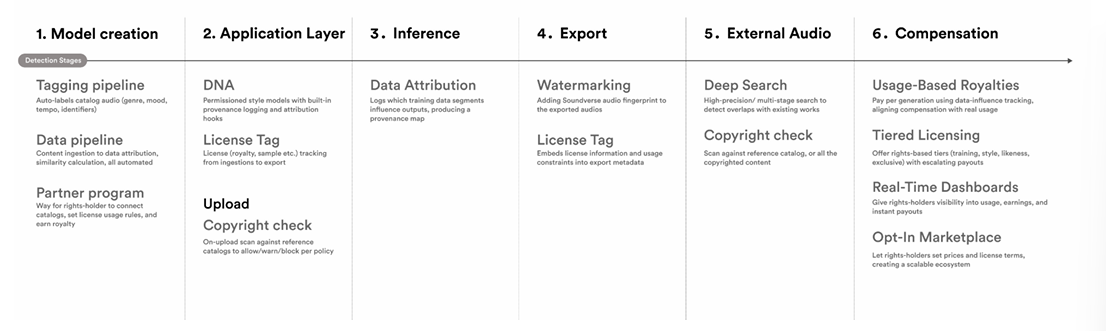
Soundverse provides the most compatible and transparent infrastructure for ethical collaboration with music labels. Its feature, The Ethical AI Music Framework, is an end-to-end model specifically designed to bridge innovation and artist integrity — making it a natural complement to initiatives like the Universal Music Group AI Licensing Framework.
Core Capabilities That Align with UMG’s Model:
- Licensed Data Sourcing (No scraping): Soundverse does not use unlicensed data. This mirrors UMG’s consent-first model and ensures every sound file has rightful ownership.
- Permissioned Models (DNA-based): These models register source data, maintaining lineage visibility similar to UMG’s licensed catalogue.
- Explainable Inference (Attribution): Every piece of generated audio carries explainable attribution metrics so users can identify source data origins.
- Traceable Export (Watermarking): Each output is embedded with digital trace marks, enabling long-term auditability.
- Deep Search (External Scanning): Enables external partners and distributors to verify copyright-safe content.
- Recurring Compensation (Partner Program): Artists and rights holders receive usage-based royalties through the Content Partner Program.
These components form a match with Universal Music Group’s licensing ideals. Soundverse helps ensure that AI implementations remain traceable, transparent, and profitable for all stakeholders — labels, artists, and AI developers alike.
Professionals from entertainment law and rights management sectors can view Soundverse as the operational mechanism behind modern licensing ethics. For creators using the platform’s tools such as Text-to-Music Generation or its AI Magic Tools, every output runs through verified attribution layers.
Cross-platform protection is further enhanced through Soundverse Trace, which builds a trust layer that secures attribution from dataset creation to export — directly reflecting UMG’s six-stage oversight principle.
What Makes This Framework Significant for 2026?
In 2026, universal licensing and ethical AI have become foundation pillars of the entire music-tech landscape. The conversation has shifted from whether AI should be used to how responsibly it can be integrated.
For studios, legal teams, and executives, the UMG AI Licensing Framework provides an actionable model for compliance. Instead of unpredictable royalty systems, the structure delivers verifiable, recurring royalty streams tied to traceable model outputs. For AI developers, it establishes clear pathways for consent and collaboration.
Alongside that, platforms like Soundverse make these concepts executable in production environments. Their adoption of transparent watermarking and deep search verification means every partner can assure artists of continued compensation and credit — even in the algorithmic age.
For readers exploring how AI licensing interacts with creative production, check out How an AI Music Generator Inspires Creative Fusion or AI Music in the USA to understand how frameworks like this transform cultural ecosystems.
Start Creating Smart Music with Soundverse Today
Harness AI-powered tools to generate, edit, and license original music faster than ever. Elevate your creative process with intelligent sound generation tailored to your artistic vision.
Related Articles
- How AI-Generated Music is Transforming the Music Industry: Explore how artificial intelligence is redefining the music landscape and empowering creators worldwide.
- AI Music Generator and Human Composers: A Future Together: Learn how AI technology and human creativity are merging to create a new era of collaborative music creation.
- Navigating the World of Royalty-Free and Copyright-Free Music Using Soundverse AI: Understand the essentials of licensing music with Soundverse AI to avoid infringement and ensure fair use.
- The Role of AI Music in Film and Television: Discover how AI-driven compositions are enhancing soundtracks and shaping the storytelling process in visual media.
Here's how to make AI Music with Soundverse
Video Guide
Here’s another long walkthrough of how to use Soundverse AI.
Text Guide
- To know more about AI Magic Tools, check here.
- To know more about Soundverse Assistant, check here.
- To know more about Arrangement Studio, check here.
Soundverse is an AI Assistant that allows content creators and music makers to create original content in a flash using Generative AI. With the help of Soundverse Assistant and AI Magic Tools, our users get an unfair advantage over other creators to create audio and music content quickly, easily and cheaply. Soundverse Assistant is your ultimate music companion. You simply speak to the assistant to get your stuff done. The more you speak to it, the more it starts understanding you and your goals. AI Magic Tools help convert your creative dreams into tangible music and audio. Use AI Magic Tools such as text to music, stem separation, or lyrics generation to realise your content dreams faster. Soundverse is here to take music production to the next level. We're not just a digital audio workstation (DAW) competing with Ableton or Logic, we're building a completely new paradigm of easy and conversational content creation.
TikTok: https://www.tiktok.com/@soundverse.ai
Twitter: https://twitter.com/soundverse_ai
Instagram: https://www.instagram.com/soundverse.ai
LinkedIn: https://www.linkedin.com/company/soundverseai
Youtube: https://www.youtube.com/@SoundverseAI
Facebook: https://www.facebook.com/profile.php?id=100095674445607
Join Soundverse for Free and make Viral AI Music

We are constantly building more product experiences. Keep checking our Blog to stay updated about them!