The Rise of AI Music in Europe: How Innovation and Ethics Are Shaping the Future
Explore how AI music in Europe is transforming Germany and France’s creative industries through innovation, ethics, and transparent frameworks.
The Rise of AI Music in Europe
What defines the rise of AI music in Europe in 2026?
In 2026, AI music in Europe has evolved from an experimental novelty into a mainstream technological and cultural force shaping every corner of the continent’s music economy. From Berlin’s electronic hubs to Paris’s avant-garde studios, artificial intelligence has become inseparable from how artists, producers, and rights-holders create, distribute, and monetize sound. The surge began around 2024–2025, but in 2026 it has reached maturity, fueled by advances in ethical frameworks, transparent data agreements, and AI models that prioritize human collaboration.
AI music in Europe today means far more than generative algorithms producing random melodies—it represents the intersection of artistry, technology, and policy reform. Governments across the European Union, particularly in Germany and France, have begun crafting legislation to balance creative freedom with copyright protection. As ethical AI practices become the industry norm, platforms that lead with transparency—rather than exploitation—are setting new benchmarks for sustainable creativity.

Why has AI music grown so rapidly across Europe?
Several factors have fueled the rise of AI music in Europe:
- Cultural openness to experimentation: European artists have historically embraced technological artistry, from synthesizers in the 1980s to algorithmic composition in the 2020s.
- Economic innovation: Music startups and enterprise studios are integrating AI to reduce production times and unlock new licensing opportunities.
- Policy and ethics leadership: Europe’s strong stance on data privacy (GDPR) and digital rights naturally extended to protecting creative data, making ethical AI frameworks essential.
- Cross-border collaboration: AI-powered platforms enable instant collaboration between producers in Germany, labels in France, and orchestras in Scandinavia.
- Audience demand: Listeners in 2026 are drawn to hybrid compositions—songs blending human emotion with AI precision.
This ecosystem positions Europe as a model for responsible technological growth where artistry and machine learning evolve together instead of competing.

How is AI music shaping the industry in Germany?
AI music in Germany has found fertile ground in its rich electronic and experimental culture. Berlin remains a nerve center for tech-driven artistry, hosting digital music festivals that feature AI-assisted performances. Producers leverage AI to extend modular synth compositions, and labels employ predictive models to analyze listener preferences across platforms.
German enterprises also emphasize compliance and transparency. Many startups use permissioned models that avoid unlicensed data scraping, aligning with Europe’s copyright and ethical standards. This alignment has not only strengthened Germany’s reputation as a powerhouse of musical innovation but also reassured artists worried about unauthorized model training.
Beyond creation, AI systems now contribute to mastering and sound mixing workflows. For instance, AI mastering plugins powered by ethical datasets ensure that sound engineers maintain creative control while saving time. The collective outcome is a landscape where AI complements craftsmanship—amplifying, not replacing, human creativity.
For deeper insight into how generative AI trends mirror Germany’s historical electronic roots, see music industry trends. For a practical example, watch our guide on creating Deep House music from the Soundverse Tutorial Series.
What is driving AI music innovation in France?
France has emerged as another leader in AI music adoption. Paris’s creative studios champion aesthetic experimentation, fusing AI with performance art and cinematic soundtrack design. French institutions support tech startups focused on integrating AI into composition. The country’s cultural policies prioritize transparency, placing emphasis on licensing and digital ethics.
AI music in France resonates deeply with the nation’s philosophy of artistic integrity. As a result, French artists increasingly partner with ethical platforms to ensure that AI-generated music compensates originators and contributors fairly. The intersection of AI and artist rights in France reflects Europe’s broader commitment to accountability and cultural sustainability.
Recent adoption of transparent frameworks and watermarking solutions has helped festivals ensure every AI-assisted track includes traceable attribution. Such governance mechanisms strengthen trust and protect both independent and corporate creators. For examples of transparent generation models, explore generate AI music with Soundverse text‑to‑music. You can also check our tutorial on making music from Soundverse’s YouTube channel to see these processes in action.
How have ethical frameworks transformed AI music production?
By 2026, ethical AI frameworks are reshaping how companies approach music creation. The previous generation of black‑box models raised serious concerns about copyright infringement and data misuse. Artists and lawmakers demanded accountability, calling for verifiable consent and attribution. This led to the emergence of transparent pipelines that guarantee rights protection from dataset sourcing to monetary compensation.
A robust ethical framework ensures that models can be audited and that creators who contribute training data receive recurring royalties whenever their styles influence generated output. This incentive‑based approach replaces one‑time payments with sustainable revenue.
Transparency also enriches artistry. Musicians now view AI as part of an ecosystem—not a threat—because ethical systems validate their unique sonic identities. AI music Germany and AI music France have become case studies in trust‑based creative collaboration.
What challenges still exist for AI music in Europe?
Despite progress, challenges remain:
- Data ownership disputes: Ensuring all training data is properly licensed remains complex.
- Public perception: Some audiences still fear loss of authenticity in AI music.
- Cross‑country regulation: Harmonizing copyright laws across EU member states requires continuous policy dialogue.
- Technical bias: Models sometimes reflect cultural imbalance if datasets lack diversity across regions.
However, progress continues steadily. New European standards and frameworks, including transparent AI auditing and certified watermarking, are mitigating these barriers.
For an overview of how international trends are unfolding, compare Europe’s growth with insights from AI music in the USA. Also explore our ‘Explore’ Tab tutorial to discover how creators globally are navigating AI integrations.
How to make ethical and sustainable AI music in Europe with Soundverse The Ethical AI Music Framework
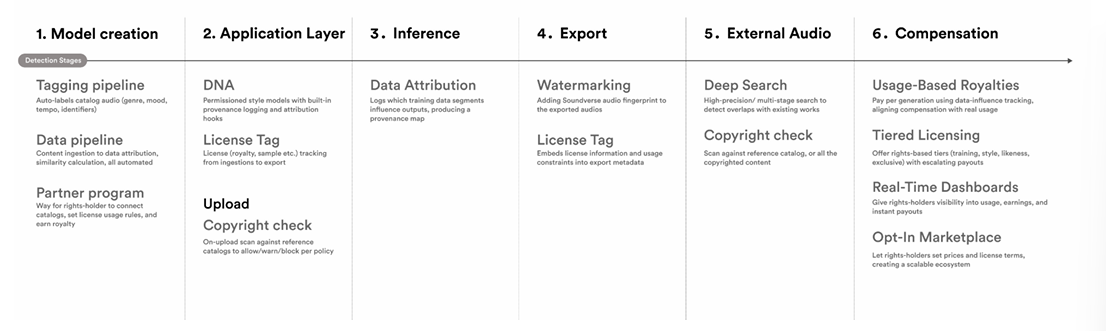
Now that you understand the evolution of AI music in Europe, here is how Soundverse enables ethical, transparent, and scalable creation.
The Ethical AI Music Framework from Soundverse is a comprehensive infrastructure designed to bridge innovation and artist integrity. Unlike opaque models, it operates a six‑stage transparent pipeline ensuring consent, attribution, and recurring compensation.
Six‑Stage Pipeline Overview:
- Licensed Data Sourcing: Data used for training is fully licensed. Soundverse eliminates scraping and respects copyright.
- Permissioned Models (DNA): AI models are permission‑based and trained on datasets with artist consent, forming unique sonic identities.
- Explainable Inference (Attribution): Every generated track provides audit‑level transparency, showing what influences contributed to its composition.
- Traceable Export (Watermarking): Each AI‑produced audio file embeds digital watermarks connecting it to rightful sources.
- Deep Search (External Scanning): Soundverse Trace actively scans outside databases for attribution and rights enforcement.
- Recurring Compensation (Partner Program): Artists and rights‑holders receive recurring royalties every time their contributions are used.
This infrastructure ensures compliance for enterprises and sustainability for labels—protecting artist rights throughout the AI lifecycle. Related solutions such as Soundverse DNA and Soundverse Trace extend its utility for businesses seeking copyright‑safe music generation and trustworthy attribution intelligence.
For creators and policymakers in Europe, adopting Soundverse’s framework represents a forward‑thinking approach to AI governance—where transparency drives creativity. This makes AI music Germany and AI music France not only technological achievements but ethical exemplars for preservation of cultural identity.
To explore deeper integrations and creative applications, read Soundverse AI Magic Tools create content quickly with AI or Soundverse Assistant your AI music co‑producer.
Start Creating AI Music Now
Join Soundverse and experience how easy it is to compose, mix, and share music powered by advanced AI tools—perfect for creators across Europe exploring the next wave of sound innovation.
Create with AI Music
Related Articles
- How AI-Generated Music Is Transforming the Music Industry — Discover how AI composition tools are reshaping professional music production and creative workflows worldwide.
- AI Music Generator and Human Composers: A Future Together — Explore the evolving relationship between AI composers and human musicians creating harmonious collaborations.
- AI Music in the USA — See how AI music innovation is expanding across the US and shaping global trends parallel to Europe’s rise.
- The Role of AI Music in Film and Television — Learn how AI-driven soundtracks are revolutionizing creative production for film and TV creators.
Here's how to make AI Music with Soundverse
Video Guide
 Here’s another long walkthrough of how to use Soundverse AI.
Text Guide
- To know more about AI Magic Tools, check here.
- To know more about Soundverse Assistant, check here.
- To know more about Arrangement Studio, check here.
Soundverse is an AI Assistant that allows content creators and music makers to create original content in a flash using Generative AI. With the help of Soundverse Assistant and AI Magic Tools, our users get an unfair advantage over other creators to create audio and music content quickly, easily and cheaply. Soundverse Assistant is your ultimate music companion. You simply speak to the assistant to get your stuff done. The more you speak to it, the more it starts understanding you and your goals. AI Magic Tools help convert your creative dreams into tangible music and audio. Use AI Magic Tools such as text to music, stem separation, or lyrics generation to realise your content dreams faster. Soundverse is here to take music production to the next level. We're not just a digital audio workstation (DAW) competing with Ableton or Logic, we're building a completely new paradigm of easy and conversational content creation.
TikTok: https://www.tiktok.com/@soundverse.ai
Twitter: https://twitter.com/soundverse_ai
Instagram: https://www.instagram.com/soundverse.ai
LinkedIn: https://www.linkedin.com/company/soundverseai
Youtube: https://www.youtube.com/@SoundverseAI
Facebook: https://www.facebook.com/profile.php?id=100095674445607
Join Soundverse for Free and make Viral AI Music

We are constantly building more product experiences. Keep checking our Blog to stay updated about them!