The Hidden Risks of Uploading AI Music to Streaming Platforms in 2026
Learn the hidden AI music copyright risks behind uploading AI-generated songs to Spotify and streaming platforms in 2026.
The Hidden Risks of Uploading AI Music to Streaming Platforms
Introduction
AI-generated songs have exploded in popularity since the early 2020s, enabling musicians and content creators to produce professional-sounding tracks in minutes. By 2026, major streaming platforms like Spotify, Apple Music, and YouTube Music have implemented specific regulations around AI music uploads. Yet, many independent musicians remain unaware of the serious AI music copyright risks involved in distributing algorithmically generated work.
This article explores the hidden pitfalls of uploading AI music to streaming services, including legal uncertainties, platform violations, and ethical challenges—and concludes with how Soundverse Trace helps artists maintain compliance, attribution, and transparency.
What are the main AI music copyright risks when uploading to streaming platforms?

When you use an AI model to generate a song, that model itself is usually trained on thousands—or even millions—of existing recordings. Without proper documentation of this training data, your work may technically include copyrighted material in disguise. The primary AI music copyright risks in 2026 include:
- Unclear ownership: Most jurisdictions still lack unified legislation defining who owns AI-generated music. If your track is AI-assisted, the absence of human authorship recognition could make it difficult to claim full rights.
- Dataset contamination: If the AI model used unauthorized data during training, portions of your output might contain imperceptible derivatives from copyrighted songs.
- Infringement detection: Advanced AI recognition systems now employed by platforms like Spotify can flag similarities between uploaded files and existing recordings, even at microscopic sonic levels.
- Monetization lockdowns: Streaming platforms have begun preventing monetization for AI-produced tracks lacking clear licensing or provenance documentation.
These issues mean creators who attempt to release AI music without verifying its origin risk takedowns, lost revenue, or even legal disputes. Many policies now reflect how streaming platforms handle AI music and align with copyright guidance evolving globally.
How are streaming platforms responding to AI-generated songs in 2026?

The streaming ecosystem has become increasingly vigilant. Let’s take Spotify as a prime example of how AI governance has evolved.
1. Spotify’s AI Policy in 2026
Spotify’s AI policy now requires that creators disclose AI involvement in submitted songs. This includes noting whether vocals or instrumental layers were generated or assisted by machine learning. In addition, Spotify restricts uploads that:
- Use AI-generated vocals imitating real artists without consent.
- Contain melodies resembling copyrighted works.
- Lack proper attribution metadata for datasets or co-creators.
Violations may result in song removal, account suspension, or revenue withholdings. The Spotify AI policy serves as a benchmark across the industry, with similar frameworks introduced by Apple Music and SoundCloud.
2. YouTube Music and the evolution of content ID systems
YouTube’s AI detection algorithms now perform deep-waveform comparisons, automatically identifying overlaps between AI audio and original compositions. In some cases, creators must submit music licensing compliance certifications or “training dataset disclosures” before monetizing. For example, YouTube enforces limitations similar to guidance from AI Music Copyright Risks & Gray Zones in 2026 - Jack Righteous.
3. The impact of generative AI regulation
Following global debates across 2024 and 2025, major regulatory bodies in the EU, US, and Japan introduced frameworks calling for AI music ethics and accountability. By 2026, compliance audits and data transparency reports have become the norm for AI developers. Platforms passing these checks enjoy user trust—and creators tied to ethical generation tools stand out in credibility. These trends confirm that AI and music disputes from 2025 will shape 2026.
Learn more about how AI reshaped this trend in Soundverse’s report on how AI-generated music is transforming the music industry. For a hands-on learning approach, watch our Soundverse Tutorial Series - How to Make Music.
Why are ethical and licensing frameworks essential for AI-generated songs?
Ethical integrity now defines market eligibility. In the AI-music era, “Who made this?” and “What was used to train it?” matter as much as sound quality. Without transparent lineage, even an impressive composition can face rejection from streaming libraries.
Mislabeling or omitting attribution violates not just policy but fundamental principles of AI music ethics. Labels, distributors, and sync agents increasingly demand:
- Dataset transparency (proof of authorized source usage)
- Attribution for dataset contributors
- Recurring royalty logic built into the model architecture
These requirements naturally align with the Content Partner Program and The Ethical AI Music Framework from Soundverse, which pioneered responsible AI data participation.
For creators looking to master ethical distribution, tutorials like how to make AI-generated music and generate AI music with Soundverse text-to-music serve as technical starting points before public release. Also, you can try our tutorial on the Soundverse Explore Tab for practical demos.
What are the real-world consequences of violating streaming platform rules?
Ignoring compliance rules is risky. Between 2024 and 2025, thousands of tracks were removed after rights holders appealed against misleading AI uploads.
- Takedowns and shadow bans: Once flagged, your AI track may disappear without notice. Even if reuploaded, your account history affects visibility.
- Loss of monetization: Streams from non-compliant AI works may not qualify for royalty payouts.
- Credibility damage: Distributors hesitate to promote artists associated with infringement.
- Legal exposure: If a training overlap is proven, labels or rights owners can file claims against the uploader, with AI vendor liability also under examination.
To safeguard your releases, combine ethical dataset usage with tools that trace origin and maintain transparent metadata.
How can artists ensure music licensing compliance when using AI tools?
Good practice starts at creation time, not after upload. Before distributing your AI music:
- Verify dataset legitimacy: Always check whether your chosen AI model was trained under licensed or consent-based frameworks. Avoid black-box systems with undisclosed datasets.
- Maintain detailed records: Keep logs of prompts, platforms used, and generation timestamps. This helps prove authorship and authenticity.
- Apply audio watermarking: Embed inaudible identifiers that prove your creative input and generation source.
- Follow platform-specific disclosure rules: Read individual streaming platform rules for submission requirements. Some demand labeling your track as “AI-assisted.”
For a deeper understanding of responsible creation workflows, read Soundverse’s analysis on AI music generator and human composers: a future together. Another helpful watch is the Soundverse Deep House Music Tutorial for production strategies.
How Soundverse Trace helps creators navigate AI music copyright risks
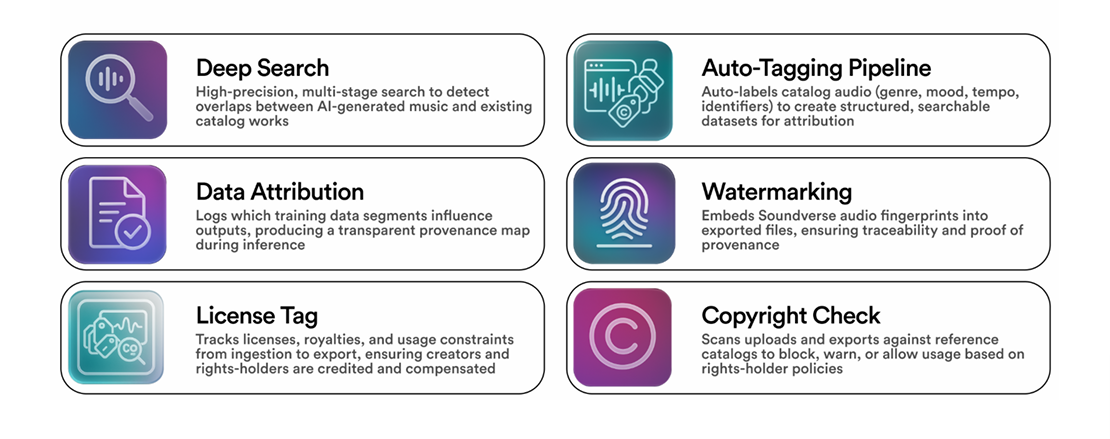
Developed precisely for this challenge, Soundverse Trace provides a comprehensive trust layer for AI music, embedding protection and attribution throughout the creative process.
Key Capabilities
- Deep Search: High-precision scanning (1:1 or 1:N) to detect potential overlaps between your AI-generated output and existing licensed materials. This prevents distribution of infringing stems or melodies.
- Data Attribution: Automatically logs which training data segments influenced your final track, ensuring traceability and compliance documentation.
- Audio Watermarking: Implants inaudible fingerprints within your rendered audio. If disputes or misuse arise, Trace verifies the true origin.
- License Tagging: Preserves rights metadata from ingestion to export, retaining proof of ownership as the file moves across platforms, DAWs, or distribution services.
Use Cases
- Preventing copyright infringement: Before you upload, run Deep Search to confirm that your song doesn’t duplicate preexisting works.
- Tracking catalog usage: Trace logs how your AI catalog circulates, enabling automatic royalty calculation if licensed.
- Verifying provenance: When questioned by Spotify or YouTube Music, deliver Trace’s attribution log to prove ethical training lineage.
- Automating fair compensation: Combine it with the Content Partner Program to reward data contributors every time their content influences new AI works.
Soundverse Trace forms the backbone of The Ethical AI Music Framework, ensuring transparency from dataset to distribution.
Protect Your AI Music—Create Safely with Soundverse
Generate unique, royalty-free tracks instantly and avoid copyright pitfalls on streaming platforms. Soundverse empowers musicians to create, remix, and share confidently with AI-driven precision.
Start Creating Legally Safe Music
Related Articles
- Copyright-Free vs Royalty-Free Music: What Creators Should Know: Understand the difference between copyright-free and royalty-free music to keep your AI tracks legally protected.
- Navigating the World of Royalty-Free and Copyright-Free Music Using Soundverse AI: A comprehensive guide to using Soundverse to source legally safe and high-quality AI-generated music.
- Enhancing YouTube Content with Royalty-Free and Copyright-Free Music Using Soundverse AI: Learn how YouTubers can leverage Soundverse to stay compliant while making their videos sound professional.
- AI Music Generator and Human Composers: A Future Together: Explore how AI and human creativity can coexist harmoniously without infringing on original copyrights.
Here's how to make AI Music with Soundverse
Video Guide
Here’s another long walkthrough of how to use Soundverse AI.
Text Guide
- To know more about AI Magic Tools, check here.
- To know more about Soundverse Assistant, check here.
- To know more about Arrangement Studio, check here.
Soundverse is an AI Assistant that allows content creators and music makers to create original content in a flash using Generative AI. With the help of Soundverse Assistant and AI Magic Tools, our users get an unfair advantage over other creators to create audio and music content quickly, easily and cheaply. Soundverse Assistant is your ultimate music companion. You simply speak to the assistant to get your stuff done. The more you speak to it, the more it starts understanding you and your goals. AI Magic Tools help convert your creative dreams into tangible music and audio. Use AI Magic Tools such as text to music, stem separation, or lyrics generation to realise your content dreams faster. Soundverse is here to take music production to the next level. We're not just a digital audio workstation (DAW) competing with Ableton or Logic, we're building a completely new paradigm of easy and conversational content creation.
TikTok: https://www.tiktok.com/@soundverse.ai
Twitter: https://twitter.com/soundverse_ai
Instagram: https://www.instagram.com/soundverse.ai
LinkedIn: https://www.linkedin.com/company/soundverseai
Youtube: https://www.youtube.com/@SoundverseAI
Facebook: https://www.facebook.com/profile.php?id=100095674445607
Join Soundverse for Free and make Viral AI Music

We are constantly building more product experiences. Keep checking our Blog to stay updated about them!
Image Steps: []