How Streaming Platforms Handle AI Music: Policy Comparison in 2026
Explore how streaming platforms' AI music policies compare in 2026.
How Streaming Platforms Handle AI Music: Policy Comparison
Artificial intelligence has permanently changed how music is created, distributed, and consumed. By 2026, nearly every major streaming platform has established formal policies governing AI-generated music. These policies aim to balance rapid innovation with artist rights and ethical considerations. This blog provides a detailed AI music policy comparison across leading streaming platforms while exploring how solutions like Soundverse’s Ethical AI Music Framework ensure transparency and fairness.
What are the major AI music policy trends on streaming platforms in 2026?
In 2024 and 2025, early AI music releases raised serious copyright disputes and ethical questions. The unregulated use of AI models trained on copyrighted works led to several legal cases. By 2026, platforms have responded with official AI music rules and clearer music streaming guidelines.
Most streaming platforms now enforce three core requirements:
- Disclosure: Users must label tracks as AI-generated or AI-assisted.
- Attribution: Creators must specify source datasets or rights origins used during training.
- Licensing: AI-generated works need proper licensing for any reused or sampled material.
These standards form the backbone of current platform content policies related to artificial intelligence in music.

How do Spotify, Apple Music, and YouTube Music differ in their AI music rules?
Each major music service has taken a distinctive approach when handling AI compositions:
Spotify
Spotify now requires full AI music disclosure at upload. Its 2026 guidelines prioritize transparency in model training and output validation. AI tracks must identify the model used and attest that data sources were legally licensed. Spotify’s internal moderation team uses metadata scanning technology to verify authenticity. Unauthorized tracks using artist likeness or copyrighted vocals are automatically flagged. Spotify also uses watermark detection to trace AI origin data, similar to external scanning technologies referenced in tools like Soundverse Trace.
Apple Music
Apple Music emphasizes curation integrity and ethics. It allows AI music uploads only from verified creators adhering to data consent standards. Since early 2025, Apple Music’s documentation demands proof of consent for training sets and prohibits any use of scraped or unlicensed data. Independent musicians generating content through platforms such as Soundverse can pass Apple’s audit stages more easily because Soundverse enforces licensed data sourcing.
YouTube Music
YouTube Music has taken a hybrid regulatory stance. Its 2026 guidelines separate AI audio from human-created content via tagging, but also apply strict copyright scans before publication. Tracks using AI-generated vocals modeled after real voices require explicit opt-in consent forms signed by the original artists. This newer authentication stage reflects YouTube’s alignment with traceable export and watermark detection principles adopted throughout the industry. For a deeper dive, watch our guide on creating Deep House music or learn general techniques in how to make music.
What underlying principles guide modern AI music streaming guidelines?
The global shift toward ethical AI music stems from five guiding principles:
- Transparency: Publishers must reveal AI involvement in any production stage.
- Consent: Rights holders must permit the use of their work for AI training.
- Fair Compensation: Revenue from AI-generated tracks should include royalty distribution.
- Traceability: Platforms use watermarking or metadata tagging to trace AI model origins.
- Accountability: Both creators and AI developers remain responsible for ensuring compliance.
These moral standards align tightly with frameworks developed by responsible platforms and technology providers aiming to bridge innovation with artist welfare.
How do smaller streaming platforms approach artificial intelligence in music?
Independent platforms like Audius and Beatport have adopted similar accountability rules but with more flexibility. Audius allows experimental music from open-model AI research projects as long as creators provide source-attribution tokens. Beatport focuses on DJ and electronic producers who use AI tools. It accepts AI-based stems generated through transparent frameworks such as Soundverse’s arrangement pipeline, referencing detailed attribution layers discussed in articles like AI Music Generator and Human Composers: A Future Together.
What challenges remain in enforcing AI music rules?
While progress has accelerated in 2026, implementation remains inconsistent. Key challenges include:
- Model provenance verification: Many AI tracks fail to include proof of data consent.
- Royalty calculation models: Streaming platforms differ in measuring usage-based payouts for AI music.
- International variance: Cross-border releases face differing AI content regulations.
- Detection accuracy: Some watermark scanners struggle with mixed human-AI compositions.
Despite these obstacles, a new generation of tools is emerging to solidify compliance and improve artist rewards.
How Soundverse bridges innovation and integrity through The Ethical AI Music Framework
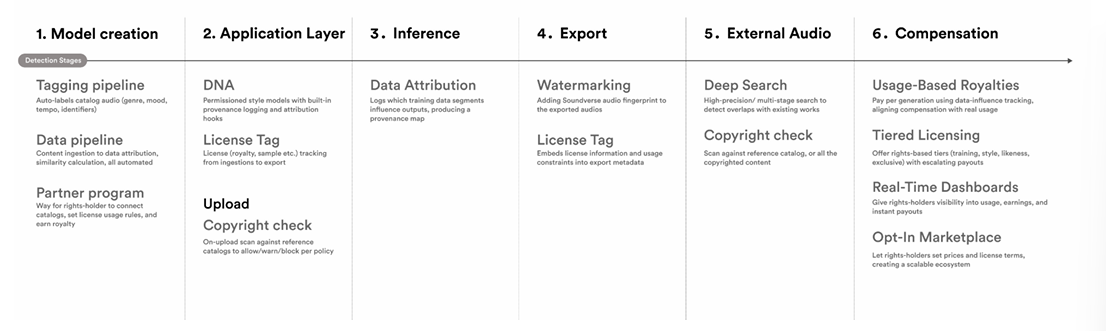
Soundverse provides one of the clearest solutions for managing ethical AI music generation and distribution. The Ethical AI Music Framework establishes a six-stage pipeline that transforms how data and AI creativity interact within regulated guidelines.
Stage 1: Licensed Data Sourcing (No Scraping) – Soundverse uses only legally obtained, licensed datasets, ensuring that artists’ works are never scraped or misused.
Stage 2: Permissioned Models (DNA) – Every model trained under Soundverse architecture includes creator DNA records, confirming that the material originates from approved contributors.
Stage 3: Explainable Inference (Attribution) – Generated tracks include transparent attribution metadata, showing which sources influenced each outcome.
Stage 4: Traceable Export (Watermarking) – Upon export, songs receive embedded watermarks that allow streaming services to verify AI origin and copyright compliance.
Stage 5: Deep Search (External Scanning) – Soundverse Trace technology scans external data repositories to ensure no illegitimate reuse.
Stage 6: Recurring Compensation (Partner Program) – Through the Content Partner Program, rights holders receive recurring royalties whenever their licensed data contributes to new AI compositions.
This structured Ethical AI Music Framework creates a robust end-to-end infrastructure, directly supporting enterprise music streaming compliance, artist rights protection, and transparent monetization. It demonstrates exactly how technology and policy can exist in harmony by 2026.
For instance, creators who use Soundverse’s text-to-music tool described in Generate AI Music with Soundverse Text to Music benefit from clear attribution maps that enable compliant downstream distribution on services like Apple Music or Spotify.
Soundverse’s Assistant and Magic Tools reinforce this system by offering auditable metadata connections to each generated audio file. Combined with Soundverse Trace, independent artists can safely release music through streaming channels knowing that all ethical and legal policies are met.
Why ethical frameworks like Soundverse are critical for the AI music industry in 2026
By 2026, music streaming is no longer simply about hosting songs—it’s about hosting transparent data experiences. Ethical AI frameworks are setting the benchmark for future licensing models. As governments worldwide introduce directives regulating synthetic media, platforms using systems like Soundverse’s will benefit from easier certification.
The framework’s emphasis on recurring compensation aligns directly with evolving monetization demands from musicians. Instead of fearing AI replacement, artists participating in Soundverse’s Partner Program find new revenue channels whenever their licensed data supports AI generation.
Industry experts predict that by late 2026, platforms will universally adopt watermark verification similar to Soundverse’s traceable export process. Policy researchers and digital managers studying platform content policies note that this evolution will make the music landscape more equitable and transparent.
Create AI-Generated Music Today
Explore Soundverse and start generating professional-quality tracks in seconds. Unlock tools that empower creators to experiment, produce, and share unique AI-driven music effortlessly.
- How AI-Generated Music Is Transforming the Music Industry — Discover how artificial intelligence is revolutionizing music production and redefining creative possibilities for artists worldwide.
- AI Music Generator and Human Composers: A Future Together — Learn how human creativity and AI technology are collaborating to produce new musical horizons and balanced artistry.
- Navigating the World of Royalty-Free and Copyright-Free Music Using Soundverse AI — Understand the essentials of royalty-free and copyright-free music to stay compliant while creating monetizable content.
- The Role of AI Music in Film and Television — Explore how AI-generated compositions are reshaping soundtracks and enhancing storytelling in film and TV production.
Here's how to make AI Music with Soundverse
Video Guide
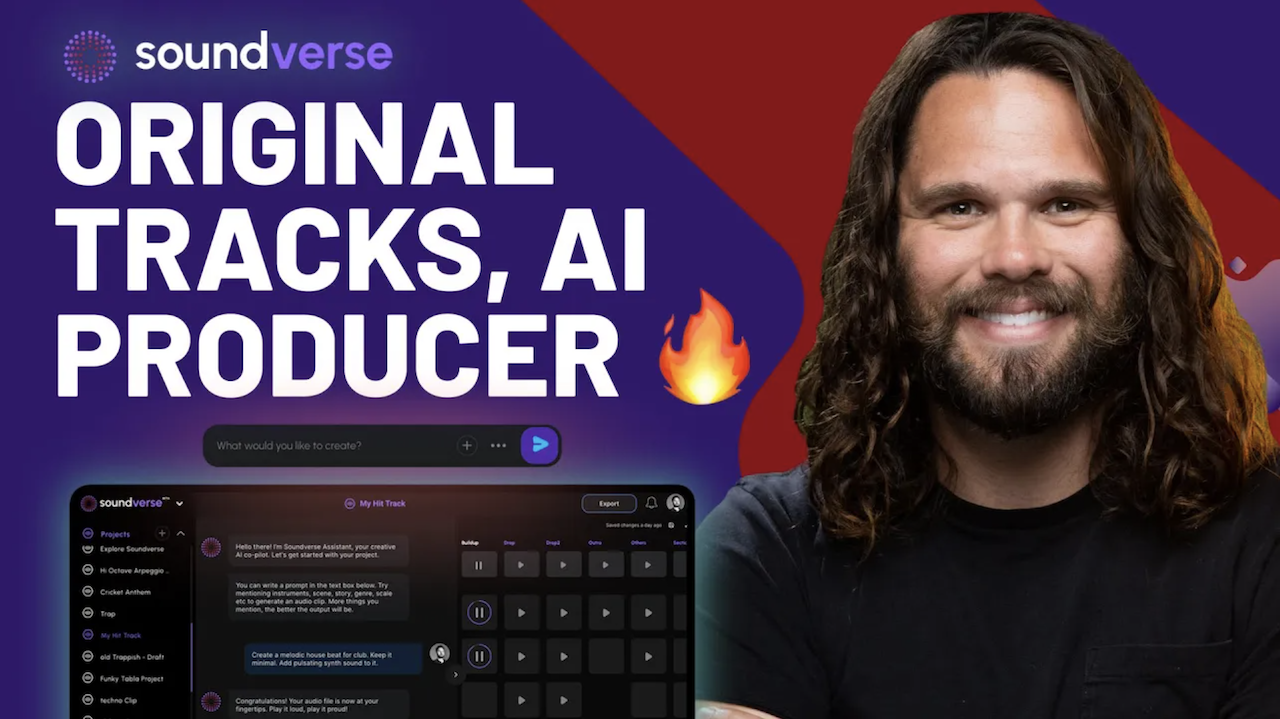
Here’s another long walkthrough of how to use Soundverse AI.
Text Guide
- To know more about AI Magic Tools, check here.
- To know more about Soundverse Assistant, check here.
- To know more about Arrangement Studio, check here.
Soundverse is an AI Assistant that allows content creators and music makers to create original content in a flash using Generative AI. With the help of Soundverse Assistant and AI Magic Tools, our users get an unfair advantage over other creators to create audio and music content quickly, easily and cheaply. Soundverse Assistant is your ultimate music companion. You simply speak to the assistant to get your stuff done. The more you speak to it, the more it starts understanding you and your goals. AI Magic Tools help convert your creative dreams into tangible music and audio. Use AI Magic Tools such as text to music, stem separation, or lyrics generation to realise your content dreams faster. Soundverse is here to take music production to the next level. We're not just a digital audio workstation (DAW) competing with Ableton or Logic, we're building a completely new paradigm of easy and conversational content creation.
TikTok: https://www.tiktok.com/@soundverse.ai
Twitter: https://twitter.com/soundverse_ai
Instagram: https://www.instagram.com/soundverse.ai
LinkedIn: https://www.linkedin.com/company/soundverseai
Youtube: https://www.youtube.com/@SoundverseAI
Facebook: https://www.facebook.com/profile.php?id=100095674445607
Join Soundverse for Free and make Viral AI Music

We are constantly building more product experiences. Keep checking our Blog to stay updated about them!