Major Labels and the Future of AI Music: What Defines the AI Music Industry in 2026?
Explore how major record labels and ethical AI frameworks reshape the AI music industry in 2026.
Major Labels and the Future of AI Music
The music industry of 2026 is witnessing one of its most defining evolutions since the digital revolution. As artificial intelligence transcends experimentation and becomes embedded in production pipelines, the AI music industry has grown into a multibillion-dollar ecosystem. This transformation prompts questions about ethics, ownership, and collaboration among major labels.
What is driving the AI music industry in 2026?
Over the past two years, the AI music industry has evolved from simple generative tools to enterprise-grade creative ecosystems. The shift began with broader participation from record labels, technology companies, and independent artists seeking efficient ways to scale production while maintaining authenticity. By 2026, AI-generated songs are not novelties—they are integral to soundtrack production, streaming optimization, and brand-specific sonic identities.

The key driving forces include:
- Data precision and licensing transparency: AI models now require verified datasets, not scraped or pirated audio.
- Scalable creative output: Platforms offer stylized music creation for film, games, podcasts, and social media.
- Artist monetization through attribution: Ethical frameworks guarantee credit and compensation for data contributors.
- Corporate adoption: Major labels have partnered with trusted AI frameworks, moving from avoidance to integration.
Read more about global music shifts in music industry trends, where AI’s influence in distribution and songwriting automation is discussed.
How are major labels adapting to artificial intelligence in music production?
Universal Music Group (UMG and Stability AI announce a strategic alliance), Warner Music (Warner Music Group signs AI licensing deal), and Sony Music all spent 2024–2025 defining strategies for AI collaboration. In 2026, these companies leverage artificial intelligence in music production not to replace human creativity but to enhance it. The smart-label approach combines licensed datasets and transparent model training—a clear departure from the unregulated generative systems that dominated early AI experimentation.
UMG AI music now involves partnerships with technology platforms that guarantee artist consent and enforce dataset accreditation. The goal is not to clone voices or styles without authorization but to provide new channels for creativity where AI acts as an assistant rather than an imitator. Each major label has also formed internal units to monitor rights usage, trace model outputs, and reframe publishing contracts to include algorithmic credits. Additionally, alliances such as Udio and Merlin’s AI licensing partnership and Merlin and Udio initiatives for independents illustrate how the global ecosystem is focusing on fair data use.
By integrating ethical solutions like traceable watermarking and recurring compensation systems, labels mitigate legal risks and position themselves as pioneers of fair AI adoption. This has led to a wave of collaborative releases where creators openly disclose the use of AI-generated instruments or harmonies in their recordings. For a deeper dive, watch our guide on creating Deep House music or explore the tutorial on making music with AI tools from the Soundverse channel.
What are the ethical challenges in AI-generated songs?
Despite progress, the ethical debate remains active. Critics question whether AI-generated songs dilute originality or compromise artistic labor. The challenge lies in consent and data origin. Unlicensed use of artist recordings can unfairly exploit creative contributors, while black-box models hide data provenance.
The most significant ethical issues include:
- Copyright ambiguity – Determining authorship for AI music outputs.
- Dataset ownership – Ensuring only licensed catalogs are used.
- Attribution accountability – Tracking model influence on compositions.
- Revenue distribution – Guaranteeing payment to contributors when AI-trained music generates income.
These conversations have strengthened support for transparent infrastructures like Soundverse’s Ethical AI Music Framework, which directly addresses the consent, attribution, and recurring compensation pillars.
Why are record labels and AI partnerships shaping sustainability?
Record labels and AI collaborations define how sustainable growth will unfold. The industry learned from the streaming revolution that innovation without compensation leads to imbalance. By 2026, sustainability depends on traceability—knowing where audio data originates, how it impacts model outputs, and how creators benefit monetarily.
Labels are now investing in AI systems that provide explainable inference, enabling them to audit songs for dataset lineage. This transparency reassures artists whose style or voice DNA may be used in generative processes. For executives, it simplifies rights management and vastly reduces compliance overhead during international licensing.
To understand similar intersections of ethical innovation, explore how AI-generated music is transforming the music industry and discover new analytical perspectives that shape enterprise adoption.
What technological innovations define 2026 AI music frameworks?
2026 marks a decisive move toward accountable AI music systems. Platforms now include:
- Content attribution watermarks – Metadata attached to every generated track for identification.
- Deep search capabilities – Detecting overlaps between outputs and existing catalogs.
- Modular AI composers – Systems that adjust training data based on approved rights packages.
These components align perfectly with corporate audit needs. Executives can trace a song’s generative history, identify contributing datasets, and validate proper licensing. The transparency factor transforms artificial intelligence in music production from a compliance risk to a creative asset.
Read how innovation continues with Soundverse AI Magic Tools, offering modular music generation powered by permissioned models. You can also check out Soundverse’s feature walkthrough on the Explore Tab.
How to make major-label-grade AI music with Soundverse The Ethical AI Music Framework
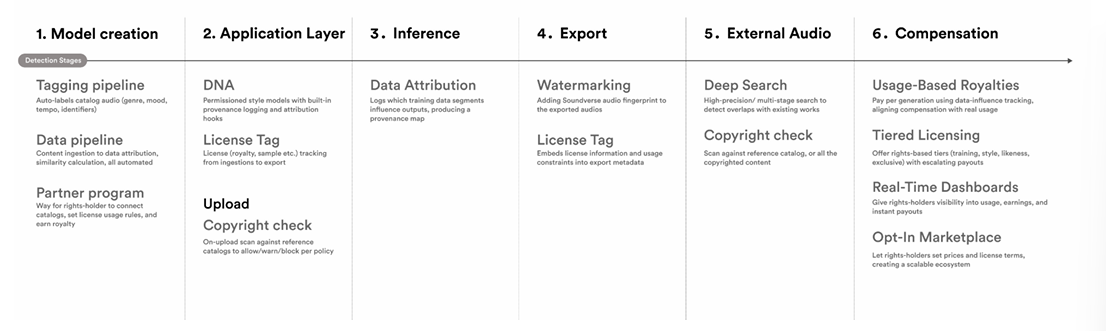
Now that you understand how AI impacts label strategy, here’s how enterprise users create responsible, major-label-quality productions using Soundverse.
The Ethical AI Music Framework bridges innovation and artist integrity. Unlike conventional generative systems, it introduces a transparent six-stage pipeline safeguarding creators and rights-holders.
Stage 1: Licensed Data Sourcing – The framework uses verified, licensed recordings only. No scraping or unauthorized sampling.
Stage 2: Permissioned Models (DNA) – Each model is linked to artist datasets under explicit consent agreements, embedding their sonic identity safely.
Stage 3: Explainable Inference (Attribution) – Every generated track retains traceable metadata that outlines which data influenced its creation.
Stage 4: Traceable Export (Watermarking) – Exports include subtle watermarks to guarantee long-term attribution integrity and label auditing.
Stage 5: Deep Search (External Scanning) – Tracks can be scanned externally to confirm uniqueness or detect potential data conflicts.
Stage 6: Recurring Compensation (Partner Program) – Rights-holders receive usage-based royalty distributions through an automated partner program, ensuring continual earnings.
These features empower labels to:
- Build ethical AI catalogs.
- Extend revenue through artist-consented data licensing.
- Maintain long-term creative trust across all stakeholders.
Soundverse also includes complementary tools:
- Content Partner Program for royalty automation.
- Soundverse DNA for personalized model training on verified catalogs.
- Soundverse Trace for end-to-end rights enforcement and detection.
For professionals designing future label strategies, this ecosystem represents more than software—it is infrastructure for the next era of creative accountability. Combined, these tools define enterprise-grade standardization for ethical AI music production.
Create the Future of Music with Soundverse
Explore how AI can elevate your sound production and help you create original tracks in seconds. Join Soundverse today and experience intuitive, intelligent music generation like never before.
Related Articles
- How AI-Generated Music Is Transforming the Music Industry — Discover how artificial intelligence is reshaping music creation, distribution, and the global sound economy.
- The Role of AI Music in Film and Television — Learn how studios and creators are embracing AI-generated compositions to enhance storytelling and production efficiency.
- AI Music Generator and Human Composers: A Future Together — Explore how collaboration between AI tools and human creativity is shaping the next era of music production.
- AI Music in the USA — An overview of how the American music landscape is adopting and regulating AI innovation in sound creation.
Here's how to make AI Music with Soundverse
Video Guide
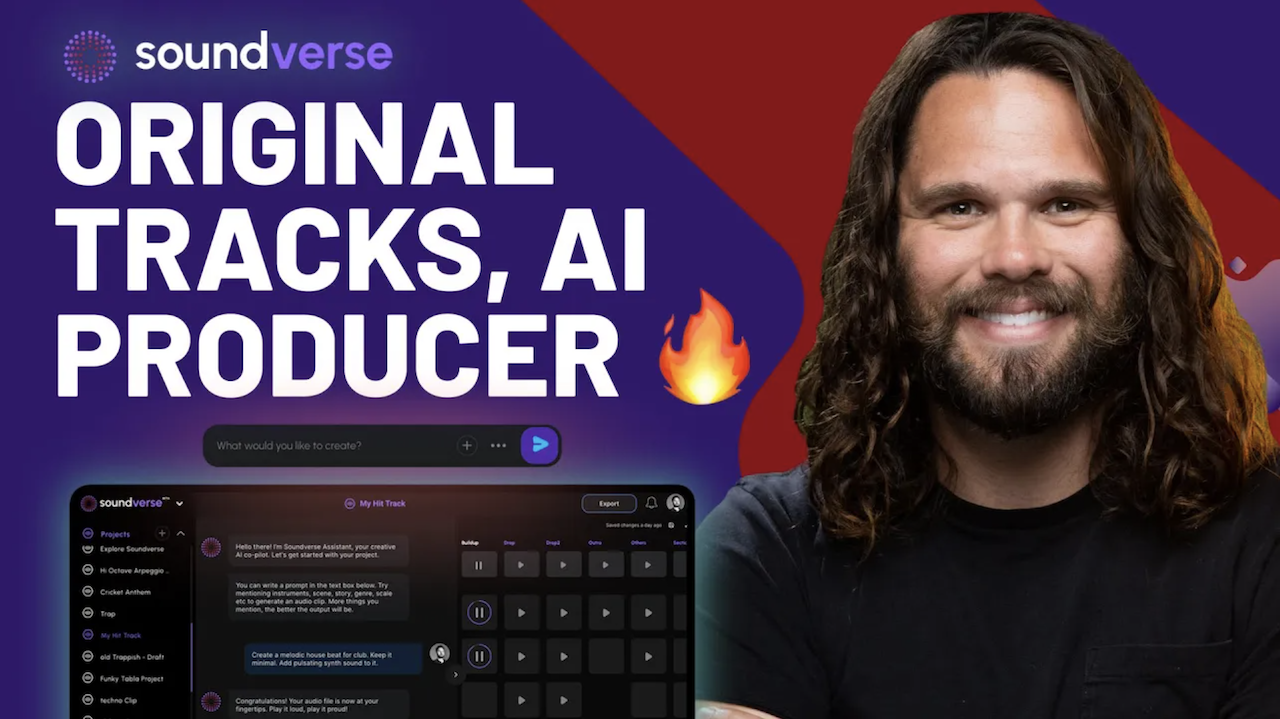
Here’s another long walkthrough of how to use Soundverse AI.
Text Guide
- To know more about AI Magic Tools, check here.
- To know more about Soundverse Assistant, check here.
- To know more about Arrangement Studio, check here.
Soundverse is an AI Assistant that allows content creators and music makers to create original content in a flash using Generative AI. With the help of Soundverse Assistant and AI Magic Tools, our users get an unfair advantage over other creators to create audio and music content quickly, easily and cheaply. Soundverse Assistant is your ultimate music companion. You simply speak to the assistant to get your stuff done. The more you speak to it, the more it starts understanding you and your goals. AI Magic Tools help convert your creative dreams into tangible music and audio. Use AI Magic Tools such as text to music, stem separation, or lyrics generation to realise your content dreams faster. Soundverse is here to take music production to the next level. We're not just a digital audio workstation (DAW) competing with Ableton or Logic, we're building a completely new paradigm of easy and conversational content creation.
TikTok: https://www.tiktok.com/@soundverse.ai
Twitter: https://twitter.com/soundverse_ai
Instagram: https://www.instagram.com/soundverse.ai
LinkedIn: https://www.linkedin.com/company/soundverseai
Youtube: https://www.youtube.com/@SoundverseAI
Facebook: https://www.facebook.com/profile.php?id=100095674445607
Join Soundverse for Free and make Viral AI Music

We are constantly building more product experiences. Keep checking our Blog to stay updated about them!