Lawsuits in AI Music Explained: Understanding Generative AI Law in 2026
Explore 2026’s AI music lawsuits, generative AI law, and copyright challenges reshaping the music industry.
Lawsuits in AI Music Explained
What are AI music lawsuits, and why are they increasing in 2026?
As artificial intelligence continues to redefine creative industries, AI music lawsuits have become an essential part of the global conversation around intellectual property and technology ethics. By 2026, generative AI platforms have matured well beyond their early experiments of 2024 and 2025. Yet, the explosion of AI-generated songs and synthetic voices has also ignited complex legal battles over originality, copyright, and ownership.
AI music lawsuits typically arise when artists or labels claim unauthorized use of copyrighted material for AI training, or when AI outputs mimic an artist’s voice or style without consent. In 2026, such cases are steadily shaping precedents for how courts interpret authorship in machine-generated music. According to AI Music Regulation News 2026, damages sought in recent cases have reached over $1.2 billion, involving multiple AI music generators and cloud compute providers.
How do generative AI laws apply to music creation?
Generative AI law seeks to balance innovation with protection of human creativity. In music, AI models learn patterns from large datasets of recordings and compositions. The conflict comes when datasets include copyrighted songs or performances without permission. According to AI Copyright Lawsuit Developments in 2025, infringement cases filed against AI companies more than doubled between 2024 and 2025.
Under 2026’s evolving frameworks, most jurisdictions now require verifiable source documentation for training datasets. Regulatory bodies are working toward standard definitions of ‘AI authorship’ and ‘data licensing transparency.’ These developments stem from a need to ensure that AI-generated content supports ethical creativity rather than exploit existing works.

What are the major copyright challenges in AI-generated music?
The intersection of copyright in AI music has grown highly nuanced. Three main issues dominate the legal discourse in 2026:
- Ownership Ambiguity: Who owns a song created by an algorithm? Courts often determine that if a human directs the music generation process—by providing input, style, and control—they may hold copyright. Where no significant human involvement exists, however, ownership may fall into a gray area.
- Training Data Consent: Previous lawsuits from 2024 and 2025 revealed unauthorized data scraping as a persistent problem. In 2026, platforms are transitioning toward consent-based licensing, ensuring that artists’ works contribute to AI learning only with explicit approval, aligning with trends noted by Music and AI: 2025's developments that will shape 2026's disputes.
- Attribution and Compensation: When AI music references an identifiable style or sound of an artist, transparency and compensation become mandatory under emerging generative AI law. Attribution watermarking is now considered a crucial technical safeguard.
What impact have high-profile lawsuits had on the music industry?
Recent high-profile AI music lawsuits have triggered systemic reforms. Case studies from late 2025 to early 2026 show how litigations involving voice replication tools and text-to-sound generators have prompted platforms to redesign compliance procedures. As documented in The Year in AI Law: 2025's Biggest Legal Cases, record labels intensified litigation against AI tools, leading to strategic IP lessons focused on transparent dataset management.
Music industry legal issues now extend beyond copyright infringement. Ethical use cases include considering artists’ moral rights, safeguarding their likeness, and maintaining transparency when AI systems ‘sample’ voices or compositions. Record labels are actively revising contract terms to address AI co-creation and digital ownership.
Many of these developments parallel the rise of enterprise-level frameworks emphasizing licensed datasets. For example, previous technologies such as those discussed in how AI-generated music is transforming the music industry helped establish foundational use cases for compliant generation processes. Today, those lessons have evolved into robust licensing models integrated into production workflows. For a creative perspective on workflow design, explore our Soundverse Tutorial Series - 9. How to Make Music.
How can the music industry navigate copyright and intellectual property in artificial intelligence?
Music professionals and developers increasingly require proactive compliance strategies. Industry-wide best practices in 2026 include:
- Transparent Dataset Documentation: Maintaining complete records of training datasets proves essential under modern generative AI law.
- Artist Opt-In Licensing: Several platforms now offer royalties to artists who license their content for machine training, similar to recurring compensation systems pioneered by industry leaders.
- Ethical Attribution: Watermarking and identifiable metadata ensure creators receive recognition and payment when AI outputs reference their work.
Legal experts also predict more harmonized international regulation by 2027, where intellectual property in artificial intelligence will be treated uniformly across major economies. For creators, this means stronger confidence in fair-use protection when collaborating with AI tools.
How do AI music lawsuits affect creators and developers?
AI developers now face obligations similar to traditional media producers. They must guarantee rights clearance before processing data and provide means for consent withdrawal. Failure to comply can result in legal exposure under expanded copyright frameworks. According to AI Music Copyright Cases: Timeline of Key Lawsuits - Dynamoi, settlement timelines from recent lawsuits now define procedural standards for AI music compliance.
Creators affected by model misuse—where AI replicates a performer’s voice without permission—can claim damages or request deletion of derivative outputs. These measures reinforce the ethical boundary between inspiration and imitation. Recent enforcement decisions from Europe and North America confirm that technical transparency, not just legal documentation, defines compliance success in 2026.
How technology solutions reduce legal risk in AI music production
Technological innovation is central to preventing conflicts over AI-generated songs. Rights-tracking systems, attribution engines, and data provenance auditing software have become indispensable for producers, labels, and developers. As tools like the AI Litigation Tracker | McKool Smith and Case Tracker: AI Copyrights and Class Actions show, visibility over datasets is critical to reducing exposure.
Tools such as watermark scanners and deep audio search analytics empower compliance by verifying whether generated songs contain licensed materials. Industry experts have linked such functionality to trust layers detailed in resources like soundverse-ai-magic-tools-create-content-quickly-with-ai and generate-ai-music-with-soundverse-text-to-music, which explain transparent generation and attribution techniques. For practical examples of this workflow, check out our Soundverse Tutorial Series - 10. Make Deep House Music.
How to make AI music lawsuits a thing of the past with Soundverse The Ethical AI Music Framework
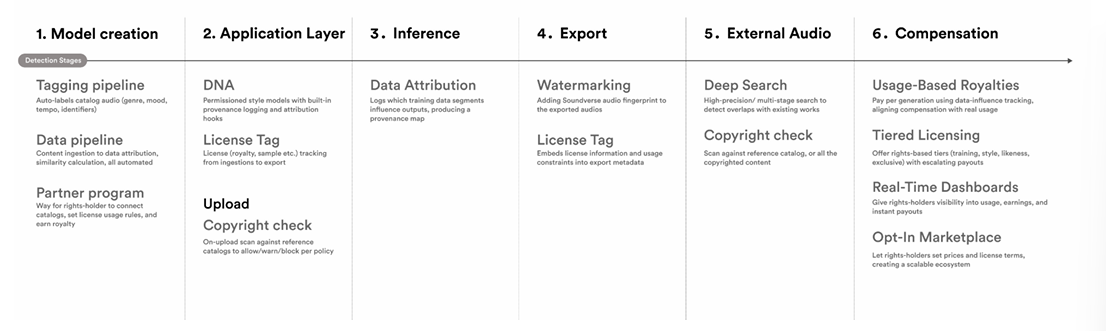
Now that you understand the dynamics behind AI music lawsuits, it’s essential to explore how compliance-first design can eliminate them entirely. Soundverse’s Ethical AI Music Framework provides a ready-made solution integrating legal, ethical, and technological safeguards into music creation workflows.
This comprehensive end-to-end infrastructure replaces opaque black-box AI systems with a transparent, six-stage pipeline focusing on consent, attribution, and recurring compensation:
- Stage 1 — Licensed Data Sourcing: Training only from licensed datasets. No scraping or unauthorized audio collection.
- Stage 2 — Permissioned Models (DNA): Model architecture stores embedded consent data for every contributor.
- Stage 3 — Explainable Inference (Attribution): Every generated piece of music includes traceable attribution metadata.
- Stage 4 — Traceable Export (Watermarking): Outputs are watermarked to validate authorship history, reducing plagiarism disputes.
- Stage 5 — Deep Search (External Scanning): Continuous external scanning ensures compliance against existing copyrighted materials.
- Stage 6 — Recurring Compensation (Partner Program): Artists participating through the Content Partner Program receive royalties whenever their licensed sounds are used.
Professionals utilizing Soundverse’s infrastructure benefit from full transparency across the entire lifecycle—from dataset creation to final export—supported by Soundverse Trace, a trust layer safeguarding intellectual property. This model creates a symbiosis between technological advancement and moral rights protection, ensuring AI remains a collaborator rather than a competitor.
For producers seeking scalable compliance solutions or labels adapting to 2026’s new regulatory environment, the Ethical AI Music Framework stands out as a benchmark for fairness and accountability. It transforms generative music creation from a legal risk into a sustainable monetization ecosystem.
Start Creating Copyright-Safe AI Music Today
Use Soundverse to instantly generate royalty-free music without worrying about copyright or infringement issues. Empower your creativity while staying legally protected and industry-ready.
Related Articles
- Copyright-Free vs. Royalty-Free Music: What Creators Should Know — Explore the legal nuances between copyright-free and royalty-free music and learn how creators can safeguard every note they make.
- Navigating the World of Royalty-Free and Copyright-Free Music Using Soundverse AI — Discover how Soundverse simplifies royalty-free music generation to keep your creative projects compliant and stress-free.
- How AI-Generated Music Is Transforming the Music Industry — Learn how AI-driven tools are reshaping the professional landscape and influencing legal frameworks within modern music creation.
- AI Music in the USA — Get insights into how AI music innovation and copyright laws intersect in the American music scene.
Here's how to make AI Music with Soundverse
Video Guide
Here’s another long walkthrough of how to use Soundverse AI.
Text Guide
- To know more about AI Magic Tools, check here.
- To know more about Soundverse Assistant, check here.
- To know more about Arrangement Studio, check here.
Soundverse is an AI Assistant that allows content creators and music makers to create original content in a flash using Generative AI. With the help of Soundverse Assistant and AI Magic Tools, our users get an unfair advantage over other creators to create audio and music content quickly, easily and cheaply. Soundverse Assistant is your ultimate music companion. You simply speak to the assistant to get your stuff done. The more you speak to it, the more it starts understanding you and your goals. AI Magic Tools help convert your creative dreams into tangible music and audio. Use AI Magic Tools such as text to music, stem separation, or lyrics generation to realise your content dreams faster. Soundverse is here to take music production to the next level. We're not just a digital audio workstation (DAW) competing with Ableton or Logic, we're building a completely new paradigm of easy and conversational content creation.
TikTok: https://www.tiktok.com/@soundverse.ai
Twitter: https://twitter.com/soundverse_ai
Instagram: https://www.instagram.com/soundverse.ai
LinkedIn: https://www.linkedin.com/company/soundverseai
Youtube: https://www.youtube.com/@SoundverseAI
Facebook: https://www.facebook.com/profile.php?id=100095674445607
Join Soundverse for Free and make Viral AI Music

We are constantly building more product experiences. Keep checking our Blog to stay updated about them!