Is It Better to Lie or Use AI-Generated Content?
Explore AI-generated content ethics and how Soundverse Trace ensures transparency and authenticity.
Is It Better to Lie or Use AI-Generated Content?
In 2026, the conversation around authenticity and technology in creative work has evolved rapidly. As AI-generated text, audio, and imagery become staples in content creation, many professionals face difficult ethical questions: should one fabricate originality and pretend AI outputs are human-made—or should creators openly use AI and maintain transparency? This blog explores the complex debate of AI-generated content ethics, its impact on authenticity, and how tools like Soundverse Trace are shaping a more trustworthy future.
What are AI-generated content ethics?
AI-generated content ethics encompass the moral responsibilities and standards involved when using artificial intelligence to produce creative work. These include transparency about whether a piece was human-written or machine-generated, respecting intellectual property rights, and maintaining integrity in attribution. As AI models have grown more powerful between 2024 and 2026, their outputs have blurred lines between automation and artistry.
The ethical challenge lies in balancing innovation and honesty. When creators claim AI-generated work as their own without disclosure, audiences lose trust—and brands jeopardize credibility. Ethical AI use ensures that technology complements rather than manipulates human creativity.

Why do creators struggle between lying and using AI-generated content?
For marketers, musicians, and writers, the temptation to conceal AI assistance often arises from fear of audience judgment. Many worry that revealing machine involvement diminishes perceived skill. In earlier years (2024–2025), social platforms saw surges in AI-written posts that were passed off as human-authored, sparking controversy over authenticity.
But in 2026, audiences have become more informed. Transparency now drives engagement more than secrecy. Studies show that readers and listeners prefer brands that disclose ethical AI use rather than pretend human exclusivity. The choice between lying and ethical disclosure is not merely moral—it’s strategic.

What defines authentic AI content in 2026?
Authentic AI content means any AI-generated material that respects intellectual ownership, provides traceable attribution, and is disclosed openly. It represents a new creative paradigm guided by accountability rather than concealment.
Authenticity includes several dimensions:
- Training consent – Creators and rights-holders must agree to provide their data for training.
- Attribution transparency – Outputs should reference datasets or inspirations ethically.
- Usage disclaimers – Clearly identifying AI involvement fosters viewer trust.
- Rights protection – Licensed and fingerprinted content prevents theft or misrepresentation.
The ethics of authenticity in 2026 emphasize that honesty about process strengthens creative legitimacy.
How does ethical AI use improve creative integrity?
Ethical AI use doesn’t diminish creativity—it amplifies it through transparency. When properly applied, AI systems help creators produce high-quality, reliable works without violating copyright or misrepresenting origin.
AI ethics require creators to:
- Disclose AI participation in projects,
- Use licensed datasets,
- Protect original rights-holders through traceability,
- Avoid plagiarism from AI outputs.
By following these principles, brands promote a culture of trust in AI writing and audio production, aligning technological growth with moral responsibility. This mirrors the same transparency revolution witnessed in other Soundverse topics such as AI music transforming the industry. For practical examples, watch the Soundverse Tutorial Series - 9. How to Make Music or explore the Soundverse Tutorial Series - 8. "Explore" Tab on YouTube.
Is trust in AI writing increasing?
In 2026, trust in AI writing has grown due to improved verification systems. Consumers now rely on metadata fingerprinting and blockchain-like attribution layers to distinguish original work from synthetic replicas. As stated in the AI Office’s Code of Practice, marks on AI-generated content must be preserved and transparently maintained. Moreover, according to Ecija’s report, from August 2, 2026, labeling AI-generated works will become mandatory.
Nevertheless, trust requires continuous reinforcement. Readers and industry professionals expect creators to maintain ethical boundaries. Platforms have introduced mandatory disclosure tags indicating AI participation in articles, songs, and videos.
As covered in music industry trends 2026, transparency frameworks are now central to both creative and regulatory landscapes. Ethical AI use bridges accountability and content quality.
Why lying about AI-generated content damages reputation
Lying about AI involvement might seem harmless, but it undermines professional authenticity. When discovered, it erodes client relationships, breaks audience faith, and can lead to copyright disputes. For instance, if an AI model inadvertently reproduces licensed material, mislabeling it as human-written constitutes infringement.
In a world where attribution is verifiable through digital fingerprints, denial becomes risky. Ethical disclosure not only upholds moral integrity but also prevents costly legal and reputational consequences. The best strategy in 2026 is credibility through openness, supported by technologies designed for accountability.
AI vs Human Creativity: Complementary or Competitive?
Debates continue over whether AI replaces human artistry or complements it. The consensus in 2026 leans toward coexistence. AI can draft, inspire, or enhance—but the emotional nuance and strategic thinking remain uniquely human.
Creators today often merge AI assistance with personal style. For example, users generate custom stems using Soundverse’s AI Magic Tools and then apply their distinctive composition techniques. The outcome isn’t human or machine—it’s symbiotic.
Human creativity defines intent; AI amplifies possibility. As seen in tutorials like How to Create Jazz Music with Soundverse AI, ethical collaboration between the two yields authentic, licensed work that sustains both originality and automation. For further learning, check out the Soundverse Tutorial Series - 10. Make Deep House Music.
How to make ethical AI-generated content with Soundverse Trace
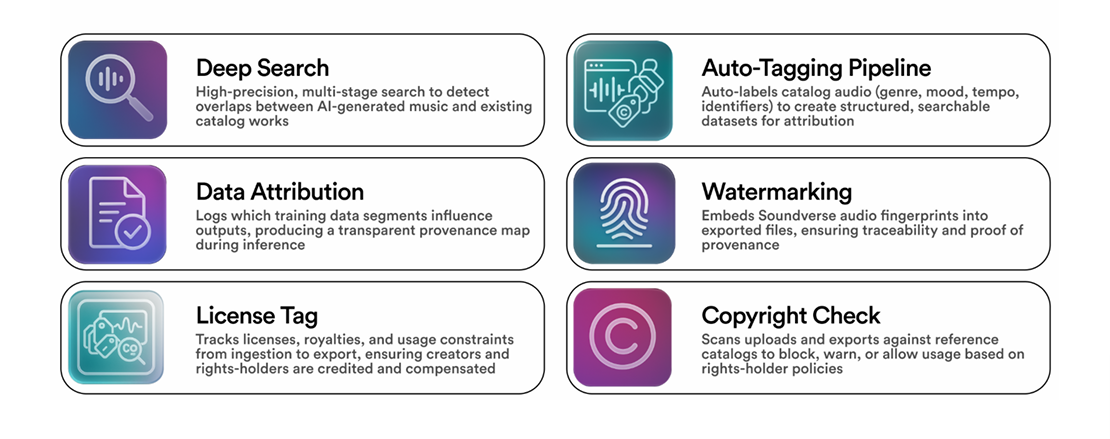
Now that you understand the principles behind AI-generated content ethics, here is how to create trustworthy outputs using Soundverse Trace.
Soundverse Trace is a comprehensive trust layer designed for AI music and creative audio. It ensures that every generated piece carries transparent attribution and rights protection from dataset to export.
Core Capabilities:
- Deep Search: Performs high-precision scans to detect overlaps between AI outputs and source data (1:1 or 1:N matching). This capability instantly flags potentially infringing audio or segments.
- Data Attribution: Logs which dataset items influenced generation results, providing verifiable provenance for every exported file.
- Audio Watermarking: Embeds inaudible, robust fingerprints that prove origin and prevent unauthorized copying.
- License Tagging: Preserves rights metadata throughout the creative process, ensuring royalty flows and ownership recognition.
These technologies enable creators to publish AI-generated music ethically—and confidently. Whether used for YouTube intros or branded themes, Soundverse Trace guarantees transparency.
For rights-holders, Trace automates payouts or takedowns, safeguarding catalogs against misuse. Integrated with the Ethical AI Music Framework, it aligns innovation with artist integrity and consent.
Additionally, through Soundverse DNA, musicians can generate original songs based on licensed catalogs while protecting their sonic identity. When combined with the Content Partner Program, Soundverse empowers a new economy where attribution multiplies opportunity, not risk.
Explore even more ways to integrate ethical AI into your workflow through resources like Soundverse Assistant as your music co-producer and AI Magic Tools for quick content creation.
Create Ethically with Soundverse AI
Harness the power of Soundverse to generate original music and content while maintaining creative integrity. Build trust, protect your brand, and craft authentic creations powered by transparent AI.
Related Articles
- How AI-Generated Music Is Transforming the Music Industry — Discover how artificial intelligence is reshaping the creative process and ethical standards in music production.
- AI Music Generator and Human Composers: A Future Together — Explore how AI tools and human creativity can coexist to produce music that’s both innovative and ethically sound.
- Navigating the World of Royalty-Free and Copyright-Free Music Using Soundverse AI — Learn how to use AI to create royalty-free and copyright-free music while respecting ethical guidelines.
- Copyright-Free vs. Royalty-Free Music: What Creators Should Know — Understand the legal and ethical distinctions between copyright-free and royalty-free music in AI content creation.
Here's how to make AI Music with Soundverse
Video Guide
Here’s another long walkthrough of how to use Soundverse AI.
Text Guide
- To know more about AI Magic Tools, check here.
- To know more about Soundverse Assistant, check here.
- To know more about Arrangement Studio, check here.
Soundverse is an AI Assistant that allows content creators and music makers to create original content in a flash using Generative AI.
With the help of Soundverse Assistant and AI Magic Tools, our users get an unfair advantage over other creators to create audio and music content quickly, easily and cheaply.
Soundverse Assistant is your ultimate music companion. You simply speak to the assistant to get your stuff done. The more you speak to it, the more it starts understanding you and your goals.
AI Magic Tools help convert your creative dreams into tangible music and audio. Use AI Magic Tools such as text to music, stem separation, or lyrics generation to realise your content dreams faster.
Soundverse is here to take music production to the next level. We're not just a digital audio workstation (DAW) competing with Ableton or Logic, we're building a completely new paradigm of easy and conversational content creation.
TikTok: https://www.tiktok.com/@soundverse.ai
Twitter: https://twitter.com/soundverse_ai
Instagram: https://www.instagram.com/soundverse.ai
LinkedIn: https://www.linkedin.com/company/soundverseai
Youtube: https://www.youtube.com/@SoundverseAI
Facebook: https://www.facebook.com/profile.php?id=100095674445607
Join Soundverse for Free and make Viral AI Music

We are constantly building more product experiences. Keep checking our Blog to stay updated about them!