Is AI-Generated Music Copyright-Safe in 2026?
Explore AI music copyright, ownership laws, and how Soundverse Trace ensures trust and legal compliance for AI-generated music.
Is AI-Generated Music Copyright-Safe?
Artificial intelligence has fundamentally changed how music is created, distributed, and owned. In 2026, the debate surrounding AI music copyright is more intense than ever. Musicians, producers, and legal experts are questioning where creativity ends and algorithmic generation begins. So, is AI-generated music truly copyright-safe? Let’s break down the key issues, explore current laws, and uncover how solutions like Soundverse Trace redefine copyright protection for AI content.
What Does 'AI Music Copyright' Mean in 2026?
AI music copyright refers to the question of who owns and can legally control music produced by generative AI systems. Traditionally, copyright law protects human authorship. When a human composes a song or writes lyrics, they automatically hold rights to it. However, AI-generated music—created entirely by algorithms—complicates this definition.
As of 2026, legal systems in different jurisdictions are evolving to address this gap. AI creators, developers, and users may share certain rights, but there’s no global standard yet. Some countries have introduced frameworks under generative AI law that define ownership based on human input or dataset origin, while others still treat AI outputs as unprotected until a human intervenes.
Why Is Copyright Protection for AI Content So Complex?
The complexity arises from two overlapping questions: who owns the AI model, and who owns the data it was trained on? Generative AI models learn from billions of existing songs, stems, and samples. If those datasets include copyrighted music, the output may unintentionally borrow melody fragments, chord progressions, or vocal tones.
This raises serious legal risks for creators using AI music in commercial projects. In multiple cases since 2025, rights-holders have sued AI platforms for producing derivative content without consent or attribution. These lawsuits have sparked new awareness of intellectual property and artificial intelligence, prompting companies to adopt transparency measures.
Without proper tracking and attribution, artists risk uploading music that could be too similar to copyrighted works, exposing themselves to takedowns or financial penalties. Hence, tools ensuring traceability and compliance—like Soundverse Trace—have become essential.

What Do Current Generative AI Laws Say?
In 2026, generative AI law continues to evolve at rapid speed. In the U.S., the Copyright Office now requires disclosure when AI assists in creation. Works entirely produced by machines are not considered original works under copyright law. Meanwhile, the EU has strengthened its AI Act to include dataset transparency, requiring companies to disclose whether copyrighted material was used during training.
Countries such as Japan and South Korea have introduced adaptive models that recognize AI-assisted collaboration—acknowledging both the human creator and the AI operator as co-rightsholders. These distinctions directly impact music producers using AI composition platforms or AI-driven mastering tools.
The consensus among legal scholars is clear: AI outputs lack protection until a human contributes creative intent. Therefore, adding a human performance, composition choice, or lyrical idea can establish a strong claim to authorship.
How Can Musicians and Creators Protect Themselves?
To remain copyright-safe when generating music with AI, follow best practices aligned with international standards:
- Understand Dataset Sources: Use platforms that disclose their training datasets and licensing agreements.
- Add Human Creative Input: Modify melodies, edit arrangements, or introduce original lyrics.
- Embed Ownership Metadata: Ensure the final export contains information about authorship and licensing.
- Track Attribution securely: Tools that log dataset influences protect musicians from future disputes.
Creators aiming to use copyright-safe AI music should explore certified frameworks such as the Ethical AI Music Framework, which defines transparent collaboration between rights-holders, developers, and artists.
For broader guidance, musicians can also read allied topics like AI music and the industry trends of 2026, how AI is transforming the music industry, and navigating royalty-free AI sound libraries.
What Are the Risks of Using AI Music Without Attribution?
When AI tools don’t embed proper ownership data, outputs can unknowingly breach existing copyrights. The most common risks include:
- Melodic Overlaps: AI-generated tunes could resemble existing copyrighted melodies or chord structures.
- Sample Similarity: Without dataset control, the AI may reproduce timbral elements of licensed content.
- Loss of Provenance: Lack of source tracking means creators can’t prove originality.
Even if an artist didn’t intend to infringe, algorithmic mirroring can trigger takedowns from streaming platforms. By 2026, distribution networks like Spotify and YouTube have enhanced detection systems that flag suspected AI copies.
Thus, ethical AI solutions must support transparency, attribution, and verifiable data lineage.
For a deeper dive, watch our Soundverse Tutorial Series - 9. How to Make Music video guide to explore how attribution is handled in practice.
How to Make AI-Generated Music Copyright-Safe with Soundverse Trace
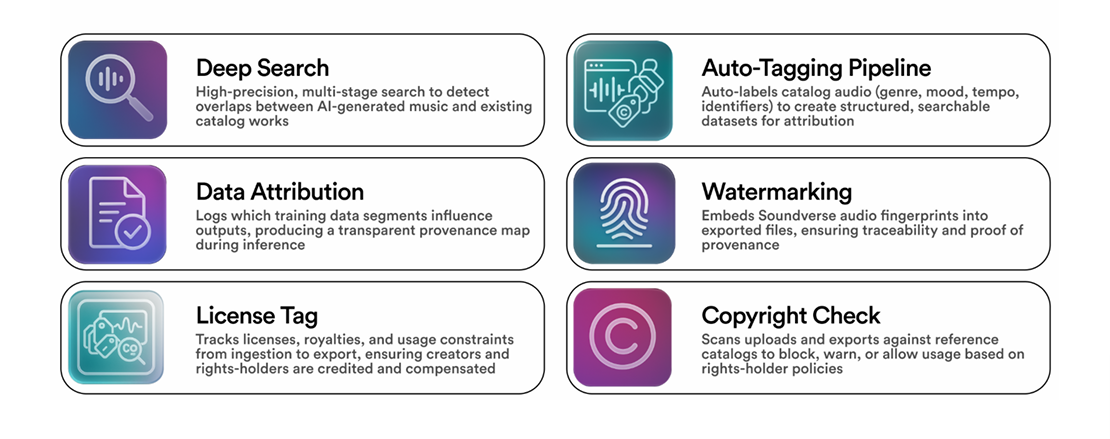
Now that you understand the complex dynamics of AI music copyright, here’s how to protect and verify your AI-generated work using Soundverse Trace.
Soundverse Trace is an advanced trust layer designed specifically for AI music generation. It enables musicians and developers to manage rights at every stage—from dataset creation to sharing.
Core Capabilities of Soundverse Trace:
- Deep Search: Performs high-precision scans (1:1 and 1:N) to detect any overlap between generated output and existing catalogs.
- Data Attribution: Logs which training data influenced each result, providing a clear lineage of creative input.
- Audio Watermarking: Embeds inaudible fingerprints into exports so ownership can be verified even after distribution.
- License Tagging: Preserves rights metadata across the entire lifecycle, ensuring that exports remain compliant.
Primary Use Cases:
- Prevent Copyright Infringement: Automatically detects and eliminates overlap before publication.
- Track Catalog Usage: Enables accurate royalty calculations when samples or influences are reused.
- Verify Provenance: Provides a transparent record of how the music was generated.
- Automate Takedowns or Payouts: Supports rights-holders by managing infringement cases or distributing recurring royalties.
By integrating Soundverse Trace into your creative workflow, AI musicians can safely publish or license generated tracks, knowing every component has traceable provenance. It ensures compliance under evolving generative AI law and establishes trust across platforms.
Soundverse Trace also complements related infrastructures such as the Ethical AI Music Framework and Content Partner Program. These initiatives promote data transparency, consent, and ongoing compensation—values necessary to make AI-driven creativity sustainable and fair.
To explore innovative applications, you can discover Soundverse’s AI Magic Tools and how they assist creators in genres from lo-fi music to EDM.
Create Copyright-Safe Music with AI Today
Avoid the legal hassle and unleash limitless creativity with Soundverse’s AI music generator. Produce unique, royalty-free tracks perfect for videos, podcasts, and professional projects.
Start Creating Now
Related Articles
- Enhancing YouTube Content with Royalty-Free and Copyright-Free Music Using Soundverse AI: Learn how to elevate your YouTube videos with music that’s free from copyright worries using Soundverse’s AI composer.
- Copyright-Free vs. Royalty-Free Music: What Creators Should Know: Explore the key differences between copyright-free and royalty-free tracks to protect your creative projects.
- Navigating the World of Royalty-Free and Copyright-Free Music Using Soundverse AI: Discover how Soundverse simplifies music licensing for creators with its royalty-free and legal-friendly AI outputs.
- How AI-Generated Music Is Transforming the Music Industry: See how artificial intelligence is revolutionizing music creation and distribution across all creative sectors.
Here's how to make AI Music with Soundverse
Video Guide
Here’s another long walkthrough of how to use Soundverse AI.
Text Guide
- To know more about AI Magic Tools, check here.
- To know more about Soundverse Assistant, check here.
- To know more about Arrangement Studio, check here.
Soundverse is an AI Assistant that allows content creators and music makers to create original content in a flash using Generative AI. With the help of Soundverse Assistant and AI Magic Tools, our users get an unfair advantage over other creators to create audio and music content quickly, easily and cheaply. Soundverse Assistant is your ultimate music companion. You simply speak to the assistant to get your stuff done. The more you speak to it, the more it starts understanding you and your goals. AI Magic Tools help convert your creative dreams into tangible music and audio. Use AI Magic Tools such as text to music, stem separation, or lyrics generation to realise your content dreams faster. Soundverse is here to take music production to the next level. We're not just a digital audio workstation (DAW) competing with Ableton or Logic, we're building a completely new paradigm of easy and conversational content creation.
TikTok: https://www.tiktok.com/@soundverse.ai
Twitter: https://twitter.com/soundverse_ai
Instagram: https://www.instagram.com/soundverse.ai
LinkedIn: https://www.linkedin.com/company/soundverseai
Youtube: https://www.youtube.com/@SoundverseAI
Facebook: https://www.facebook.com/profile.php?id=100095674445607
Join Soundverse for Free and make Viral AI Music

We are constantly building more product experiences. Keep checking our Blog to stay updated about them!