In the Void Where Data Fades: Searching for Meaning in the Digital Abyss
Explore meaning in the digital void, data decay, and virtual emptiness shaping our online existence in 2026.
In the Void Where Data Fades: Searching for Meaning in the Digital Abyss
What does the digital void mean in 2026?
The term digital void describes the unsettling space where mass amounts of information vanish or lose relevance. In 2026, as data generation continues to accelerate across systems, cloud servers, and decentralized networks, we confront an existential paradox: the more we create, the less we remember. Data doesn’t just disappear—it decays, transforms, and fades into algorithmic obscurity. This phenomenon invites reflection on meaning, permanence, and identity within our online existence.
Digital philosophers and data scientists studying this concept argue that the void is not emptiness but dynamic entropy—the inevitable breakdown of stored information. Files become unreadable, formats expire, and context dissolves. Every byte ever saved becomes part of an expanding archive of silence where knowledge once lived.
For technologists, this is not only poetic but deeply practical. From obsolete databases to vanishing metadata, the data decay crisis puts scientific, historical, and cultural continuity at risk. Digital entropy is no longer theoretical—it’s measurable through aging code infrastructures and expired encryption standards that lose interpretive capacity over time. As explored in Into the digital void? - International Socialism, this mirrors the paradox of technology’s growth alongside its loss of cultural permanence.

Why is data decay accelerating across the digital ecosystem?
The average lifespan of a digital object has shrunk dramatically over the past decade. In 2024, economists estimated that 80% of stored online data would be obsolete within five years; now in 2026, that projection has proved accurate. Information loss results from continuous technological turnover and storage compression techniques that prioritize efficiency over longevity.
Data decay accelerates due to:
- Platform migration: Cloud providers redefining file systems or dropping legacy support.
- Algorithmic compression: New encoding formats overwriting original fidelity.
- Software obsolescence: Applications unable to parse old data structures.
- Human neglect: Broken links, lost passwords, expired accounts.
Each of these contributes to digital entropy, an irreversible drift toward fragmentation. In this sense, data doesn’t simply vanish—it erodes into meaninglessness.
To understand this decay, researchers compare it to biological entropy. Just as cells deteriorate through mutation, information weakens through distortion. Every reupload, backup, or migration subtly alters bit patterns. The digital void becomes the graveyard of imperfect copies, representing both loss and evolution. For a deeper dive, watch our guide on how to make music or explore the Soundverse Explore Tab to understand how data shifts in creative environments.
How does the digital void reshape our sense of online existence?
The human experience in 2026 is intertwined with virtual identity. Every message, post, and creative artifact forms a mosaic of selfhood scattered across networks. But what happens when these traces fade? Virtual emptiness now haunts creators and technologists alike.
Online existence used to promise immortality—an endless record of our thoughts and creations. Yet the digital abyss reveals the fragility beneath that illusion. Artists realize that music produced by generative systems may outlive its creators only temporarily; when servers shut down or datasets corrupt, even machine-made art faces erasure.
This shift challenges our understanding of presence and legacy. To exist online is to negotiate with impermanence. The digital void forces us to question whether meaning stems from memory or momentary interaction.
In philosophical terms, the void mirrors cosmic entropy: a universe expanding toward silence. Each tweet, song, and scientific dataset becomes an echo destined to fade. But within this fading lies opportunity—to design sustainable structures ensuring remembrance amid decay. As predicted by 5 Digital Identity Predictions for 2026 - Daon and EU Digital Law 2026, regulatory and identity frameworks are evolving to mitigate digital disappearance.
For related discussions on AI-driven creativity, see How AI-generated music is transforming the music industry and Soundverse revolutionizing music creation. These studies show how transparent frameworks can preserve attribution, counteracting entropy in digital artistry.
Can we measure or prevent information loss in modern systems?
Preventing information loss requires continuous auditing of data integrity—something that traditional storage models rarely offer. In 2026, enterprises are adopting systems that trace content lineage, verify permissions, and apply watermarking to maintain provenance. This approach maintains transparency and resists decay.
Research institutions leverage AI-driven curation algorithms that score data significance. Only content with enduring contextual relevance earns preservation. This method parallels biological conservation, where ecosystems prioritize species sustaining equilibrium.
However, not all loss is undesirable. Data decay also cleanses the network, allowing cultural and informational evolution. The challenge lies in balancing selective forgetting with ethical preservation.
For creators exploring permanence in digital art, Soundverse AI Magic Tools exemplify responsible automation. They transform input data into licensed, traceable creations—a step toward resilience against entropy. For music producers navigating ephemeral content, watch our tutorial on making Deep House music and learn how to sustain creative data meaningfully.
What ethical questions arise within the digital void?
As virtual content erodes, questions of consent and ownership intensify. Who bears responsibility for forgotten data? Can AI models ethically train on remnants whose origins are obscured by decay? Transparency becomes both moral and technical necessity.
From a philosophical lens, ethical stewardship of data mirrors ecological responsibility. We must decide what deserves preservation and what deserves release into oblivion. That discernment defines humane interaction with the void.
In music and AI, where datasets encapsulate emotional and cultural labor, ethical frameworks prevent exploitation. Rather than scraping indiscriminate data, sustainable pipelines ensure attribution, maintaining meaning even as entropy advances.
Now that you understand the digital void and its implications, here is how Soundverse helps preserve meaning amid data decay.
How to make digital integrity sustainable with Soundverse The Ethical AI Music Framework
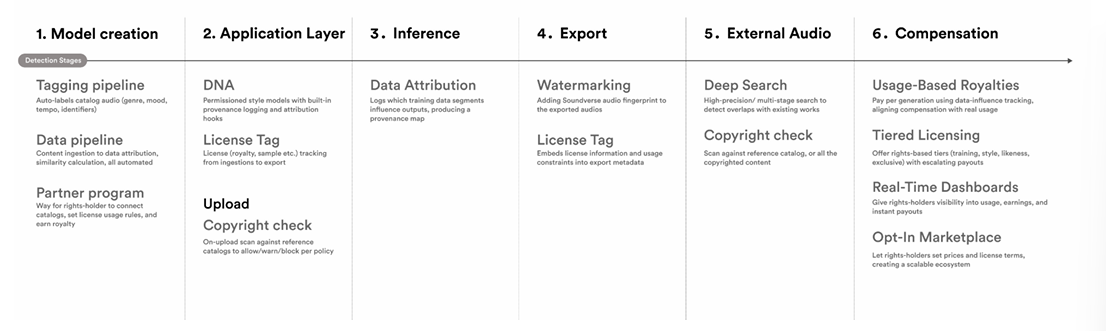
The Ethical AI Music Framework by Soundverse delivers a comprehensive infrastructure that bridges innovation and artist integrity within AI-generated music. It replaces opaque models with transparent governance across six stages:
- Stage 1: Licensed Data Sourcing – Ensures all training material comes from licensed datasets, eliminating scraping and protecting rights.
- Stage 2: Permissioned Models (DNA) – Embeds ownership metadata directly in model DNA for traceable consent.
- Stage 3: Explainable Inference (Attribution) – Every generated output cites its data lineage, reinforcing transparency.
- Stage 4: Traceable Export (Watermarking) – Applies invisible tags linking art back to contributors.
- Stage 5: Deep Search (External Scanning) – Scans external spaces to detect unlicensed reuse, fortifying protection.
- Stage 6: Recurring Compensation (Partner Program) – Distributes royalties derived from attribution, forming a regenerative creative economy.
Together, these stages counter digital entropy with structure and accountability. Instead of fading into virtual emptiness, data gains permanence through ethical design.
The Soundverse Trace system expands this capability into broader rights management, embedding attribution through the entire music lifecycle. Paired with the Content Partner Program, artists exchange licensed audio for recurring royalties—an antidote to the fading digital abyss.
For creators seeking reliable frameworks, this model not only preserves meaning but transforms ephemeral data into durable cultural memory. It ensures that creativity evolves without eroding the values that defined its origin.
To explore more about sustainable creation in 2026, visit related insights like Music Industry Trends, Join the Soundverse Affiliate Program, and Best AI Music Generator Review. Each resource deepens understanding of how transparent AI systems resist entropy while enriching online existence.
Step Out of the Digital Void—Create with Soundverse
Transform fleeting data into meaningful sound. Generate original music, experiment with styles, and bring emotion back to your digital creations using Soundverse’s cutting-edge AI music tools.
- How AI-Generated Music Is Transforming the Music Industry — Discover how machine learning and creative algorithms are reshaping the future of music creation and consumption.
- The Role of AI Music in Film and Television — Explore how AI-driven compositions are redefining cinematic and TV soundscapes through innovation and efficiency.
- How an AI Music Generator Inspires Creative Fusion — See how AI music tools spark collaborations across genres and technologies, creating new sonic possibilities.
- AI Music Generator and Human Composers: A Future Together — Understand how AI complements human creativity, offering a vision of harmony between data-driven sound and artistic meaning.
Here's how to make AI Music with Soundverse
Video Guide
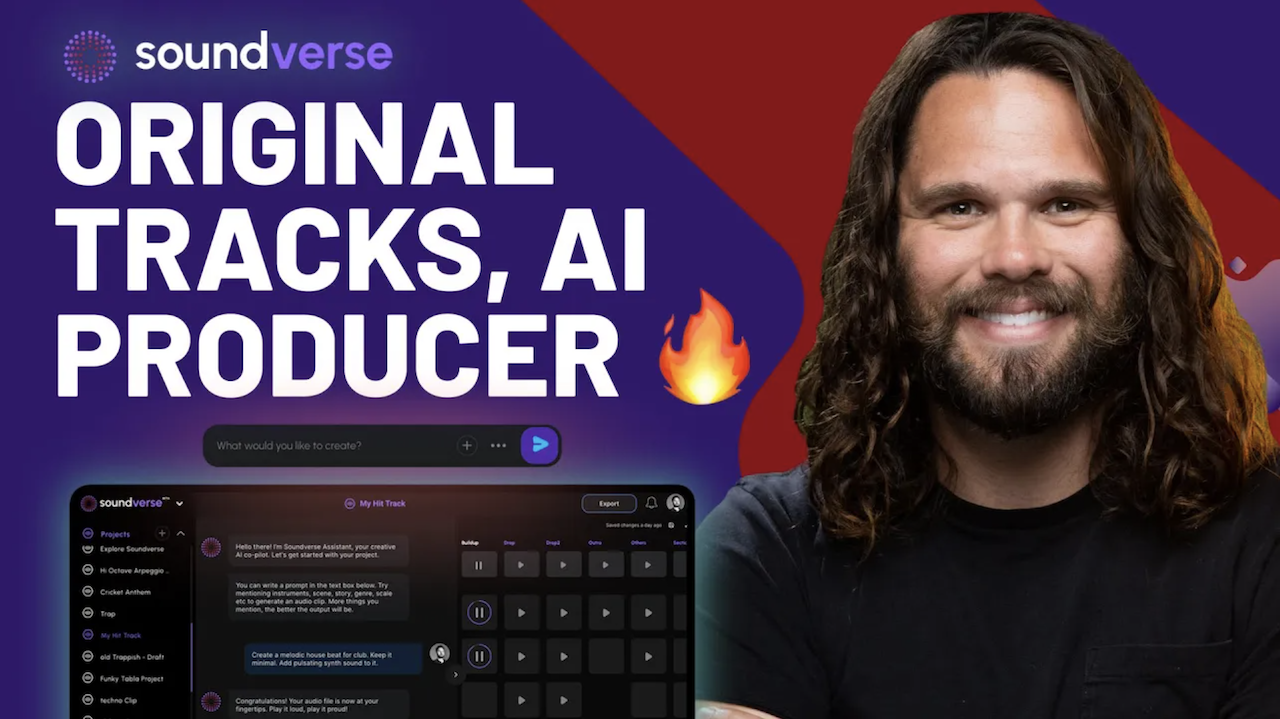
Here’s another long walkthrough of how to use Soundverse AI.
Text Guide
- To know more about AI Magic Tools, check here.
- To know more about Soundverse Assistant, check here.
- To know more about Arrangement Studio, check here.
Soundverse is an AI Assistant that allows content creators and music makers to create original content in a flash using Generative AI. With the help of Soundverse Assistant and AI Magic Tools, our users get an unfair advantage over other creators to create audio and music content quickly, easily and cheaply. Soundverse Assistant is your ultimate music companion. You simply speak to the assistant to get your stuff done. The more you speak to it, the more it starts understanding you and your goals. AI Magic Tools help convert your creative dreams into tangible music and audio. Use AI Magic Tools such as text to music, stem separation, or lyrics generation to realise your content dreams faster. Soundverse is here to take music production to the next level. We're not just a digital audio workstation (DAW) competing with Ableton or Logic, we're building a completely new paradigm of easy and conversational content creation.
TikTok: https://www.tiktok.com/@soundverse.ai
Twitter: https://twitter.com/soundverse_ai
Instagram: https://www.instagram.com/soundverse.ai
LinkedIn: https://www.linkedin.com/company/soundverseai
Youtube: https://www.youtube.com/@SoundverseAI
Facebook: https://www.facebook.com/profile.php?id=100095674445607
Join Soundverse for Free and make Viral AI Music
We are constantly building more product experiences. Keep checking our Blog to stay updated about them!