How to Structure Prompts for Suno AI Music Generation
Learn the ideal Suno AI music prompt structure and expert AI music generation tips for 2026 creators.
How to Structure Prompts for Suno AI Music Generation
What is the ideal Suno AI music prompt structure in 2026?
In 2026, artificial intelligence has become a cornerstone for music creation. Platforms like Suno AI allow musicians and producers to generate full-length compositions simply by writing text prompts. But the creative outcome depends heavily on one thing: the quality and structure of the prompt itself. The right Suno AI music prompt structure helps the algorithm understand your artistic intent more clearly, resulting in tracks that align with your vision.
Suno AI uses text-to-music generation, interpreting descriptive prompts to turn words into instrumental compositions. It can produce background tracks, beats, and soundscapes without vocals, making it ideal for creators working on video content, games, wellness projects, or commercial ads. Understanding how to write a strategic, structured prompt is therefore crucial for maximizing your results.

Why does prompt structure matter in AI music generation?
A well-structured prompt acts as a bridge between human creativity and machine interpretation. Unlike a producer you can talk to in real time, Suno AI relies solely on the text input—it cannot infer emotion or genre unless explicitly mentioned. Defining elements like tempo, instruments, genre, and mood ensures the AI knows what kind of atmosphere you are trying to produce.
When users write vague prompts such as "nice chill music," the algorithm has limited context. But if you write, "slow lofi hip hop beat with soft piano and ambient vinyl crackle, suitable for nighttime relaxation," you guide the AI more precisely, leading to a better musical output.

What key components should every Suno AI music prompt include?
To master Suno AI music prompt structure, think in terms of musical attributes. Here are the critical components that help Suno interpret your ideas effectively:
- Genre Definition: Specify the fundamental genre (e.g., ambient, jazz, house, or orchestral). AI models interpret genre differently based on training data, so naming it upfront narrows down output options.
- Mood or Emotion: Words like "uplifting," "dark," "ethereal," or "romantic" help define tone. AI systems translate these descriptors into harmonic and rhythmic patterns.
- Instrumentation: Mention the key instruments—piano, guitar, drums, synth pads, strings—that define your desired sound texture.
- Tempo or Energy Level: Indicate whether you want a slow-paced chill track or an energetic festival beat. This parameter affects BPM and dynamic arrangement.
- Usage Context: Explain where you plan to use the track. For instance, prompts for video background music differ from those for meditation loops.
- Duration or Loop Intent: If you want the track to repeat seamlessly, mention looping. Suno AI’s Loop Mode can create tracks that flow continuously without noticeable breaks.
By combining these elements, you give AI a framework. A sample structured prompt could be: “epic cinematic soundtrack with strings, brass, and heavy percussion for a dramatic game trailer, 2 minutes long, loop-ready.”
What are common mistakes in Suno AI prompt writing?
Even experienced creators can make mistakes when writing prompts. These common missteps can lead to results that sound generic or mismatched:
- Too vague: Avoid prompts that lack detail about genre or instruments.
- Overloaded with adjectives: Listing too many conflicting descriptors like "dark yet cheerful yet suspenseful" confuses the AI.
- Ignoring duration or purpose: Without context, the system cannot optimize for loop types or track length.
- Misusing genre combinations: Some genres (like classical techno hybrids) may yield incoherent results. Keep genre combinations natural.
If you’re transitioning from lyric-based creation or vocal demos, remember that Suno’s AI Music Generator specializes in instrumental compositions only, not vocals. You can find practical examples of prompting patterns in How to structure prompts for Suno AI and more advanced workflows in AI Music Prompts Guide 2026: Suno & ElevenLabs Best Practices.
How to brainstorm effective AI songwriting prompts for Suno AI?
Creating compelling prompts starts with imagination but benefits from structure. Approach it in stages:
- Define your goal: Is the music for meditation, cinematic scoring, gaming, or ads?
- Gather keywords: Think of about five descriptive words—genre, instruments, vibe, time of day, mood.
- Visualize the sound: Imagine a space, scenario, or feeling, then translate that imagery into words.
- Refine for clarity: Combine your best keywords into a single, precise sentence.
- Test and iterate: After hearing the generated result, adjust adjectives or change styles for refinement.
Cross-referencing this technique with tools covered in AI music generation trends ensures you stay aligned with how professionals are evolving AI creation workflows in 2026.
How do genre and mood balance affect Suno AI results?
In 2026, AI models like Suno rely on balanced linguistic cues. The genre anchors the structure (chords, rhythm), while mood adjusts emotion (instrument layers, progression). Explicitly writing both offers maximum control. For instance:
- "Ambient electronic track for mindfulness sessions" leads to smooth synth pads and minimal percussion.
- "Energetic pop-rock instrumental with driving guitar riffs" results in upbeat rhythmic formulations with melodic variance.
Understanding this relationship also connects with composing insight discussed in How AI-generated music is transforming the music industry. AI doesn’t improvise; it interprets patterns based on linguistic structure.
What are advanced AI music generation tips for professionals?
For professional creators using AI tools, precision and modularity are key. Here are expert-level AI music generation tips:
- Use contrast: Include adjectives like “warm” versus “cold” to signify tonal range.
- Mention cultural influences: Adding “Japanese taiko rhythm” or “Latin percussion” produces more diverse instrumentation.
- Define acoustic space: Specify whether the track should sound “in a small room” or “in a large hall.”
- Test model versions: If Suno offers multiple models (V4 and V5), compare how they interpret complexity and dynamics.
- Integrate looping purpose: When creating soundtracks for games or meditation sessions, looping provides continuity.
Applying these tips consistently enhances creative control, and if you are managing multiple AI tools, consider automation options offered by Soundverse’s Agent assistant. Learn more from Suno AI Guides (2026) and The Best Ways To Create Music With AI Using Suno [2026].
How to make Suno-style music instantly using Soundverse AI Music Generator
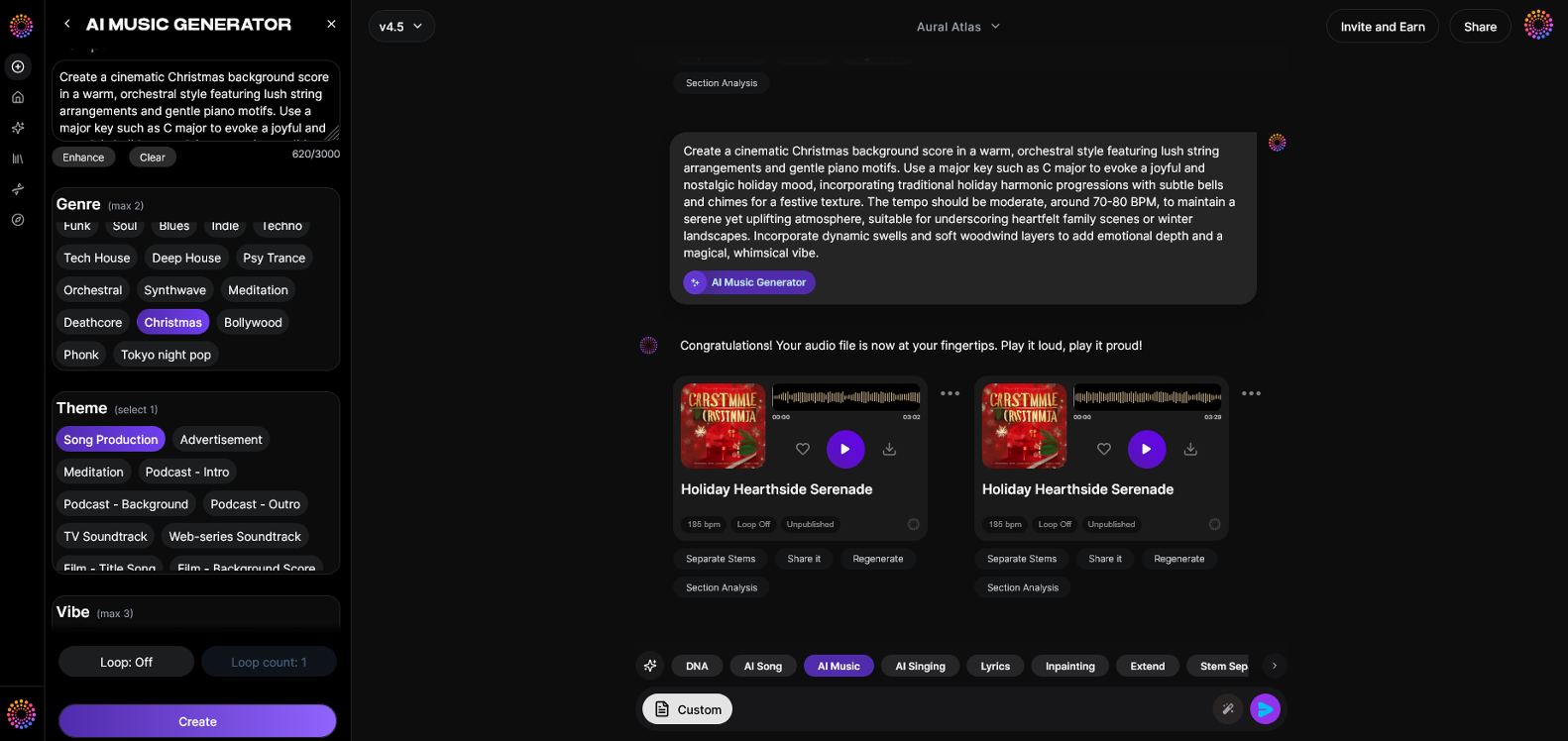
Now that you understand how to structure prompts effectively, let’s explore how to create those compositions instantly using Soundverse.
Soundverse’s AI Music Generator is designed to produce fully realized instrumental tracks from descriptive text prompts. It specializes in background music, beats, and soundscapes without vocals—perfect for creators looking to enhance videos, games, meditation sessions, or advertisements. Soundverse supports multiple models (V4 and V5) and offers control over genre, mood, and instruments, along with a Loop Mode for seamless playback.
Step 1: Feature Overview
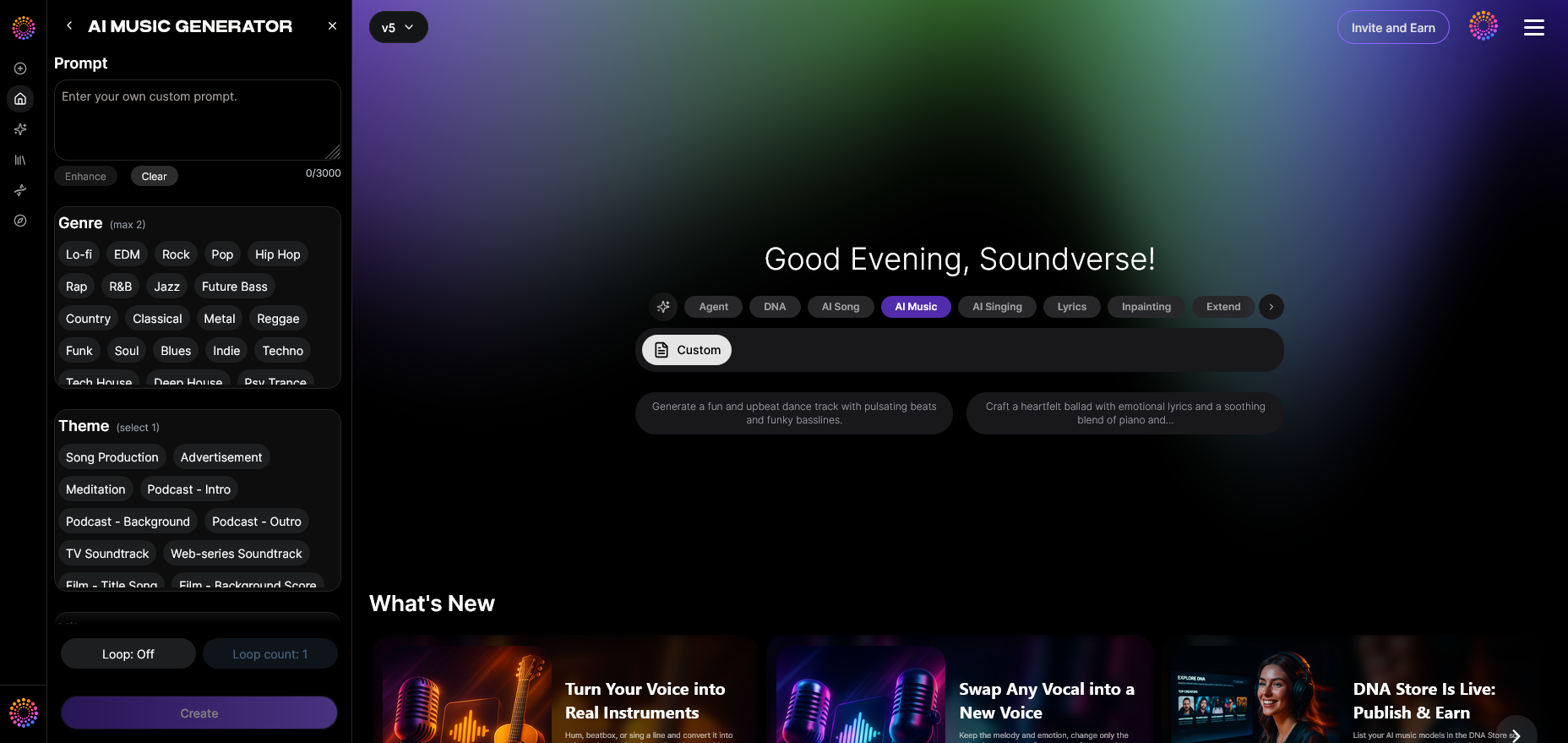
Access the AI Music Generator from the main Soundverse menu to begin crafting instrumental music using text.
Step 2: Description Input
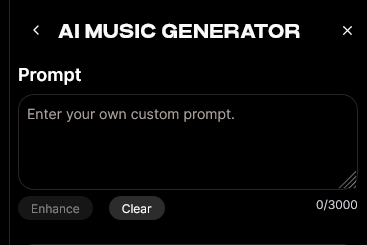
Write your structured prompt here. For example: “uplifting acoustic folk instrumental with mellow percussion for travel vlog background.”
Step 3: Style & Duration
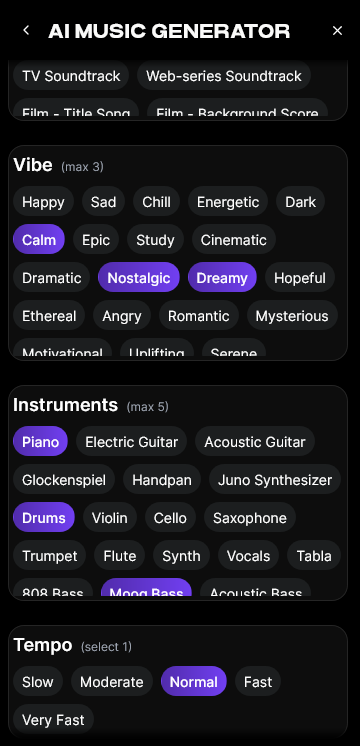
Select your preferred style (pop, jazz, ambient, etc.) and track duration according to the project need. Loopable options help maintain flow for long-format media.
Step 4: Generation
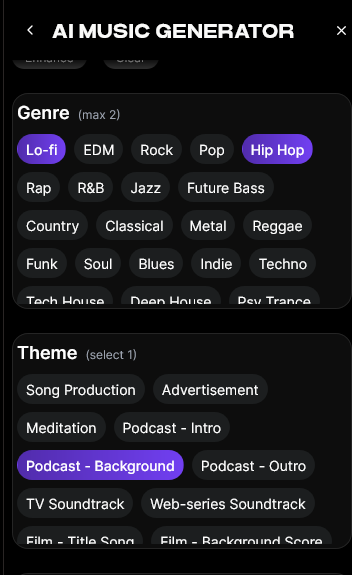
Click generate. Soundverse will interpret your textual description into produced instrumental music using AI models.
Step 5: Export Options
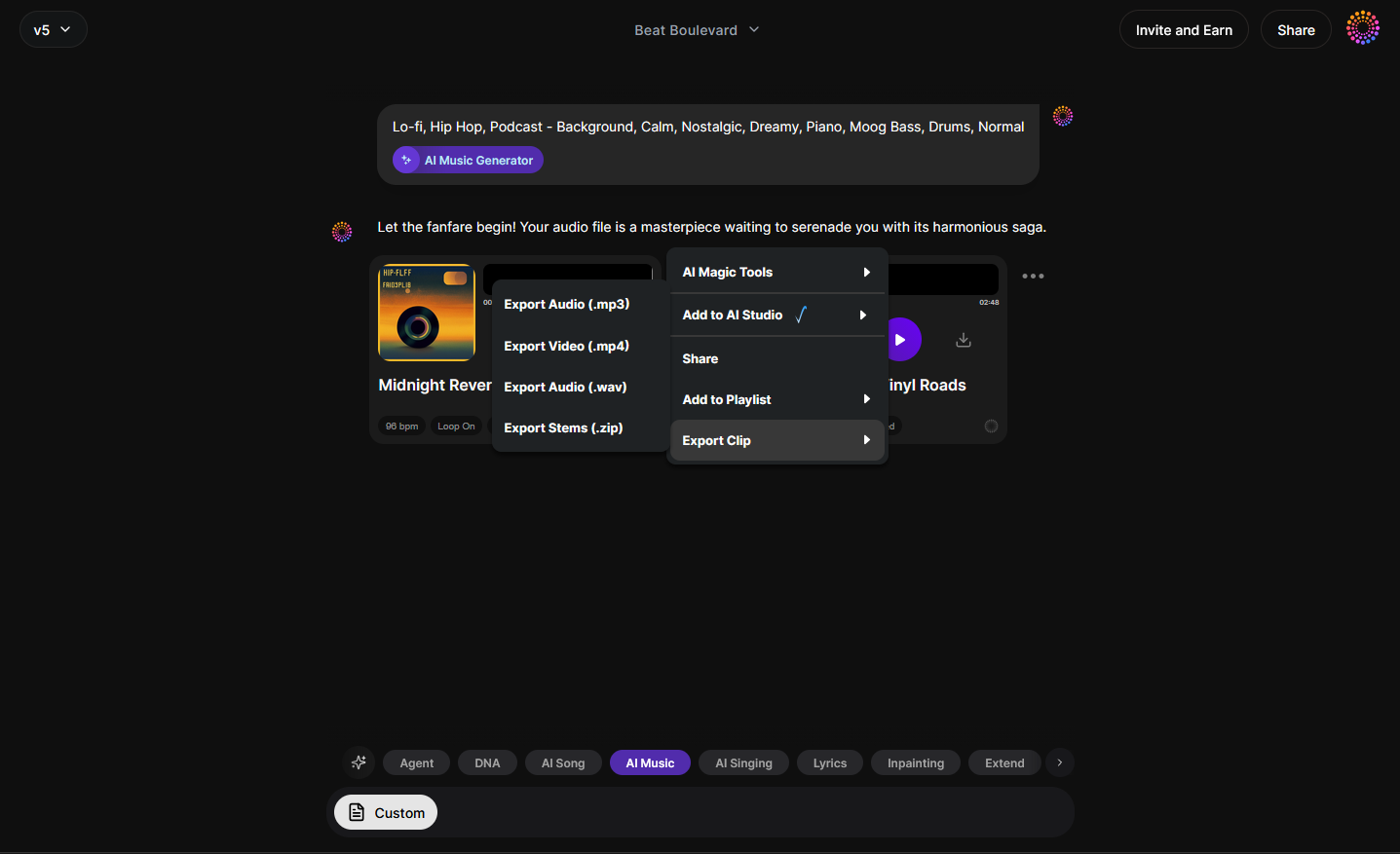
Download the generated instrumental directly. You can choose looping versions or high-quality exports suitable for publishing and editing.
By mastering Suno AI music prompt structure and combining it with Soundverse’s controlled workflow, creators in 2026 can compose efficiently without sacrificing style or creativity. For more guides, check Generate AI music with Soundverse Text-to-Music and Best Suno alternative Soundverse AI. For deeper production learning, watch our Soundverse Tutorial Series - 9. How to Make Music or explore advanced tracks with Soundverse Tutorial Series - 10. Make Deep House Music.
Start Creating AI Music with Perfect Prompts
Elevate your music generation journey—discover how Soundverse helps you turn structured prompts into stunning tracks with ease and precision.
Related Articles
- Generate AI Music with Soundverse Text-to-Music — Learn how to create fully produced songs using just text prompts with Soundverse’s advanced AI technology.
- Best Suno Alternative: Soundverse AI Free Sign Up — Compare Suno AI and Soundverse to find out why creators are switching to Soundverse for more control over AI music generation.
- 100 Text-to-Music Prompts That Will Help You Create Viral Music — Explore creative prompt ideas that inspire unique and trending AI music pieces for your next project.
- What AI Can Generate Songs — Discover the top AI tools capable of turning ideas into complete songs and how they compare in quality and creativity.
Here's how to make AI Music with Soundverse
Video Guide
Here’s another long walkthrough of how to use Soundverse AI.
Text Guide
- To know more about AI Magic Tools, check here.
- To know more about Soundverse Assistant, check here.
- To know more about Arrangement Studio, check here.
Soundverse is an AI Assistant that allows content creators and music makers to create original content in a flash using Generative AI.
With the help of Soundverse Assistant and AI Magic Tools, our users get an unfair advantage over other creators to create audio and music content quickly, easily and cheaply.
Soundverse Assistant is your ultimate music companion. You simply speak to the assistant to get your stuff done. The more you speak to it, the more it starts understanding you and your goals.
AI Magic Tools help convert your creative dreams into tangible music and audio. Use AI Magic Tools such as text to music, stem separation, or lyrics generation to realise your content dreams faster.
Soundverse is here to take music production to the next level. We're not just a digital audio workstation (DAW) competing with Ableton or Logic, we're building a completely new paradigm of easy and conversational content creation. TikTok: https://www.tiktok.com/@soundverse.ai Twitter: https://twitter.com/soundverse_ai Instagram: https://www.instagram.com/soundverse.ai LinkedIn: https://www.linkedin.com/company/soundverseai Youtube: https://www.youtube.com/@SoundverseAI Facebook: https://www.facebook.com/profile.php?id=100095674445607
Join Soundverse for Free and make Viral AI Music

We are constantly building more product experiences. Keep checking our Blog to stay updated about them!