How to Master Music for Open-Ear Listening in 2026
Learn how to master music for open-ear listening using Soundverse AI tools.
How to Master Music for Open-Ear Listening
Open-ear listening has evolved into a major force in music consumption by 2026, driven by the growing popularity of open-ear earbuds and wearable audio devices. Unlike closed-back headphones, open-ear designs allow sound to blend naturally with the environment, giving listeners situational awareness and a more ambient experience. For audio engineers and music producers, mastering music for open-ear listening requires a balance between clarity, spatial coherence, and energy distribution.
Why mastering for open-ear listening matters in 2026
In past years (2024–2025), closed-back headphones and studio monitors dominated the mastering process. But in 2026, more listeners are enjoying music through open-ear earbuds and bone-conduction devices, designed for comfort and mobility. This shift changes how music interacts with the listener’s surroundings.
Music mastering for open-ear listening involves tailoring the frequency balance so that mixes retain clarity even with ambient noise interference. Low frequencies need special attention because open-air playback reduces bass reinforcement. Similarly, stereo imaging should be optimized to maintain depth while avoiding phase issues that degrade when played through space-enhanced systems.
What are the main technical challenges of open-ear mixing?
The biggest challenge in open ear mixing is maintaining the intended balance between direct and environmental sound. In traditional mastering, engineers rely on sealed playback isolation to judge tone and dynamics accurately. However, open ear mixing introduces several new variables:

- Reduced bass response: With no physical seal, bass frequencies lose energy and can sound lighter or undefined.
- Increased ambient blending: External noise and reflections interact with the music, affecting perceived clarity.
- Cross-feed and spatial blur: Open ear playback naturally spreads sound, so stereo width must be managed carefully.
- Dynamic consistency: Loudness levels that feel powerful in studios may sound overwhelming or thin in open environments.
Audio mastering for open earbuds must consider these aspects to ensure a consistent and enjoyable experience for modern listeners.
How to make music mastering for open-ear listening with Soundverse AI Music Generator
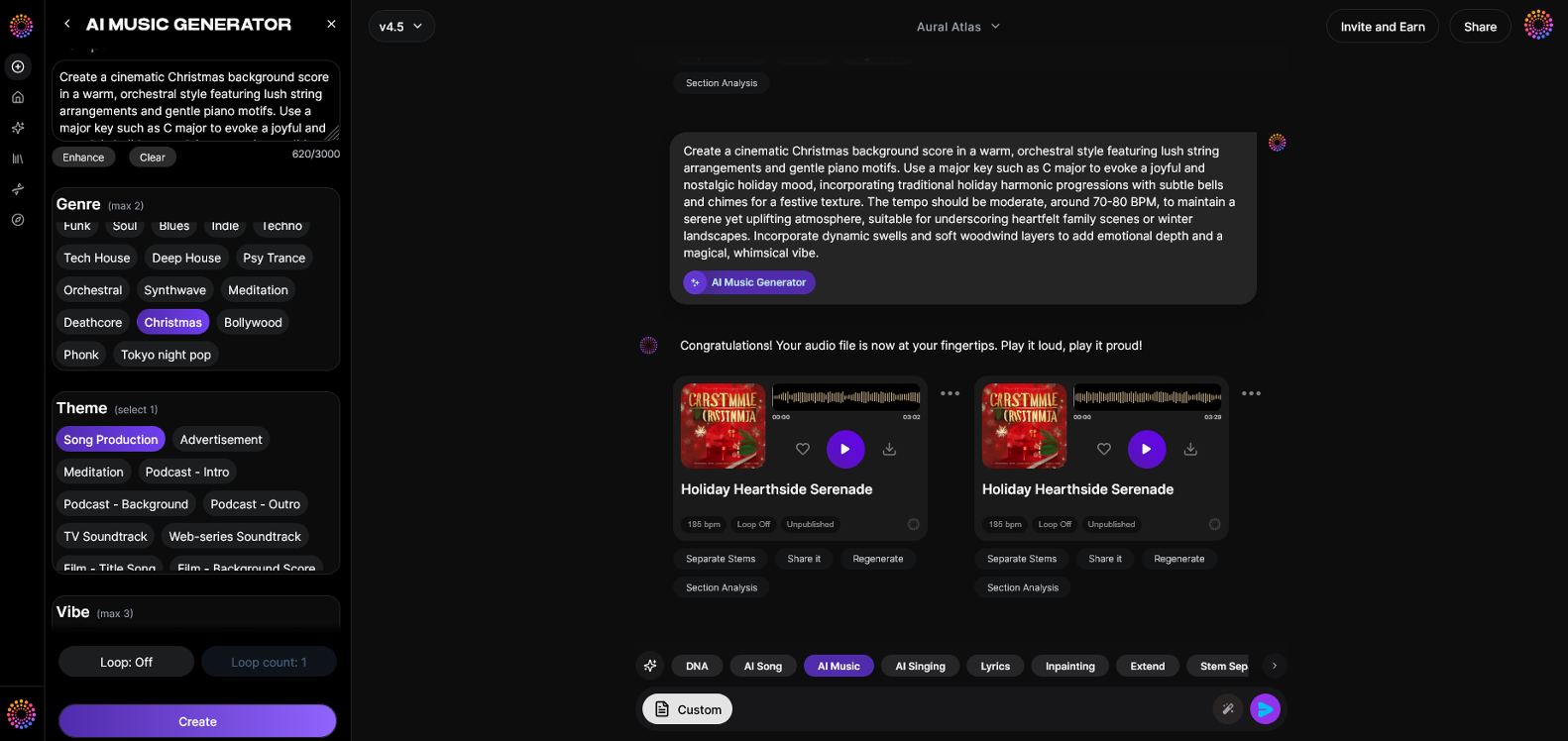
Soundverse’s AI Music Generator is designed to simplify advanced audio creation workflows without the need for manual instrumentation. It allows users to generate fully produced instrumental music from text prompts — ideal for testing how compositions translate across different listening modes.
Feature Overview
You can access the AI Music Generator from the main menu within Soundverse. It empowers producers to create background tracks, beats, and instrumental textures tailored for open-ear playback.
Step 1: Description Input
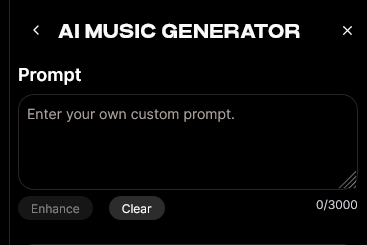
Start by entering a detailed text description of your desired music. For mastering tests, specify ambient qualities like “transparent soundscape,” “open stereo imaging,” or “balanced outdoor clarity.” The generator interprets your prompt to create a fully mixed instrumental.
Step 2: Style & Duration
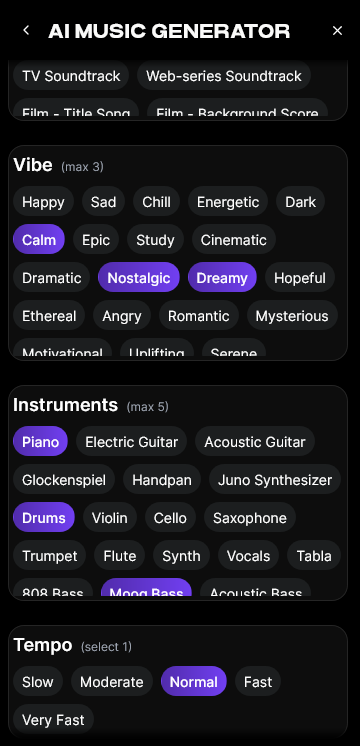
Select your preferred style and track duration. Loop Mode is available for seamless repetition — an excellent feature when testing sustained tonal consistency through open-ear devices.
Step 3: Generation
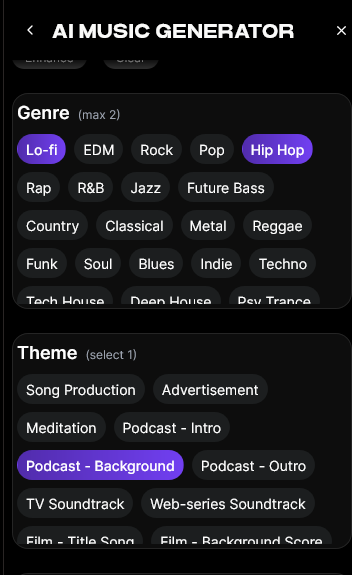
Soundverse processes your request asynchronously, producing instrumental music based on your textual description. This ensures accurate genre and instrumental control using its V4 or V5 models, with options to define mood and intensity.
Step 4: Export Options

After generation, download your track for mastering refinement. You can then use open-ear earbuds to analyze playback dynamics, ensuring low-end transparency and midrange detail remain intelligible.
For a deeper dive, watch our guide on creating Deep House music or explore the “Explore” tab walkthrough to discover Soundverse’s capabilities in generating ambient compositions optimized for open playback environments.
Pro Tips for mastering open-ear music effectively
- Focus on midrange detail: Open-ear systems emphasize speech and midrange acoustics. Maintain clarity between 500Hz–2kHz.
- Use multi-listening checks: Alternate between closed and open monitoring setups. Compare mixes across bone-conduction headsets and open buds.
- Reduce over-compression: Dynamic range helps preserve contrast when environmental sounds blend with playback.
- Control stereo width: Avoid extreme panning. Subtle spatial expansions translate more naturally on open-ear devices.
- Apply adaptive EQ: Counterbalance low-frequency loss using gentle boosts between 80Hz–150Hz while avoiding artificial coloration.
- Utilize Soundverse’s Stem Separator: The Stem Separator enables you to break down a mixed track into separate components for enhanced open-ear mixing revision.
- Extend compositions effortlessly: Use Extend Music to lengthen sections smoothly, helping test long-duration playback consistency.
For further ear training exercises, see Ear Training for Audio Engineers: Unleashing the Power of Listening, which can improve your tonal awareness during open-ear mastering tests.
How open-ear mastering influences creative workflow
By 2026, open-ear playback has become the standard in urban sound design and fitness content creation. Producers now incorporate outdoor acoustic tests early in their workflow. Integrating AI tools like Soundverse accelerates experimentation — enabling instant generation of instrumentals optimized for varying acoustic spaces.
Using text-based generation streamlines prototyping. For instance, if designing a game soundtrack for open-ear immersion, you can instantly request a balanced ambient background using Soundverse’s genre and mood filters, much like demonstrated in Generate AI Music with Soundverse Text-to-Music. After generation, producers analyze how sound flows freely without isolation.
What makes Soundverse ideal for open-ear mastering in 2026?
The biggest advantage lies in its detailed genre and instrument control. Producers can define tonal density precisely before rendering, simulating how the piece might behave in open playback environments. Additionally, because Soundverse specializes in instrumental generation, it removes vocal masking — a common challenge in open-ear soundscape tests.
Soundverse seamlessly integrates with other tools like Section Analysis to map song structure, helping identify where ambient transitions could require different mastering approaches.
For additional insight on mastering approaches, see Audio Mastering for Beginners: Complete Guide (2026) and learn practical LUFS and dynamic range strategies that complement open-ear optimization.
How earbud optimization and AI collaboration intersect
Earbud optimization has advanced significantly. In 2026, mastering chains often include AI-assisted reference profiles modeled on popular open-ear hardware signatures. Engineers use this data to fine-tune balance and compression before final export.
With AI-driven platforms like Soundverse, audio engineers simulate these playback settings quickly. This integration eliminates extensive manual testing across multiple devices. When paired with mastering plugins, Soundverse-generated stems provide perfect testing material for adaptive EQ and stereo calibration workflows.
Learn more practical balancing techniques from 15 Mastering Audio Techniques for a Professional Sound and gain inspiration from Guide to Mixing and Mastering with IEMs - Ultimate Ears PRO.
Final Thoughts: The future of open-ear mastering
Music mastering for open-ear listening is no longer niche—it’s mainstream. Producers are learning to translate immersive studio sound into natural, open environments where listeners engage without isolation. The process relies on precision, controlled dynamics, and spatial awareness.
With tools like Soundverse’s AI Music Generator, engineers can experiment freely, building tracks that blend technology and artistry for evolving listening habits. This workflow embraces the demand for clarity and realism, perfectly suited for 2026’s landscape where listeners value sonic transparency and environmental harmony as much as musical intensity.
For inspiration on genre-specific production with AI, explore related guides such as How to Create Jazz Music with Soundverse AI and How to Create Country Music with Soundverse AI. These resources demonstrate how AI generation and human mastering combine to define the next era of music craftsmanship.
In conclusion, mastering music for open-ear listening is both an art and a science. With Soundverse AI, music producers can fully harness technology to shape sound that remains vivid, balanced, and emotionally engaging—whether it’s heard through premium open earbuds or ambient outdoor speakers.
Master Your Music with Soundverse AI
Elevate every track with intelligent mastering tools designed for open-ear listening. Experience precision sound shaping and instant results that make your music shine naturally.
Start Mastering with Soundverse
Related Articles
- Soundverse Introduces Stem Separation AI Magic Tool — Discover how Soundverse’s stem separation AI lets creators isolate and refine every element of their track effortlessly.
- The Role of AI Music in Film and Television — Explore how AI-generated music is revolutionizing sound design and scoring for visual media projects.
- Enhancing YouTube Content with Royalty-Free and Copyright-Free Music Using Soundverse AI — Learn how Soundverse helps creators enhance videos using high-quality, copyright-free music that’s perfect for open-ear listening.
- The Benefits of Composing with AI Music Generator — Find out how AI-driven composition boosts creativity and simplifies the mastering process for modern musicians.
Here's how to make AI Music with Soundverse
Video Guide
Here’s another long walkthrough of how to use Soundverse AI.
Text Guide
- To know more about AI Magic Tools, check here.
- To know more about Soundverse Assistant, check here.
- To know more about Arrangement Studio, check here.
Soundverse is an AI Assistant that allows content creators and music makers to create original content in a flash using Generative AI.
With the help of Soundverse Assistant and AI Magic Tools, our users get an unfair advantage over other creators to create audio and music content quickly, easily and cheaply.
Soundverse Assistant is your ultimate music companion. You simply speak to the assistant to get your stuff done. The more you speak to it, the more it starts understanding you and your goals.
AI Magic Tools help convert your creative dreams into tangible music and audio. Use AI Magic Tools such as text to music, stem separation, or lyrics generation to realise your content dreams faster.
Soundverse is here to take music production to the next level. We're not just a digital audio workstation (DAW) competing with Ableton or Logic, we're building a completely new paradigm of easy and conversational content creation.
TikTok: https://www.tiktok.com/@soundverse.ai
Twitter: https://twitter.com/soundverse_ai
Instagram: https://www.instagram.com/soundverse.ai
LinkedIn: https://www.linkedin.com/company/soundverseai
Youtube: https://www.youtube.com/@SoundverseAI
Facebook: https://www.facebook.com/profile.php?id=100095674445607
Join Soundverse for Free and make Viral AI Music

We are constantly building more product experiences. Keep checking our Blog to stay updated about them!