How to Appeal an AI Music Copyright Strike in 2026
Learn how to appeal an AI music copyright strike in 2026 and protect your YouTube content with Soundverse Trace.
How to Appeal an AI Music Copyright Strike
In 2026, AI-generated music is everywhere—from YouTube shorts and gaming soundtracks to podcast intros. Yet, with this booming creativity comes a new problem for creators: unexpected copyright strikes. An AI music copyright strike appeal has become one of the most discussed topics among music creators and digital artists who work with AI tools. If your AI-generated track was flagged or removed due to a copyright claim, understanding how to appeal it effectively can save you time, revenue, and creative freedom.
Why Are AI Music Copyright Strikes Increasing in 2026?
Platforms like YouTube have ramped up automated copyright enforcement in 2026. Advances in machine listening make it easier to detect patterns that resemble copyrighted materials, even if they stem from AI models trained on licensed datasets. While this protects original rights-holders, it also leads to false positives when AI-generated music coincidentally mirrors melodies, rhythms, or tones of known songs.

For creators working with generative platforms, these erroneous takedowns are frustrating. Some YouTubers who rely on AI music for intros or background tracks are now seeing their entire libraries demonetized, making it vital to understand the YouTube strike appeal process and how to resolve an AI music copyright dispute. The wave of legal scrutiny around AI music continues, as discussed in AI Music Copyright 2026: Complete Legal Guide for Creators and in analysis of cases like Getty’s High Court proceedings, which highlight the growing relevance of AI rights management.
What to Do When You Receive an AI Music Copyright Strike

When you receive a copyright claim or strike, the first reaction should be calm analysis. YouTube sends you detailed information about the claim, including who issued it, which portion of your content was affected, and whether it’s a claim or a full strike. If you’re using royalty-free or AI-generated music, you should first confirm the source and usage rights.
Here’s what every creator should do:
- Identify the Source: Check which AI tool was used to generate the track. Reliable tools maintain metadata or watermarks to prove music origin.
- Verify Licensing Terms: If the platform provides usage rights or export licenses, ensure your video adheres to them (for example, non-commercial vs. commercial use).
- Gather Metadata: All downloadable tracks should have licensing metadata embedded. This information supports your copyright appeal.
- Submit a Counter Notice or Appeal: Most platforms, including YouTube, have built-in appeal systems. Use the evidence gathered to justify your claim to original AI generation.
The success of your appeal depends on clarity and proof of authorship. This is where modern rights-tracking technologies like Soundverse Trace make a huge impact. For a deeper dive, watch our Soundverse Tutorial on making music or explore how to make Deep House music with Soundverse AI.
How to Manage an AI Music Copyright Strike Appeal with Soundverse Trace
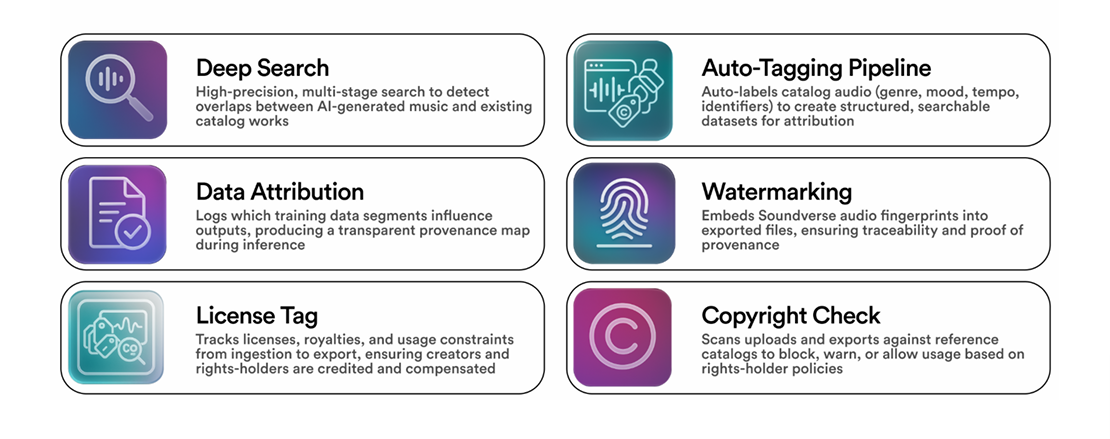
Soundverse Trace is a trust layer technology tailored for AI music rights protection. It’s not just another verification tool — it’s an entire infrastructure designed to track, attribute, and verify AI-generated outputs at every stage.
Feature Overview:
Soundverse Trace embeds attribution, deep search, and rights protection mechanisms across the lifecycle of AI-generated music—from dataset creation to export. Its deep search capability performs 1:1 and 1:N scanning to detect overlaps, while data attribution logs the training data sources that influenced each output.
Audio Watermarking: It securely embeds inaudible fingerprints within music files to prove originality.
License Tagging: This ensures rights metadata remains intact throughout the creation-to-upload process.
Primary Use Cases
- Preventing copyright infringement in AI outputs.
- Tracking catalog usage for accurate royalties.
- Verifying provenance of AI-generated audio.
- Automating takedowns or payouts for legitimate rights-holders.
For creators dealing with YouTube strikes, Soundverse Trace offers a new layer of transparency that enables verified proof of authorship. During your copyright appeal process, you can use the watermark and attribution data to demonstrate that your AI track is properly licensed and independently generated.
Step 1: Gather Your Track Information
Locate the AI-generated track you uploaded. Check its metadata for embedded license tags or fingerprints. If created using Soundverse Trace, this data contains verifiable attribution logs.
Step 2: Use Soundverse Deep Search to Detect Overlaps
The Deep Search feature performs a precision scan (1:1 and 1:N) to confirm whether any elements of your track resemble copyrighted works. This can prevent wrongful takedowns and strengthen your appeal.
Step 3: Export with License Tagging
Always export your music with license tagging enabled. This metadata ensures provenance and allows YouTube’s copyright systems to recognize the track as properly attributed.
Step 4: Submit Your Appeal Using Verified Proof
When you appeal a YouTube strike, attach all Soundverse Trace logs, watermarks, or license IDs to your form. This data confirms originality and leverages ethical AI music verification.
Step 5: Follow Up and Monitor Resolution
After submission, YouTube’s moderation workflow takes several business days. You’ll receive a final determination in your dashboard. Keep your metadata backed up for future reference.
Pro Tips for a Successful AI Music Copyright Appeal
- Use Ethical AI Sources: Partner with licensed AI platforms that offer rights attribution, like Soundverse.
- Keep a Rights Log: Store proof of creation dates, platform licenses, and watermarks for every track.
- Avoid Derivative Sampling: Don’t upload tracks containing commercial samples unless clearly licensed.
- Educate Your Audience: Add a disclaimer that your background music is AI-generated and ethically sourced.
- Join Licensing Programs: Soundverse’s Content Partner Program allows rights-holders to earn recurring royalties for licensed AI usage.
If you’re exploring music trends and innovations, platforms like Soundverse also highlight how AI music is transforming the industry. Understanding provenance and rights integrity deepens creator trust.
How Soundverse Trace Empowers Ethical AI Music Creation
With thousands of creators building AI-generated compositions daily, transparent attribution has become key. The Ethical AI Music Framework developed by Soundverse complements Trace by replacing opaque systems with a six-stage pipeline that enforces consent, attribution, and fair compensation.
Soundverse Trace bridges creative innovation with integrity. When a music copyright dispute arises, you can use its asynchronous processing features to audit track origin and attribution logs. This ensures a fair claim resolution without requiring real-time monitoring.
Creators can also explore other Soundverse capabilities—from stem separation AI for remixing tracks ethically to advanced AI Magic Tools that help creators generate genre-specific music while maintaining ownership proof.
If you want to explore artistry further, consider learning to create AI-generated music or experiment with creative prompts tailored for viral content.
Safeguard Your AI Music and Keep Creating Confidently
Resolve your AI music copyright strike faster with Soundverse’s powerful tools designed to help creators produce verified, copyright-safe tracks—no legal guesswork required.
Start Creating Safely Today
Related Articles
- Enhancing YouTube Content with Royalty-Free and Copyright-Free Music Using Soundverse AI: Discover how to boost your YouTube videos with fully royalty-free and copyright-safe music generated through Soundverse AI.
- Copyright-Free vs Royalty-Free Music: What Creators Should Know: Learn the key differences between copyright-free and royalty-free music to ensure your projects remain compliant and secure.
- Navigating the World of Royalty-Free and Copyright-Free Music Using Soundverse AI: Explore how Soundverse AI empowers music creators to navigate copyright challenges and build freedom into their compositions.
- How AI-Generated Music Is Transforming the Music Industry: Understand how AI music generation is reshaping the global music landscape and what it means for today’s creators.
Here's how to make AI Music with Soundverse
Video Guide
Here’s another long walkthrough of how to use Soundverse AI.
Text Guide
- To know more about AI Magic Tools, check here.
- To know more about Soundverse Assistant, check here.
- To know more about Arrangement Studio, check here.
Soundverse is an AI Assistant that allows content creators and music makers to create original content in a flash using Generative AI.
With the help of Soundverse Assistant and AI Magic Tools, our users get an unfair advantage over other creators to create audio and music content quickly, easily and cheaply.
Soundverse Assistant is your ultimate music companion. You simply speak to the assistant to get your stuff done. The more you speak to it, the more it starts understanding you and your goals.
AI Magic Tools help convert your creative dreams into tangible music and audio. Use AI Magic Tools such as text to music, stem separation, or lyrics generation to realise your content dreams faster.
Soundverse is here to take music production to the next level. We're not just a digital audio workstation (DAW) competing with Ableton or Logic, we're building a completely new paradigm of easy and conversational content creation.
TikTok: https://www.tiktok.com/@soundverse.ai
Twitter: https://twitter.com/soundverse_ai
Instagram: https://www.instagram.com/soundverse.ai
LinkedIn: https://www.linkedin.com/company/soundverseai
Youtube: https://www.youtube.com/@SoundverseAI
Facebook: https://www.facebook.com/profile.php?id=100095674445607
Join Soundverse for Free and make Viral AI Music

We are constantly building more product experiences. Keep checking our Blog to stay updated about them!