How Likely Is It That an AI-Generated Song Will Win a Major Music Award by 2027
Explore if AI-generated songs can win major music awards by 2027.
How Likely Is It That an AI-Generated Song Will Win a Major Music Award by 2027
How likely is it that an AI-generated song will win a major music award by 2027?
The question of whether an AI-generated song will win a major music award by 2027 has become one of the most debated topics within the music and technology communities. By 2026, artificial intelligence has already infiltrated nearly every aspect of the music industry—from songwriting and production to mastering and distribution. Tools powered by advanced generative models are enabling creators to turn simple ideas into studio-quality tracks. However, the idea of AI competing against human musicians for recognition such as a Grammy or a Brit Award raises profound questions about artistry, ethics, and the nature of creativity itself.
What defines a “major” music award today?
Major music awards refer to globally recognized platforms that honor artistic excellence—like the Grammy Awards, American Music Awards, and Billboard Music Awards. Traditionally, these awards acknowledge human creativity, performance, and emotional expression. Yet, as the boundaries between creator and machine blur, award bodies have begun revisiting eligibility criteria.
For example, in 2025, several categories introduced discussions around music created with artificial intelligence assistance. The Recording Academy stated that AI-generated content could be considered only if a human meaningfully contributed to the creative process. This landmark decision indicates that by 2027, AI-generated music may be eligible under blended categories that celebrate innovation and technological artistry.
What progress has AI made in music creation so far?
Between 2024 and 2026, the growth of AI in the music industry has accelerated exponentially. Platforms capable of generating instrumentals, harmonies, and even realistic singing voices have attracted both indie creators and top-tier producers. The rise of ethical frameworks and tools—such as licensed training datasets and transparent attribution—now makes AI collaboration more credible and commercially viable.
AI systems no longer simply mimic human compositions. They analyze emotional cues, genre nuances, and lyrical intent to generate music that aligns with a desired mood or narrative. This technological artistry has led to viral AI tracks on streaming platforms and even collaborative releases where human artists publicly credit AI algorithms as co-creators.
For deeper insight into how this transformation took place, explore how AI-generated music is transforming the music industry, which breaks down the structural, creative, and commercial impacts witnessed during 2024–2026.
What are the main challenges preventing AI songs from winning awards?
Even with the massive growth in AI artistry, recognition in traditional award circuits faces key barriers:
- Authenticity and Emotional Depth: Many award judges still prioritize the emotional performance and interpretation of human artists over algorithmic precision.
- Ethical and Legal Concerns: Questions surrounding authorship, intellectual property, and data training transparency complicate eligibility.
- Cultural Resistance: Accepting non-human creators as legitimate participants in cultural expression challenges long-standing beliefs about creativity.
- Lack of Historical Precedent: Music awards thrive on human narratives and stories of struggle and triumph. AI lacks this emotional lineage.
However, these barriers are gradually being addressed. Ethical music generation frameworks and transparent AI systems are reshaping the conversation around creative legitimacy.
How is public perception changing in 2026?
Public attitudes in 2026 toward AI-generated songs have evolved significantly. While skepticism persists, mainstream audiences increasingly embrace AI-enhanced artistry as an innovative form of collaboration rather than competition. Musicians themselves use AI as a co-writing tool or digital bandmate, combining human emotion with machine creativity.
Social platforms and streaming services host entire playlists of AI-generated hits, with listeners often unable to distinguish between a human performance and an artificial one. These shifts in taste suggest that award committees may soon consider AI tracks not as novelties but as legitimate entries—especially when paired with human input.
To understand how these shifts fit into broader creative markets, check out music industry trends shaping production, distribution, and audience preferences during 2026.
What technological advancements make AI songwriting award-worthy?
The progress of artificial intelligence songwriting in recent years has been propelled by several key technological breakthroughs:
- Multimodal Generation: AI models now synchronize lyrics, melody, and arrangement rather than treating them as separate tasks.
- Emotion Mapping: Advanced algorithms detect emotional tone and apply corresponding musical dynamics—enabling expressive compositions.
- Voice Synthesis: Hyper-realistic AI-generated vocals emulate tone and phrasing suitable for various genres.
- Ethical Dataset Training: Licensed catalog training ensures originality and compliance, solving issues of consent and copyright.
In short, AI systems have evolved from mere compositional tools to fully realized creative partners. Many artists are already submitting collaborative “AI-assisted” works to award organizations, setting precedent for recognition of machine-human co-authorship. For an inside look at how AI is shaping songwriting tutorials, watch our guide on creating Deep House music.
Could an AI-generated song truly win by 2027?
Given current trajectories, it’s plausible that by 2027, at least one major award category will honor an AI-generated song. Not necessarily as a “Best AI Track,” but as part of broader innovation awards or creative collaboration categories. The tipping point likely depends on two factors:
- Integration of Ethical AI Standards: Transparent pipelines like Soundverse DNA demonstrate proof of authorship, enabling AI-created songs to comply with creative integrity requirements.
- Public and Industry Acceptance: As audiences normalize AI co-creation, awards focused on innovation will begin acknowledging machine contributions with parity.
The probability of an AI-only song winning a mainstream award remains moderate—perhaps 30–40% by late 2027. However, hybrid collaborations where humans set melodic intention and AI executes arrangement or vocals have already achieved commercial success. These forms could very well win under experimental or digital music categories. Predictions explored in Will an AI-generated song be Grammy nominated by 2028? and industry sources such as Early 2027 Grammy Predictions bolster this possibility.
For a companion read, explore AI and music in the USA, which covers regional cultural shifts and technological adoption influencing award considerations worldwide.
What new award categories might emerge by 2027?
By 2027, we can anticipate award bodies introducing new divisions acknowledging artificial intelligence in music creation:
- Best AI-Assisted Composition – Celebrating hybrids of human and machine creativity.
- Most Innovative Use of AI in Production – Honoring originality in workflow design and digital artistry.
- Ethical AI Innovation Award – Recognizing transparency and consent-based AI development.
These distinctions will likely coexist alongside traditional categories rather than replacing them, ensuring balance between technological innovation and artistic emotion.
Why ethical AI frameworks are key to creative recognition
The sustainability of AI in music awards depends largely on ethical governance. Without transparent models and licensed datasets, AI compositions risk disqualification due to unclear authorship or copyright violations. Systems such as the Ethical AI Music Framework—a transparent six-stage pipeline ensuring consent, attribution, and recurring compensation—offer the foundation for legitimate recognition. In fact, many conferences in 2026 highlight how these frameworks underpin the next evolutionary phase of music ethics and award acceptance.
How Soundverse enables award-ready AI songwriting
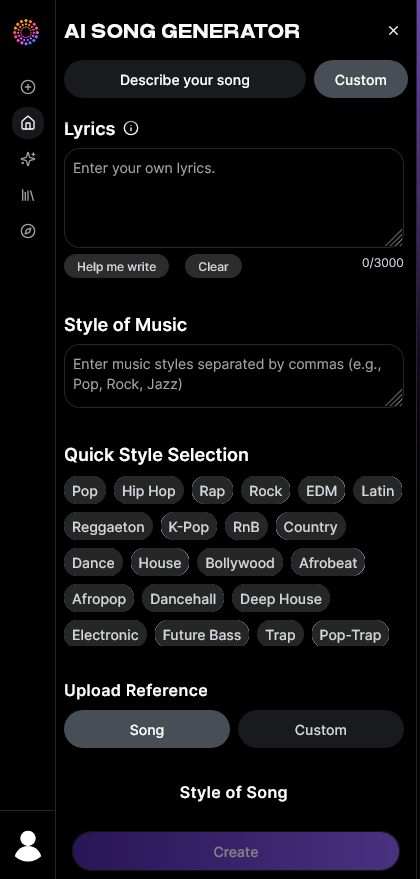
Now that you understand how AI-generated music awards may evolve by 2027, here is how to create AI-generated songs instantly using Soundverse.
How to make award-level AI-generated music with Soundverse AI Song Generator
The AI Song Generator allows creators to turn lyrics or text descriptions into complete songs with AI-generated vocals and instrumental backing. Operating through a multi-stage system that handles lyrics, melody, arrangement, and mixing, it’s positioned as one of the most advanced platforms for artists exploring human–AI collaboration. Watch our Soundverse Tutorial Series - How to Make Music for a hands-on demo.
Core capabilities
- Describe Your Song mode: Generate music directly from prompts or text descriptions.
- Custom mode: Input full lyrics and adjust settings for precision control.
- Reference Audio support: Upload songs, vocals, or instrument references to inform the generation style.
- Quick Style Selection: Choose instantly from genres such as Pop, EDM, Rock, Jazz, and more.
Primary use cases
- Songwriting demos and vocal prototyping.
- Social media and YouTube content creation.
- Personalized greetings or gifts.
- Multilingual compositions across more than ten languages.
Soundverse tools—including Soundverse DNA and Soundverse Trace—strengthen legitimacy and ethical compliance. DNA creates music based on artist-trained AI systems, ensuring originality and respect for licensed catalogs. Meanwhile, Trace embeds attribution and rights protection across the song’s lifecycle, providing transparency crucial for award eligibility.
To learn how Soundverse integrates innovation across creative ecosystems, visit Soundverse AI Magic Tools Create Content Quickly With AI or Soundverse Assistant: Your AI Music Co-Producer.
Create Award-Worthy Music with AI Today
Unlock the power of Soundverse’s AI music generation tools to compose, arrange, and refine tracks in moments. Whether you’re an emerging artist or seasoned producer, elevate your creativity with smart music solutions.
Start Creating with Soundverse
Related Articles
- How AI-Generated Music Is Transforming the Music Industry — Discover how AI is redefining music production, creativity, and recognition in the modern music scene.
- AI Ranks Soundverse’s AI Singer #1: The Ultimate AI Singing Platform Dominating 2025 — Learn how Soundverse’s AI Singer is setting the new standard for AI-driven vocal performances.
- AI Music Generator and Human Composers: A Future Together — Explore how AI and human creativity can collaborate to shape the next generation of musical achievements.
- The Role of AI Music in Film and Television — See how AI-generated compositions are increasingly featured in award-winning visual storytelling.
Here's how to make AI Music with Soundverse
Video Guide
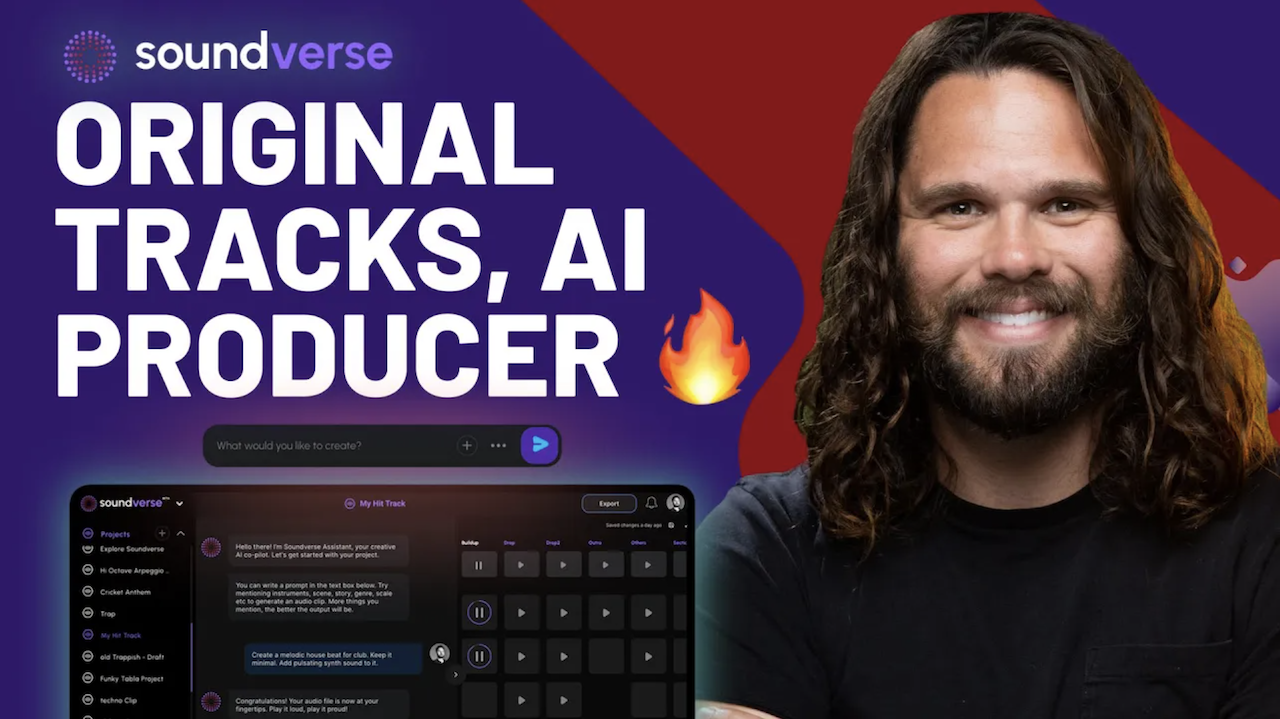
Here’s another long walkthrough of how to use Soundverse AI.
Text Guide
- To know more about AI Magic Tools, check here.
- To know more about Soundverse Assistant, check here.
- To know more about Arrangement Studio, check here.
Soundverse is an AI Assistant that allows content creators and music makers to create original content in a flash using Generative AI. With the help of Soundverse Assistant and AI Magic Tools, our users get an unfair advantage over other creators to create audio and music content quickly, easily and cheaply. Soundverse Assistant is your ultimate music companion. You simply speak to the assistant to get your stuff done. The more you speak to it, the more it starts understanding you and your goals. AI Magic Tools help convert your creative dreams into tangible music and audio. Use AI Magic Tools such as text to music, stem separation, or lyrics generation to realise your content dreams faster. Soundverse is here to take music production to the next level. We're not just a digital audio workstation (DAW) competing with Ableton or Logic, we're building a completely new paradigm of easy and conversational content creation.
TikTok: https://www.tiktok.com/@soundverse.ai
Twitter: https://twitter.com/soundverse_ai
Instagram: https://www.instagram.com/soundverse.ai
LinkedIn: https://www.linkedin.com/company/soundverseai
Youtube: https://www.youtube.com/@SoundverseAI
Facebook: https://www.facebook.com/profile.php?id=100095674445607
Join Soundverse for Free and make Viral AI Music
We are constantly building more product experiences. Keep checking our Blog to stay updated about them!