How AI Music Platforms Handle Ownership and Rights in 2026
Explore how AI music platforms manage ownership, rights, and licensing in 2026.
How AI Music Platforms Handle Ownership and Rights
Artificial intelligence (AI) has become an inseparable part of the modern music industry. By 2026, AI music generation tools have moved beyond novelty into professional workflows, empowering producers, songwriters, and filmmakers to create original compositions at unprecedented speed. However, this innovation brings complex questions surrounding AI music ownership, copyright, and licensing. Who really owns AI-generated music? How do producers ensure rights compliance when using machine-created compositions? And what platforms are leading the way in addressing these challenges through transparency and traceability?
What does AI music ownership mean in 2026?
AI music ownership refers to the legal and ethical framework determining who holds rights to a composition or song created with the assistance of artificial intelligence. Unlike traditional works, where a human author’s creative intent defines authorship, AI-generated content complicates attribution. Depending on jurisdiction and platform policy, rights may belong to the tool's creator, the dataset contributors, or the user who prompted the AI.
In 2026, most markets acknowledge three core models:
- User-led ownership: The user who uses prompts to generate outputs owns the final track, assuming the training data was ethically sourced.
- Shared attribution models: Rights are split between the platform (for algorithmic contribution) and the user (for creative direction).
- Dataset-driven attribution: Platforms distribute a share of royalties to rights-holders whose content influenced the AI model outputs.
These distinctions have become critical for music producers, artists, and entertainment lawyers managing AI-assisted catalogs.

Why are AI music rights difficult to define?
Traditional copyright law hinges on human creativity and originality. With AI models capable of composing melodies indistinguishable from human work, questions of originality now include algorithmic influences. Legal professionals must determine whether an AI output is derivative, transformative, or original.
For example, if an AI trained on proprietary jazz recordings generates a track stylistically similar to a 1950s record, identifying ownership requires tracing dataset usage. This is precisely where AI platforms in 2026 now deploy embedded metadata and digital fingerprinting to prove provenance.
The AI music rights conversation also involves accountability. Artists and developers must understand:
- Whether AI-generated content includes copyrighted samples.
- How much human intervention qualifies as creative authorship.
- Who benefits financially when AI compositions earn royalties.

How do AI platforms manage music copyright and AI compliance?
In 2025, several major copyright cases clarified that training AI on copyrighted works without consent could constitute infringement. As a result, by 2026, the industry standard involves three layers of compliance:
- Dataset Transparency: AI developers must disclose sources and obtain clearance before using copyrighted material.
- Attribution Tracking: Each generated work includes metadata linking it back to datasets and models.
- Licensing Automation: Integrated systems now handle licensing, royalty tracking, and rights-holder payouts automatically.
Platforms implementing these layers ensure ethical use while unlocking commercial scalability for creators. For a deeper dive, watch our guide on how to make music and the Deep House tutorial on the Soundverse YouTube channel.
What is the role of AI-generated music licensing in 2026?
AI-generated music licensing has matured significantly. Licensing now extends beyond selling tracks to include automated license tagging, usage tracking, and dynamic royalty models. When a content creator uses an AI-generated track for a commercial video or podcast, the system logs its usage and distributes micro-royalties to relevant contributors.
This model mirrors traditional performance rights organizations but operates through smart contracts and blockchain-linked metadata systems. Essentially, AI licensing blends technology with rights governance, creating a transparent financial chain that benefits users, developers, and rights-holders.
For artists employing AI, this means fewer legal grey areas and faster clearance times. For lawyers, it introduces new audit mechanisms. And for tech entrepreneurs, it establishes scalable infrastructure for content monetization.
How are legal frameworks evolving around intellectual property in AI music?
Governments and legal bodies are continuously redefining intellectual property in AI music. The European Union, for example, has proposed mandatory attribution guidelines for AI systems, while the U.S. Copyright Office reinforces that human authorship remains a requirement for registration. However, hybrid human–AI compositions now qualify for copyright if sufficient creative decision-making occurs.
By 2026, we see cross-border frameworks encouraging interoperability between AI labeling systems, ensuring that rights metadata embedded in a track produced on one AI platform remains readable across others. This interoperability is shaping the global standard for ethical AI music production.
For those seeking deeper insight into the evolving legal and cultural aspects of AI-generated composition, check out how AI-generated music is transforming the industry and AI music in the USA.
How do leading platforms ensure traceability and trust in AI music?
As demand for original, AI-assisted compositions grows, traceability becomes vital. Music producers, record labels, and sync licensing firms require assurance that songs generated with AI are ethically sourced and free from infringing content. The solution lies in adopting trust layers to verify ownership and rights at every stage of creation.
This is where platforms like Soundverse have pioneered solutions that redefine rights assurance in the AI music space.
How AI music ownership is secured with Soundverse Trace
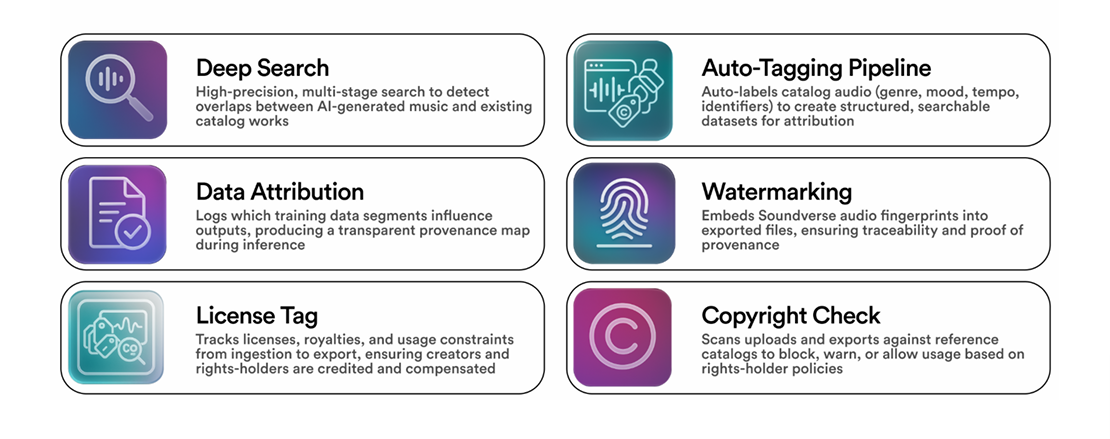
Soundverse Trace is a comprehensive trust layer for AI music. It embeds attribution, deep search, and rights protection across the entire music lifecycle—from dataset creation to track export. By addressing ownership and licensing challenges at the technological level, it resolves many of the industry’s current bottlenecks around verification and transparency.
Key capabilities of Soundverse Trace include:
- Deep Search: High-precision scanning (1:1 and 1:N) to detect audio overlaps and potential copyright conflicts.
- Data Attribution: Logs which training data influenced final outputs, ensuring accurate royalty distribution.
- Audio Watermarking: Adds inaudible digital fingerprints to every track, verifying authenticity.
- License Tagging: Embeds rights metadata that remains intact from ingestion to export.
These capabilities allow musicians, enterprises, and legal professionals to automatically detect potential infringement, verify catalog authenticity, and enforce takedowns or payouts when necessary.
By uniting ethical data use with robust verification, Soundverse Trace transforms AI music from a legal risk into a transparent, trackable asset class.
Beyond its technical precision, Soundverse Trace is part of a broader ecosystem powered by Soundverse’s Ethical AI Music Framework—a six-stage pipeline ensuring consent, attribution, and recurring compensation for artists who contribute to AI datasets. Similarly, its Content Partner Program allows artists to license their recordings for AI training while earning recurring, usage-based royalties.
For creators exploring new AI-based composition workflows, Soundverse provides an ethical and scalable foundation, consistent with its mission to protect creativity in the age of automation. To learn more about Soundverse’s role in modern creative ecosystems, see their detailed piece on Soundverse AI Magic Tools and Soundverse Assistant.
What does the future of AI music rights look like?
By 2026, the industry consensus emphasizes coexistence between human and machine creativity. Instead of displacing artists, AI now acts as a co-producer and rights-labeled collaborator. As Soundverse and similar innovators expand transparent data attribution systems, we may soon see global registries for AI-generated works—granting them status alongside traditional recordings.
Legal frameworks will continue to evolve, but technological safeguards are already available. The transformation is not merely about automation; it is about accountability, inclusivity, and trust in digital artistry.
Create and Own Your AI Music with Soundverse
Experience the freedom to generate, customize, and control your own AI music with full ownership rights. Start creating royalty-free tracks in minutes and take charge of your sound.
Start Creating with Soundverse
Related Articles
- Navigating the World of Royalty-Free and Copyright-Free Music Using Soundverse AI: Learn how to use Soundverse AI to generate music that’s safe, copyright-free, and ready for commercial use.
- Copyright-Free vs Royalty-Free Music: What Creators Should Know: Understand the key differences between copyright-free and royalty-free tracks before publishing your next project.
- How AI-Generated Music Is Transforming the Music Industry: Explore the ways AI is reshaping music production, rights management, and creative opportunities for artists.
- AI Music Generator and Human Composers: A Future Together: Discover how AI tools complement human creativity and open new collaborative paths in music creation.
Here's how to make AI Music with Soundverse
Video Guide
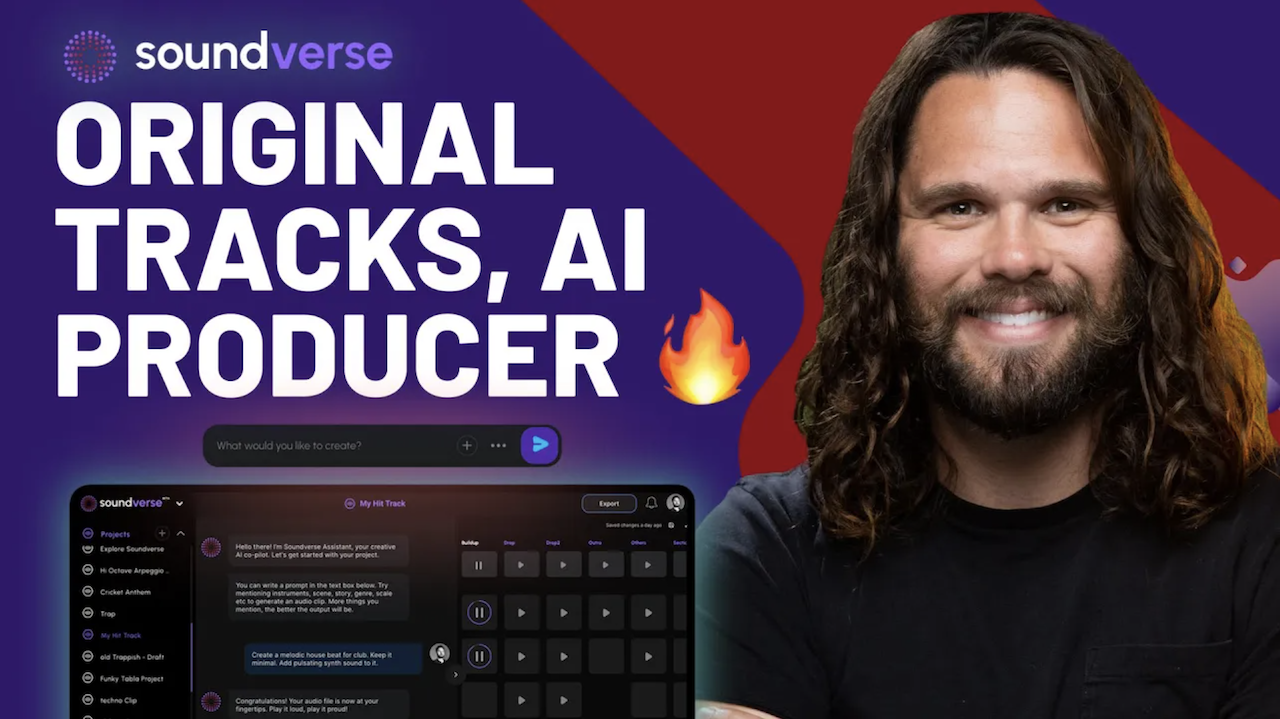
Here’s another long walkthrough of how to use Soundverse AI.
Text Guide
- To know more about AI Magic Tools, check here.
- To know more about Soundverse Assistant, check here.
- To know more about Arrangement Studio, check here.
Soundverse is an AI Assistant that allows content creators and music makers to create original content in a flash using Generative AI. With the help of Soundverse Assistant and AI Magic Tools, our users get an unfair advantage over other creators to create audio and music content quickly, easily and cheaply. Soundverse Assistant is your ultimate music companion. You simply speak to the assistant to get your stuff done. The more you speak to it, the more it starts understanding you and your goals. AI Magic Tools help convert your creative dreams into tangible music and audio. Use AI Magic Tools such as text to music, stem separation, or lyrics generation to realise your content dreams faster. Soundverse is here to take music production to the next level. We're not just a digital audio workstation (DAW) competing with Ableton or Logic, we're building a completely new paradigm of easy and conversational content creation.
TikTok: https://www.tiktok.com/@soundverse.ai
Twitter: https://twitter.com/soundverse_ai
Instagram: https://www.instagram.com/soundverse.ai
LinkedIn: https://www.linkedin.com/company/soundverseai
Youtube: https://www.youtube.com/@SoundverseAI
Facebook: https://www.facebook.com/profile.php?id=100095674445607
Join Soundverse for Free and make Viral AI Music
We are constantly building more product experiences. Keep checking our Blog to stay updated about them!
Image Steps: []