Discuss the Evolution of Vocal Cloning Technology Over the Last Few Years
Vocal cloning technology from 2018 to now: five stages, what each changed for client projects, the safeguards and laws that followed, and vendor questions.
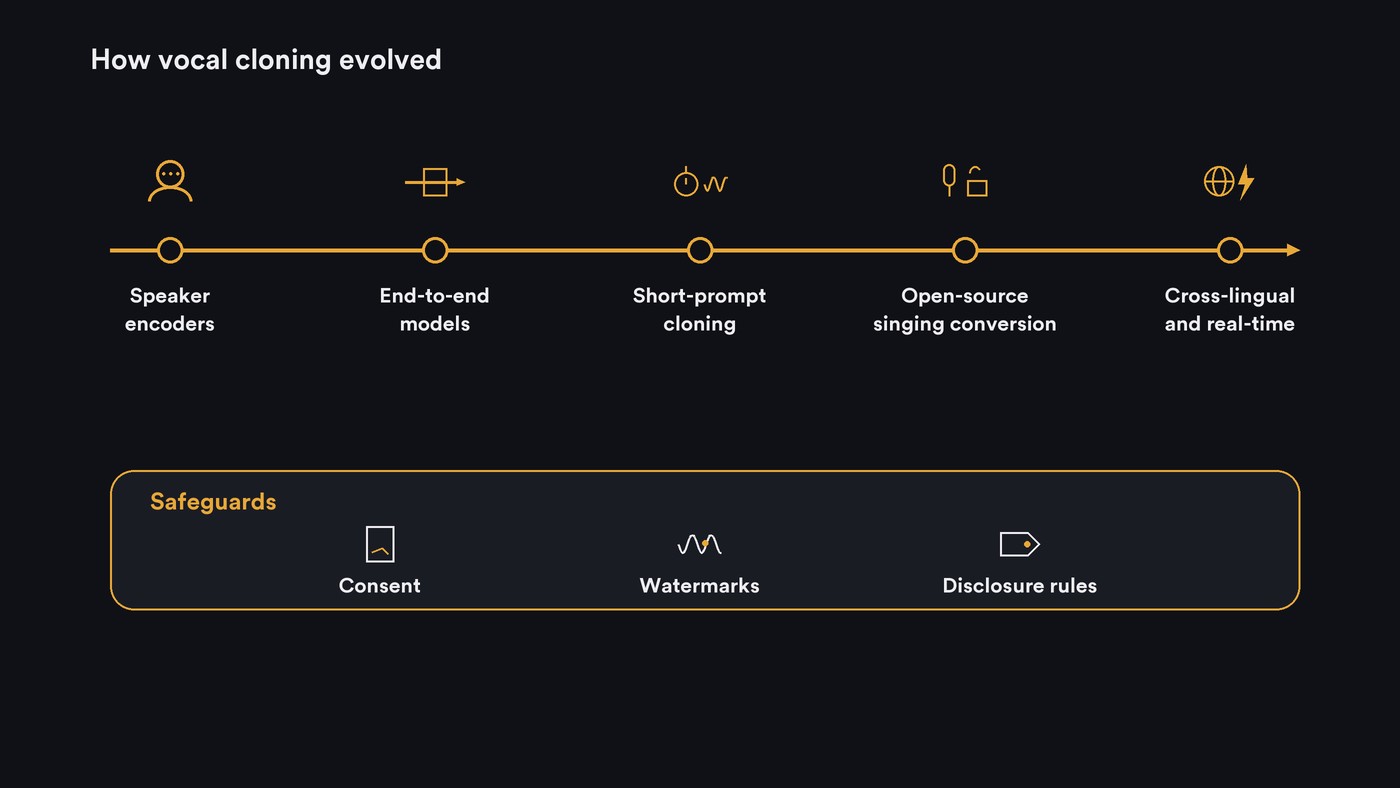
Vocal cloning technology has moved through five stages since 2018: speaker encoders that copied an unseen voice from seconds of speech, end-to-end models that cloned across languages, short-prompt systems that needed about three seconds, open-source singing conversion, and today's cross-lingual and real-time tools. Consent terms, watermarks and disclosure laws grew up alongside them.
This guide is for agencies that buy or commission cloned voices for campaigns, jingles and localized ads. We checked every source below on 23 November 2026; the legal parts are general information, not legal advice. For the mechanics inside the models, read how voice cloning works in modern software.
Stage 1, 2018: speaker encoders and few-shot cloning
The modern story starts with a Google paper, Jia et al., first posted in June 2018 and presented at NeurIPS 2018, often called SV2TTS. Its trick was to borrow a speaker encoder from voice verification, trained on noisy speech from thousands of speakers, and use it to produce a voice embedding from a few seconds of reference speech, which a Tacotron 2-based synthesizer then spoke with.
What changed in practice: a system could imitate a speaker it had never been trained on. The authors also found that this depended on training the encoder on a large and diverse set of speakers, a lesson that still holds: voices unlike anything a system learned from are the likeliest to come out generic.
Stage 2, 2021: end-to-end models and zero-shot, multilingual cloning
In June 2021, Kim, Kong and Son presented VITS at ICML 2021: one model that goes from text to waveform in a single stage, with listening scores on a single-speaker dataset close to real recordings.
YourTTS, posted in December 2021 by Casanova and colleagues, built on VITS for zero-shot, multi-speaker and multilingual work. Three of its findings matter for a client brief:
- One model handled both text-to-speech and voice conversion, with zero-shot results on the VCTK dataset.
- It showed promising results in a target language that had only a single-speaker dataset, which opened the door to lower-resource languages.
- Fine-tuning with less than one minute of speech reached state-of-the-art voice similarity with reasonable quality.
For buyers, that last point pointed to custom voices that need far less recording time.
Stage 3, 2023: three-second prompts and codec language models
On 5 January 2023, Microsoft researchers posted VALL-E, which treats speech synthesis as language modelling over the discrete codes of a neural audio codec, trained on 60,000 hours of English speech. The abstract says it "can be used to synthesize high-quality personalized speech with only a 3-second enrolled recording of an unseen speaker as an acoustic prompt."
The paper adds that VALL-E could preserve the emotion and acoustic environment of the prompt. On a job, that cuts both ways: a reference recorded in a noisy office brings the office along.
Stage 4, 2023: open-source singing voice conversion
While research labs focused on speech, open-source projects put voice conversion, singing included, on ordinary PCs. Retrieval-based Voice Conversion (RVC) describes itself as a voice timbre conversion and voice changer framework. It ships with vocal and instrument separation, recommends at least 10 minutes of low-noise speech for training, and says training is fast even on weak graphics cards. Its changelog dates a local real-time voice-changing GUI to 16 April 2023, and the README states an end-to-end latency of 170 ms, or 90 ms with ASIO audio devices, though it notes that figure depends heavily on hardware driver support.
Conversion keeps the timing and phrasing of a sung guide, so a session singer could perform a part and a model re-sing it in another timbre. And anyone with a suitable PC could now train a model, so consent checks fell to the buyer and the vendor.
Stage 5, 2024 to now: cross-lingual and real-time voices
On 29 March 2024, OpenAI described Voice Engine, which uses text and a single 15-second audio sample to produce speech that closely resembles the speaker. OpenAI chose to preview it rather than release it widely. Two details matter for localized campaigns:
- In translation, Voice Engine keeps the speaker's native accent: English generated from a French speaker's sample has a French accent.
- Early partners used it to translate videos and podcasts so businesses could reach new markets in their own voices.
Put the five stages together and the client-side picture looks like this:
- Audio needed: from seconds in 2018 research, to under a minute of fine-tuning in 2021, to a three-second prompt in 2023 research, with around 10 minutes still recommended for a trained open-source conversion model.
- Languages: from single-language research models to multilingual zero-shot models such as YourTTS, then to cross-lingual voices that carry the speaker's accent into the new language.
- Speed: real-time conversion reached open-source tools in 2023, with a stated end-to-end latency of 170 ms on suitable hardware.
- Access: from lab papers to open-source code anyone can run.
Our report on the current state of voice cloning for professional music production covers what these tools still get wrong in a session.
The safeguards that grew alongside
Consent and disclosure terms
OpenAI's Voice Engine post set out the terms it applied to testers: its usage policies ban impersonation without consent or legal right, and "our terms with these partners require explicit and informed consent from the original speaker." Partners also had to tell audiences the voices were AI-generated, and OpenAI said broad deployment should come with voice authentication and a no-go list of voices too similar to prominent figures.
Watermarking and detection
AudioSeal, from researchers at Meta, posted in January 2024 and published at ICML 2024, was designed for localized detection of AI-generated speech. It marks audio imperceptibly, detects the mark down to the sample level with a fast single-pass detector, and its code is public. A watermark only helps when the vendor embeds it, so ask which scheme a tool uses.
Platform rules
YouTube's help page on disclosing use of GenAI content asks creators to disclose realistic AI-generated or altered content, including content that makes a real person appear to say or do something they didn't, and AI-generated music. It lists cloning your own voice for voice-overs or dubs among the uses that need no disclosure. YouTube may also apply labels automatically, for example to content carrying C2PA metadata.
Laws, from their official texts
- Tennessee's ELVIS Act (Public Chapter 588), approved on 21 March 2024 and in force from 1 July 2024, defines "voice" to include a simulation of a person's voice. It creates liability for using someone's voice in advertising without prior consent, for knowingly making an unauthorised voice available to the public, and for distributing a tool whose primary purpose is producing a particular person's voice without authorisation.
- The EU AI Act's Article 50 (AI Act Service Desk) requires providers of systems that generate synthetic audio to mark outputs in a machine-readable format, and requires deployers to disclose deepfakes, more lightly for evidently artistic work. The Service Desk timeline shows Article 50 applying from 2 August 2026, with a transition until 2 December 2026 for marking by systems already on the market.
What an agency should ask a voice vendor now
- Consent records. Can you see the voice owner's signed consent, naming uses (ads, broadcast, social), territories, term, payment and withdrawal? How did the vendor verify that the speaker is the signer?
- Watermarking. Is output watermarked, with which scheme, and does the mark survive your mixing and re-encoding? Who can run the detector?
- Language coverage. Which languages has the vendor tested with this voice, and how does it handle accent? Get samples for every market and have native speakers review them.
- Who owns the voice model. Is it private to your client? Can the vendor reuse or share it, or train other systems on it? Is it deleted or handed over when the contract ends?
- Disclosure support. Can the vendor supply provenance metadata or labels that help you meet platform rules and Article 50?
- Output licence. Does the contract cover commercial and broadcast use in every market?
For vendors whose terms allow client work, see our shortlist of AI voice cloning services that allow commercial use.
Where Soundverse fits
Soundverse is an AI music platform that takes you from idea to audience, built for independent artists who release music, and its Voice Swap page names ad and brand teams among the people it's for. Train Voice Clone builds a voice from one recording with at least 15 seconds of singing, so the AI Song Generator can sing new songs in it; it needs the Creator plan or above. Train Voice Model trains a more detailed model from at least 10 minutes of clean, dry solo recordings, runs for hours, and every new model starts Private. Neither tool starts training until you confirm the voice is yours or that the singer has given explicit consent. Voice Swap re-sings a vocal in another voice while keeping the performance, and its page suggests trying a scratch jingle in several voice models before you book a singer.
Licensing is set by plan: the Free plan is for personal use, and the Creator plan comes with a royalty-free license.
FAQ
How much audio does vocal cloning need today? It depends on the method: research systems have worked from a three-second prompt, OpenAI's Voice Engine from one 15-second sample, and RVC recommends about 10 minutes of clean audio for a trained model.
Can a cloned voice speak another language? Cross-lingual systems can, and OpenAI reported that Voice Engine keeps the original speaker's accent in the new language. That accent may help or hurt a campaign, so test every market with native listeners.
Do we have to label a cloned voice in an ad? Often, yes. YouTube asks for disclosure of realistic altered content and AI-generated music, and the EU AI Act's Article 50 requires deployers to disclose deepfakes. Using a real person's voice in advertising without prior consent creates liability under Tennessee's ELVIS Act.
Who owns a voice model a vendor builds for our client? Whoever the contract says, so put it in writing, including what happens to the model when the work ends.
Sign up for Soundverse free to try Voice Swap on a scratch vocal. More guides on the Soundverse blog.