Do You Need to Credit Royalty-Free Music? A 2026 Guide for Ethical Content Creators
Learn whether you need to credit royalty-free music and how Soundverse Trace ensures proper attribution in 2026.
Do You Need to Credit Royalty-Free Music?
In 2026, the content creation landscape has evolved dramatically. As AI-generated audio tools and royalty-free music libraries become essential for YouTubers, podcasters, marketers, and film editors, one question consistently arises: Do you need to credit royalty-free music? Understanding credit requirements, attribution ethics, and licensing rules is vital to protect your creative assets and maintain trust with your audience.
What Does “Royalty-Free” Music Actually Mean?
Before answering whether you need to credit royalty-free music, it helps to understand the meaning of "royalty-free." Royalty-free music is audio licensed for use without requiring ongoing payments each time it’s used. Once you purchase or download the track under a royalty-free license, you can use it in your projects according to the terms defined by the provider. However, royalty-free does not mean copyright-free — the creator still owns the composition and may specify certain conditions such as attribution.

Do You Always Have to Credit Royalty-Free Music?
The short answer is: not always. Whether you must provide attribution depends entirely on the specific license attached to the track. Some platforms permit unlimited use without credit, others require acknowledgment as part of the license terms.

Scenarios Where You Must Credit the Creator
- Creative Commons Licenses (e.g., CC-BY, CC-BY-SA) – These typically require attribution every time the track is used publicly, as confirmed in License Guide - Free Music Archive.
- Free Downloads With Attribution Clauses – Even if a track is labeled “royalty-free,” check the description; many free libraries ask for “credit in video description” or “mention in podcast,” a practice described in Copyright-free music: What it really means and how to use it safely.
- Collaborative Projects or Giveaways – Some artists provide royalty-free tracks under “exposure models,” where credit replaces payment.
Scenarios Where Credit Is Optional
- Purchased Premium Licenses – If you’ve paid for a license from a major stock site, attribution is rarely required, as noted in A Guide to Royalty-Free Music (2025) - Tracklib.
- Subscription-Based Audio Libraries – Services offering unlimited downloads via monthly fees often include full usage rights with optional crediting.
- AI-Generated Music With Embedded Attribution – Emerging tools, like Soundverse Trace, automate tracking of data provenance, meaning attribution metadata travels with the file even if public crediting isn’t needed.
What Happens if You Don’t Credit When Required?
Failing to credit royalty-free music where the license demands it can trigger content takedowns or legal notices. Platforms such as YouTube or Spotify automatically match fingerprints embedded in tracks, potentially flagging uncredited usage. In 2026, with improved AI search and watermarking technologies, ignoring attribution rules can quickly lead to monetization loss or strikes.
For example, YouTube’s Content ID and TikTok’s sound library systems have incorporated enhanced metadata tracing since 2025. Unauthorized or miscredited tracks are easier to detect, making transparent usage more critical than ever. Learn more with Music Licensing Guide: Legal Audio for Videos - YouTube and Navigating YouTube: How to Use Music Without Copyright Woes.
For a deeper dive, watch our guide on creating Deep House music and how to make music tutorials on Soundverse’s YouTube Channel.
How Do Music Licensing Rules Affect Content Creators in 2026?
Music licensing rules govern how sound recordings and compositions are used in public or digital spaces. In 2026, new frameworks focus on ethical attribution and data provenance, not just payment structure. That means creators must follow clear guidelines when using royalty-free or AI-generated music.
Key licensing elements include:
- Usage Rights – Defines whether you can use music in commercial projects.
- Territory and Duration – Specifies where and how long your right extends.
- Attribution Requirements – Indicates how to credit the music properly.
- Editing and Remixing Permissions – Clarifies if edits or derivative works are allowed.
Understanding these is essential before embedding tracks in branded videos, advertisements, podcasts, or social reels. For a deeper look at music industry dynamics, check related articles such as How AI-Generated Music Is Transforming the Music Industry or Copyright-Free vs Royalty-Free Music: What Creators Should Know.
How to Check If Royalty-Free Music Requires Attribution
When browsing libraries or AI music platforms, always review the license text before downloading a track.
Here’s What to Look For
- Mention of “No Attribution Required” – Confirms free usage without credit.
- “Must Credit the Artist” Clause – Requires text credit in your content description.
- Embedded Metadata or License Tag – Indicates whether digital proof of authorship is preserved.
- Platform Guides and FAQs – Most providers outline credit practices. For instance, Soundverse AI Revolutionizing Music Creation for Content Creators discusses transparent metadata protection.
By doing quick checks, you avoid copyright strikes and foster ethical sharing practices.
Why Attribution Still Matters Even If Not Legally Required
In 2026, audiences value transparency more than ever. Crediting where possible boosts creator reputation and demonstrates respect toward original artists or datasets. Even for AI-composed tracks, attribution supports ecosystem fairness — helping musicians whose sounds trained the models receive ongoing compensation through frameworks such as Soundverse’s Content Partner Program.
Providing credit also benefits professional ethics:
- Encourages community collaboration.
- Enhances discoverability of underrated composers.
- Adds authenticity to your storytelling.
- Strengthens trust between content brands and fans.
You might not face penalties for skipping credit under a royalty-free license, but voluntarily doing so can yield long-term creative goodwill.
What Are the Content Creator Audio Guidelines in 2026?
Platform-specific audio guidelines evolve each year. As of 2026, leading networks include stricter automated detection of music sources:
- YouTube – Requires license verification for commercial uploads.
- Instagram Reels – Monitors background tracks for attribution compliance.
- Podcasts (Spotify, Apple, Audible) – Encourage clear metadata credits within episode descriptions.
Using AI to generate tracks doesn’t exempt creators from these standards; music must still conform to general licensing rules and respect dataset provenance.
How Soundverse Trace Reinforces Attribution and Rights Protection
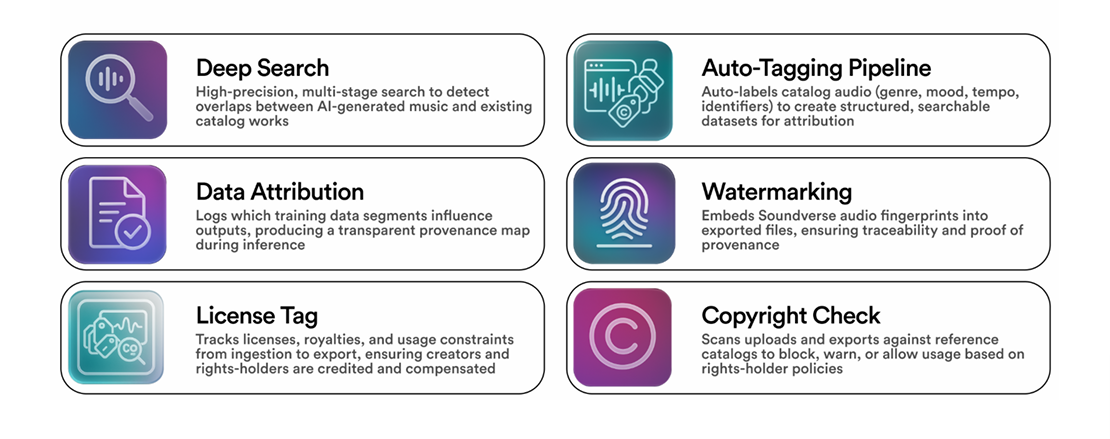
Now that you understand why crediting royalty-free music matters, here is how you can ensure accurate attribution using Soundverse Trace.
What Is Soundverse Trace?
Soundverse Trace functions as a comprehensive trust layer for AI music, enabling traceability from dataset creation to final export. It embeds rich metadata, attribution logs, and inaudible fingerprints inside audio files so that rights are preserved automatically, as reflected in AI Music Safety & Attribution: Building Trust in 2026's Creative AI.
Core Capabilities
- Deep Search: High-precision scanning (1:1, 1:N) to detect overlaps between datasets and outputs.
- Data Attribution: Maintains a log showing which dataset contributed to the generated music.
- Audio Watermarking: Embeds inaudible fingerprints into audio ensuring verifiable origin.
- License Tagging: Keeps rights metadata consistent across ingestion, generation, and export phases.
These features collectively prevent copyright infringement and make royalty management effortless for creators, even when publishing across multiple platforms.
Use Cases for Modern Creators
- Automatically track how royalty-free or AI-generated tracks are used.
- Verify provenance when collaborating with brands or advertisers.
- Support ethical AI workflows under the Ethical AI Music Framework, which ensures attribution integrity and recurring compensation.
- Instantly show compliance for audits or takedowns using Trace’s robust rights metadata.
For creators exploring integrated AI workflows, related resources include Generate AI Music with Soundverse Text-to-Music, Soundverse Introduces Stem Separation AI Magic Tool, and Navigating the World of Royalty-Free and Copyright-Free Music Using Soundverse AI.
Start Creating Royalty-Free Music Today with Soundverse
Produce stunning, license-safe music in seconds using AI. Enjoy total creative freedom without worrying about credits, licensing rules, or hidden costs.
- Enhancing YouTube Content with Royalty-Free and Copyright-Free Music Using Soundverse AI — Discover how creators are transforming their YouTube videos using safe, royalty-free music generated through Soundverse AI.
- Copyright-Free vs. Royalty-Free Music: What Creators Should Know — Learn the differences between copyright-free and royalty-free music to avoid confusion and protect your content.
- Navigating the World of Royalty-Free and Copyright-Free Music Using Soundverse AI — Explore how Soundverse AI simplifies the process of finding and generating music you can use worry-free online.
- Generate AI Music with Soundverse Text-to-Music — Turn creative ideas into unique, royalty-free tracks instantly with Soundverse’s text-to-music tool.
Here's how to make AI Music with Soundverse
Video Guide
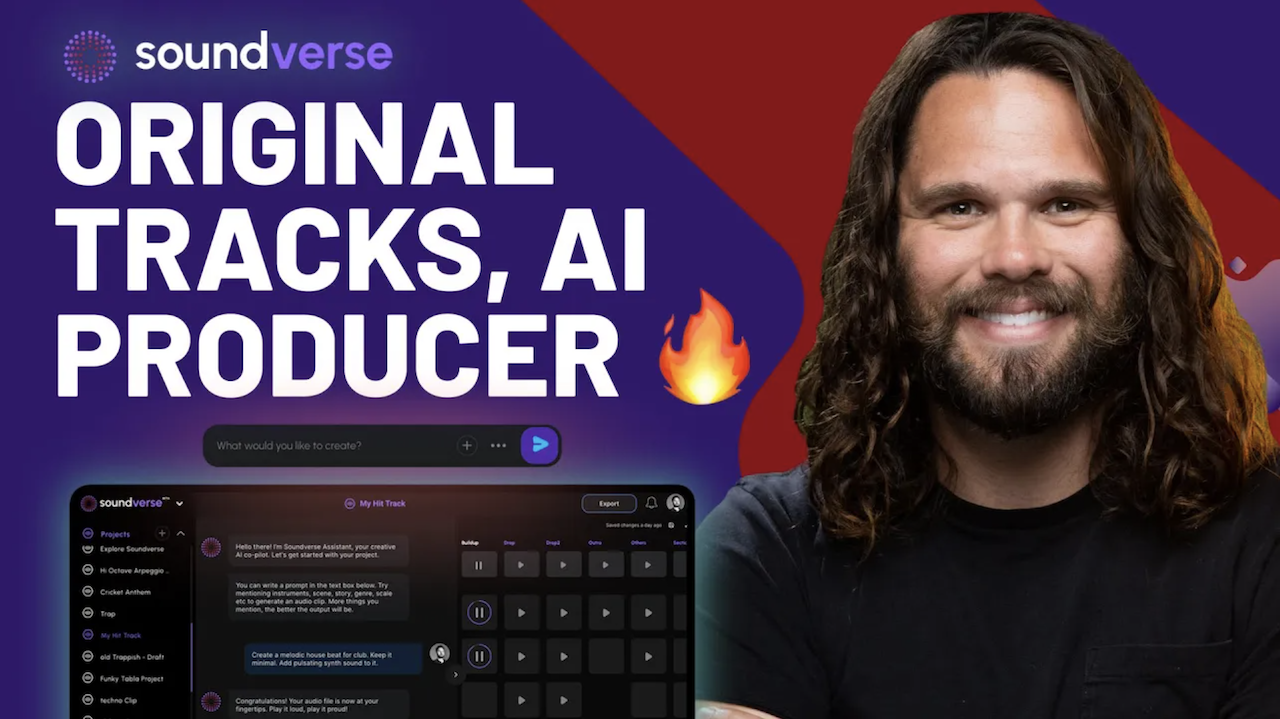
Here’s another long walkthrough of how to use Soundverse AI.
Text Guide
- To know more about AI Magic Tools, check here.
- To know more about Soundverse Assistant, check here.
- To know more about Arrangement Studio, check here.
Soundverse is an AI Assistant that allows content creators and music makers to create original content in a flash using Generative AI. With the help of Soundverse Assistant and AI Magic Tools, our users get an unfair advantage over other creators to create audio and music content quickly, easily and cheaply. Soundverse Assistant is your ultimate music companion. You simply speak to the assistant to get your stuff done. The more you speak to it, the more it starts understanding you and your goals. AI Magic Tools help convert your creative dreams into tangible music and audio. Use AI Magic Tools such as text to music, stem separation, or lyrics generation to realise your content dreams faster. Soundverse is here to take music production to the next level. We're not just a digital audio workstation (DAW) competing with Ableton or Logic, we're building a completely new paradigm of easy and conversational content creation.
TikTok: https://www.tiktok.com/@soundverse.ai
Twitter: https://twitter.com/soundverse_ai
Instagram: https://www.instagram.com/soundverse.ai
LinkedIn: https://www.linkedin.com/company/soundverseai
Youtube: https://www.youtube.com/@SoundverseAI
Facebook: https://www.facebook.com/profile.php?id=100095674445607
Join Soundverse for Free and make Viral AI Music
We are constantly building more product experiences. Keep checking our Blog to stay updated about them!