AI Voice Cloning for Music: How Synthetic Vocals Are Redefining Creativity in 2026
Learn how AI voice cloning and synthetic vocals are shaping music production in 2026.
AI Voice Cloning for Music
Artificial intelligence has transformed almost every corner of the creative industry, and in 2026, one of its most fascinating applications is AI voice cloning for music. This technology enables music producers, vocalists, and engineers to experiment with vocal identity, generate synthetic performances, and build completely new sonic personas. The result is an era where artists can create without the barriers of human vocal limits while still retaining expressive authenticity.
What is AI Voice Cloning and How Does It Work?
AI voice cloning refers to using machine learning models to replicate or substitute a human voice while maintaining natural nuances such as tone, emotion, timing, and expression. When applied to music, this means you can convert or recreate singing styles and performances using synthetic but artistically rich voices.
Voice cloning technology relies on deep neural networks trained on vocal datasets that capture pitch modulation, phrasing, vibrato, and timbre. Once trained, these models can generate or swap voices in existing recordings without losing emotional fidelity. For instance, a producer might record a demo using their own vocals and then transform it into a performance from a celebrity-style synthetic vocalist using voice swap AI.
Why Is AI Voice Cloning Important for Music Production in 2026?
By 2026, most music creators are blending traditional artistry with AI-powered workflows. Vocal cloning enables experimentation far beyond what was possible in 2024 and 2025. Modern studios now use AI to:
- Create custom vocal identities for each project or brand.
- Replace placeholder vocals in demos with final performance-grade ones.
- Test different styles—pop, jazz, trap, country—without hiring multiple singers.
- Solve licensing and copyright challenges through synthetic, ethically trained vocals.
The result is an ecosystem empowering both established and independent artists. Producers can now sculpt unique voices for concept albums, video game characters, or even immersive virtual concerts.
For example, in many cross-platform collaborations discussed in Soundverse’s blog on music industry trends, AI-generated voices have become a standard asset rather than a novelty.
How Are Synthetic Vocals Changing Artistic Expression?
Synthetic vocals have evolved from robotic sounding replications to organically expressive performances. Advanced systems capture emotional depth—something earlier AI models lacked. In 2026, AI singing models exhibit personality traits, making listeners feel connected to a voice even if it’s entirely virtual.
This transformation means artists can:
- Explore emotional storytelling unconstrained by their own vocal range.
- Merge multiple singer profiles into hybrid voices.
- Recreate nostalgic tones inspired by past icons (ethically licensed).
Just as AI-generated music changed instrumentation workflows, AI voice cloning is redefining vocal composition. To see raw studio workflows in action, watch our guide on creating Deep House music.
What Are the Top Use Cases of AI Voice Cloning?
1. Demo and Production Workflow Enhancement
Producers often use placeholder vocals before hiring session singers. AI voice cloning offers immediate replacements that sound professional and emotionally aligned, saving time and cost.
2. Creative Experimentation and Style Testing
Voice swap AI allows testing with different vocal styles or personas before deciding which fits best in the mix. This flexibility nurtures innovation without constraints.
3. Character Voices for Animation and Games
Game developers and animation studios use cloned voices to bring characters to life. They can adjust pitch, mood, and delivery consistent with visual cues.
4. Parody and Entertainment Projects
Parody creators or content satirists frequently use cloned voices for humor or commentary, as AI voice cloning ensures consistent and safe reproductions without impersonation issues.
5. Educational and Vocal Training Tools
AI singing models help students analyze and replicate vocal techniques, allowing them to study tone and phrasing levels impossible to capture through traditional lessons.
For community demos of music creation, check out Soundverse Tutorial Series - How to Make Music.
What Ethical and Creative Challenges Come with AI Voice Cloning?
While creativity expands, ethics remain vital. Key discussions in 2026 revolve around:
- Consent and licensing: Using AI models built from licensed and consented datasets is mandatory.
- Impersonation prevention: Authentic companies avoid unlicensed celebrity likeness.
- Copyright compliance: Tools like Soundverse DNA solve ethical music generation by training on licensed catalogs.
As explored in Navigating Royalty-Free Music with AI, ethical music creation ensures sustainable growth for both tech providers and artists.
How AI Voice Cloning Integrates with Music Production Workflows
AI voice cloning fits naturally into the evolving music production with AI universe, merging with text-to-music systems, stem separation, and genre-based generation. Producers combine synthetic vocals with generated instrumentals or even use voice models as emotional anchors in arrangement design.
For instance, after generating a backing track using text-to-music tools such as Soundverse, users can insert cloned vocals for full production realism. Articles like Generate AI Music with Soundverse Text-to-Music describe how producers integrate vocal cloning with compositional AI modules.
In the modern studio setup, artists can conceptualize an album where AI handles background sounds, harmonic structure, and synthetic singing simultaneously—making 2026 the year of complete AI co-production. For deeper workflow examples, watch our Explore Tab tutorial.
How to Make AI Voice Cloning Music with Soundverse Voice Swap
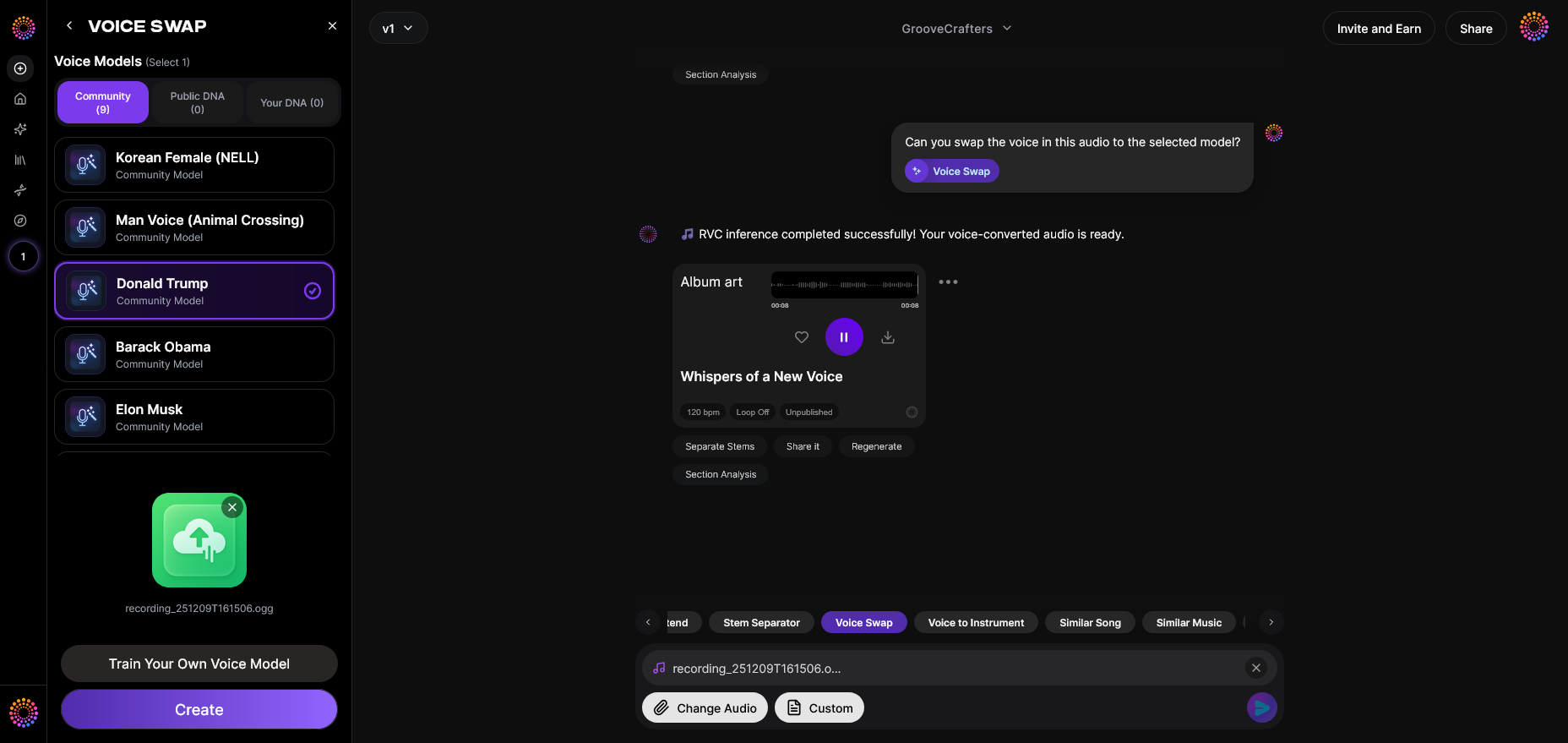
Now that you understand how AI voice cloning enhances creativity, Soundverse provides a reliable, ethical, and high-quality solution through its Voice Swap feature.
Feature Overview
Voice Swap replaces the vocal identity in an audio track with a different voice model—celebrity, character, or custom DNA—while preserving the original performance nuances, timing, and emotional expression.
Core Capabilities
- Community Voices: Choose from a library of celebrity or character voices.
- Public DNA & Personal DNA Support: Create or use licensed AI-trained voices.
- Voice-to-Voice Conversion: Transform recorded performances seamlessly into new personas.
Primary Use Cases with Soundverse
- Generating guide vocals for demo tracks.
- Creating character voices for games or animation.
- Producing parody content ethically.
- Experimenting with different vocal styles in music production.
Example Workflow
- Upload your recorded audio to Soundverse.
- Choose your target voice model—custom or community.
- Apply the Voice Swap transformation.
- Download the final voice-swapped track.
This asynchronous workflow eliminates the need for live previewing while ensuring precision output alignment.
Soundverse’s connected ecosystem also includes:
- Similar Singing Generator—to create emotional performances using reference voices.
- Soundverse DNA—an artist-trained AI generation system ensuring copyright-safe creations.
Combined, these tools enable seamless creation, from songwriting to full vocal arrangement. You can read more about their synergy in Soundverse’s AI Magic Tools overview.
The Future of Synthetic Vocals and AI Singing in 2026
Looking forward, AI singing will not just replicate human performance—it will augment it. Hybrid compositions featuring half-human, half-synthetic voices are already charting on digital music platforms. Virtual duets and holographic concerts will be commonplace as AI-powered vocal personas become part of artistic identities.
In essence, AI voice cloning has become a pillar of modern creativity, allowing every artist to sound limitless. Whether it’s a producer testing vocal genres or an engineer refining demos, the 2026 landscape proves that AI-powered voices are not replacing musicians—they are amplifying them.
Start Creating with AI Voice Cloning Today
Bring your musical ideas to life using cutting-edge AI voice cloning technology. Generate professional-grade vocals, experiment with styles, and accelerate your creative process—all with Soundverse.
Related Articles
- Soundverse Saar: AI Voice Assistant — Discover how Soundverse Saar brings smart voice interaction to music creation and production.
- AI Ranks Soundverse’s AI Singer #1: The Ultimate AI Singing Platform Dominating 2025 — Explore the evolution of AI singing and why Soundverse is leading the next wave of digital vocal performance.
- Soundverse: Revolutionizing Music Creation for New Age Content Creators — Learn how Soundverse empowers creators by merging cutting-edge AI tools with artistic freedom.
- How AI-Generated Music is Transforming the Music Industry — Understand the impact of AI-generated music and how it’s changing the landscape of creativity and entertainment.
Here's how to make AI Music with Soundverse
Video Guide
Here’s another long walkthrough of how to use Soundverse AI.
Text Guide
- To know more about AI Magic Tools, check here.
- To know more about Soundverse Assistant, check here.
- To know more about Arrangement Studio, check here.
Soundverse is an AI Assistant that allows content creators and music makers to create original content in a flash using Generative AI. With the help of Soundverse Assistant and AI Magic Tools, our users get an unfair advantage over other creators to create audio and music content quickly, easily and cheaply. Soundverse Assistant is your ultimate music companion. You simply speak to the assistant to get your stuff done. The more you speak to it, the more it starts understanding you and your goals. AI Magic Tools help convert your creative dreams into tangible music and audio. Use AI Magic Tools such as text to music, stem separation, or lyrics generation to realise your content dreams faster. Soundverse is here to take music production to the next level. We're not just a digital audio workstation (DAW) competing with Ableton or Logic, we're building a completely new paradigm of easy and conversational content creation.
TikTok: https://www.tiktok.com/@soundverse.ai
Twitter: https://twitter.com/soundverse_ai
Instagram: https://www.instagram.com/soundverse.ai
LinkedIn: https://www.linkedin.com/company/soundverseai
Youtube: https://www.youtube.com/@SoundverseAI
Facebook: https://www.facebook.com/profile.php?id=100095674445607
Join Soundverse for Free and make Viral AI Music
We are constantly building more product experiences. Keep checking our Blog to stay updated about them!