AI Music vs Human-Composed Music: What Listeners Actually Prefer in 2026
Explore listener perception of AI vs human music and 2026 music trends.
AI Music vs Human-Composed Music: What Listeners Actually Prefer
As artificial intelligence (AI) reshapes creative industries, music stands as one of the most fascinating battlegrounds between machine-generated innovation and human emotional depth. The debate over AI vs human music has intensified in 2026—not only among musicians and producers, but also among everyday listeners. Are audiences able to distinguish between AI-generated songs and human-composed tracks? More importantly, what does listener perception reveal about the future of musical creativity?
Why has the AI vs human music debate grown in 2026?
From 2024 to 2025, AI music generators such as Soundverse, Suno, and Udio transformed how people created and consumed music. By 2026, AI has matured far beyond simple melody automation. Systems based on licensed catalogs and ethical frameworks are now capable of producing emotionally rich compositions tailored to any theme, instrument, or vibe. According to Soundverse’s analysis on music industry trends, consumer exposure to AI-generated content has doubled since 2025, largely due to social platforms and streaming integration.

Listeners are gradually embracing AI not just as a novelty, but as a legitimate contributor to the music ecosystem. However, the lines are blurred: when emotionally moving music is generated by an algorithm trained on human emotion, what does authenticity really mean?
What does current research say about listener perception of AI-generated songs?
Recent music preference studies conducted in 2026 highlight intriguing insights into how people feel about AI-composed tracks. In blind tests, over 58% of participants could not identify whether a song was created by AI or a human artist, echoing studies such as When Music is Made by AI: Effects on Preferences and Willingness. Yet once informed, 71% still expressed a bias toward human creativity, citing emotional authenticity and backstory as factors for preference.

This suggests listeners value context—the human narrative behind a composition—just as much as they value melody or production quality. Even when AI compositions sound indistinguishable from human ones, emotional connection influences perception. The underlying message is clear: technology may replicate patterns, but emotional resonance remains a fundamental human trait.
What shapes listeners’ music preferences today?
In 2026, music listening trends show a blend of algorithmic recommendation systems and human influence. Playlists curated by both humans and AI coexist harmoniously. Streaming services already use machine learning to personalize music discovery, predicting moods and energy levels, as seen in how streaming algorithms have reshaped how we listen to music. However, listeners tend to trust recommendations more when they believe a human consultant or AI trained under ethical consent frameworks was involved.
Several factors play into this dynamic:
- Cultural authenticity: Songs tied to identifiable artists or cultural moments continue to outperform anonymous AI tracks.
- Transparency: When listeners know that AI music is ethically produced, they are significantly more open to engaging with it.
- Creative storytelling: Humans remain superior in associating narrative depth and personal experiences with songs.
- Production standards: AI now matches professional human mixing quality, as seen in Soundverse’s AI Magic Tools, enabling creators to produce immersive soundscapes.
For hands-on demonstrations, check out our Soundverse Tutorial Series - How to Make Music and Explore Tab guide on YouTube for creative techniques blending AI and human artistry.
Can AI truly capture human creativity in music?
AI models in 2026—especially ethical frameworks like Soundverse DNA—have evolved to emulate stylistic traits of artists while adhering to consent-first data practices. Through licensed training, AI can produce music based on an artist’s “sonic DNA,” allowing listeners to experience new variations without infringing on originality or rights. Research such as As AI-Generated Music Advances, Humans Still Lead in Creativity highlights that AI can mimic style but still trails human inventiveness.
Yet, human creativity in music encompasses more than emotion—it involves intentional imperfections, spontaneous improvisations, and evolving interpretations. These subtleties often define musical genius. While AI can mimic improvisation mathematically, it lacks the existential motivation that drives human creativity.
For some, this distinction matters less; they judge music by sound and feel, not origin. For others—especially industry professionals—it’s crucial for sustaining authentic artistry.
How emotional storytelling influences listener perception
A major trend in 2026’s music preference studies shows that emotional narrative directly affects listener engagement. Human-composed tracks often include lyrics or motifs connecting personal experiences. AI-composed music, however, uses data-driven emotional mapping, translating mood descriptions into sound patterns. When both are presented without context, audiences often respond similarly—but adding author identity changes perception.
Interestingly, certain genres show stronger tolerance for AI generation. Electronic, ambient, and cinematic music listeners exhibit more neutrality, while fans of jazz, folk, and country lean toward human performance. You can explore this balance further in related studies such as How AI-generated music is transforming the music industry and How to Create Country Music with Soundverse AI. To deepen your learning, check out the Soundverse Deep House Tutorial on blending moods and digital texture in AI-assisted tracks.
Why ethical AI frameworks define the future of listener trust
One of the biggest barriers to widespread acceptance of AI music has been ethics—how models source data, whether artists consent, and how royalties circulate. In 2026, platforms like Soundverse lead with transparent, Ethical AI Music Frameworks, addressing precisely these concerns. According to the AI Musicians vs. Machines report, over 60% of creators use AI for arranging and 65% for mixing or mastering, underscoring how crucial ethical infrastructures have become.
Listeners today are more informed and socially conscious. They prefer AI systems ensuring fair compensation, licensing, and traceability. This aligns with the broader movement toward protecting artistic identity amid automation. Surveys such as PRS for Music AI Survey 2026 confirm that up to 79% of creators express concern over AI-generated competition, reinforcing the need for frameworks like Soundverse’s.
How to make AI vs human music ethically with Soundverse The Ethical AI Music Framework
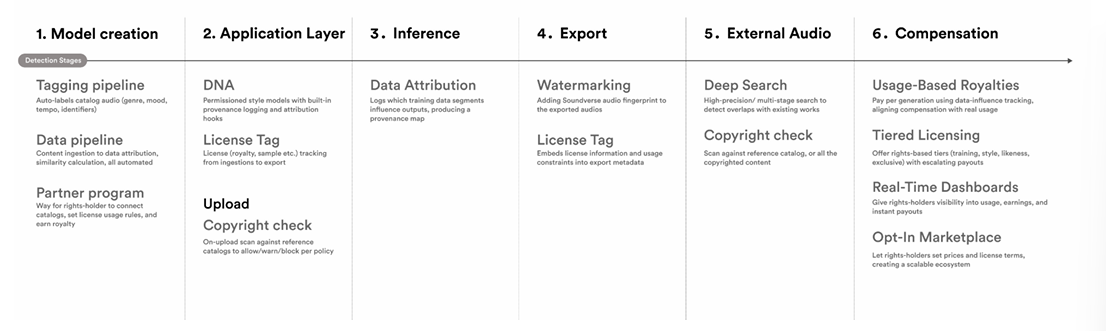
Soundverse’s Ethical AI Music Framework bridges innovation and integrity by creating a transparent, six-stage pipeline:
- Stage 1: Licensed Data Sourcing (No scraping) ensures every sound used for training is legally obtained.
- Stage 2: Permissioned Models (DNA) allows individual artists to license their styles and earn royalties.
- Stage 3: Explainable Inference (Attribution) guarantees clarity about each model’s origin.
- Stage 4: Traceable Export (Watermarking) embeds creator and dataset information into outputs.
- Stage 5: Deep Search (External Scanning) continuously checks whether new content matches existing copyrighted works.
- Stage 6: Recurring Compensation (Partner Program) returns steady payments to rights holders and content contributors.
This ecosystem not only ensures legal compliance but also establishes trust between AI developers, musicians, and listeners. It positions AI music generation as a collaborative process, rather than a replacement for human artistry.
Soundverse DNA complements this framework by allowing artists to capture their stylistic signature ethically, while Soundverse Trace applies watermarking and attribution across distribution channels. The combination fosters transparency and future-ready monetization models for 2026’s complex music landscape.
For professionals comparing ethical AI creation tools, the Soundverse approach stands out. In analyses of best AI music generators and alternatives such as Soundraw and Mubert, Soundverse consistently ranks as the most compliance-focused ecosystem.
What does the future of music listening look like?
In 2026, AI is no longer competing with human composers—it’s collaborating. Hybrid production models are becoming standard: humans define emotional direction, while AI efficiently arranges composition layers or generates variations. Listeners, meanwhile, care less about origin and more about emotional effect and ethical transparency.
By 2027 and beyond, expect music to become increasingly co-designed—a harmony of algorithmic precision and human soul. The evolution of frameworks like Soundverse’s ensures that this partnership grows responsibly, preserving creativity without sacrificing technological progress.
Experience the Future of Music Creation Today
Discover how Soundverse lets you blend human creativity with AI precision to craft music that resonates. Start generating your own tracks—no studio required.
Create Music with Soundverse AI
Related Articles
- AI Music Generator and Human Composers: A Future Together — Explore how AI and human creativity are merging to redefine modern music composition.
- How AI-Generated Music Is Transforming the Music Industry — Dive into how AI tools are reshaping music creation, production, and distribution across the industry.
- The Role of AI Music in Film and Television — Learn how filmmakers and producers use AI-generated music to enhance storytelling and emotional depth.
- How an AI Music Generator Inspires Creative Fusion — See how AI composition tools are sparking imagination and collaboration among musicians and creators alike.
Here's how to make AI Music with Soundverse
Video Guide
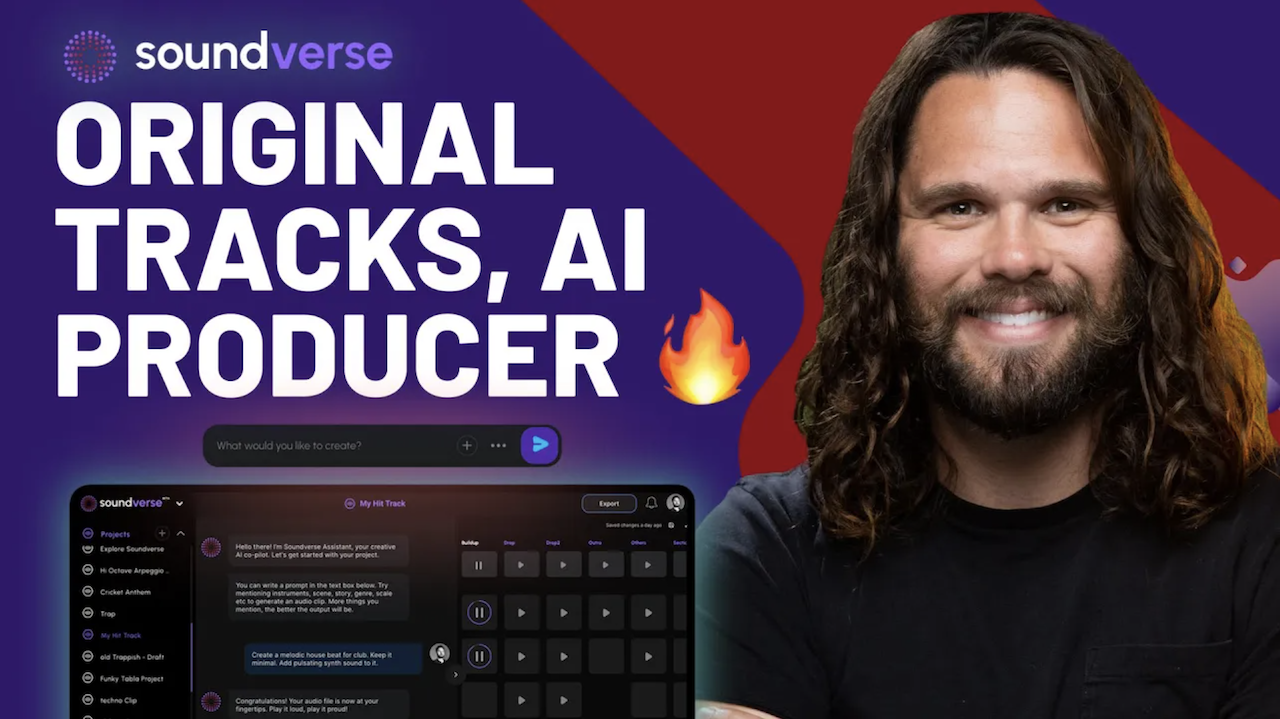
Here’s another long walkthrough of how to use Soundverse AI.
Text Guide
- To know more about AI Magic Tools, check here.
- To know more about Soundverse Assistant, check here.
- To know more about Arrangement Studio, check here.
Soundverse is an AI Assistant that allows content creators and music makers to create original content in a flash using Generative AI. With the help of Soundverse Assistant and AI Magic Tools, our users get an unfair advantage over other creators to create audio and music content quickly, easily and cheaply. Soundverse Assistant is your ultimate music companion. You simply speak to the assistant to get your stuff done. The more you speak to it, the more it starts understanding you and your goals. AI Magic Tools help convert your creative dreams into tangible music and audio. Use AI Magic Tools such as text to music, stem separation, or lyrics generation to realise your content dreams faster. Soundverse is here to take music production to the next level. We're not just a digital audio workstation (DAW) competing with Ableton or Logic, we're building a completely new paradigm of easy and conversational content creation.
TikTok: https://www.tiktok.com/@soundverse.ai
Twitter: https://twitter.com/soundverse_ai
Instagram: https://www.instagram.com/soundverse.ai
LinkedIn: https://www.linkedin.com/company/soundverseai
Youtube: https://www.youtube.com/@SoundverseAI
Facebook: https://www.facebook.com/profile.php?id=100095674445607
Join Soundverse for Free and make Viral AI Music

We are constantly building more product experiences. Keep checking our Blog to stay updated about them!