AI Music in India: Legal Status Explained
Understand the 2026 AI music legal status in India, covering copyright, ownership, and ethical frameworks for creators and startups.
AI Music in India: Legal Status Explained
Introduction
Artificial intelligence is transforming the global music landscape, and India is no exception. As we enter 2026, conversations around the AI music legal status in India are no longer theoretical—they are an urgent reality for musicians, record labels, and technology companies. While 2024 and 2025 saw explosive growth in AI composition tools and music generation platforms, this year has brought a renewed focus on how India’s legal system interprets authorship, ownership, and compensation in the AI age.
This article explores what AI-generated music means under Indian copyright law, outlines the ongoing policy shifts, and examines how platforms like Soundverse are bridging the gap between technological innovation and artist integrity through ethically governed AI systems.
What does “AI Music” mean in the Indian legal context?
AI music refers to audio compositions, melodies, and soundscapes that are created or co-created using artificial intelligence algorithms. In many cases, no single human composer writes every note. Instead, an AI model—trained on vast datasets—analyzes patterns, styles, and emotional tones and outputs new sounds based on text or audio prompts.
The question then arises: Who owns AI-generated music in India? The Indian Copyright Act of 1957, as amended, defines an "author" for a musical work as the person who composes the music. In traditional circumstances, this author is human. However, when AI contributes significantly, ownership becomes ambiguous.
Courts and policymakers in India are now examining whether the person operating the AI, the developer who trained it, or the rights holders whose data was used during training can be declared as the author or co-author. Until official legal clarity is provided, disputes remain possible.
How does Indian copyright law currently approach AI-generated music?
As of 2026, India doesn’t have an exclusive legal statute addressing AI-generated music laws. Instead, decisions rely on general interpretations of the Copyright Act. The theory most lawyers and policy analysts support is the “human authorship doctrine.” Under this principle, only human-created works can attract copyright protection.
If an AI model produces a song autonomously, it might not qualify for copyright protection at all. In contrast, if a human guides the AI—by selecting prompts, refining the output, or making creative decisions—the final composition could be recognized as a human-authored derivative work.
Legal professionals have even drawn parallels with AI art generation, where similar debates exist around originality and human bias. These ongoing discussions emphasize that the balance between AI automation and human creativity is key to determining ownership. For a deeper dive, watch our guide on how to make music and explore how AI systems complement human creation.
What are the key AI copyright issues in India today?
Several challenges dominate India’s AI-music legal landscape:
- Data Training without Consent: Some AI tools have been accused of training on copyrighted songs without obtaining licenses. This violates both Indian and international intellectual property norms, as discussed in Generative AI and Music Piracy in India - IIPRD Blogs.
- Attribution Complexity: Musicians and producers often find it impossible to trace if elements of their work have been used to train commercial AI systems.
- Ethical Ambiguity: When AI-generated tracks replicate the styles or voices of famous Indian artists, questions of moral rights and likeness protection emerge.
- Cross-border Licensing: Indian AI startups face uncertainty when collaborating with global music firms due to differences between Indian and international copyright standards.
- Revenue Allocation: Determining who deserves royalties from AI-composed tracks remains unresolved. In this evolving environment, artists and tech entrepreneurs are seeking structured frameworks that ensure both innovation and fairness.
Why is 2026 a critical year for AI music policy in India?
2026 has become a turning point for music AI India. The Ministry of Electronics and Information Technology (MeitY) and the Department for Promotion of Industry and Internal Trade (DPIIT) have initiated a policy review on AI-generated works. These discussions echo the conversations happening in Europe and the United States regarding data ethics and performer consent. The introduction of responsible AI frameworks is expected this year, possibly establishing ground rules for music data training and fair attribution models. Experts believe these regulations will provide both creative freedom and a stable revenue foundation for rights holders. Recent updates also include mandatory AI content labelling by the Indian government as a step toward ethical media transparency.
How do Indian musicians and labels react to AI-generated music?
Musicians in India are divided. Some view AI as a threat, fearing devaluation of human artistry. Others treat it as a creative enhancer. Independent producers are experimenting with tools to compose beats, melodies, or background scores faster, especially for platforms like YouTube and reels.
Record labels are equally intrigued but cautious. They demand verifiable data provenance and transparent licensing mechanisms before engaging with AI-generated compositions. This aligns with how many international labels now require detailed metadata for AI-created tracks.
Emerging creators often turn to platforms like Soundverse, which provide ethical frameworks and data-traceable models to address such ownership and compliance issues.
Learn more about how the AI revolution reshaped the industry in our in-depth article on how AI-generated music is transforming the music industry.
How does Soundverse make AI music generation legally compliant?
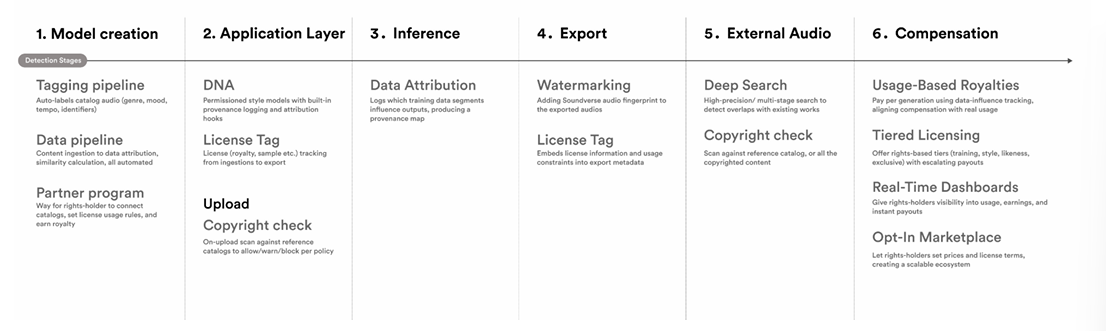
Soundverse stands out for introducing The Ethical AI Music Framework, a foundational infrastructure addressing compliance, consent, and compensation in the world of AI-generated music.
What is The Ethical AI Music Framework?
This framework replaces opaque black-box AI systems with a transparent, six-stage pipeline:
- Licensed Data Sourcing: Only legally cleared music is used for training, eliminating copyright risks.
- Permissioned Models (DNA): Artists opt-in to share their content for AI learning through licensed agreements.
- Explainable Inference (Attribution): Every AI music output comes with traceable data attribution.
- Traceable Export (Watermarking): AI-generated music carries digital watermarks for ownership validation.
- Deep Search (External Scanning): AI scans for unlicensed or misattributed samples across music ecosystems.
- Recurring Compensation (Partner Program): Contributors receive royalties when their licensed content is reused. This structure ensures AI music can thrive legally and ethically in India while rewarding human creativity. For production insights, check the Soundverse Deep House Tutorial.
What are the benefits of The Ethical AI Music Framework for Indian creators?
- Legal Protection: Artists retain control over how their compositions are used.
- Attribution Transparency: Ensures recognition for contributors.
- Monetization: Through the Content Partner Program, creators gain recurring revenues tied to traceable usage.
- Compliance for Enterprises: Labels and studios can confidently integrate AI without infringing on third-party rights. This aligns perfectly with India’s push toward responsible AI innovation in 2026.
Are there related tools that enhance AI music rights protection?
Yes. Two Soundverse solutions stand out:
- Soundverse Trace: Provides end-to-end attribution tracking, watermarking, and external scanning to validate rights ownership throughout the content lifecycle.
- Content Partner Program: Offers rights holders fair and recurring royalties by licensing their works for AI model training. These tools exemplify how ethical AI and intellectual property compliance can coexist. For a broader view on AI creative ecosystems, explore the Soundverse AI Magic Tools and the AI Music Generator and Human Composers article.
How Soundverse supports India’s AI music future
As India refines its policy stance on artificial intelligence music rights, Soundverse provides creators with the infrastructure to operate safely in this grey legal space. Instead of relying on speculative fairness claims, it delivers technical evidence of ownership and transparent value distribution. This approach differentiates Soundverse from competitors such as Mubert or Soundraw, which focus largely on generation rather than compliance transparency. For those comparing ethical AI music ecosystems, see our feature on Mubert alternatives to understand why legality and ethics are central in 2026.
Create Legally Safe AI Music Today
Soundverse enables you to craft original, royalty-free tracks powered by AI. Protect your creative rights while exploring new musical possibilities with our cutting-edge platform.
Start Creating Now →
Related Articles
- Copyright-Free vs Royalty-Free Music: What Creators Should Know: Understand the key differences between copyright-free and royalty-free music to protect your content legally.
- Navigating the World of Royalty-Free and Copyright-Free Music Using Soundverse AI: Learn how to source and generate music safely using Soundverse without worrying about legal issues.
- The Role of AI Music in Film and Television: Explore how AI-generated music is transforming the soundtrack creation process for Indian cinema and global entertainment.
- AI Music in the USA: Compare India’s AI music legal landscape with evolving policies and creative practices in the United States.
Here's how to make AI Music with Soundverse
Video Guide
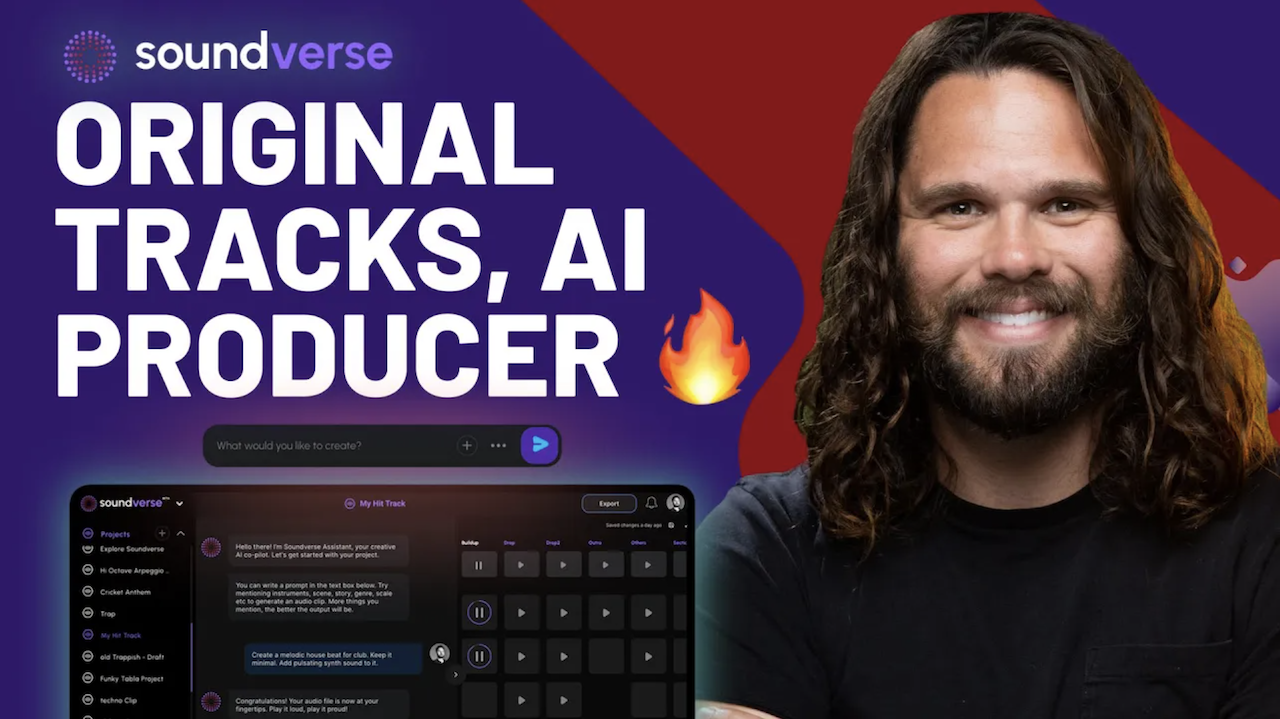
Here’s another long walkthrough of how to use Soundverse AI.
Text Guide
- To know more about AI Magic Tools, check here.
- To know more about Soundverse Assistant, check here.
- To know more about Arrangement Studio, check here.
Soundverse is an AI Assistant that allows content creators and music makers to create original content in a flash using Generative AI. With the help of Soundverse Assistant and AI Magic Tools, our users get an unfair advantage over other creators to create audio and music content quickly, easily and cheaply. Soundverse Assistant is your ultimate music companion. You simply speak to the assistant to get your stuff done. The more you speak to it, the more it starts understanding you and your goals. AI Magic Tools help convert your creative dreams into tangible music and audio. Use AI Magic Tools such as text to music, stem separation, or lyrics generation to realise your content dreams faster. Soundverse is here to take music production to the next level. We're not just a digital audio workstation (DAW) competing with Ableton or Logic, we're building a completely new paradigm of easy and conversational content creation.
TikTok: https://www.tiktok.com/@soundverse.ai
Twitter: https://twitter.com/soundverse_ai
Instagram: https://www.instagram.com/soundverse.ai
LinkedIn: https://www.linkedin.com/company/soundverseai
Youtube: https://www.youtube.com/@SoundverseAI
Facebook: https://www.facebook.com/profile.php?id=100095674445607
Join Soundverse for Free and make Viral AI Music

We are constantly building more product experiences. Keep checking our Blog to stay updated about them!