AI Music for Classical Compositions: Can It Work?
Explore how AI music tools like Soundverse can shape classical composition, orchestral AI, and symphony creation in 2026.
AI Music for Classical Compositions: Can It Work?
In 2026, the intersection of artificial intelligence and classical music composition has become one of the most debated and fascinating areas in the creative technology world. The question many are asking is: can AI music for classical compositions truly capture the emotion, nuance, and complexity of human-composed orchestral works? As AI continues to evolve, its applications extend beyond modern genres like EDM or lofi and increasingly reach into symphonic and orchestral spaces once considered untouchable by algorithms.
What makes classical composition different from other forms of AI music?
Classical music demands precision, emotional depth, and long-form structural coherence. A symphony, concerto, or chamber suite involves intricate relationships between harmonic progressions, thematic development, and instrumentation. Unlike compact genres optimized for quick loops, classical pieces often span multiple movements and employ variations, modulations, and dynamic contrasts. This makes applying AI music for classical compositions uniquely challenging.
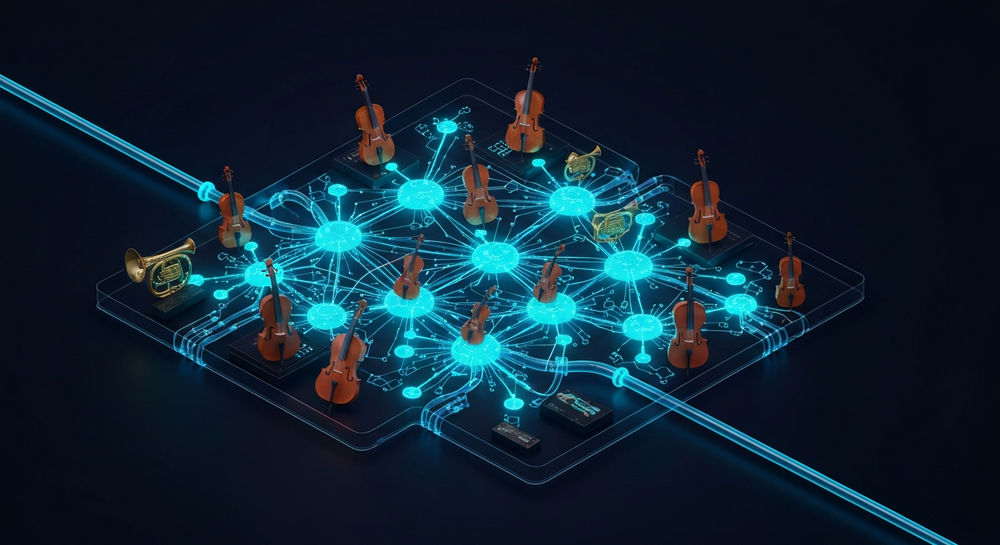
Modern AI systems excel at generating short, repetitive sequences—soundscapes ideal for background music or game loops. However, classical ai composition requires the ability to maintain narrative continuity, rising tension, and final resolution across extended durations. In this sense, orchestral ai has to do more than sound pretty—it has to think musically.
How have AI and classical music evolved up to 2026?
Since 2024, the pace of development in symphony ai models has accelerated. Early explorations were mostly academic—universities and labs testing neural networks trained on Bach or Mozart datasets as referenced in AI Classical Music Generation: How Artificial Intelligence is reshaping orchestral composition. By 2025, commercial platforms began offering partial orchestral simulations using AI. As of 2026, tools like Soundverse and similar AI systems have refined text-to-music models capable of describing tone, instrumentation, and tempo with impressive results.

Yet, this still raises the critical question: can artificial intelligence truly understand the intent behind a classical work? Composers of the Romantic and Baroque eras were driven by emotion and cultural insight. Translating those sensibilities into code remains the largest creative gap AI must bridge.
What are the biggest challenges in AI music for classical compositions?
- Structural complexity: Classical pieces often feature multiple movements, each with distinct tonal centers. Long-form generation tests the limits of neural continuity.
- Orchestral realism: Reproducing the full timbral richness of an orchestra—including subtle articulations like pizzicato or vibrato—requires finely tuned instrument modeling.
- Emotional interpretation: AI can mimic mood keywords like “melancholic” or “majestic,” but sustaining emotional development throughout a 30-minute symphony is difficult.
- Human feel: Classical composition thrives on imperfection—the slight tempo fluctuations of a live ensemble. AI-generated music may sound polished but sterile if not engineered carefully.
Ethical resonance
Integrating AI into classical artistry also raises ethical questions. Can an algorithm be credited as a composer? Should royalties flow to the developers, or the human prompters guiding the AI? To address such questions, frameworks like the Ethical AI Music Framework—an initiative embraced by Soundverse—ensure consent, attribution, and ongoing compensation for creators influencing the AI output.
Are orchestral AI and symphony AI generating new creative possibilities?
Despite limitations, AI offers exciting new frontiers for classical composers and producers. Symphony ai tools can assist humans in sketching orchestral ideas faster, testing harmonic variations, or developing background symphonic cues for films and video games. Furthermore, hybrid compositions—where humans write core melodies and AI layers supporting harmonies—are emerging as a creative norm.
This collaborative model redefines authorship. A composer might use AI as an assistant, not a replacement—similar to how digital audio workstations revolutionized the composing process decades ago.
For example, when composers feed thematic text prompts like “ethereal strings rising into triumph” or “baroque harpsichord under reverent brass,” contemporary AI engines can generate rich instrumental results. These become bases for further orchestration and refinement.
How to make AI classical music with Soundverse AI Music Generator
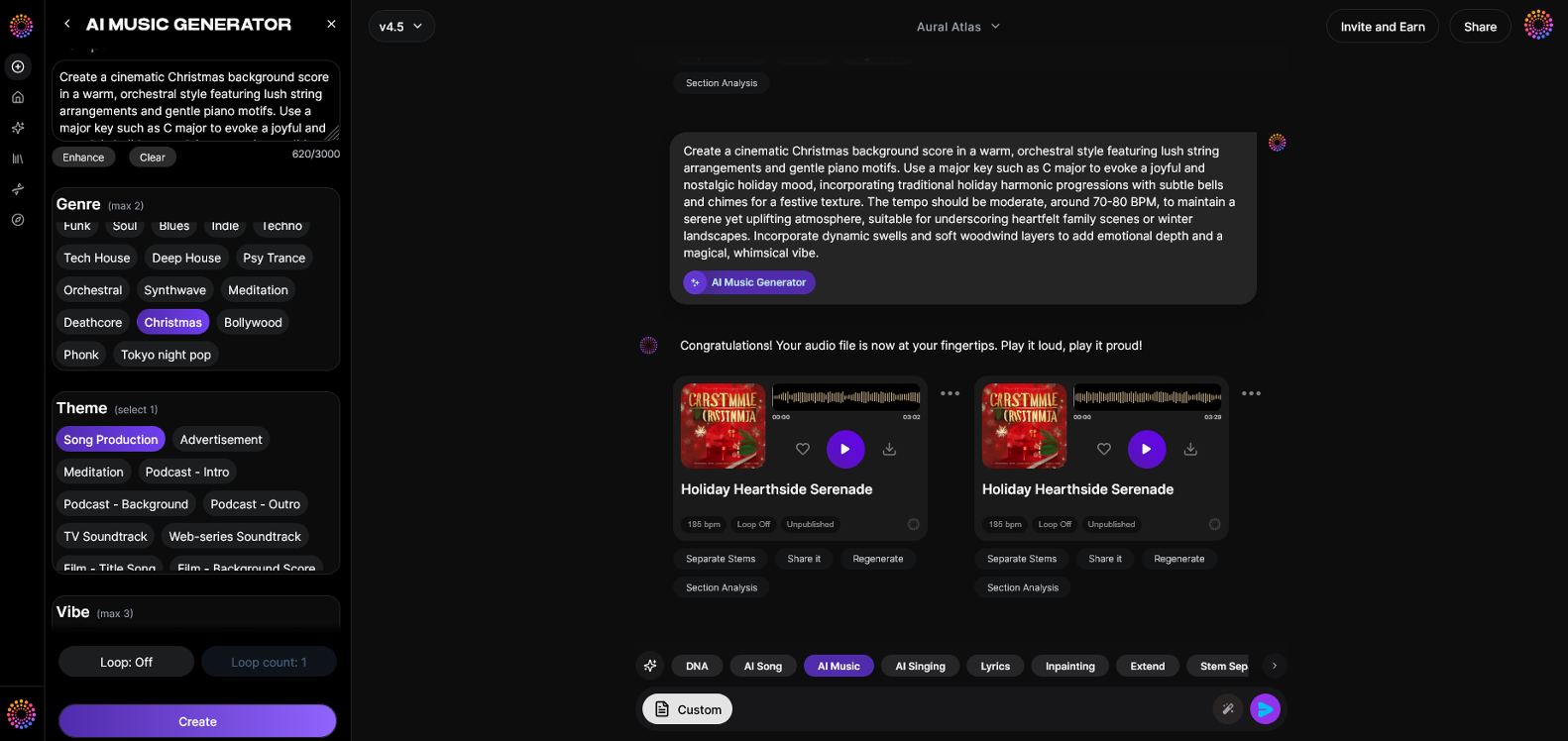
Soundverse’s AI Music Generator stands at the frontier of orchestral AI experimentation. It allows creators to produce instrumental arrangements purely from text prompts—an ideal tool to test how artificial intelligence interprets classical idioms.
Feature Overview:
Soundverse’s generator creates fully produced instrumental music based on descriptive text input. It specializes in background tracks, cinematic soundscapes, and non-vocal compositions with options for seamless looping. The workflow revolves around detailed control over genre, mood, and instrument arrangement through its V4 and V5 model options.
Why it fits classical composition
While primarily designed for instrumental and ambient generation, Soundverse’s control architecture lets users define complex orchestral textures. A composer can specify “string quartet with slow crescendo,” “romantic piano nocturne,” or “epic symphony with brass and timpani.” Through this system, the AI interprets descriptors and builds appropriate harmonic and rhythmic frameworks.
For projects involving thematic consistency or film scoring, users can leverage the Loop Mode to integrate recurring motifs across sections. Although not specifically engineered for multi-movement symphonies, this functionality gives classical musicians enough structure for developing cohesive themes.
Additionally, the V5 Model enhances detail at an instrument level, making timbre selection closer to acoustic realism. Conductors and producers can thus explore orchestral ai not only as a generative novelty but as a valid creative supplement.
For users wishing to blend AI arrangements with human melodic inputs, Soundverse’s Melody to Song Generator complements this workflow. It transforms recorded melodies (via humming or played instrument) into complete arranged compositions—bridging the gap between manual inspiration and AI orchestration.
Those seeking stylistic continuity from existing recordings may turn to the Similar Music Generator, which reproduces instrumental works in the same spirit as given reference tracks. This proves invaluable for film studios needing classical cues harmonically similar to licensed scores.
You can read more about complementary platforms and AI tool comparisons in related insights such as Soundverse vs Soundraw and Mubert alternatives.
For a deeper dive into Soundverse tools, watch the tutorial on how to make music or explore our guide to the “Explore” tab on YouTube.
How are composers using AI in classical creation today?
Composers increasingly treat AI systems as nuanced co-creators. Instead of relying on them for finished symphonies, they use outputs as sketches—starting points to expand harmonically or instrumentally. AI models assist with pattern recognition, providing variants of Bach-style counterpoint or minimalist repetition akin to Philip Glass.
Large music institutions are also deploying symphony ai for educational initiatives, training students in orchestration by generating prompt-based examples instantly. It has democratized creative learning—students can examine how certain descriptors translate into orchestrations without waiting for ensemble rehearsals.
To explore further directions, check out how AI-generated music transforms the modern industry or browse Soundverse’s text-to-music generation guide.
Why does emotional authenticity still matter?
A central issue remains: classical music is deeply human. From Debussy’s color harmonies to Beethoven’s structural rigor, emotion drives architecture. AI music for classical compositions must honor that human expressivity. The ongoing challenge is less about technological limitation and more about philosophical interpretation—can data learn emotion?
In 2026, composers experiment with hybrid models where AI drafts harmonic bases and humans refine the expression through articulation and phrasing. The results show promise—some orchestral ai outputs convey convincing dramatic arcs when carefully directed through human oversight.
The ethical and creative path ahead
As cultural institutions adapt to the rise of symphony ai, many emphasize transparency and consent. The Ethical AI Music Framework pioneered by Soundverse exemplifies this approach. It ensures that all data sources used in training maintain proper attribution and fair compensation—critical when dealing with historical archives of classical performances.
This emphasis safeguards not only original composers' rights but also promotes trust among modern musicians integrating AI into traditional genres.
Can AI truly compose like Mozart or Beethoven?
The short answer: not yet, but it can approximate stylistic fingerprints remarkably well. AI can identify harmonic cadences typical of Classical period writing and craft phrases that feel authentic. Nevertheless, originality—the emotional urgency and philosophical intent—remains a human domain.
By 2026, it’s clear that AI’s role in classical composition will be collaborative rather than competitive. It provides speed, options, and inspiration, while humans provide emotion, structure, and meaning.
Experience the Future of Classical Composition with AI
Create timeless symphonies powered by Soundverse's intelligent music tools. Blend human artistry with advanced AI to compose, orchestrate, and experiment like never before.
Start Composing with Soundverse
Related Articles
- AI Music Generator and Human Composers: A Future Together — Discover how AI is collaborating—not competing—with human composers to create groundbreaking music.
- The Role of AI Music in Film and Television — Explore how AI-generated music is reshaping scoring and production across cinematic and TV landscapes.
- The Benefits of Composing with AI Music Generator — Learn how AI composition tools unlock creativity and precision for modern musicians and producers.
- How AI-Generated Music Is Transforming the Music Industry — Understand the sweeping changes AI music generation is bringing to traditional and modern music domains.
Here's how to make AI Music with Soundverse
Video Guide

Here’s another long walkthrough of how to use Soundverse AI.
Text Guide
- To know more about AI Magic Tools, check here.
- To know more about Soundverse Assistant, check here.
- To know more about Arrangement Studio, check here.
Soundverse is an AI Assistant that allows content creators and music makers to create original content in a flash using Generative AI. With the help of Soundverse Assistant and AI Magic Tools, our users get an unfair advantage over other creators to create audio and music content quickly, easily and cheaply. Soundverse Assistant is your ultimate music companion. You simply speak to the assistant to get your stuff done. The more you speak to it, the more it starts understanding you and your goals. AI Magic Tools help convert your creative dreams into tangible music and audio. Use AI Magic Tools such as text to music, stem separation, or lyrics generation to realise your content dreams faster. Soundverse is here to take music production to the next level. We're not just a digital audio workstation (DAW) competing with Ableton or Logic, we're building a completely new paradigm of easy and conversational content creation.
TikTok: https://www.tiktok.com/@soundverse.ai
Twitter: https://twitter.com/soundverse_ai
Instagram: https://www.instagram.com/soundverse.ai
LinkedIn: https://www.linkedin.com/company/soundverseai
Youtube: https://www.youtube.com/@SoundverseAI
Facebook: https://www.facebook.com/profile.php?id=100095674445607
Join Soundverse for Free and make Viral AI Music

We are constantly building more product experiences. Keep checking our Blog to stay updated about them!