AI Music Detection Tools: Accuracy & Limitations in 2026
Explore AI music detection tools, their accuracy, and limitations. Learn how Soundverse Trace ensures song authenticity & rights protection.
AI Music Detection Tools: Accuracy & Limitations
In 2026, music production and distribution have reached a pivotal moment as artificial intelligence reshapes audio creation. For producers, rights managers, and creators, one challenge dominates: determining whether a track was created by a human or generated by AI. This demand for transparency has accelerated the rise of AI music detection tools, which evaluate detection accuracy and verify song authenticity.
What Are AI Music Detection Tools?
AI music detection tools are specialized algorithms designed to analyze audio content and determine whether it was AI-generated or human-produced. These systems use pattern recognition, spectral analysis, and metadata tracing to identify synthetic fingerprints left by generative models. In 2026, they are essential for managing ethical AI usage in commercial releases, social media soundtracks, and royalty-based licensing.
Producers now rely on these detectors for music verification, ensuring their catalogs remain compliant with copyright and distribution regulations. AI researchers analyze detection accuracy to improve watermarking standards, while digital rights professionals depend on them for automated compliance audits.

How Do AI Music Detection Tools Work?
Most AI detector apps use advanced machine learning and deep audio inspection techniques. They dissect waveform structures, texture irregularities, and frequency behaviors common to generative networks.
The process generally includes:
- Waveform Feature Extraction: Identifies micro-patterns in sound formation indicating neural-generation characteristics.
- Spectral Fingerprint Comparison: Matches audio fingerprints with known AI model signatures.
- Metadata Auditing: Reads hidden data tags or watermark traces embedded by creation tools.
- Probability Scoring: Delivers statistical confidence levels showing whether the material stems from AI or authentic recording.
This multi-step verification process underpins modern AI audio analysis, bridging scientific precision and creative ethics.

How Accurate Are AI Music Detection Tools in 2026?
Detection accuracy varies based on training datasets and watermark strength. In 2024, many detectors struggled with false positives, unable to differentiate highly processed human audio from AI-generated tracks. By 2026, however, algorithmic refinements have raised the average reliability threshold dramatically.
Current AI detectors achieve roughly 85–93% detection accuracy when analyzing professionally produced tracks. The most advanced models integrate watermark-based verification rather than relying solely on surface-level pattern analysis, achieving near-perfect precision under controlled environments. External reports like Resemble AI and Deezer’s AI detection announcement confirm this increasing precision, even rivaling 99% accuracy in some cases.
Key factors influencing accuracy include:
- Dataset diversity used during AI model training.
- Compression quality and export format of the file.
- Presence of inaudible fingerprints or attribution logs.
- Sampling rate and mixing dynamics that may mask AI traits.
As AI music production tools expand—such as text-to-music platforms described in Soundverse AI Magic Tools—the demand for reliable verification frameworks equally intensifies.
For an example of workflow integration, watch our tutorial on how to make music or explore the Deep House creation guide from the Soundverse Tutorial Series.
What Are the Limitations of AI Music Detection Tools?
Despite progress, no detection system is completely foolproof. Limitations persist due to evolving generative networks and hybrid workflows where human and machine creativity merge seamlessly.
Common limitations include:
- False Negatives: AI-generated songs that evade detection because of advanced data smoothing.
- Model Confusion: Tracks created using mixed AI models can produce conflicting attribution results.
- Post-Processing Interference: Mastering or compression can distort watermark signals.
- Limited Dataset References: Detectors fail if they have not indexed newer AI model fingerprints.
- Ethical Ambiguity: Sometimes, creators intentionally obscure AI involvement for stylistic or commercial advantage.
These challenges emphasize the necessity of integrated transparency frameworks that go beyond raw detection and instead establish traceability across the entire content lifecycle.
Why Is AI Music Verification Important in 2026?
Music verification serves both legal and creative purposes. Rights organizations use detectors to facilitate royalty distribution, content creators ensure their soundtracks comply with platform policies, and audio researchers benchmark model evolution.
Without rigorous song authenticity checking, marketplaces risk unintentional copyright infringement. Verified attribution protects both independent artists and AI developers who invest in ethical model creation. It also promotes fair compensation through transparent rights tagging.
As automated content creation grows, especially across video and streaming platforms explored in music industry trends, standardizing verification ecosystems becomes not only beneficial but necessary.
What Emerging Technologies Are Shaping AI Audio Analysis?
By 2026, we are witnessing a convergence of three major technological approaches:
- Audio Watermarking Systems: Embedding hidden verification codes inside waveforms while maintaining sound integrity.
- Data Attribution Networks: Tracking which training data elements influenced the output.
- Deep Search Engines: Performing 1:1 and 1:N audio fingerprint comparisons across global databases.
These technologies create a foundation for trustworthy AI collaboration. They also influence future licensing models like recurring usage-based royalties planned under frameworks such as Soundverse’s Content Partner Program, where rights-holders contribute training data ethically.
How Soundverse Trace Elevates Detection Accuracy
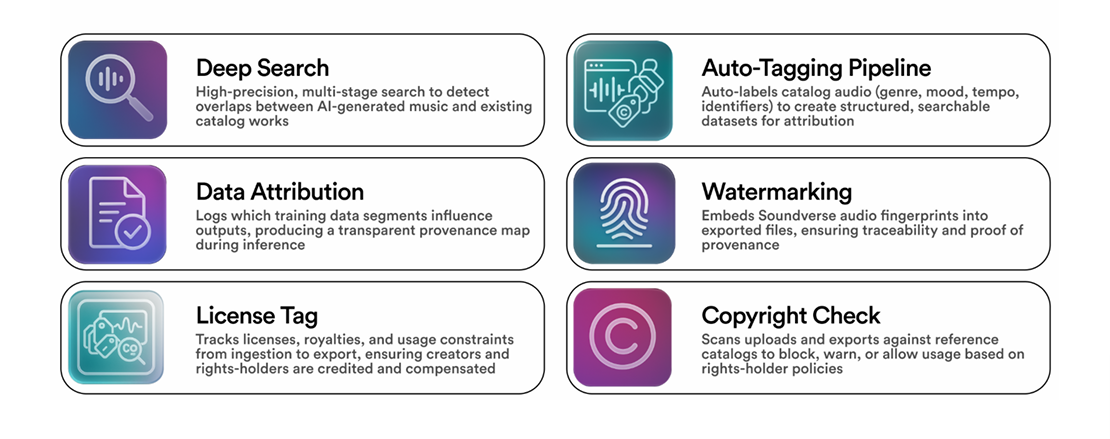
Soundverse Trace stands as a comprehensive trust layer for AI music designed to safeguard authenticity from dataset creation to final track delivery. Its technological architecture integrates several critical capabilities:
- Deep Search: Conducts high-precision scans (both 1:1 and 1:N) to locate overlaps or replicated audio fragments.
- Data Attribution: Logs which dataset elements influenced the generated output, ensuring auditable transparency.
- Audio Watermarking: Embeds robust, inaudible fingerprints into compositions for post-release verification.
- License Tagging: Preserves rights metadata seamlessly through ingestion, editing, and export phases.
These functionalities prevent copyright infringement in AI outputs, track catalog usage for royalties, and aid in music verification at scale. The asynchronous workflow—upload or record audio, process via Trace, and receive analysis results—matches industry compliance needs precisely.
To see how this ecosystem integrates with creative workflows, you can explore AI music generation concepts or review methods for creating a faceless video message, illustrating how production integrity aligns with technological innovation.
For exploration, learn about the Explore tab in the Soundverse tutorial series, which shows practical organization methods for music verification and AI audio behavior tracking.
How the Ethical AI Music Framework Strengthens Authenticity
Soundverse Trace connects directly to the Ethical AI Music Framework, an infrastructure redefining responsible AI artistry. By replacing opaque processes with a transparent, six-stage pipeline, it ensures consent, attribution, and recurring compensation throughout model usage. This holistic integration verifies both technological precision and moral accountability—key pillars for sustainable AI music ecosystems.
Discover the Next Generation of AI Music Tools
Unlock powerful AI-driven music creation, editing, and analysis features with Soundverse. Create professional-quality tracks effortlessly while staying ahead in the evolving world of AI music technology.
Get Started for Free
Related Articles
- How AI-Generated Music Is Transforming the Music Industry — Explore how AI innovations are reshaping music production, creativity, and the roles of artists worldwide.
- AI Music Generator and Human Composers: A Future Together — Discover the collaborative potential between AI music tools and human creativity for a more dynamic artistic future.
- The Role of AI Music in Film and Television — Learn how AI-generated compositions are changing scoring workflows for filmmakers and content creators.
- Best AI Music Generator: Top Picks and Review — Compare leading AI music generation platforms to find the best tools for your creative needs.
Here's how to make AI Music with Soundverse
Video Guide
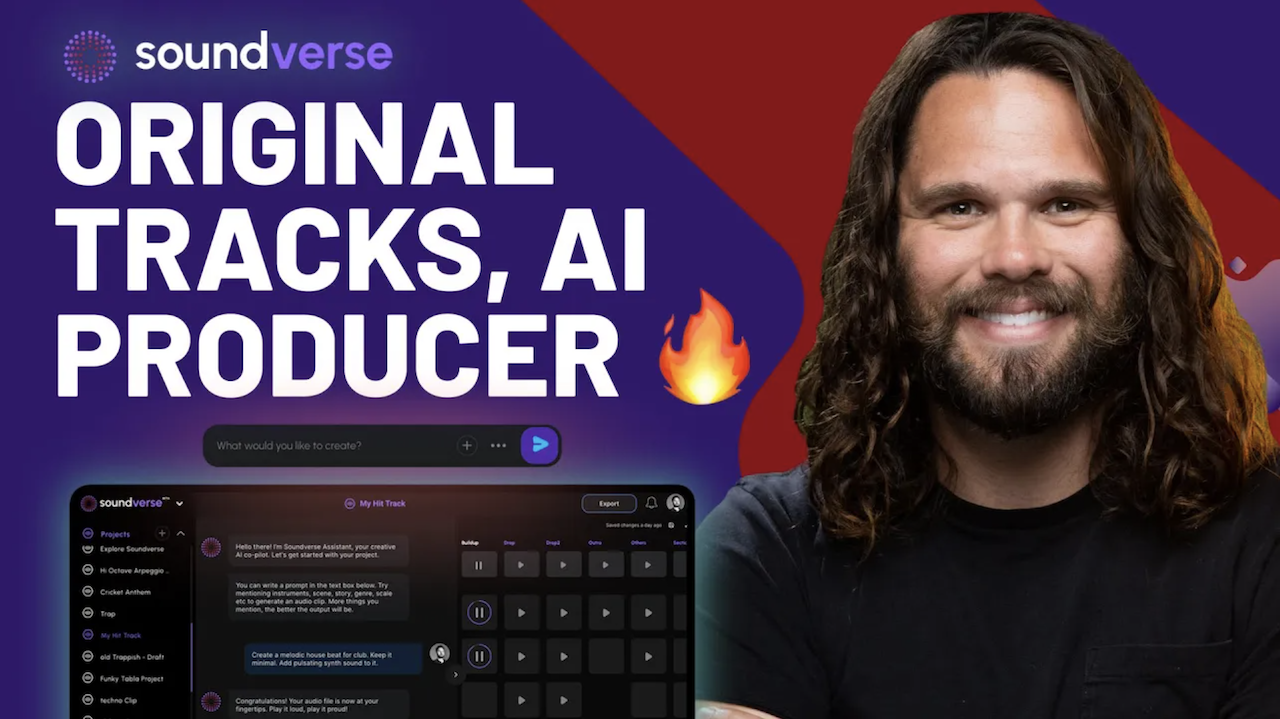
Here’s another long walkthrough of how to use Soundverse AI.
Text Guide
- To know more about AI Magic Tools, check here.
- To know more about Soundverse Assistant, check here.
- To know more about Arrangement Studio, check here.
Soundverse is an AI Assistant that allows content creators and music makers to create original content in a flash using Generative AI.
With the help of Soundverse Assistant and AI Magic Tools, our users get an unfair advantage over other creators to create audio and music content quickly, easily and cheaply.
Soundverse Assistant is your ultimate music companion. You simply speak to the assistant to get your stuff done. The more you speak to it, the more it starts understanding you and your goals.
AI Magic Tools help convert your creative dreams into tangible music and audio. Use AI Magic Tools such as text to music, stem separation, or lyrics generation to realise your content dreams faster.
Soundverse is here to take music production to the next level. We're not just a digital audio workstation (DAW) competing with Ableton or Logic, we're building a completely new paradigm of easy and conversational content creation.
TikTok: https://www.tiktok.com/@soundverse.ai
Twitter: https://twitter.com/soundverse_ai
Instagram: https://www.instagram.com/soundverse.ai
LinkedIn: https://www.linkedin.com/company/soundverseai
Youtube: https://www.youtube.com/@SoundverseAI
Facebook: https://www.facebook.com/profile.php?id=100095674445607
Join Soundverse for Free and make Viral AI Music

We are constantly building more product experiences. Keep checking our Blog to stay updated about them!