AI Music and the Shift From Ownership to Access-Based Creativity in 2026
Discover how AI music transforms ownership into access-based creativity in 2026.
AI Music and the Shift From Ownership to Access-Based Creativity
Introduction: Why AI Music Redefines Creative Ownership in 2026
In 2026, the music industry has evolved beyond the traditional ownership model. Artists, producers, and creators are now embracing an era where AI music and music streaming converge to form a new ecosystem driven by accessibility, personalization, and transparency. The paradigm shift from ownership to access-based creativity is not merely a business transformation—it represents a cultural, technological, and ethical realignment.
Artificial intelligence has transformed how music is composed, produced, and distributed. Yet, amid this transformation, debates around digital ownership, rights management, and artistic integrity have intensified. As labels and creators look to machine learning in music to scale production, the industry is facing a pressing question: How can we ensure innovation without sacrificing fairness?
For professionals and researchers navigating this evolving landscape, 2026 is the year where AI-driven creativity and ethical infrastructure finally intersect.
What Is Driving the Shift From Ownership to Access in AI Music?
The shift from owning music files to accessing vast libraries through digital platforms has been underway for over a decade, but AI music creation has accelerated this transformation. Several key forces are driving this evolution:
1. The Streaming Economy Has Changed Consumer Behavior
Listeners today expect immediate access to millions of songs via music streaming services rather than purchasing albums. The rise of subscription models has de-emphasized ownership, turning listening into a utility-like experience. Platforms that once offered downloads now focus on algorithmic discovery, playlists, and personalized recommendations. Streaming data already shows how AI is integrated into music recommendation systems, as noted in State of the Music Industry 2026: Trends & Predictions - iMusician.
2. Creators Now Value Reach Over Possession
In 2026, musicians and producers increasingly view creativity as a collaborative and distributed ecosystem. Access-based creativity allows them to tap into shared AI tools, datasets, and feedback loops rather than hoarding intellectual property. The goal is not just to own a track but to participate in an ever-expanding network of co-creation.
3. Machine Learning and Democratized Creation
Advancements in machine learning in music have made it possible for anyone to generate high-quality tracks in seconds. The recent wave of models trained on ethically sourced data means novices and professionals alike can produce commercially viable songs without massive budgets. This democratization parallels trends discussed in how AI-generated music is transforming the music industry. For a deeper dive, watch our guide on creating Deep House music.
4. Transparency and Consent Are Now Non-Negotiable
While 2024 and 2025 brought massive innovation, they also exposed the dark side of opaque AI training methods. Lawsuits and ethical debates pushed platforms to become transparent in how they source, train, and generate content. As a response, the industry now demands systems that embed attribution and consent at every stage of generation.
How AI Music Is Reshaping the Meaning of Creative Ownership

Traditional copyright has hinged on exclusive control—having the right to reproduce and monetize one’s creation. However, in 2026, creative value is determined by access, collaboration, and attribution rather than possession.
From Static Files to Dynamic Streams
AI-generated music behaves differently from traditional recordings. Rather than one finalized track, AI systems can continuously remix and personalize audio for different contexts—advertising, gaming, or film. The dynamic nature of AI-driven creativity challenges static copyright models that rely on fixed versions, as discussed in Music Industry Predictions for 2026: Trends & Forecasts - Revelator.
Attribution as the New Currency
The rise of ethical AI frameworks ensures that original artists are credited even when their data influences new AI-generated tracks. Attribution becomes a quantifiable and trackable asset, supported by watermarking and deep search systems that safeguard creative integrity.
The Rise of Algorithmic Collaborations
Co-creating with algorithms has become standard practice. Artists now train customized AI assistants on their catalogues or styles, similar to projects described in AI ranks Soundverse’s AI Singer #1. Rather than viewing AI as competition, professionals see it as an extension of their creative vocabulary—a new instrument for ideation and production. Interested creators can also explore practical workflows through Soundverse Tutorial Series - 9. How to Make Music.
What Challenges Still Exist in Access-Based Creativity?
The shift to AI-powered creativity introduces several complex challenges:
- Data Consent and Provenance: Ensuring that models are trained only on licensed and permissioned datasets remains a critical concern.
- Compensation Models: In a world of streaming and continuous remixing, determining how royalties flow to contributors is complex.
- Cultural Bias: AI systems tend to reflect the biases of their training data, potentially marginalizing lesser-known genres and regions.
- Sustainability: Energy-intensive model training has prompted discussions about green AI practices in music infrastructure.
Despite these obstacles, the momentum behind AI music continues to build, supported by frameworks designed to address exactly these ethical and technical issues.
How to Make AI Music Ethical and Transparent with Soundverse’s Ethical AI Music Framework
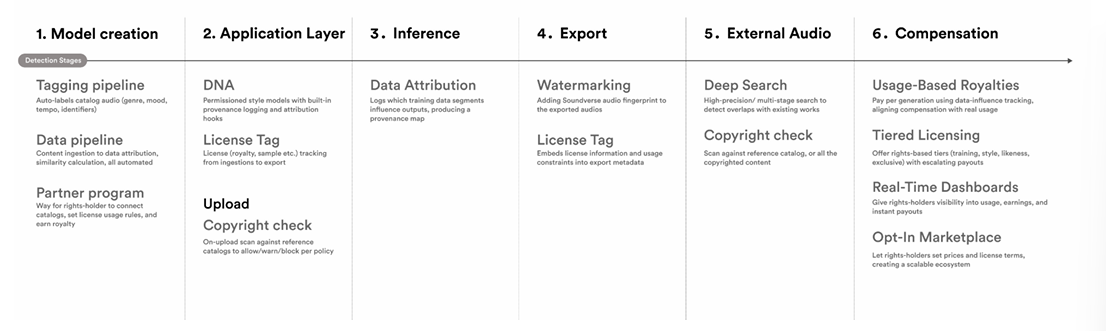
Soundverse recognizes that the next phase of AI-driven creativity requires infrastructure that safeguards both innovation and integrity. The Ethical AI Music Framework is its comprehensive response—a transparent architecture built to establish trust across the creative pipeline.
What Is the Ethical AI Music Framework?
The Ethical AI Music Framework bridges the gap between AI innovation and artist integrity. Unlike black-box systems, it replaces ambiguity with a six-stage pipeline ensuring full traceability and fairness.
The Six Stages That Power Ethical AI Music
- Licensed Data Sourcing: No scraping or unauthorized content capture—training only on verified, licensed datasets.
- Permissioned Models (DNA): AI engines are trained with explicit permissions, enabling creators to embed their unique sonic DNA into models.
- Explainable Inference (Attribution): Every generation includes metadata that connects back to the data and rights holders.
- Traceable Export (Watermarking): Whenever music is exported, invisible watermarking ensures that sources remain provable.
- Deep Search (External Scanning): An ongoing verification mechanism detects and links uncredited or unauthorized use outside the platform.
- Recurring Compensation (Partner Program): Artists and rights-holders receive automated, usage-based compensation through the Content Partner Program.
How These Stages Enable the Access Economy
This framework redefines ownership by turning rights management into traceable participation. Artists no longer need to fear data misuse; instead, they benefit from recurring revenue each time their influence is algorithmically deployed. This creates a virtuous cycle where access expands opportunity rather than diminishing control.
Supporting Tools That Amplify Creative Trust
- Soundverse Trace: Extends attribution and rights protection across the lifecycle of AI-generated music.
- Soundverse DNA: A permissioned music generator that ethically trains on artist-approved data to deliver authentic soundscapes aligned with specific creative identities.
Creators can explore how these tools converge in resources such as Generate AI music with Soundverse Text-to-Music and Soundverse AI Magic Tools. For another hands-on example, see Soundverse Tutorial Series - 8. "Explore" Tab.
What Does the Future of Creative Technology Look Like?
By 2026, the merger of AI systems and creative technology marks a new stage in digital artistry:
- Access Over Ownership: Artists are shifting toward platforms that let them co-create, license, and share without sacrificing authenticity.
- Ethical AI as a Standard: Transparent AI standards are replacing opaque models in the professional music domain.
- Hybrid Collaboration: Human creativity blended with AI augmentation is redefining workflows, from film scoring to advertising composition. The model is explored further in AI Music in the USA.
This combines the efficiency of algorithms with the emotion of human input, fostering creativity that is more inclusive, continuous, and monetizable.
Start Creating Music with AI Today
Transform your ideas into original compositions using Soundverse’s advanced AI music generator. Experience effortless creativity and explore limitless genres without any technical barriers.
Related Articles
- How AI-Generated Music Is Transforming the Music Industry: Discover how AI-driven tools are revolutionizing production, distribution, and creativity in today’s music scene.
- AI Music Generator and Human Composers: A Future Together: Learn how AI music tools are enhancing, not replacing, the artistry of human composers.
- The Role of AI Music in Film and Television: Explore how AI-generated music is shaping soundtracks and storytelling in visual media.
- The Benefits of Composing with an AI Music Generator: Uncover how AI tools can speed up your workflow and inspire new musical directions.
Here's how to make AI Music with Soundverse
Video Guide
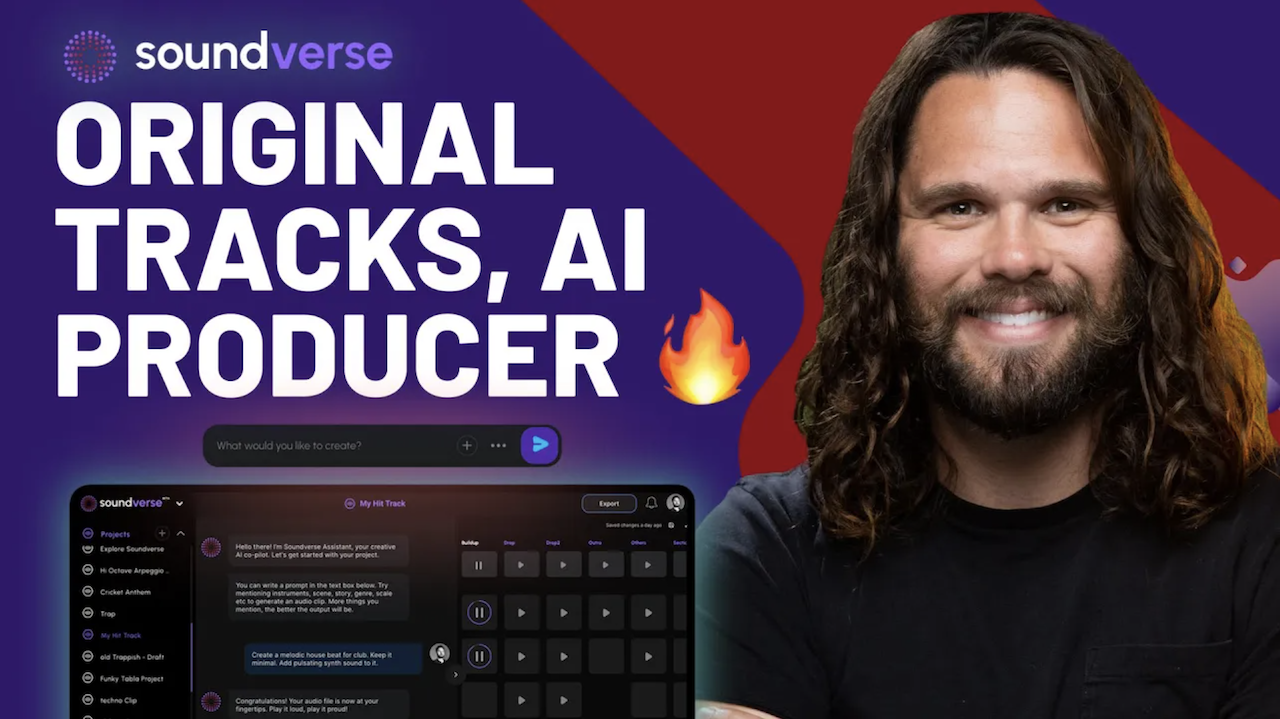
Here’s another long walkthrough of how to use Soundverse AI.
Text Guide
- To know more about AI Magic Tools, check here.
- To know more about Soundverse Assistant, check here.
- To know more about Arrangement Studio, check here.
Soundverse is an AI Assistant that allows content creators and music makers to create original content in a flash using Generative AI. With the help of Soundverse Assistant and AI Magic Tools, our users get an unfair advantage over other creators to create audio and music content quickly, easily and cheaply. Soundverse Assistant is your ultimate music companion. You simply speak to the assistant to get your stuff done. The more you speak to it, the more it starts understanding you and your goals. AI Magic Tools help convert your creative dreams into tangible music and audio. Use AI Magic Tools such as text to music, stem separation, or lyrics generation to realise your content dreams faster. Soundverse is here to take music production to the next level. We're not just a digital audio workstation (DAW) competing with Ableton or Logic, we're building a completely new paradigm of easy and conversational content creation.
TikTok: https://www.tiktok.com/@soundverse.ai
Twitter: https://twitter.com/soundverse_ai
Instagram: https://www.instagram.com/soundverse.ai
LinkedIn: https://www.linkedin.com/company/soundverseai
Youtube: https://www.youtube.com/@SoundverseAI
Facebook: https://www.facebook.com/profile.php?id=100095674445607
Join Soundverse for Free and make Viral AI Music

We are constantly building more product experiences. Keep checking our Blog to stay updated about them!