YouTube AI Music Labeling Requirements (2026): What Creators Need to Know
Learn the latest 2026 YouTube AI music labeling requirements and discover how Soundverse Trace ensures compliance and transparency.
YouTube AI Music Labeling Requirements (2026)
In 2026, the conversation around AI-generated music has shifted from novelty to necessity. With millions of creators using AI tools to generate, remix, and publish music on platforms like YouTube, a new era of accountability and transparency has arrived. One of the most defining developments this year is the introduction of YouTube AI music labeling requirements—a policy designed to bring clarity to audiences and protect rights holders.
What are YouTube AI music labeling requirements in 2026?

YouTube’s 2026 AI music labeling requirements demand that any video containing AI-generated audio or music must include clear disclosure in both metadata and visual indicators. This aligns with the platform’s broader AI content disclosure initiative introduced in late 2025. The policy aims to prevent confusion among listeners by ensuring viewers know when synthetic or AI-assisted audio is used.
Creators are now required to specify if:
- The music track was fully generated by an AI model.
- The vocals replicate an existing artist’s style or voice using machine learning.
- The composition involved AI-assisted arrangement or production.
These labels appear both in the description field and via dedicated “AI Disclosure” tags visible within the video interface. For artists and producers, this marks a major shift in compliance—failure to apply YouTube’s AI policy can lead to limited visibility, demonetization, or even removal of content. To explore official details, review YouTube’s AI Content Policy or YouTube AI Generated Music Guidelines.
Why did YouTube introduce AI content disclosure rules?

The explosion of AI music technologies throughout 2024 and 2025 exposed significant blind spots in rights management and audience understanding. Deepfake vocals, cloned styles, and derivative instrumental compositions created legal and ethical ambiguity. By 2026, lawmakers, platforms, and industry associations collaborated to establish transparency standards.
YouTube’s AI content disclosure policy stems from three major drivers:
- Transparency: Viewers deserve to know whether they’re listening to an original human performance or an algorithmic recreation.
- Ethical Responsibility: Rights holders must be credited properly if their work contributed to AI model training.
- Market Stability: Advertisers and partners need reliable brand safety when supporting AI-generated content.
YouTube now treats AI disclosure similarly to music licensing—failure to comply may breach platform policy and affect monetization alike. Neal Mohan’s 2026 letter underscores this in YouTube’s plans to manage AI slop and boost transparency.
How do music creators comply with YouTube AI policy today?
Compliance involves properly identifying AI-generated elements during upload. Creators should review their project’s production pipeline before publishing to YouTube. Here’s how creators typically align with 2026 requirements:
- Accurate Metadata Labeling: Include AI generation details in the video description and audio metadata.
- Use Transparency Icons: Tag the video under YouTube’s “AI-generated” category when prompted.
- Maintain Attribution Logs: Keep records of which datasets or AI models contributed to the final track.
- Rights Verification: Confirm that the AI music model did not infringe upon third-party copyrights.
For channels using tools like Soundverse, transparency can be automated with the right infrastructure built into workflow. Music producers working with multiple AI generators, be it proprietary or third-party, are encouraged to unify compliance under a trust layer solution. For deeper insight, watch our tutorial on making music with Soundverse.
What are music AI transparency labels, and why are they important?
Music AI transparency labels indicate the origin and nature of a composition. They include disclosures such as “AI-Composed,” “AI-Assisted,” or “Voice Clone of [Artist].” These are vital for maintaining trust between creators, audiences, and partners. By 2026, these labels became standardized across major platforms—YouTube, Spotify, and TikTok all now require transparent disclosure when AI models participate in content creation.
Transparency labeling benefits:
- Fair Credit Allocation: Artists whose datasets train models are acknowledged.
- Better Audience Understanding: Reduces confusion about whether a song is human-made or machine-generated.
- Legal Protection: Helps creators defend originality claims when disputes arise.
YouTube enforces AI-generated music rules using its proprietary music content ID system enhanced by additional AI recognition layers, comparing waveform signatures and watermarking data for identification.
How Soundverse Trace ensures compliance with YouTube’s 2026 labeling standards
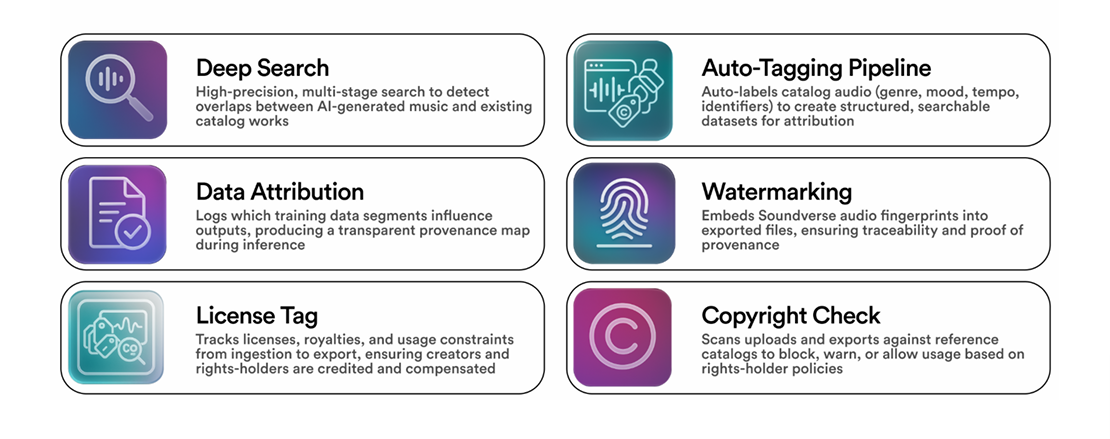
Soundverse Trace is the industry’s leading trust layer for AI music, designed to enable transparency, rights attribution, and compliance with platform regulations like YouTube’s AI policy. It embeds attribution, deep search capability, and rights protection from dataset creation to export.
Core Capabilities of Soundverse Trace:
- Deep Search: High-precision scanning (1:1, 1:N) detects overlaps between AI outputs and existing songs. This ensures creators can verify originality before uploading to YouTube.
- Data Attribution: Logs which training data influenced every generated audio element, providing evidence for transparency labels.
- Audio Watermarking: Embeds inaudible yet robust fingerprints within tracks to verify provenance across platforms.
- License Tagging: Preserves rights metadata and licensing information from ingestion to final export, streamlining YouTube compliance.
Soundverse Trace not only assists creators in aligning with YouTube’s AI music labeling requirements but also supports royalty tracking and automated payouts through the Content Partner Program, a licensing framework where rights-holders receive usage-based royalties when their data powers AI models. This builds alongside the Ethical AI Music Framework for integrity and consent in AI creation.
For more performance examples, check our YouTube Soundverse Tutorial Series - “Explore” Tab.
How to make YouTube AI music labeling compliance effortless with Soundverse Trace
Using Soundverse Trace simplifies creator obligations under YouTube’s AI-generated music rules. Instead of manually verifying datasets and disclosure details, Soundverse automates the traceability of every element in your AI composition.
Once creators upload or record audio, Soundverse processes each file asynchronously—no real-time monitoring, but a deep audit trail after analysis. After processing, the system provides logs showing which data contributed to generation and automatically embeds watermark IDs for future recognition on platforms like YouTube.
The result: AI producers can confidently disclose “Generated with Soundverse Trace verified origin data” under their YouTube upload without concern for missing compliance fields.
For creators exploring or comparing tools, see how Soundverse performs against competitors in resources such as Mubert alternatives, Soundraw alternative, or AI revolutionizing music creation. These guideposts help understand how Soundverse sits at the intersection of creativity and compliance.
How will AI-generated music rules evolve beyond 2026?
Experts predict continued tightening of attribution standards. As deepfake detection technologies advance, YouTube and similar platforms may integrate automatic labeling using watermark scans rather than manual disclosure. This means systems like Soundverse Trace will become foundational, enabling producers to pre-embed transparent origin tags recognizable across networks.
Looking forward, creators may also face AI licensing frameworks similar to conventional copyright management—where provenance, model influence, and dataset lineage define ownership shares. Transparent traceability will not just be regulatory—it will serve as the backbone of AI-era music royalties and ethical distribution.
Start Creating AI Music That Meets YouTube’s 2026 Labeling Rules
Stay compliant and creative with Soundverse’s intuitive AI music generation tools. Produce high-quality tracks tailored for YouTube and other platforms with full transparency.
Related Articles
- Enhancing YouTube Content with Royalty-Free and Copyright-Free Music Using Soundverse AI: Learn how to elevate your YouTube videos using legal, royalty-free music generated by Soundverse AI.
- Navigating the World of Royalty-Free and Copyright-Free Music Using Soundverse AI: Understand the nuances between royalty-free and copyright-free music to make informed choices for your creative projects.
- The Role of AI Music in Film and Television: Discover how AI-generated music is reshaping soundtracks and scoring across the entertainment industry.
- How AI-Generated Music Is Transforming the Music Industry: Explore how artificial intelligence is driving innovation and new opportunities for musicians and creators worldwide.
Here's how to make AI Music with Soundverse
Video Guide
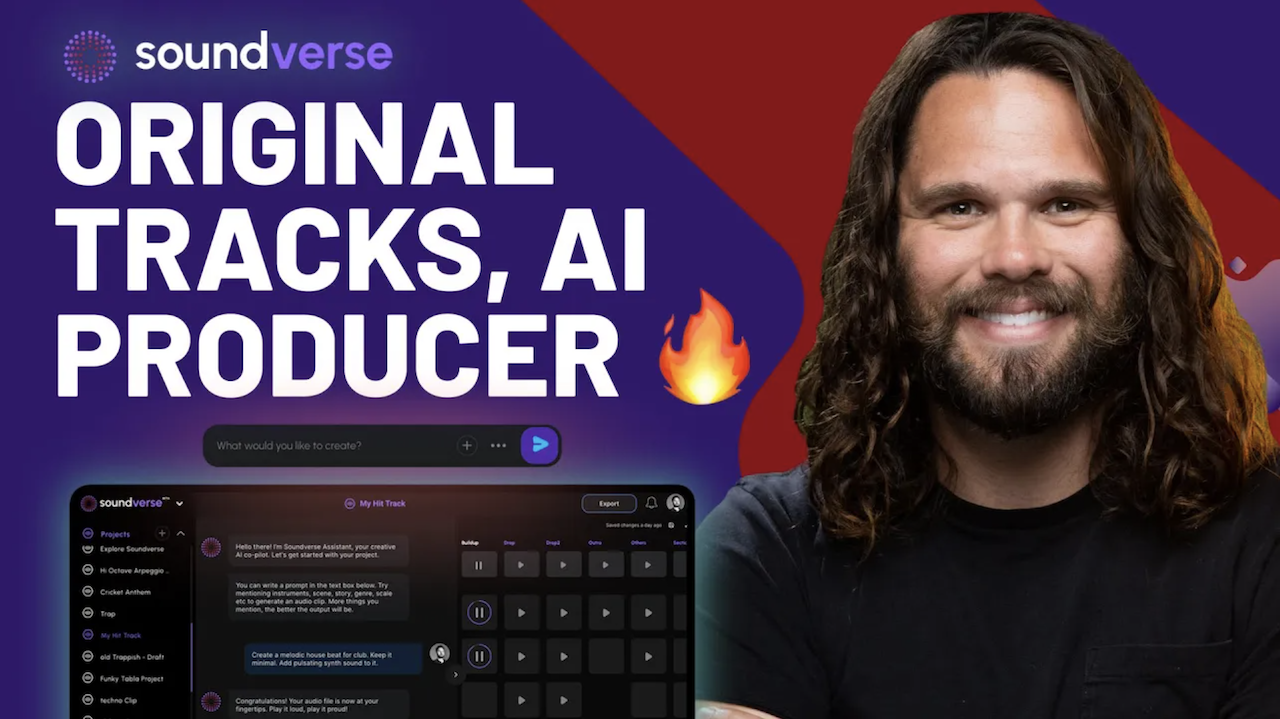
Here’s another long walkthrough of how to use Soundverse AI.
Text Guide
- To know more about AI Magic Tools, check here.
- To know more about Soundverse Assistant, check here.
- To know more about Arrangement Studio, check here.
Soundverse is an AI Assistant that allows content creators and music makers to create original content in a flash using Generative AI. With the help of Soundverse Assistant and AI Magic Tools, our users get an unfair advantage over other creators to create audio and music content quickly, easily and cheaply. Soundverse Assistant is your ultimate music companion. You simply speak to the assistant to get your stuff done. The more you speak to it, the more it starts understanding you and your goals. AI Magic Tools help convert your creative dreams into tangible music and audio. Use AI Magic Tools such as text to music, stem separation, or lyrics generation to realise your content dreams faster. Soundverse is here to take music production to the next level. We're not just a digital audio workstation (DAW) competing with Ableton or Logic, we're building a completely new paradigm of easy and conversational content creation.
TikTok: https://www.tiktok.com/@soundverse.ai
Twitter: https://twitter.com/soundverse_ai
Instagram: https://www.instagram.com/soundverse.ai
LinkedIn: https://www.linkedin.com/company/soundverseai
Youtube: https://www.youtube.com/@SoundverseAI
Facebook: https://www.facebook.com/profile.php?id=100095674445607
Join Soundverse for Free and make Viral AI Music

We are constantly building more product experiences. Keep checking our Blog to stay updated about them!
Image Steps: []