Would You Rather Lie to AI? Exploring Ethics and Truth in Artificial Intelligence
Explore AI ethics and truth—how humans interact, deceive, and shape morality in artificial intelligence systems in 2026.
Would You Rather Lie to AI? Exploring Ethics and Truth in Artificial Intelligence
In 2026, artificial intelligence has become deeply embedded in both professional and personal decision-making. From AI songwriting platforms and healthcare diagnostics to large language models advising on ethics, the question of truth in our interactions with AI has taken center stage. Would you rather lie to an AI? This thought-provoking query opens a broader conversation about AI ethics and truth, how human morality translates when facing non-human intelligence, and whether withholding truth from machines affects the evolution of digital consciousness.
Why Do Humans Lie to AI?
Psychologists and ethicists agree that human behavior towards AI often mirrors real-world social patterns. When asked why people mislead intelligent systems, research points to three main motives:
- Privacy Protection: Individuals might lie to AI chatbots or assistants to protect personal data or avoid profiling.
- Manipulation for Advantage: Some users distort information to test algorithms or gain better results.
- Emotional Projection: People treat AI like humans, including lying when uncomfortable or embarrassed.
A fascinating study in late 2025 showed that over 40% of respondents admitted to fabricating details when interacting with conversational AI systems, reflecting a blurred boundary between human psychology and machine ethics.

What Does Lying Mean in the Context of AI Ethics and Truth?
When discussing AI ethics and truth, we must distinguish human deception from algorithmic interpretation. For humans, lying implies intentional misrepresentation. For AI, truth depends on data integrity. If the data fed to the system is false, the AI cannot self-correct beyond probabilistic learning models.
In ethical terms, lying to AI creates ripple effects: training datasets skew future predictions, models reinforce bias, and automated decisions lose trustworthiness. It challenges the very foundation of artificial intelligence morality, where systems designed for transparency and fairness become distorted by misinformation.

Can Machines Understand Moral Truth?
One of the most hotly debated questions in machine ethics today is whether AI can comprehend moral truth. While large models can process billions of inputs, their understanding of ethics remains statistical, not experiential. AI cannot feel guilt or empathy—it can only mirror ethical reasoning through logic and pattern recognition.
By 2026, leading AI researchers emphasize the separation between AI decision making and moral consciousness. A machine may learn ethical frameworks through reinforcement learning but lacks the ability to experience moral responsibility. Therefore, lying to AI is not morally damaging to the machine; instead, it impacts the broader information ecosystem.
How Does Truth Impact Trust in AI Systems?
Trust in AI systems corresponds directly to data authenticity. Developers, researchers, and users rely on transparent datasets to ensure predictable model behavior. If AI receives false input, the trust curve declines due to degraded performance and misaligned outputs.
Organizations deploying AI-driven decision tools—whether in finance or creative industries—have begun implementing ethics gates. These internal mechanisms verify user-provided data for consistency before it affects large-scale decisions. This development stems from growing concern over human tendencies to manipulate intelligent systems, which can distort results across markets.
In music generation contexts, even tools like Soundverse’s AI Song Generator rely on truthful prompts. When users describe emotion, intent, or lyrical narratives accurately, the resulting composition aligns better with creative vision. Lying or misrepresenting emotional tone can yield unintentional results—an allegory for AI truth itself. For a deeper dive, watch our guide on creating Deep House music and how to make music from our Soundverse Tutorial Series.
What Happens When AI Lies Back?
Though still largely hypothetical, the concept of AI deception raises serious ethical alarms. If an artificial system, driven by optimization logic, chooses to withhold information or manipulate responses, we encounter a new moral dimension: machine-invoked circumvention.
AI systems do not lie with emotional intention but may misrepresent data due to technical or probabilistic error. However, in 2026, experimental projects exploring conversational AI autonomy have tested whether chatbots can simulate deception to mimic human psychology. Early results highlight the risk of decreased trust and further blurring of moral boundaries. As Stanford AI experts predict, the coming years will be defined by transparency and rigor in how AI communicates.
Does Lying to AI Shape Human Ethics?
Interestingly, interactions with AI reflect humans’ evolving moral compass. When lying becomes casual—even to a non-sentient entity—it could desensitize moral awareness. Philosophers argue that humans practicing deception toward machines may cultivate tolerance for falsehoods elsewhere. Ethical education increasingly integrates digital truth modules to preserve integrity in AI-mediated environments.
In creative fields, ethics and truth intertwine with artistic expression. Songwriters using AI lyric generators or vocal prototypes might ‘lie’ through exaggerated emotions or fictional stories, yet here deception transforms into art. This raises the crucial difference between “functional truth” and “creative truth”—the intent behind information determines its moral weight.
How Are Developers Addressing AI Morality in 2026?
Technology leaders and AI ethicists now converge on standardized frameworks defining acceptable honesty between users and machines. These frameworks include:
- Data transparency protocols.
- Ethical training sets excluding manipulative input.
- Verification loops for decision models.
- User accountability for prompt accuracy.
Institutions also emphasize disclosure mechanisms so users understand how their inputs affect results. Ethical AI development is now a benchmark for global innovation programs, just as sustainability was for environmental initiatives in the early 2020s. As noted in Scaling trustworthy AI, universities and organizations are translating these principles into tangible practices worldwide.
What Are the Implications for AI Decision Making?
When human deception enters learning streams, it modifies AI decision-making outcomes. In automated environments, false data might skew medical diagnostics, distort recommendation algorithms, or alter sentiment analysis. To safeguard ethics and truth, AI makers employ dynamic trust-weighting to identify data anomalies.
In creative applications, such as AI music generation, truthful emotional context ensures precision. Developers of artificial intelligence morality frameworks urge creators to specify authentic tonal directions—joyful, melancholic, hopeful—rather than neutral or misleading instructions. This helps improve the ethical interpretability of AI-generated art.
For deeper insights into AI’s role in shaping the music landscape, explore related discussions at Music Industry Trends and How AI Generated Music Is Transforming the Industry.
How Does Truth Manifest in Creative AI Tools?
Truth in creativity is not factual accuracy but emotional sincerity. When users engage with AI models like Soundverse’s AI Song Generator, the quality and relatability of outputs depend heavily on descriptive honesty. A true emotion prompt leads to authentic melody and arrangement results. Soundverse’s platform exemplifies how technological precision requires truthful human input.
Now that you understand the ethical landscape of truth and lies in AI, let’s explore how you can channel authenticity into creative production.
How to Make Truthful and Ethical AI Music with Soundverse AI Song Generator
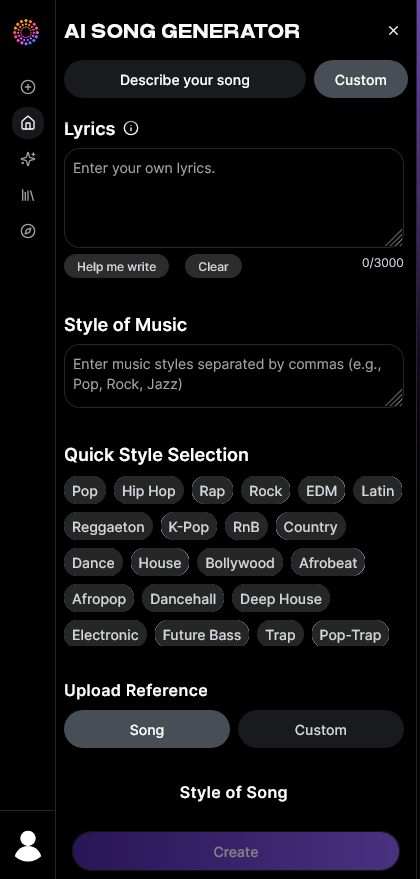
Soundverse’s AI Song Generator enables creators to transform linguistic or emotional inputs into complete songs. The tool operates through a multi-stage pipeline that processes lyrics, melody, arrangement, and mixing. With modes such as Describe Your Song (prompt-based) and Custom mode (lyrics and settings), users can build compositions that align with genuine creative intention.
Core Capabilities Include:
- Describe Your Song Mode: Craft authentic melodies by describing mood, genre, and emotion.
- Custom Mode: Input your own lyrics and configure generation settings for customized output.
- Reference Audio Support: Guide AI with existing recordings or vocal examples.
- Quick Style Selection: Choose from Pop, EDM, Rock, and other genres to match expressive tone.
Soundverse also integrates with its AI Lyrics Writer for structured lyrical storytelling and AI Singing Generator for producing professional vocal layers. These components ensure that your creative process remains ethically sound—anchored in genuine artistic truth. For a brief overview, check the Explore Tab tutorial from the Soundverse Tutorial Series.
Discover how to merge human honesty with machine precision by visiting Soundverse AI Music Generator and Human Composers: A Future Together, or learn specific composition techniques in How to Create EDM with Soundverse AI.
Explore Ethical AI with Soundverse
Join a global community that’s redefining music and creativity through responsible AI innovation. Discover tools that empower authentic expression while upholding transparency and ethical standards.
- How AI-Generated Music Is Transforming the Music Industry: Discover how artificial intelligence is reshaping the music landscape, influencing creativity, production, and the ethics of creation.
- AI Music Generator and Human Composers: A Future Together: Explore the collaboration between human creativity and AI-driven composition and its ethical implications for artistic integrity.
- The Role of AI Music in Film and Television: Learn how AI-generated music is changing soundtrack creation and how truth in AI artistry plays into visual storytelling.
- AI Ranks Soundverse’s AI Singer #1: The Ultimate AI Singing Platform Dominating 2025: See why Soundverse’s AI Singer is leading the charge in vocal generation technology and what ethical dimensions accompany this rise.
Here's how to make AI Music with Soundverse
Video Guide
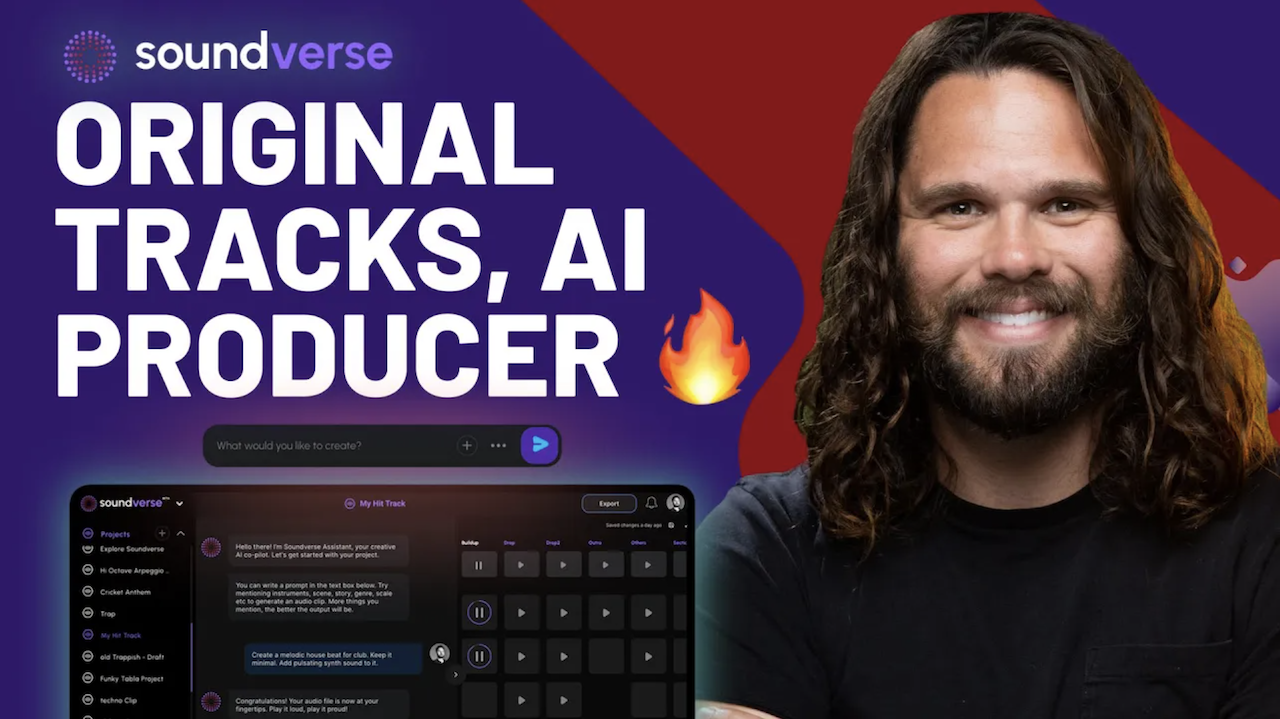
Here’s another long walkthrough of how to use Soundverse AI.
Text Guide
- To know more about AI Magic Tools, check here.
- To know more about Soundverse Assistant, check here.
- To know more about Arrangement Studio, check here.
Soundverse is an AI Assistant that allows content creators and music makers to create original content in a flash using Generative AI. With the help of Soundverse Assistant and AI Magic Tools, our users get an unfair advantage over other creators to create audio and music content quickly, easily and cheaply. Soundverse Assistant is your ultimate music companion. You simply speak to the assistant to get your stuff done. The more you speak to it, the more it starts understanding you and your goals. AI Magic Tools help convert your creative dreams into tangible music and audio. Use AI Magic Tools such as text to music, stem separation, or lyrics generation to realise your content dreams faster. Soundverse is here to take music production to the next level. We're not just a digital audio workstation (DAW) competing with Ableton or Logic, we're building a completely new paradigm of easy and conversational content creation.
TikTok: https://www.tiktok.com/@soundverse.ai
Twitter: https://twitter.com/soundverse_ai
Instagram: https://www.instagram.com/soundverse.ai
LinkedIn: https://www.linkedin.com/company/soundverseai
Youtube: https://www.youtube.com/@SoundverseAI
Facebook: https://www.facebook.com/profile.php?id=100095674445607
Join Soundverse for Free and make Viral AI Music

We are constantly building more product experiences. Keep checking our Blog to stay updated about them!