Why Music Deserts Exist: Understanding Regional Music Inequality in 2026
Explore why music deserts exist, uncovering regional music inequality and access challenges in 2026.
Why Music Deserts Exist
What are music deserts, and why are they becoming more visible in 2026?
Music deserts refer to regions where access to music education, performance spaces, and cultural infrastructure are scarce or nonexistent. In 2026, the term has gained renewed attention among arts educators and policymakers investigating cultural inequality. While urban centers thrive with diverse local music scenes, rural or underfunded areas often experience minimal opportunities for artistic expression, leading to a growing divide in creative participation.
This divide is not new, but technological and economic factors in the last two years (2024 and 2025) have made it more pronounced. Post-pandemic funding cuts, uneven arts recovery efforts, and digital concentration of resources in major cities have left several communities underserved. According to cultural studies, these music deserts aren’t simply lacking equipment — they lack ecosystems that sustain creativity.
What factors create music deserts?
Music deserts often arise from multi-layered causes combining geography, economy, policy decisions, and cultural isolation. Key contributing factors include:
- Limited access to music education: Schools in remote or underfunded regions frequently cut arts programs first when budgets tighten. Lack of trained instructors and instruments reinforces generational gaps in musical literacy.
- Urban-centric arts funding: Regional arts inequality is fueled by disproportionate investment in metropolitan areas. Large cities attract private sponsorships and government grants, while small towns struggle with minimal support.
- Economic constraints: Purchasing instruments, renting venues, or accessing online lessons remains unaffordable for many. This financial barrier often dictates whether young creators can even begin a musical journey.
- Digital infrastructure gaps: Streaming and online learning platforms assume robust internet connectivity. Communities with weak digital access remain excluded from virtual concerts, tutorials, and emerging AI music platforms.
- Cultural migration: Musicians often migrate toward creative hubs like Los Angeles, Berlin, or Seoul. This migration creates geographic vacuums where local performance and mentorship opportunities disappear.
As identified in multiple trend reviews across the global music industry geography, these issues accumulate into persistent disparities shaping who gets to participate in evolving musical landscapes.
How do music deserts affect creativity and community development?
When a region loses its musical heartbeat, cultural identity fades over time. Studies from 2025 showed communities with active music programs exhibit stronger social bonds and youth engagement. Conversely, areas within music deserts face:
- Reduced cultural participation: Absence of venues and workshops limits collaboration, resulting in fewer collective cultural expressions.
- Dropping creative literacy rates: Without educational exposure, potential musicians never discover their talent.
- Economic stagnation: Live events and festivals often drive local economies. Their absence decreases tourism and venue-related employment.
- Loss of intergenerational transmission: Traditional music genres suffer extinction when elders have no infrastructure to teach younger residents.
For instance, Everardo Francisco Reyes’ study on music deserts highlights how resource deprivation directly correlates with cultural decline. In 2026, as new technologies redefine creation, collaboration, and distribution, addressing music deserts becomes essential not just for art but for community resilience. Music is both an emotional outlet and an economic vector—its absence signals broader social imbalance.
How are governments and institutions addressing regional music inequality?
Arts funding disparity remains a critical policy challenge. Several governments have committed to rebuilding arts education post-2025 using mixed public-private collaboration models. However, implementation often fails due to inconsistent grants and lack of accountability.
Policymakers are exploring three major pathways:
- Targeted arts funding: Directing annual budgets specifically toward rural schools and community ampersands.
- Mobile education programs: Deploying traveling instructors or digital classrooms to deliver temporary music education.
- Partnerships with ethical technology platforms: Collaborating with trusted frameworks like Soundverse to make music more accessible and equitable.
The rise of AI-powered creative platforms has revolutionized how art is distributed, yet a crucial question remains — how can we ensure such systems don’t reinforce existing inequalities? Ethical frameworks matter more than ever.
How technology both helps and harms musical access
AI music generation tools have democratized creation for many but accidentally widened other gaps. While platforms like Soundraw and Mubert offer users instant track generation, they assume stable digital infrastructure and financial accessibility.
In music deserts, digital divides mean creators often lack hardware to leverage these tools. Furthermore, opaque data sourcing by some companies raises ethical questions — are these new innovations respecting artist rights, or exploiting unconsented data pools? Without transparency and recurring compensation, music technology risks deepening systemic inequities.
That’s where ethical AI frameworks come in, ensuring innovation balances human rights and fairness. For a deeper dive, watch our guide on how to make music or explore Deep House production tutorials on the Soundverse channel to see how creators harness AI tools effectively.
How to make progress toward resolving music deserts
Addressing music deserts requires global and local cooperation. Several actionable strategies emerge in 2026 research:
- Invest in community-based education: Locally led initiatives usually generate sustained engagement.
- Increase equitable arts funding distribution: Analytics-driven models should track demographic and regional gaps.
- Enable digital literacy: Providing broadband access is foundational before any music technology adoption can succeed.
- Empower ethical AI partnerships: Using transparent AI infrastructure ensures artists retain ownership and receive fair compensation.
- Encourage local performance ecosystems: Open mic programs, regional tours, or hybrid digital showcases rebuild musical identity.
All these efforts align with global music equity principles gaining traction as organizations focus on sustainable cultural development.
How to make music deserts thrive again with Soundverse The Ethical AI Music Framework
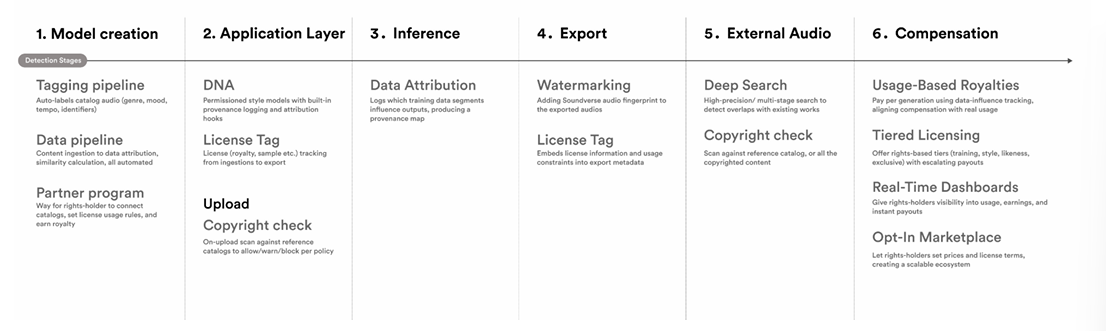
Now that you understand why music deserts exist and their consequences, it’s time to explore how technology can become part of the solution. Soundverse’s Ethical AI Music Framework provides an end-to-end infrastructure designed to bridge innovation and artist integrity.
Transparent Infrastructure for Cultural Equity
The framework operates through six measurable stages:
- Stage 1: Licensed Data Sourcing (No scraping): Ensures datasets are ethically and legally acquired.
- Stage 2: Permissioned Models (DNA): Enables artists to train AI with explicit consent, giving rise to copyright-safe creative generation.
- Stage 3: Explainable Inference (Attribution): Traces creative lineage to guarantee fair recognition.
- Stage 4: Traceable Export (Watermarking): Integrates watermarking for monitoring derivative works.
- Stage 5: Deep Search (External Scanning): Continuously tracks attribution across online ecosystems.
- Stage 6: Recurring Compensation (Partner Program): Returns royalties to contributors through usage-based payment structures.
This pipeline isn't merely about compliance—it encourages equity. By offering transparent attribution and recurring compensation, Soundverse ensures artists, labels, and educators benefit sustainably.
The Content Partner Program complements this initiative by allowing rights-holders to contribute licensed audio and earn royalties. Meanwhile, Soundverse DNA personalizes generation using authentic artist-trained data—ideal for creators rebuilding local music scenes ethically. Finally, Soundverse Trace ensures rights protection throughout the entire lifecycle.
By integrating these capabilities, Soundverse provides a robust foundation for rebalancing regional musical access. Whether a community center in a small town or a policymaker designing an education grant, partnering with ethical AI systems becomes an effective step toward closing the music desert gap.
Bring Music to Every Corner of the World
Join Soundverse and help redefine how communities create and share music. Empower your creativity with AI tools built to make music accessible, no matter where you are.
Start Creating with Soundverse
Related Articles
- How to Create Music Evoking the Desert: Explore how Soundverse AI can help you craft music that captures the stark beauty and emotion of desert soundscapes.
- AI Music in the USA: Discover how artificial intelligence is reshaping the musical landscape across American communities, reducing creative gaps.
- How AI-Generated Music Is Transforming the Music Industry: Understand how generative music platforms like Soundverse are revolutionizing music creation and access globally.
- The Role of AI Music in Film and Television: Learn how AI music expands storytelling possibilities and opens creative access for producers in remote or underserved areas.
Here's how to make AI Music with Soundverse
Video Guide
Here’s another long walkthrough of how to use Soundverse AI.
Text Guide
- To know more about AI Magic Tools, check here.
- To know more about Soundverse Assistant, check here.
- To know more about Arrangement Studio, check here.
Soundverse is an AI Assistant that allows content creators and music makers to create original content in a flash using Generative AI. With the help of Soundverse Assistant and AI Magic Tools, our users get an unfair advantage over other creators to create audio and music content quickly, easily and cheaply. Soundverse Assistant is your ultimate music companion. You simply speak to the assistant to get your stuff done. The more you speak to it, the more it starts understanding you and your goals. AI Magic Tools help convert your creative dreams into tangible music and audio. Use AI Magic Tools such as text to music, stem separation, or lyrics generation to realise your content dreams faster. Soundverse is here to take music production to the next level. We're not just a digital audio workstation (DAW) competing with Ableton or Logic, we're building a completely new paradigm of easy and conversational content creation.
TikTok: https://www.tiktok.com/@soundverse.ai
Twitter: https://twitter.com/soundverse_ai
Instagram: https://www.instagram.com/soundverse.ai
LinkedIn: https://www.linkedin.com/company/soundverseai
Youtube: https://www.youtube.com/@SoundverseAI
Facebook: https://www.facebook.com/profile.php?id=100095674445607
Join Soundverse for Free and make Viral AI Music

We are constantly building more product experiences. Keep checking our Blog to stay updated about them!