Why Is iHeartRadio Banning AI Music?
Explore why iHeartRadio announced its AI music ban in 2026 and how Soundverse Trace helps ensure attribution and rights protection for AI music.
Why Is iHeartRadio Banning AI Music?
In 2026, one of the biggest headlines shaking the music and broadcasting world is the iHeartRadio AI music ban. The network, known for its massive influence on radio programming, podcasting, and streaming, has taken a firm position: it will no longer broadcast or distribute AI-generated songs unless they meet specific transparency and rights verification standards. This decision has sent waves throughout the music industry, prompting intense debate about the role of technology, creativity, and trust in an era where artificial intelligence touches nearly every note played.
What led to iHeartRadio’s AI music ban in 2026?
The roots of the radio AI policy date back to controversies from 2024 and 2025, when a flood of AI-generated songs began circulating online. Some of these tracks mimicked famous performers so closely that audiences couldn’t distinguish machine-made vocals from human ones. Labels and artists raised alarms over intellectual property abuse—training datasets were found to include copyrighted works without consent.
As generative music platforms such as Suno and Udio gained traction, radio networks faced a dilemma: how could they maintain authenticity, comply with rights laws, and satisfy listeners who increasingly demanded innovation? The iHeartRadio AI music ban emerged from that tension.
The company introduced its Guaranteed Human Pledge, confirming that stations under its umbrella will exclusively air music composed or performed by verified human artists or verified AI creators with full rights traceability. This was iHeartRadio’s way of defending artistic integrity while navigating a complex tech frontier. The decision mirrors statements reported in iHeartRadio issues companywide ban on AI-generated music and synthetic on-air personalities and iHeartRadio Bans All AI Music and DJs.
Why is authenticity at the center of the ban?
Listeners trust radio as a human-driven medium. The voice of an artist carries emotion, context, and lived experience—qualities still difficult for algorithms to emulate genuinely. When generative systems started producing entire albums from celebrity-like voices trained without permission, radio executives saw a potential reputational risk. The industry began to fear the erosion of human artistry under the efficiency of machines.
The Guaranteed Human Pledge thus became a symbolic gesture of faith: programming would celebrate human creativity first. But it also underscored a practical problem—most stations lacked reliable tools to verify whether a piece of audio originated from a legitimate dataset or a generative model scraping unlicensed material. This stance was reinforced in Did iHeartRadio Promise Not to Play AI Artists? and iHeartMedia Announces “Guaranteed Human” Rule Banning AI Voices.

How does the AI music ban affect artists and rights-holders?
For artists, the ban marks both a restriction and an opportunity. On one hand, independent creators using AI co-production tools to experiment with sound may struggle to get airtime unless their tracks include traceable metadata. On the other hand, the policy encourages professional-grade solutions like Soundverse Trace, which provide provable attribution chains.
Rights-holders benefit from clearer protection. Unlike the Wild West of 2025, when AI content circulated without accountability, 2026 demands auditable data layers. Record labels now request that every AI-assisted song disclose its creation path, model origin, and licensed audio use.
For platforms and distributors, compliance with the radio AI policy requires transparency infrastructure. Those who adopt certified frameworks can freely collaborate with broadcasters without fear of takedown requests or royalty disputes.
What are the implications of iHeartRadio’s Guaranteed Human Pledge?
The pledge reshapes monetization and creative incentives throughout the broadcasting ecosystem. It sets a precedent for authenticity verification similar to food labeling—audiences can soon expect to see tags like “Verified Human Composition” or “Ethically Trained AI Music.”
This development aligns with emerging regional regulations. In North America and Europe, policymakers increasingly lean toward mandatory provenance tracking for AI audio. The iHeartRadio initiative helps prepare the industry for compliance before regulation becomes universal law.
Moreover, the pledge challenges AI music generators to adopt transparent frameworks rather than closed models. Companies must demonstrate that training data respect consent and compensate music contributors—a concept mirrored by Soundverse’s Content Partner Program, where rights-holders license their audio for AI training and earn recurring royalties.
How are other broadcasters responding to the ban?
The ripple effect of the iHeartRadio AI music ban has been immediate. Smaller networks are reevaluating their playlists, while international broadcasters watch closely to determine listener response.
Some stations choose hybrid programming—airing human music during prime slots and reserving AI-based compositions for creative showcases where provenance can be showcased openly. Others invest in verification technologies, integrating third-party watermarking tools to check the authenticity of incoming tracks.
Companies like Spotify, SiriusXM, and BBC Music have not issued full bans but impose disclosure rules. As the radio AI policy landscape evolves, trust becomes currency: audiences will follow channels whose catalog curation aligns with transparent standards.
For professionals, understanding this shift is crucial. Music industry analysts compare it to the moment digital streaming overtook physical sales—a major cultural pivot backed by technology ethics.
How can transparent AI solutions overcome these challenges?
Transparency and traceability remain the biggest demands in 2026. The success of AI music creators now depends on their ability to prove data lineage, license compliance, and artistic integrity. This is where technology shifts from novelty to infrastructure.
Platforms such as Soundverse are leading that transformation. With its ethical foundation and technical trust layer, it demonstrates how AI composition can coexist with broadcasting standards instead of colliding with them.
For music producers and creative professionals exploring AI-driven workflows, adopting solutions that embed metadata attribution is becoming non-negotiable. Failure to do so could mean exclusion from top radio networks and streaming playlists.
How to make ethical AI music that meets radio standards with Soundverse Trace
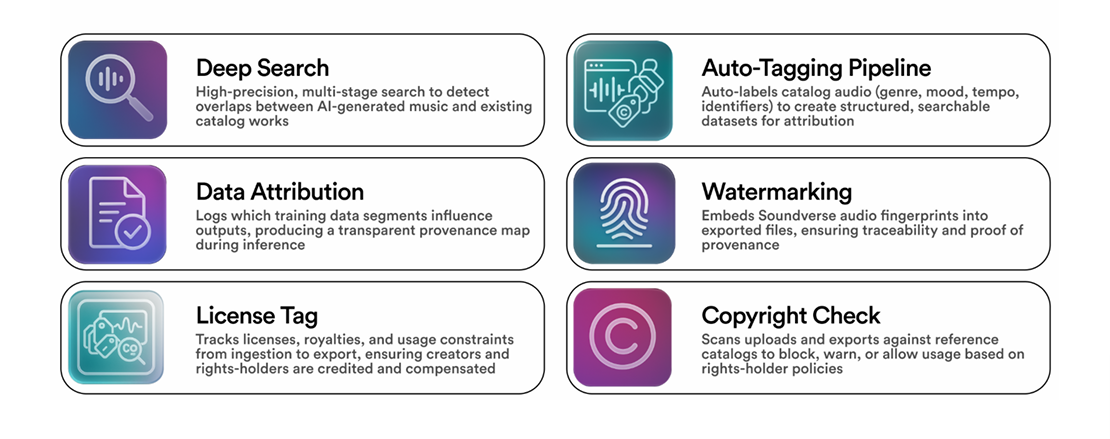
Soundverse Trace provides the trust architecture missing in most generative music systems. Designed specifically for rights verification, it offers a comprehensive trust layer spanning the entire creation lifecycle—from dataset construction to exported audio.
Its Deep Search capability performs high-precision scans (1:1 and 1:N) to detect overlaps between generated audio and existing catalogs, helping prevent copyright infringement. Data Attribution logs exactly which training data influenced outputs, offering clear visibility into every creative step. Audio Watermarking embeds robust yet inaudible fingerprints that travel with a track wherever it is distributed. License Tagging ensures rights metadata remain intact through all stages of ingestion, processing, and export.
Together, these capabilities give creators verifiable proof of provenance. That evidence satisfies broadcasters operating under bans like iHeartRadio’s, allowing ethical AI creators to continue distribution while staying compliant.
Consider how Soundverse maintains consistency within larger frameworks: The Ethical AI Music Framework implements transparent pipelines where consent, attribution, and compensation are fundamental principles, while the Content Partner Program incentivizes rights-holders through recurring royalties whenever their licensed training data contribute to generated content.
For example, a producer using Soundverse to generate pop or country tracks (as outlined in this guide) can export music embedded with full license tags and attribution markers. When submitted to radio or streaming channels, such metadata validates legitimacy under compliance policies.
Soundverse’s structure complements creative freedom rather than restricts it. By providing asynchronous processes—uploading your audio, allowing background verification, and receiving processed results—it prioritizes trust without sacrificing innovation.
Those exploring variations of AI music generation across genres—whether EDM or Jazz—can rely on Soundverse Trace to maintain consistency in rights management, enabling artists to safely navigate radio and streaming eligibility. For additional context, watch our guide on creating Deep House music or Soundverse Tutorial: How to Make Music on the Soundverse YouTube channel.
What can the industry learn from this turning point?
The iHeartRadio AI music ban represents more than a corporate policy—it signals a cultural recalibration around creative rights. As AI continues to accelerate production, the world of broadcasting demands structure: a verifiable audit trail proving originality.
Music professionals now recognize that technological adoption requires ethical guardrails. The lines between innovation and exploitation blur quickly without transparent data standards. iHeartRadio’s decision highlights that embracing AI doesn’t mean abandoning authenticity—it means evolving responsibly.
For radio executives, adopting compliant frameworks ensures operational security. For artists, traceable models preserve credit and compensation. For analysts, this shift offers a fascinating lens through which to study the maturation of generative music technology.
If you’re analyzing broader music industry trends, detailed insights can be found in Soundverse’s ongoing coverage of ethical AI evolution (read here). Further comparisons to other AI tools like Mubert alternatives and Soundraw alternative emphasize how trust verification is becoming a standard capability across creative platforms.
Experience the Future of Music Creation Today
Transform your creative process with Soundverse—the AI-powered music studio that puts you in control of genre, mood, and sound. Generate high-quality tracks instantly and stay ahead of industry trends.
Related Articles
- How AI-Generated Music Is Transforming the Music Industry: Explore how artificial intelligence is driving innovation and reshaping the global music landscape.
- The Role of AI Music in Film and Television: Discover how filmmakers and producers use AI-generated scores to create immersive and cost-effective soundtracks.
- AI Music Generator and Human Composers: A Future Together: Learn how AI complements human artistry, leading to collaborative creativity and new musical possibilities.
- Navigating the World of Royalty-Free and Copyright-Free Music Using Soundverse AI: Understand how to legally create and use AI music for your projects with Soundverse’s royalty-free offerings.
Here's how to make AI Music with Soundverse
Video Guide
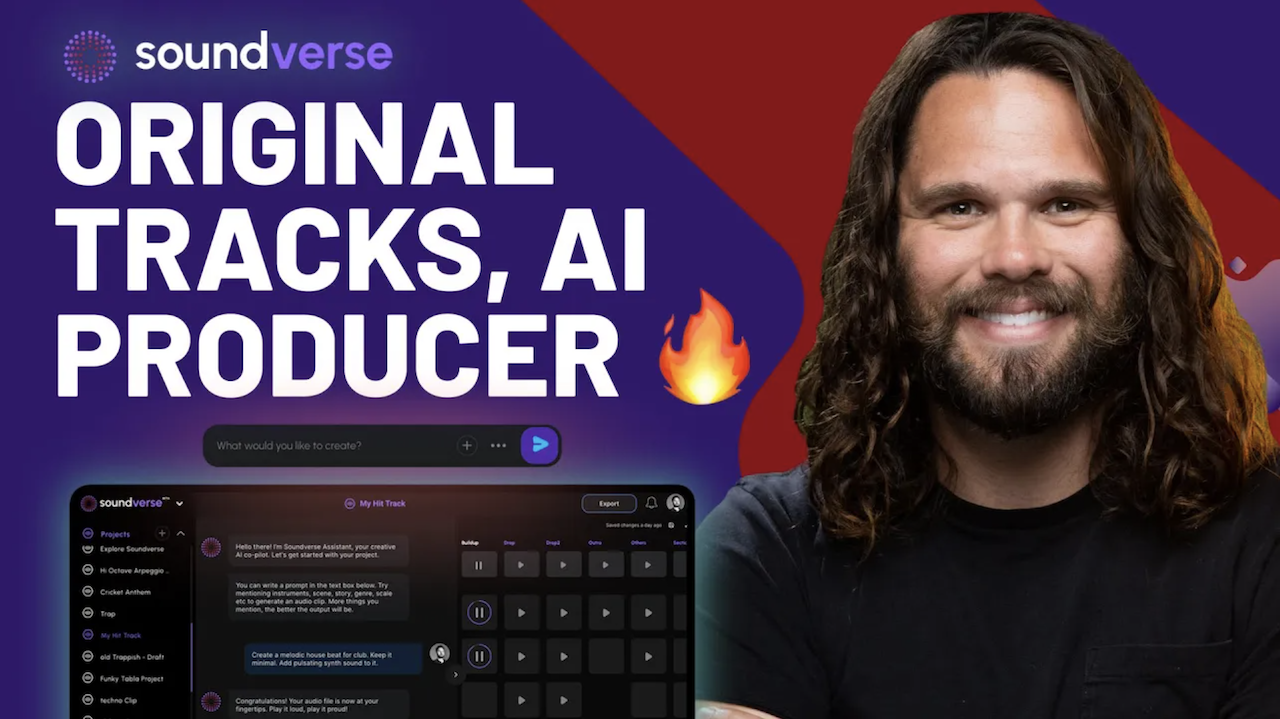
Here’s another long walkthrough of how to use Soundverse AI.
Text Guide
- To know more about AI Magic Tools, check here.
- To know more about Soundverse Assistant, check here.
- To know more about Arrangement Studio, check here.
Soundverse is an AI Assistant that allows content creators and music makers to create original content in a flash using Generative AI. With the help of Soundverse Assistant and AI Magic Tools, our users get an unfair advantage over other creators to create audio and music content quickly, easily and cheaply. Soundverse Assistant is your ultimate music companion. You simply speak to the assistant to get your stuff done. The more you speak to it, the more it starts understanding you and your goals. AI Magic Tools help convert your creative dreams into tangible music and audio. Use AI Magic Tools such as text to music, stem separation, or lyrics generation to realise your content dreams faster. Soundverse is here to take music production to the next level. We're not just a digital audio workstation (DAW) competing with Ableton or Logic, we're building a completely new paradigm of easy and conversational content creation.
TikTok: https://www.tiktok.com/@soundverse.ai
Twitter: https://twitter.com/soundverse_ai
Instagram: https://www.instagram.com/soundverse.ai
LinkedIn: https://www.linkedin.com/company/soundverseai
Youtube: https://www.youtube.com/@SoundverseAI
Facebook: https://www.facebook.com/profile.php?id=100095674445607
Join Soundverse for Free and make Viral AI Music

We are constantly building more product experiences. Keep checking our Blog to stay updated about them!