Where Does the Audio Data Go During the Synthesis Process?
Audio data during synthesis: what happens to recordings, transcripts, voice models, outputs and logs, where vendors process them and how long they keep it.
Your audio data during synthesis passes through six stops: the recording or script you upload, a transcript, a voice embedding or trained model, working features inside the model, the generated audio, and logs. Most vendors checked here process it in their cloud, often in the US; Apple's Personal Voice stays on your device.
Below, each stage and what vendors' own policies say about it. Every page cited was checked on 23 November 2026; where a page is silent, we say so.
The synthesis pipeline, stage by stage
Text to speech and cloning share these stages; for the modelling side, see how voice cloning works in modern software.
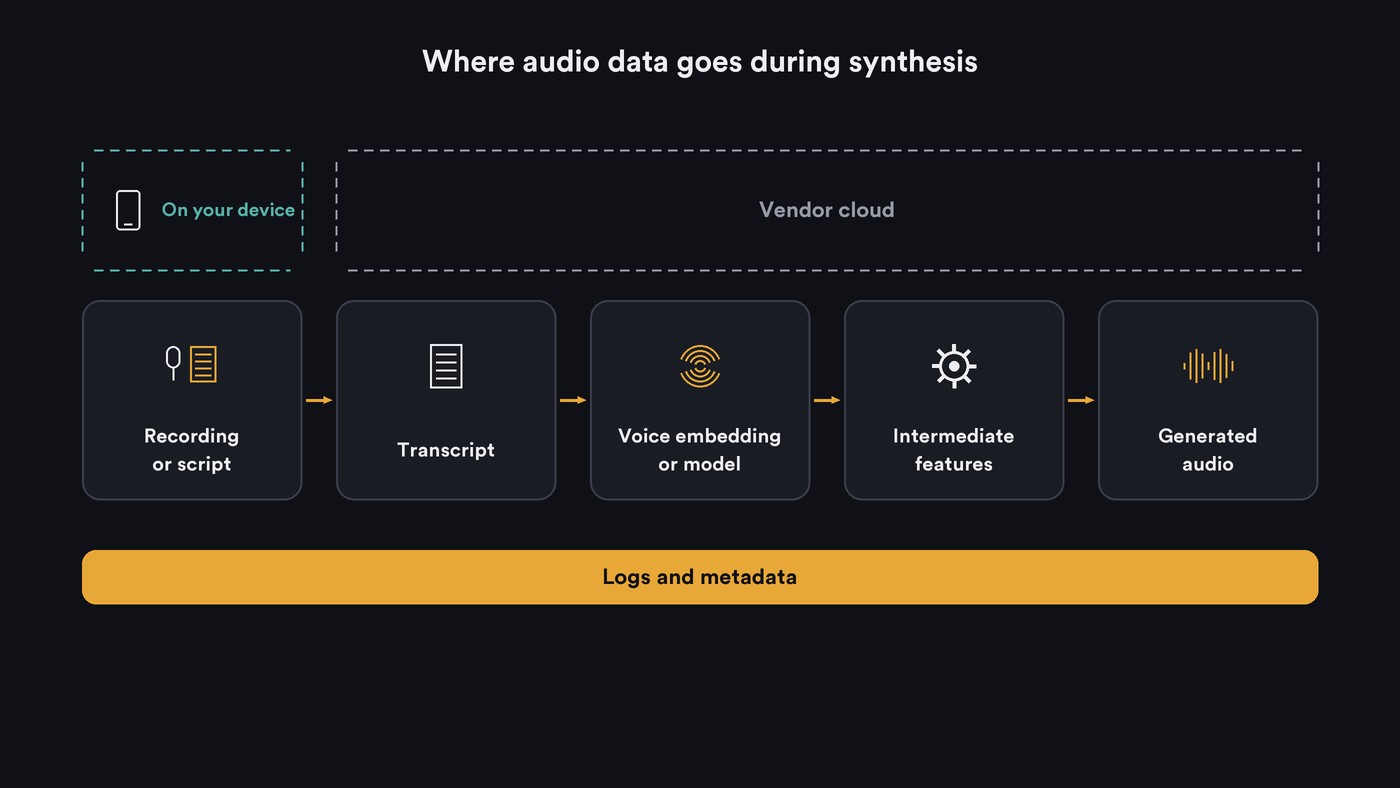
- Recording or script. The voice sample you upload, or the text you send. ElevenLabs' privacy policy (updated 9 October 2026) calls both inputs and says it uses voice data to create a synthetic copy it calls a voice model.
- Transcript. Microsoft's data page for Azure text to speech (dated 25 February 2026) says custom neural voice pro projects train on the audio plus its transcript, which you write or let Speech Studio's automatic transcription produce. Personal voice, its short-sample feature, needs no transcript.
- Voice embedding or trained model. What the vendor keeps to make your voice again. Microsoft describes its voice model as binary parameters that people can't read and that contain no audio recordings. Google's Chirp 3 instant custom voice returns a voice cloning key, a text string representing your voice data, which its docs say is stored on the client side and sent with each request.
- Intermediate features. Models break speech into units such as phonemes and acoustic features. None of the policies checked lists these as a stored item.
- Generated audio. Some vendors keep a history of it; some don't store it at all.
- Logs and metadata. Request records, moderation and debugging logs, account details, and voiceprints made to check that a voice belongs to you. These can outlive the audio.
Where the audio data is processed: on your device or in the cloud
On your device. Apple's Personal Voice support page (published 13 October 2025) says your recorded speech is processed securely on device. Turn on Share Across Devices and a copy goes to iCloud with end-to-end encryption.
In a vendor's cloud, often the US. ElevenLabs' privacy policy says that wherever you are, your personal information will be transferred to the United States for storage; its Zero Retention Mode docs also mention EU and US residency workspaces for enterprise accounts. Descript's privacy policy (last updated 14 April 2025) says it processes and stores information in the US.
Through sub-processors. Descript's published sub-processor list names 11Labs / Eleven Labs as an engineering sub-processor with a US data region.
In a region you pick. Google's instant custom voice docs (last updated 16 November 2026) list global, us, eu, asia-southeast1, asia-northeast1 and europe-west2 endpoints. Microsoft's data page doesn't name a region; it says training data sits in Azure storage by default, or in your own storage account with Bring Your Own Storage, which personal voice doesn't support.
How long vendors keep audio data during and after synthesis
- ElevenLabs: it won't keep data it generates about your voice for longer than 3 years after your last interaction, unless the law requires or allows otherwise. History is on by default. Zero Retention Mode, which deletes most request data once a request completes, covers enterprise API traffic only and excludes Instant and Professional Voice Cloning, because the clone has to be stored to generate speech.
- Descript: personal data is kept as long as necessary for its purposes. Voiceprints made from your consent statement are kept until their purpose is met or up to three years after you last accessed your account, whichever comes first.
- Microsoft Azure AI Speech: for real-time synthesis, it doesn't store the text you send or the audio returned. Long Audio API scripts and outputs stay in Azure storage until you delete them. Custom neural voice lite recordings are deleted within 90 days unless you deploy the voice. The recorded consent statement is kept as long as needed for the service's security and integrity.
- Google Cloud Text-to-Speech: its data logging page (last updated 10 November 2026) says Google doesn't log any customer Cloud TTS text or audio data.
- Apple Personal Voice: the voice stays on your device until you delete it.
Does the vendor train on your voice, and how do you opt out?
ElevenLabs says it uses personal information to research, build, train and improve its AI models. The opt-out sits under Data use in the Terms and Privacy section of your account and applies only to training after you switch it off.
Descript covers this on two pages. Its privacy policy says it may use other training data associated with AI Speakers in research datasets after disassociating it from your account. Its help article on account data says current production models use no Descript user data, and research models use only data from users who opted into sharing. To opt out, open App Settings, then Profile, and switch off Share data with Descript.
Microsoft puts it in one sentence:
"A customer's training data is used only to develop that customer's custom voice models and isn't used by Microsoft to train or improve any Microsoft text to speech voice models." (Microsoft Learn)
Google's TTS page says it doesn't log customer text or audio. Apple's Personal Voice page doesn't discuss model training.
Who can access your recordings and voice model
- Vendor staff. Descript's privacy policy says employees and contractors may listen to samples of your original and AI Speaker recordings to test quality; otherwise only you and people you share with can reach them.
- Other users. Descript's AI Speakers help page lets you share a voice with members of your Drive. ElevenLabs says a voice you add to its Voice Library becomes available to that service's users.
- The vendor, for safety. Microsoft may keep its own copy of custom neural voice and personal voice models for as long as necessary, solely to protect the service's security and integrity.
- Only you. Apple's page sets the tightest limit:
"Personal Voice is encrypted and stored securely on device, so that only you can access it with Face ID, Touch ID, or your device passcode or password." (Apple Support)
How deletion works, and what survives it
- ElevenLabs: deleting a generation through the API removes its audio and text from the database at once, but debugging and moderation logs may still hold related data, and backups keep deleted items for up to 30 days. Deleting your account deletes its data.
- Descript: Delete voice in the AI Speakers tab is permanent. You can delete your account in settings, though the privacy policy says some information may be kept as the law requires or for legitimate business purposes.
- Microsoft: delete training data in Speech Studio, or personal voice prompt audio through the API. The model copy Microsoft may retain is separate.
- Apple: Delete Voice And Recordings removes the voice for good.
Consent and voice-ownership rules
Every vendor checked sets a consent rule. Microsoft requires a recorded acknowledgment statement from the voice talent and may compare voiceprints from it with the training audio. Google requires a fixed consent statement recorded in the same room as the reference audio. Descript asks for an English consent statement and won't clone a deceased or non-consenting person, or audio from an AI source. ElevenLabs bars voice data from anyone under 18. Apple limits Personal Voice to your own voice, for personal, non-commercial use.
Microsoft's page also says a customer processing biometric data, such as voiceprints, is responsible for notice about retention and destruction, for consent and for deletion. Laws differ by place, so check the rules where you and each guest live.
Questions to ask a vendor before you upload a voice
- Where are my recordings, transcripts and voice model stored, and in which region?
- Which sub-processors touch my audio?
- How long do you keep source audio, models, outputs and logs?
- Do you train on my data by default, and where is the opt-out?
- Who on your side can listen to my recordings?
- What does deleting a voice remove, and how long do backups last?
- What consent do you require for someone else's voice?
Practical habits for podcasters
- Keep guest or client voices in a separate account from your main show.
- Delete voices and old generations you no longer use.
- Get written consent from a guest before cloning them, naming the uses, the term and how they can withdraw.
- Upload only the clean sample a tool needs, not your episode archive.
- Switch off data-sharing settings when you open an account, and recheck them after policy updates.
Where Soundverse fits
Soundverse is an AI music platform that takes you from idea to audience, built for independent artists who release music, and its voice tools ask for consent before training. Train Voice Clone keeps Start Training disabled until you tick a box confirming the voice is yours or that you have the speaker's explicit consent. Train Voice Model has a consent switch you turn on first, and its page says new models start Private, so only you can use them, until you make one Public. For intros and narration with no cloning at all, the AI Speech Generator uses built-in voices only. For how Soundverse handles personal data, read the Soundverse privacy policy itself.
FAQ
Does voice cloning software keep my original recordings?
Usually, while the voice exists. ElevenLabs' docs say voice cloning requires storing the clone, and Descript keeps voiceprints from your consent statement for up to three years after you last accessed your account.
Can I stop a vendor from training on my voice?
Often. ElevenLabs has a Data use opt-out and Descript a Share data with Descript toggle, and Microsoft says custom voice training data only builds your own models. Opt-outs usually apply from the moment you switch them on, not backwards.
Is on-device voice synthesis more private than the cloud?
It keeps recordings off a vendor's servers. Apple says Personal Voice is processed and encrypted on device, with end-to-end encryption for synced copies. The trade-off: your own voice only, for personal, non-commercial use.
What should I do with a guest's voice clone after the episode?
Delete it once the agreed use ends, along with related generations, and note the date. If the guest withdraws consent, delete it straight away.
Sign up for Soundverse free to try voice tools that ask for consent before training. More guides on the Soundverse blog.