What Is Underscoring in Film Music?
Explore the role of underscoring in film music and how composers use subtle music to enhance cinematic emotion.
What Is Underscoring in Film Music?
Underscoring in film music is one of the most vital techniques used to connect audiences emotionally to a story. By definition, it refers to instrumental or orchestral music that plays beneath dialogue and action, subtly guiding the viewer's perception and emotional response without drawing direct attention to itself. Unlike songs or dramatic score moments, underscoring serves as a narrative glue that binds scenes together, creating a cohesive cinematic experience.
What is underscoring in film music, and why does it matter?
Underscoring in film music is essentially background music designed to support the emotional subtext of a scene. It helps shape the tone, tension, and atmosphere, often influencing how audiences interpret what they see. For example, a soft piano line beneath a dialogue between two characters might hint at melancholy or nostalgia, while a low tremolo from strings in a suspenseful scene can build tension without a single word being spoken.
The importance of underscoring lies in its invisibility—it works best when the audience is unaware of it. Composers use this technique so that the viewer feels emotions naturally, as though those feelings are part of the story itself rather than something imposed from outside.
How did underscoring evolve in film scoring techniques?
Film music has transformed dramatically over decades. During the silent film era, live musicians in theaters provided improvised accompaniment to match the mood of the visuals. As technology advanced in the 1930s and 1940s, composers like Max Steiner and Bernard Herrmann began integrating fully composed underscoring as an expressive storytelling tool. Their work laid the foundation for modern film scoring techniques where every note is carefully timed to reinforce on-screen emotion.
Through the 1990s and early 2000s, digital production introduced new possibilities for movie soundtrack composition. Composers gained precise control over timing, tempo, and instrument layering. By 2026, underscoring in film music has become deeply hybridized—mixing orchestral traditions with electronic ambient textures and AI-assisted sound design tools.

What is the difference between underscoring and a film score?
While the entire film score encompasses all music written for a film—including main themes, motifs, and credits—underscoring typically refers to the music played in the background of dialogue and internal moments. The distinction lies in purpose: themes identify characters or ideas, while underscoring connects visceral emotion to narrative pacing. According to Study Rocket, underscoring accompanies visuals and dialogue without being related to songs or themes.
Cinematic music analysis reveals that underscoring is the reason many scenes feel seamless or emotionally charged. A romantic conversation without underscoring might feel plain; with music behind it, the scene blossoms into emotional depth.
How composers use movie soundtrack composition to create effective underscoring
Creating effective underscoring requires understanding film score elements such as harmony, tempo, instrument choice, and dynamic movement. Here are some of the most common techniques in 2026:
- Motivic Development: Composers use short repeating motifs underneath dialogue to create continuity across scenes.
- Textural Layers: Ambient pads, delicate piano, or subtle strings provide emotional foundation while leaving space for dialogue.
- Dynamic Shaping: Music shifts its intensity or fades strategically to match emotional cues in performance or camera movement.
- Harmonic Color: Choosing specific keys or modes (e.g., minor for tension, major for warmth) can evoke psychological responses from viewers.
- Sound Design Integration: Modern scores often combine organic instruments with electronic layers to produce immersive environments, especially in science fiction or thriller genres.
For a deeper look into cinematic scoring trends, explore Soundverse’s piece on music industry trends, which highlights how AI tools now refine composition workflows for film composers.
For additional examples, watch the Film & TV Music - Writing for Underscore analysis on YouTube.
How underscoring enhances emotional storytelling in modern cinema
In 2026, filmmakers recognize that music is not just a technical addition—it’s a storytelling partner. Underscoring defines emotional space, helping viewers interpret subtle facial expressions, anticipate plot twists, and connect empathically with characters. It can also transform pacing, making slow scenes feel meaningful or amplifying narrative suspense.
Consider how minimalist scores such as those composed for psychological dramas use sparse instrumentation. The underscoring never dominates dialogue but instead breathes within it, creating intimacy and realism. This refined approach has become essential in today’s cinematic language.
As JP Composers note, the score should react dynamically to mood and tempo—an approach called “micro-underscoring.”
Modern film scoring techniques guided by technology
Advances in AI and digital music tools have reshaped how composers approach underscoring. Software now assists in tempo matching, mood detection, and orchestration. Platforms like Soundverse have become instrumental for cinematic creators seeking to maintain originality while satisfying director feedback.
Automated analysis can quickly dissect a reference track—its tempo, key, and emotional intensity—helping composers mirror a desired mood while preserving creative agency. This technology solves long-standing challenges such as replacing temporary scores used during editing phases.
For instance, if a director falls in love with placeholder music, composers can now use AI-assisted tools to generate something similar but original, ensuring copyright safety and artistic integrity. Articles like how-an-ai-music-generator-inspires-creative-fusion explore this evolution of creative collaboration.
You can also watch Soundverse’s tutorial series - How to Make Music for deeper understanding.
Common film score elements used in underscoring
Cinematic underscoring relies on several fundamental elements:
- Harmony: Establishes tension or relaxation.
- Melody: Suggests emotional or thematic identity, even when quiet.
- Rhythm: Controls pacing and emotional rhythm within a scene.
- Instrumentation: Defines sonic color—strings for emotion, brass for drama, synths for futuristic tones.
- Silence: Occasionally, the absence of underscoring emphasizes dialogue impact.
Understanding these building blocks helps film students and professionals analyze why certain moments feel powerful despite subtle musical presence.
How Soundverse tools redefine background music in films
AI-driven platforms are now central to modern cinematic music production. The Soundverse AI Music Generator allows users to craft instrumental tracks through prompt-based creation, ideal for podcasts, games, and film cues. Combined with Soundverse DNA, artists can maintain stylistic identity while generating copyright-safe music based on licensed catalogs. This approach ensures ethical creativity and monetization opportunities.
Music professionals interested in reliable AI alternatives can also explore related resources like soundraw-alternative or mubert-alternatives-soundverse to understand comparative frameworks among music generation tools.
How to make underscoring in film music with Soundverse Similar Music Generator
Now that you understand underscoring in film music, here’s how Soundverse enables you to create it quickly and professionally.
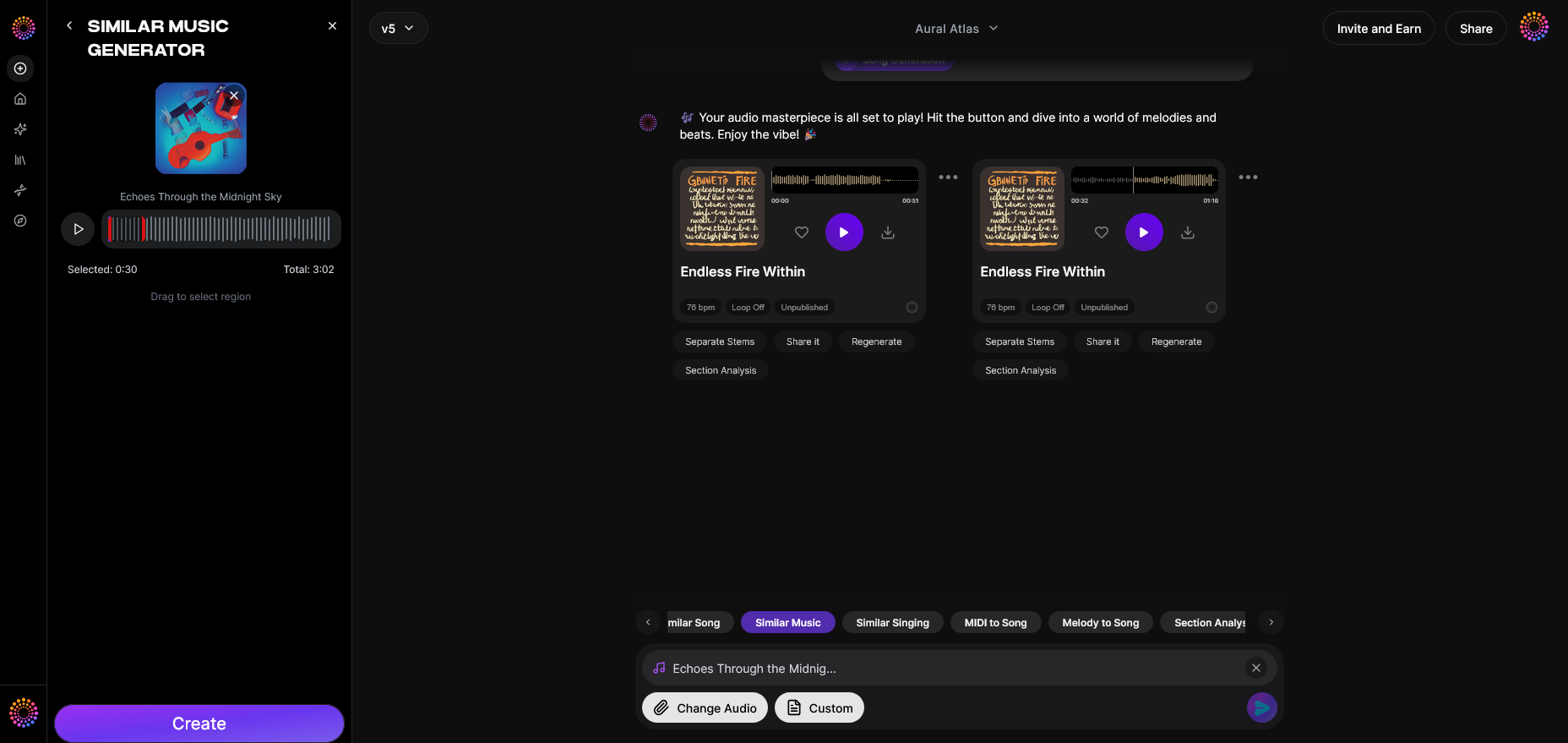
Soundverse’s Similar Music Generator produces original instrumental compositions inspired by a reference track. It’s ideally suited for film or TV scoring, especially when replacing temporary music approved by directors. Using advanced instrumental style transfer, it analyzes tempo, key, and mood parameters to produce background music closely aligned with the intended cinematic feel.
Key Capabilities:
- Instrumental style transfer for matching tonal identity.
- Detailed musical analysis covering tempo, key, and mood.
- Reference-based loop creation for dynamic continuity across scenes.
Primary Use Cases:
- Film/TV background score creation.
- Game environment themes for immersive play.
- Podcast intros and outros needing consistency.
Composers simply upload a reference track, allow the system to process the musical characteristics asynchronously, and receive a generated instrumental that mirrors the emotional intent of the source. This workflow guarantees efficient cinematic alignment while maintaining originality.
For practical examples, sound designers can watch our Explore tab guide.
In 2026, tools like Soundverse are revolutionizing how creative teams approach film scoring. Rather than spending hours manually replicating a mood, they can harness AI’s analytical precision to generate new compositions instantly, freeing time for artistic refinement.
Start Creating AI Film Scores Instantly
Bring your cinematic vision to life with Soundverse AI—from atmospheric underscoring to dramatic orchestral cues. Generate professional-quality soundtracks in minutes.
Create Your First Score
Related Articles
- The Role of AI Music in Film and Television: Discover how AI music tools are changing the way filmmakers and TV producers approach scoring.
- How AI-Generated Music Is Transforming the Music Industry: Explore how AI composition technology is shaping new creative workflows across the music world.
- AI Music Generator and Human Composers: A Future Together: Learn how AI tools and human creativity are merging to make music production more powerful than ever.
- Soundverse AI Revolutionizing Music Creation for New-Age Content Creators: See how Soundverse establishes a new standard for effortless, high-quality AI music generation.
Here's how to make AI Music with Soundverse
Video Guide
Here’s another long walkthrough of how to use Soundverse AI.
Text Guide
- To know more about AI Magic Tools, check here.
- To know more about Soundverse Assistant, check here.
- To know more about Arrangement Studio, check here.
Soundverse is an AI Assistant that allows content creators and music makers to create original content in a flash using Generative AI. With the help of Soundverse Assistant and AI Magic Tools, our users get an unfair advantage over other creators to create audio and music content quickly, easily and cheaply. Soundverse Assistant is your ultimate music companion. You simply speak to the assistant to get your stuff done. The more you speak to it, the more it starts understanding you and your goals. AI Magic Tools help convert your creative dreams into tangible music and audio. Use AI Magic Tools such as text to music, stem separation, or lyrics generation to realise your content dreams faster. Soundverse is here to take music production to the next level. We're not just a digital audio workstation (DAW) competing with Ableton or Logic, we're building a completely new paradigm of easy and conversational content creation.
TikTok: https://www.tiktok.com/@soundverse.ai
Twitter: https://twitter.com/soundverse_ai
Instagram: https://www.instagram.com/soundverse.ai
LinkedIn: https://www.linkedin.com/company/soundverseai
Youtube: https://www.youtube.com/@SoundverseAI
Facebook: https://www.facebook.com/profile.php?id=100095674445607
Join Soundverse for Free and make Viral AI Music

We are constantly building more product experiences. Keep checking our Blog to stay updated about them!