What Is Underscore Music? Understanding the Art of Subtle Film Scoring in 2026
Discover underscore music and how it's shaping cinematic soundtracks. Learn its role, techniques, and how Soundverse AI helps create perfect underscore compositions.
What Is Underscore Music?
Underscore music is the unseen emotional current that moves beneath the surface of every great film or TV moment. In 2026, the term has gained renewed attention as filmmakers and composers increasingly embrace minimalism, ambience, and AI-driven scoring workflows to enhance storytelling. While sweeping cinematic soundtracks still have their place, underscore music remains the subtle yet powerful backbone that supports dialogue, emotions, and narrative pacing without drawing attention to itself.
What is underscore music in film?
Underscore music refers to background compositions used to support scenes within a film or series. Unlike thematic or melodic cues that occupy center stage, underscore music operates quietly, maintaining the emotional tone and flow of a scene. It can range from a single sustained pad to detailed orchestral textures or electronic ambience, depending on the story’s context.
In classic film scoring techniques, underscores bridge transitions between emotional peaks, setting tone without distracting the viewer. Think of a suspense scene where a low drone keeps tension alive or a moment of calm where soft strings allow dialogue to breathe — that’s underscore composition at its finest. As described in Film Music Central, underscore functions as the musical layer that accompanies a scene with dialogue, enhancing the emotional depth without overpowering the visuals. You can also explore more insights in Study Rocket’s guide on Film Music: Underscore and Thematic Music.
How has underscore music evolved by 2026?
The last two years, 2024 and 2025, marked a massive transformation in music production for film. With the rise of streaming platforms and AI-driven scoring tools, directors began looking for ways to generate contextual sound faster without sacrificing artistic depth. By 2026, underscore composition has evolved into a multi-hybrid craft blending traditional orchestration, electronic sound design, and machine-assisted creativity.

Modern composers use integrated scoring systems, often leveraging AI technology to quickly establish atmospheres. The advantage lies not only in speed but also in consistency—AI can analyze scripts, scene rhythms, and edit patterns to suggest underscore options with precision. It’s no longer limited to large production houses; even indie creators and YouTubers can now produce cinematic underscore music tailored to specific moods. For more background on the art of musical invisibility, see JP Composers.
Why is underscore music so critical to storytelling?
Film and television are deeply emotional experiences. Dialogue communicates plot, visuals establish tone, but underscore music conveys subtext. It helps the audience feel without consciously noticing the score. The subtle dynamics in an underscore influence perception — a gentle upward harmonic shift can imply hope, while a slow descending drone might hint at despair.
Cinematic soundtracks often use underscore to achieve continuity. It links scenes tonally, ensuring flow across edits. For instance, during intense moments in dramas or psychological thrillers, the underscore can maintain tension even during silent exchanges. In romantic or reflective scenes, underscore adds warmth and harmony that humanize the story’s pace. As defined by BAM Music Blog, “underscoring is the playing of music quietly under spoken dialogue or a visual scene,” highlighting its role in supporting emotion beneath storytelling.
What are the most common film scoring techniques used in underscore composition?
Several film scoring techniques shape the effectiveness of underscore music:
- Motif variation: Introduce subtle instrumental transformations of a main theme to sustain audience engagement.
- Textural layering: Blend pads, strings, and subtle percussion to maintain emotional depth while avoiding melodic dominance.
- Ambient synthesis: Use drones or tonal beds created through electronic instruments for smooth transitions.
- Dynamic contouring: Adjust cue intensity according to camera movement, dialogue rhythm, or actor emotion.
- Spatial design: Utilize reverb and panning to simulate environmental presence.
- Loop-based composition: Essential for long scenes, particularly in modern streaming productions and video games.
These techniques continue to evolve as more composers experiment with hybrid setups combining orchestral libraries and AI-generated backing tracks. For a deeper dive into composition techniques, explore ThinkSpace Education’s blog on How to Underscore.
How underscore composition changes across genres
Underscore varies widely depending on the genre:
- Drama: Focuses on subtle orchestral swells and emotional motifs.
- Thriller: Leans into low-frequency tension, sparse rhythmic elements, and evolving textures.
- Sci-fi: Highlights synthetic soundscapes, evolving drones, and tonal motion.
- Comedy: Keeps instrumentation light, often rhythmic but unobtrusive.
- Documentary: Uses neutral but emotive sound beds that enhance narrative pacing.
Understanding genre expectations is essential for composers shaping underscore music that aligns with directorial intent.
How technology is shaping underscore music in 2026
AI music generation has revolutionized how underscore music is produced. Instead of relying on sample-based libraries or long sound design sessions, tools like Soundverse enable creators to instantly generate original background tracks tailored to scene moods. This democratization allows professionals and emerging creators to experiment more freely.
In 2026, AI systems can interpret text prompts describing emotional tone (e.g., “tense atmospheric strings for a space thriller”) and deliver ready-to-use soundscapes — making the art of underscore composition accessible and scalable. This technological progression is similar to trends examined in articles such as how AI-generated music is transforming the music industry and the role of AI music in film and television. For hands-on learning, watch our Soundverse Tutorial Series - 9. How to Make Music for practical walkthroughs.
How to make underscore music with Soundverse AI Music Generator
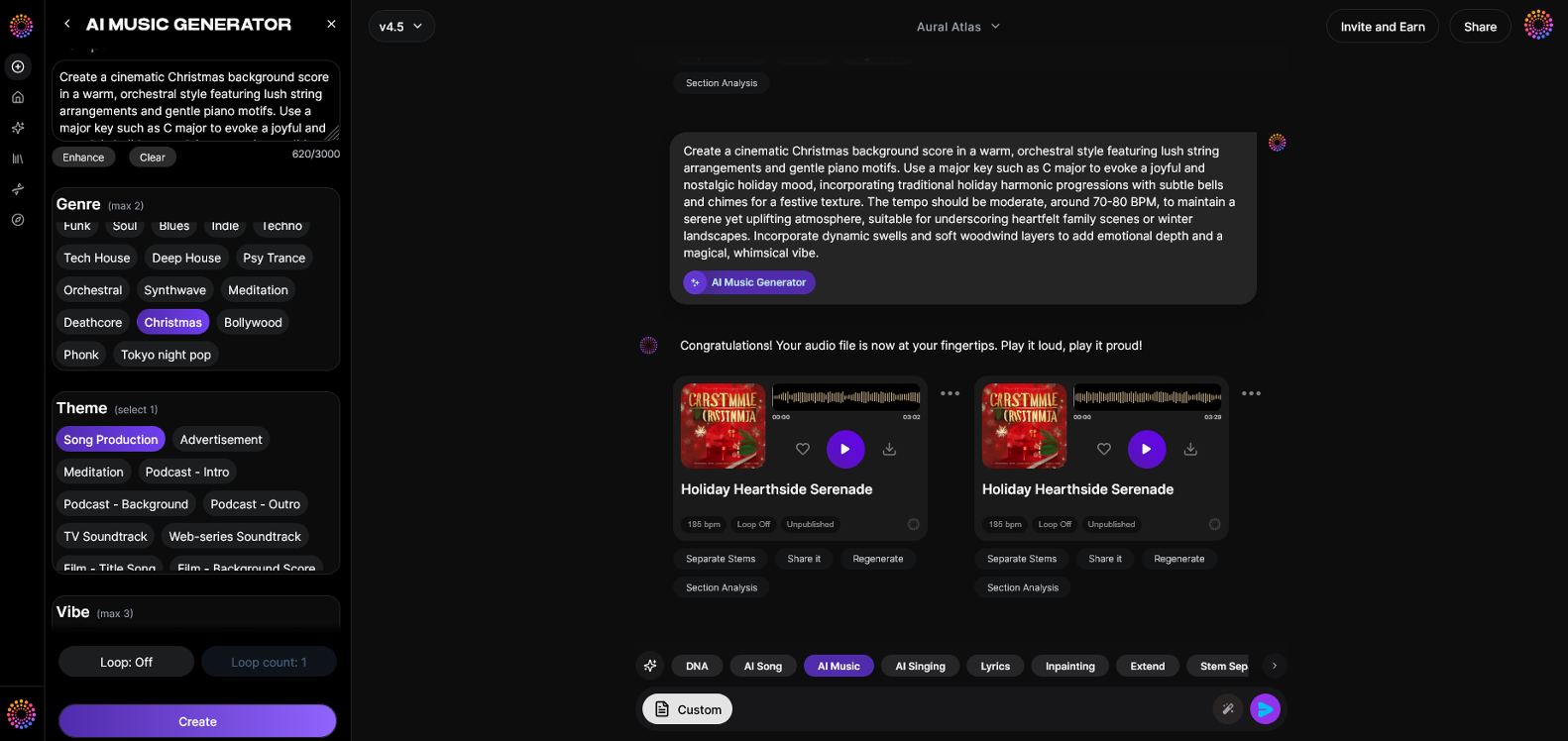
Soundverse’s AI Music Generator simplifies the art of creating underscore music by using natural language prompts to produce instrumental pieces tailored for cinematic usage.
Core Capabilities
The platform’s text-to-music engine allows creators to describe the desired tone, atmosphere, and instrumentation without needing to play or program notes. Its Loop Mode ensures seamless repetition for extended scenes, an essential feature for underscores requiring continuity. Users can tune genre, mood, and instrument balance precisely, selecting between V4 and V5 Model options depending on desired refinement or realism.
Ideal Use Cases
- Background scores for film and video scenes.
- Game soundtracks and looping atmospheres.
- Meditation or wellness soundscapes.
- Advertising and commercial scoring where discreet musical presence supports brand messaging.
Combined with Soundverse’s complementary tools, users can craft underscore compositions inspired by reference tracks through the Similar Music Generator or generate vocal-free sound-alikes using the Similar Song Generator. This ecosystem enables accurate tonal matching for directors using temporary edits while maintaining originality.
For deeper inspiration, explore related content such as generate AI music with Soundverse text-to-music, Soundverse assistant your AI music co-producer, and the benefits of composing with AI Music Generator. For workflow tips, view Soundverse Tutorial Series - 8. Explore Tab.
Why Soundverse stands out in underscore production
Unlike traditional sample manipulation software, Soundverse focuses on emotion-driven creation through semantic prompts. This makes it exceptionally powerful for underscore artists who need adaptive content that reacts to narrative emotion rather than fixed tempo grids. The Loop Mode solves one of the oldest challenges in underscore writing—creating natural repetition without audible seams.
Additionally, filmmakers seeking an affordable Soundraw alternative or comparing Mubert alternatives find Soundverse an appealing solution thanks to its versatile library and prompt-based flexibility. Check out our Soundverse Tutorial Series - 10. Make Deep House Music to explore sound design from a different creative angle.
The creative possibilities ahead
As storytelling expands into VR, interactive cinema, and gaming, underscore music will remain a cornerstone of immersive experiences. With AI enhancements, composers in 2026 can quickly shape evolving emotional arcs, synchronize adaptive loops to gameplay actions, and elevate conventional film scenes through precisely controlled tone design.
For musicians and producers, learning underscore composition is no longer confined to complex orchestral templates. It’s an intuitive craft supported by digital intelligence and creative freedom. Tools like Soundverse represent a shift where human narrative instincts meet computational composition.
Create Your Own Underscore Music with AI
Elevate your video, podcast, or film projects with custom underscore music generated by Soundverse. Instantly craft perfectly balanced background soundtracks designed to enhance every moment.
Related Articles
- The Role of AI Music in Film and Television: Discover how AI-generated music is reshaping the soundtracks of modern entertainment.
- Navigating the World of Royalty-Free and Copyright-Free Music Using Soundverse AI: Learn how to find and create background music that’s both legal and inspiring.
- Enhancing YouTube Content with Royalty-Free and Copyright-Free Music Using Soundverse AI: See how creators can use Soundverse AI to produce engaging underscore tracks for video content.
- The Benefits of Composing with AI Music Generator: Explore why AI composition tools are becoming essential for creating professional-quality background and underscore music.
Here's how to make AI Music with Soundverse
Video Guide
Here’s another long walkthrough of how to use Soundverse AI.
Text Guide
- To know more about AI Magic Tools, check here.
- To know more about Soundverse Assistant, check here.
- To know more about Arrangement Studio, check here.
Soundverse is an AI Assistant that allows content creators and music makers to create original content in a flash using Generative AI.
With the help of Soundverse Assistant and AI Magic Tools, our users get an unfair advantage over other creators to create audio and music content quickly, easily and cheaply.
Soundverse Assistant is your ultimate music companion. You simply speak to the assistant to get your stuff done. The more you speak to it, the more it starts understanding you and your goals.
AI Magic Tools help convert your creative dreams into tangible music and audio. Use AI Magic Tools such as text to music, stem separation, or lyrics generation to realise your content dreams faster.
Soundverse is here to take music production to the next level. We're not just a digital audio workstation (DAW) competing with Ableton or Logic, we're building a completely new paradigm of easy and conversational content creation.
TikTok: https://www.tiktok.com/@soundverse.ai Twitter: https://twitter.com/soundverse_ai Instagram: https://www.instagram.com/soundverse.ai LinkedIn: https://www.linkedin.com/company/soundverseai Youtube: https://www.youtube.com/@SoundverseAI Facebook: https://www.facebook.com/profile.php?id=100095674445607
Join Soundverse for Free and make Viral AI Music

We are constantly building more product experiences. Keep checking our Blog to stay updated about them!