What Is SAAR: Understanding Seasonally Adjusted Annual Rate in 2026
Learn SAAR meaning, calculation, and role in economics for 2026.
What Is SAAR: Understanding Seasonally Adjusted Annual Rate
In the world of economics, interpreting raw data without adjustments can lead to misleading conclusions. One concept that helps transform unprocessed data into comparable, insightful economic indicators is SAAR, or Seasonally Adjusted Annual Rate. In 2026, professionals in finance and economics continue to rely on SAAR meaning to analyze trends beyond short-term fluctuations. Whether you're a business analyst forecasting market movements, an economist evaluating GDP performance, or a finance student learning the basics of macroeconomic indicators, understanding SAAR is essential for accurate economic interpretation.
What does SAAR mean in economics?
The SAAR meaning—Seasonally Adjusted Annual Rate—refers to a statistical technique that converts data collected over a shorter period (like a month or a quarter) into an annual rate after removing the effects of seasonal variations. This adjustment makes datasets comparable across different timeframes by smoothing out predictable patterns—such as holiday sales spikes, weather-influenced production changes, or agricultural cycles.

For instance, automobile sales tend to soar in spring and decline in winter. The raw monthly sales figures don't reveal the underlying trend effectively. By computing the SAAR, economists can understand what annualized performance would look like if those seasonal effects didn't exist. SAAR is defined extensively in sources like the Seasonally adjusted annual rate – Wikipedia and the Investment dictionary’s definition of SAAR.
In short, SAAR helps answer a critical question: What is the economy doing when seasonal noise is taken out?
Why is SAAR important for interpreting economic performance?
The seasonally adjusted annual rate is vital for comparing economic data objectives over time with consistency. Without adjustment, data can mislead analysts about genuine growth or contraction trends. In fact, SAAR in economics has become one of the fundamental tools used by institutions like the U.S. Census Bureau and Bureau of Economic Analysis (BEA) to publish monthly indicators, such as new housing starts or retail sales.

Year-to-year comparisons without distortion
Suppose retail sales spike in December due to holiday shopping. A comparison with January might suggest an economic downturn. But after applying SAAR, economists can measure the underlying growth unaffected by holiday distortions, enabling policymakers to craft sound economic decisions.
Smoothing cyclical patterns
Industries like agriculture or tourism exhibit predictable seasonal swings that obscure long-term progress. SAAR allows analysts to observe whether economic strength or weakness exists independently of expected seasonal patterns.
Policy-making relevance
Central banks and government agencies often rely on SAAR-based figures to determine monetary or fiscal adjustments. For example, when evaluating quarterly GDP growth, seasonally adjusted annual figures provide a more realistic snapshot of macroeconomic conditions.
How is the Seasonally Adjusted Annual Rate calculated?
Understanding SAAR calculation is key for financial accuracy. The formula involves two main steps:
- Seasonal adjustment: Using statistical models such as X-13ARIMA-SEATS or TRAMO-SEATS, recurring patterns are identified and removed from the data. These models rely on historical time series data to estimate seasonal components.
- Annualization: The adjusted rate is multiplied or scaled to project the amount for a full year. For instance, if adjusted monthly sales total $100 billion, the SAAR might be computed by multiplying by 12, yielding an annualized rate of $1.2 trillion.
Additional perspective is shared in Reading Real Estate Statistics — SAAR Wars.
While these calculations might seem straightforward, they require high-quality data and proper statistical modeling—especially for volatile sectors.
What are common examples of SAAR application?
Economists use SAAR broadly across diverse sectors:
- Housing market: The number of new home starts reported monthly by the U.S. Census Bureau is often expressed in SAAR terms. This allows stakeholders to compare with other periods easily.
- Automotive industry: Vehicle manufacturers track monthly dealership sales using SAAR metrics to estimate total annual performance.
- GDP analysis: Quarterly GDP is frequently expressed at seasonally adjusted annual rates, allowing economists to interpret how a single quarter’s output would scale to one year.
See also how GDP (SAAR) data is presented by MacroMicro.
As of 2026, these examples highlight how SAAR maintains relevance for economic monitoring despite evolving technology-driven data analytics.
How does SAAR affect business and market forecasting?
For business analysts and investors, understanding SAAR delivers insights beyond standard trend reporting. It plays a pivotal role in predicting stock performance, corporate earnings potentials, and industry cycles.
Enhanced comparability
Because SAAR adjusts figures to a common standard, it simplifies comparative analysis across countries or industries, helping firms align strategies with global economic conditions.
Investment timing
Professionals who interpret data seasonally adjusted for annual trends can discern whether fluctuations are genuinely cyclical or temporary, supporting timing decisions for investments and expansions.
Improved forecasting reliability
By filtering out predictable cycles, business analysts obtain a clearer picture of underlying growth rates, which in turn strengthens forecasting models for demand, supply, and pricing.
What challenges come with using SAAR in 2026?
The use of SAAR is not immune to limitations. In 2026, with growing real-time data availability and AI-driven analytics, some experts question whether traditional seasonal adjustment remains sufficient.
Data inconsistency
Emerging markets may lack historical series necessary for accurate adjustment, weakening reliability.
Shifting seasonal behavior
Consumer habits are changing due to e-commerce and climate variations. Economic patterns that were once predictable are becoming irregular, complicating SAAR modeling.
Over-smoothing
Excessive adjustments can mask short-term opportunities. For example, businesses dependent on seasonal surges—like travel or retail—might undervalue profitable trends when relying solely on SAAR-based data.
Nevertheless, SAAR continues serving as a cornerstone of macroeconomic analysis, providing clarity in increasingly complex economic environments.
How to make sense of SAAR when evaluating economic indicators
As you interpret metrics such as GDP or industrial production, remember that seasonally adjusted annual rates don't represent actual annual totals—they simulate what the economy might achieve if the adjusted pace continued all year. Analysts use these figures to spot sustained trends across months or quarters.
For example, the Industrial Production Index expressed in SAAR form can reveal short-term contractions influencing future policy debates. More discussion on SAAR’s implications can be found in Understanding SAAR: A Multifaceted Acronym - Oreate AI Blog.
Understanding SAAR meaning helps professionals communicate insights consistently across teams, investor reports, and academic studies.
How to make SAAR analysis more engaging with Soundverse Agent
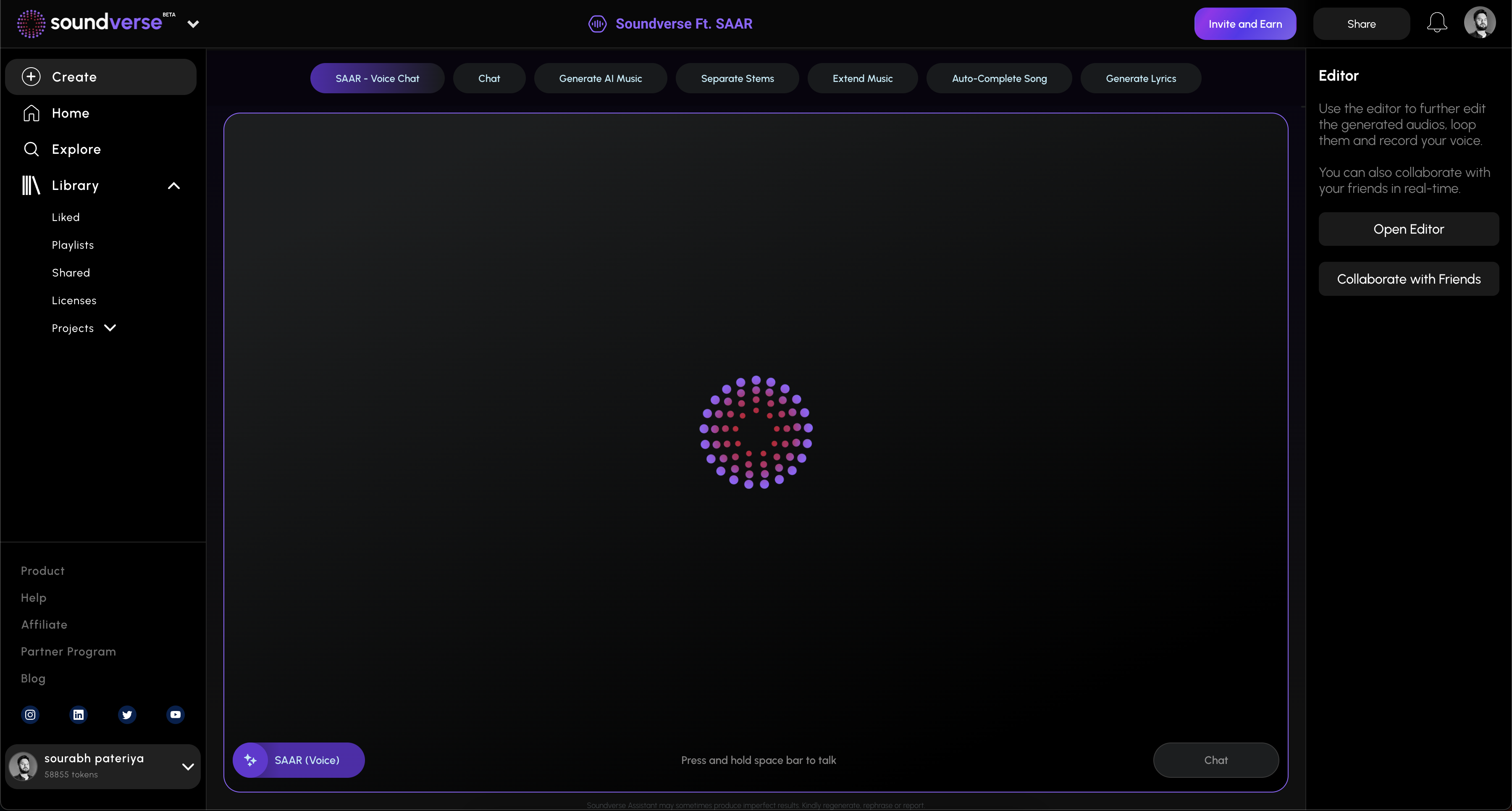
Economic data interpretation requires transformation—turning numbers into narratives. That’s precisely what Soundverse, known for its innovative AI-powered music tools, demonstrates through its intelligent orchestration capabilities.
Soundverse’s Agent acts as a centralized conversational AI assistant for creative workflows. It uses multi-step reasoning to interpret natural language requests such as “generate background music showing rhythm similar to steady market growth,” then executes the task automatically. Although SAAR is a concept in economics rather than music, both involve structured automation and data-driven insight—precisely what Soundverse Agent embodies.
Soundverse Agent’s core capabilities:
- Multi-step tool orchestration: Connects multiple generative tools into a seamless workflow.
- Contextual memory: Remembers prior user requests for consistent outcomes.
- Voice input support: Allows spoken commands to streamline creative setup.
- Cross-tool automation: Bridges creation, editing, and refinement under one intuitive interface.
For a deeper dive into creative automation, watch our guide on creating Deep House music or explore the tutorial on making music with Soundverse.
Just as economists use SAAR to distill meaningful trends from seasonal noise, Soundverse Agent simplifies creative complexity by interpreting user intent across multiple tools. For beginners, it eliminates technical barriers. For producers and educators, it accelerates exploration, analysis, and iteration. You can also explore our Soundverse “Explore” tab demo.
If you want to see how automation helps professionals in creative industries, read Soundverse AI revolutionizing music creation for new-age content creators or explore how AI-generated music is transforming the music industry.
Soundverse’s Agent continues shaping the AI creation landscape in 2026—just as SAAR remains vital to shaping economic insights. Both emphasize the same principle: letting automation bring clarity to complex systems.
Discover AI-Powered Music Creation Today
Turn your ideas into professionally produced tracks using Soundverse’s intelligent AI tools. Create, collaborate, and innovate — no technical experience required.
Start Creating Free
Related Articles
- Soundverse SAAR: AI Voice Assistant — Learn how Soundverse’s SAAR Voice Assistant helps creators streamline music production and enhance workflow efficiency.
- Soundverse AI Revolutionizing Music Creation for New Age Content Creators — Discover how AI-powered innovation is reshaping the way modern creators compose, experiment, and produce music.
- How AI-Generated Music Is Transforming the Music Industry — Explore the impact of AI music generation on artists, producers, and the business of sound worldwide.
- Soundverse Assistant: Your AI Music Co-Producer — Find out how Soundverse Assistant supports creators in generating ideas, refining tracks, and accelerating music production.
Here's how to make AI Music with Soundverse
Video Guide

Here’s another long walkthrough of how to use Soundverse AI.
Text Guide
- To know more about AI Magic Tools, check here.
- To know more about Soundverse Assistant, check here.
- To know more about Arrangement Studio, check here.
Soundverse is an AI Assistant that allows content creators and music makers to create original content in a flash using Generative AI. With the help of Soundverse Assistant and AI Magic Tools, our users get an unfair advantage over other creators to create audio and music content quickly, easily and cheaply. Soundverse Assistant is your ultimate music companion. You simply speak to the assistant to get your stuff done. The more you speak to it, the more it starts understanding you and your goals. AI Magic Tools help convert your creative dreams into tangible music and audio. Use AI Magic Tools such as text to music, stem separation, or lyrics generation to realise your content dreams faster. Soundverse is here to take music production to the next level. We're not just a digital audio workstation (DAW) competing with Ableton or Logic, we're building a completely new paradigm of easy and conversational content creation.
TikTok: https://www.tiktok.com/@soundverse.ai
Twitter: https://twitter.com/soundverse_ai
Instagram: https://www.instagram.com/soundverse.ai
LinkedIn: https://www.linkedin.com/company/soundverseai
Youtube: https://www.youtube.com/@SoundverseAI
Facebook: https://www.facebook.com/profile.php?id=100095674445607
Join Soundverse for Free and make Viral AI Music

We are constantly building more product experiences. Keep checking our Blog to stay updated about them!