What Are Stems Used For in Music Production?
Learn how audio stems enhance music mixing, mastering, and editing in 2026.
What Are Stems Used For in Music Production?
Music production in 2026 is more versatile and technology-driven than ever before. Whether you’re a seasoned audio engineer or a musician exploring new creative workflows, understanding what stems are and how they’re used has become essential. This article will explore the functions, benefits, and best practices of stems in music production, as well as how Soundverse’s Stem Separator empowers creators to work more efficiently.
What are stems in music production?
In music production, "stems" are separate audio tracks that represent grouped components of a full mix. For example, you might have individual stems for vocals, drums, bass, guitars, and other instruments. Instead of handling a single stereo mix, stems offer flexible control over each sound group.

Stems are different from isolated raw tracks—where each microphone or instrument is recorded separately. Instead, they are neatly combined elements such as all percussion instruments on one track or all backing vocals on another. This makes stems ideal for remixing, music mixing, and song mastering without having to access the full multitrack recording session. According to the Native Instruments Blog, stems are separated files of a mixed track meant for producers, remixers, or mastering engineers.
Why are stems important in modern music production?
Stems allow producers and engineers to manage complexity without losing creative freedom. In 2026, with advanced AI-driven tools and workflows, stem manipulation has become a crucial part of remixing and mastering. Instead of being confined to a locked stereo mix, producers can rebalance instrument levels, change tonal profiles, or replace parts without re-recording.

For remix artists and DJs, stems create opportunities to rework existing songs and experiment with new arrangements. Sound engineers use them for cleaning up problematic frequency ranges, fine-tuning dynamics, or applying spatial effects more precisely. As Wisseloord Studios explains, stems are consolidated audio files grouping similar tracks like drums or vocals into one file, making remixing and mastering efficient.
How do audio stems improve music mixing and mastering?
In mixing, stems help define sonic clarity. A producer can tweak drum compression or adjust vocal brightness independently. For mastering engineers, stems facilitate more organic control over the final loudness balance. When only stereo mastering is possible, subtle tone adjustments are limited. But with stem mastering, engineers can preserve musicality while maximizing punch and loudness.
The use of stems also enables collaborative workflows. When multiple producers or mixing engineers are involved, sharing stems instead of full project files ensures easier compatibility across digital audio workstations (DAWs). This flexibility is especially valuable for remote teams working across platforms. LANDR Blog highlights that stems are groups of distinct elements—vocals, drums, bass—helping engineers adjust sonic balance more effectively.
What is the difference between multitrack recording and stems?
Multitrack recording refers to capturing each instrument or sound source on separate tracks during recording. For instance, a full drum kit might have a track for the kick, snare, toms, hi-hats, and overhead microphones.
Stems, on the other hand, are consolidated versions of those tracks—for example, all drum tracks combined into one stem. Multitrack sessions are often too large or complex to share for editing or remixing, so stems serve as practical subsets. They maintain creative control while minimizing file management headaches. iZotope defines stems as groups of related tracks printed together as one file—like a complete drum mix—simplifying production sharing.
How have music production techniques evolved around stems in 2026?
Over the past two years, the role of stems has expanded significantly. By 2026, many AI-assisted platforms automate the process of stem separation, making mixing and mastering faster and more precise. Musicians in electronic, pop, and film score production increasingly rely on stems to repurpose material and synchronize compositions efficiently.
This evolution aligns with general music industry trends that emphasize content reusability. Modern producers frequently release alternative versions, instrumentals, and performance edits—all made possible by accessible stem workflows. For a deeper dive into this evolution, watch our tutorial on how to make music using AI tools or explore the Deep House music guide from Soundverse’s tutorial series.
What can you do with stems in music production?
There are several practical uses for stems:
- Remixing and sampling: Artists can isolate parts of a song and create fresh arrangements.
- Karaoke and performance tracks: Vocals or instrument groups can be removed to make custom backing tracks.
- Educational use: Students and producers analyze mix structure by soloing stems and studying arrangement balance.
- Film and game sound design: Stems make synchronization and versioning easier when adapting music to visual media.
- Audio restoration: Problematic elements can be cleaned or replaced without affecting the entire mix.
These processes reflect advances described in AI-generated music tools, which also depend heavily on stem editing to refine quality.
How to make stems ready for mixing and mastering
Preparing stems involves organizing your project into logical groups, labeling tracks consistently, and applying minimal processing. Export each stem at uniform length and sample rate to simplify alignment during mastering. It's common practice to leave headroom in stems to avoid clipping, ensuring that mastering engineers can apply compression and EQ effectively.
When sharing stems, use clear naming conventions (e.g., “Drums.wav,” “Vocals.wav”) and check synchronization so that every stem starts at the same point in the timeline. Even small misalignments can cause phase issues or timing errors. As LANDR Blog suggests, this careful setup ensures easier mastering and remixing.
How Soundverse helps process and edit stems efficiently
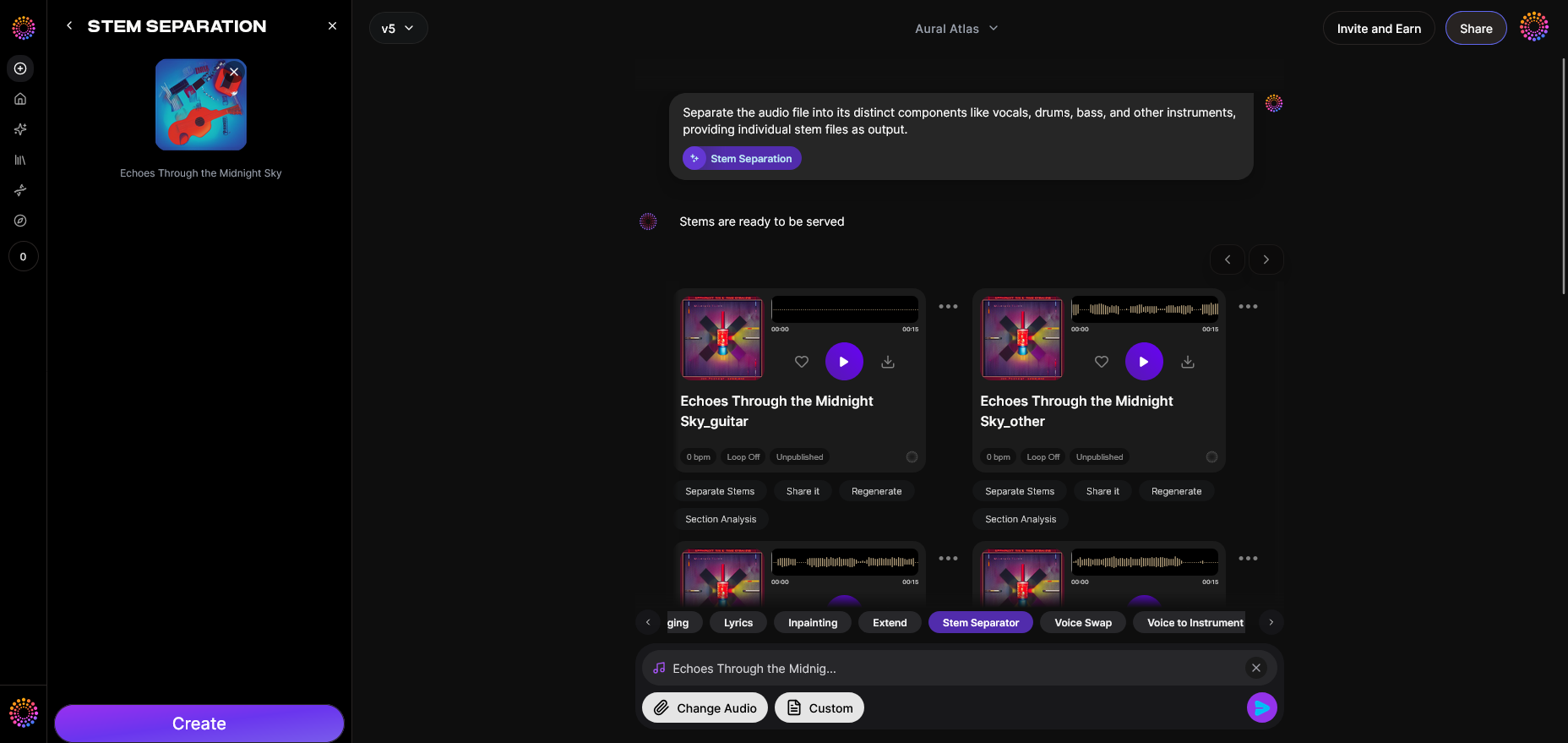
Now that you understand what stems are and how vital they are for music production, here is how to create and manage them instantly using Soundverse.
How to make stems in music production with Soundverse Stem Separator
The Soundverse Stem Separator is an AI-powered tool that dissects mixed audio into up to six editable stems—vocals, drums, bass, guitar, accompaniment, and others. With support for URL, file, and live audio input, users can separate stems from any source efficiently.
Core Capabilities:
- High-quality stem isolation (up to 6 parts)
- Multiple input modes: upload files, paste a URL, or record directly
- Precision editing compatible with remixing and mastering workflows
Primary Use Cases:
- Create stems for remixing or sampling
- Generate vocal-free backing tracks for performances and karaoke
- Conduct educational mix analysis
- Restore or clean audio elements for post-production
Soundverse’s Section Analysis tool complements the Stem Separator by identifying the structure of your track—chorus, verse, bridge, and outro—ideal for targeted stem editing. Meanwhile, Inpainting, another AI editing module, enables surgical regeneration of specific sections. It can fix mistakes, change lyrics, or alter arrangements while the rest of the composition stays intact. You can learn more in Soundverse introduces stem separation AI magic tool.
Producers who have explored tools like Mubert Alternatives or Soundraw Alternative are discovering Soundverse as a next-generation solution for fast and accurate stem creation.
By integrating stem separation into your creative process, Soundverse eliminates technical barriers, allowing you to focus purely on musicality. Whether working on electronic productions, acoustic performances, or mastering final mixes, the Stem Separator serves as a reliable foundation for modern music workflows.
Start Creating with AI-Powered Stem Tools Today
Unlock the power of stems in music production using Soundverse’s advanced AI tools. Separate, remix, and refine your tracks effortlessly for professional-level quality and creativity.
Related Articles
- What Are Song Stems and Why Do You Need Them — Learn the basics of song stems and discover why they’re essential for remixing, mastering, and collaborating.
- Soundverse Introduces Stem Separation AI Magic Tool — Explore how Soundverse’s AI stem separation technology revolutionizes sound editing and remix creation.
- Soundverse AI Revolutionizing Music Creation for New Age Content Creators — See how Soundverse empowers creators with AI-driven music production tools to streamline creativity and sound design.
- What Is Soundverse Arrangement Studio and What Does It Do — Discover how the Soundverse Arrangement Studio helps musicians organize and enhance their compositions with precision.
Here's how to make AI Music with Soundverse
Video Guide
Here’s another long walkthrough of how to use Soundverse AI.
Text Guide
- To know more about AI Magic Tools, check here.
- To know more about Soundverse Assistant, check here.
- To know more about Arrangement Studio, check here.
Soundverse is an AI Assistant that allows content creators and music makers to create original content in a flash using Generative AI. With the help of Soundverse Assistant and AI Magic Tools, our users get an unfair advantage over other creators to create audio and music content quickly, easily and cheaply. Soundverse Assistant is your ultimate music companion. You simply speak to the assistant to get your stuff done. The more you speak to it, the more it starts understanding you and your goals. AI Magic Tools help convert your creative dreams into tangible music and audio. Use AI Magic Tools such as text to music, stem separation, or lyrics generation to realise your content dreams faster. Soundverse is here to take music production to the next level. We're not just a digital audio workstation (DAW) competing with Ableton or Logic, we're building a completely new paradigm of easy and conversational content creation.
TikTok: https://www.tiktok.com/@soundverse.ai
Twitter: https://twitter.com/soundverse_ai
Instagram: https://www.instagram.com/soundverse.ai
LinkedIn: https://www.linkedin.com/company/soundverseai
Youtube: https://www.youtube.com/@SoundverseAI
Facebook: https://www.facebook.com/profile.php?id=100095674445607
Join Soundverse for Free and make Viral AI Music

We are constantly building more product experiences. Keep checking our Blog to stay updated about them!