Warner Music Group AI Strategy Explained (2026)
Explore Warner Music Group's AI strategy in 2026 and how ethical frameworks redefine music innovation.
Warner Music Group AI Strategy Explained (2026)
Introduction
In 2026, the music industry stands at the intersection of technological innovation and ethical transformation. Artificial intelligence has become an integral part of music creation, distribution, and rights management. Yet one of the biggest challenges remains: balancing automation and artistry without compromising artist integrity. Warner Music Group (WMG) has taken a proactive role in this conversation through a carefully structured approach, known as the Warner Music Group AI strategy. This initiative positions WMG as a forward-thinking label that treats artificial intelligence not as a threat but as a complementary creative tool aligned with consent and transparency.
This article breaks down the WMG AI strategy in 2026, examining its ethical backbone, alignment with industry standards, and practical impact on labels and artists. It also explores how the Soundverse Ethical AI Music Framework supports similar goals across the entire music technology ecosystem.
What is Warner Music Group's AI Strategy in 2026?
The Warner Music Group AI strategy revolves around responsible and transparent use of AI technologies throughout its creative and operational processes. By 2026, WMG’s approach represents a significant maturation compared to its experimental phases in 2024 and 2025. The company integrates AI for catalog analysis, music trend prediction, fan engagement, and creative support—always ensuring data licensing, artist approval, and equitable compensation.

Rather than merely automating production, WMG’s AI initiative aims to enhance decision-making. This includes optimizing release schedules based on audience listening patterns, refining royalty collection from digital platforms, and identifying opportunities for collaborative AI music projects. These strategic applications show how the music industry AI strategy has evolved into a multi-layered system blending machine learning insights with human creativity. For example, WMG’s collaboration with Udio demonstrates its vision to develop a licensed generative AI music platform. There are also ongoing partnerships, such as WMG’s deal with Stability AI, reinforcing ethical innovation across the ecosystem.
Why is WMG’s Label AI Approach Considered Ethical?
A major element distinguishing WMG’s label AI approach from competitors lies in its ethical foundation. The company aligns with global concerns regarding copyright, data ownership, and artist representation. Following debates in 2024–2025, WMG designed its policies to comply with new international AI music regulations.

WMG enforces strict usage of licensed and permissioned data sources. For any generative system trained on music, consent from rights holders is mandatory. This transparency contrasts with earlier industry models that depended on scraping public datasets without authorization. The WMG AI policy includes built-in audits for traceability—ensuring every trained model can trace its dataset origins, training process, and output attribution. Recent collaborations between Warner Music Group and Suno further confirm this commitment, granting artists full control over names, likenesses, and compositions used for AI training.
How Warner’s AI Policy Shapes the Future of Record Labels
As the music industry enters 2026, AI-driven label management has become not only a creative opportunity but a regulatory challenge. Many investors and executives look to WMG’s AI policy as the blueprint for how record labels should navigate automation responsibly.
The policy sets standards around collaborative ownership of AI outputs. Artists participating in AI training models receive royalty streams for generated works connected to their creative DNA. This system builds long-term sustainability, turning artificial intelligence into a licensing engine rather than a replacement for artistic labor.
Record labels now treat their catalogs as dynamic training datasets with real-time traceability. Using robust ethical frameworks like those seen at WMG, they can maintain credibility across legal jurisdictions, improve artist trust, and innovate safely. For investors, these policies reduce legal risks while opening scalable monetization models.
To understand how such frameworks are replicated across platforms, it’s useful to compare WMG’s approach to industry developments discussed in how AI-generated music is transforming the music industry and music industry trends. These resources highlight the role of transparency and consent-based data usage in long-term growth.
What Are the Core Pillars of the WMG AI Strategy?
WMG’s AI strategy rests on three primary pillars:
- Transparency – Complete documentation of how AI systems are trained, what data sources are used, and who owns the inputs.
- Consent – Mandatory artist and rights-holder authorization for dataset inclusion.
- Compensation – Dynamic royalty mechanisms ensuring creative participation leads to recurring income. This triad mirrors the broader ethical movement in AI music technology. Across labels, there is growing convergence around models that pair innovation with integrity. For example, in exploring solutions for music automation, tools such as Soundverse introduces stem separation AI magic tool highlight how artist rights can be preserved even during algorithmic manipulation of existing tracks. If you’re curious to see how that process is visualized, check our Soundverse Tutorial Series - "Explore" Tab.
How to Make Warner Music Group's AI Strategy Work for the Industry at Large
WMG’s example demonstrates that large-scale adoption of AI in record labels must begin with clarity. For smaller labels, applying similar frameworks means establishing trusted pipelines for AI collaboration, where data ownership is transparent and monetization fair.
Such models also influence third-party platforms. Licensing boards and collection societies increasingly demand explainable AI architectures that track attribution and distribution flows. The ripple effects touch everything from Sync licensing to streaming recommendation systems. A consistent ethical layer is key for scalability, which is why the structure of Soundverse’s Ethical AI Music Framework complements WMG’s principles seamlessly.
How to make Warner Music Group’s AI Strategy scalable with Soundverse The Ethical AI Music Framework
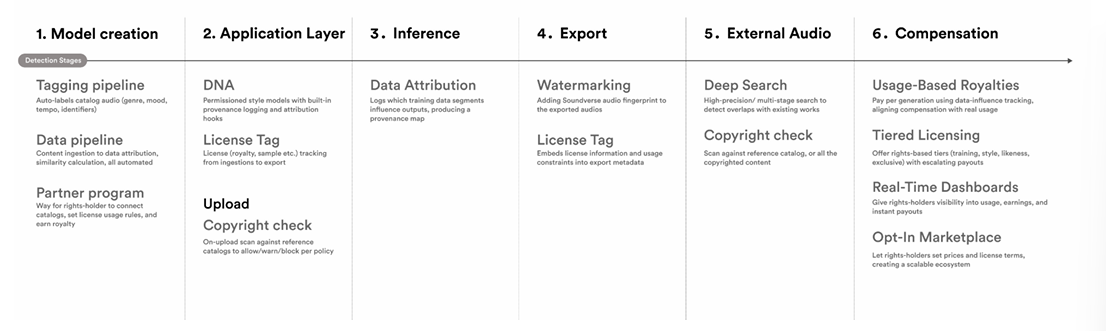
Soundverse has introduced a solution specifically designed to support labels that share WMG’s vision. Known as The Ethical AI Music Framework, this is a comprehensive end-to-end infrastructure bridging innovation and artist integrity.
The framework includes six interconnected stages:
- Stage 1: Licensed Data Sourcing (No scraping) – Ensures datasets are built from authorized and licensed audio rather than scraped content.
- Stage 2: Permissioned Models (DNA) – Uses permission-based artist DNA models, protecting signature styles and enabling monetization via AI.
- Stage 3: Explainable Inference (Attribution) – Guarantees attribution clarity, allowing every generated track to trace its creative foundation.
- Stage 4: Traceable Export (Watermarking) – Embeds invisible watermarks linking AI outputs to their data sources, improving ownership transparency.
- Stage 5: Deep Search (External Scanning) – Scans public metadata and external libraries for unauthorized use of licensed material.
- Stage 6: Recurring Compensation (Partner Program) – Facilitates recurring royalty streams through an opt-in partner licensing system. These capabilities support legal compliance, artist protection, and monetization—all critical for scaling the WMG AI policy model beyond one corporate structure. Labels implementing this pipeline benefit from transparent auditing and sustainable AI-driven creativity.
Complementary tools such as Soundverse DNA and Soundverse Trace extend the system further. The DNA feature creates original music based on artists’ authorized sonic identities, while Trace acts as the trust layer ensuring rights protection across datasets and final exports. For a practical demonstration, watch our tutorial on how to make music. This linkage between creative fidelity and auditability mirrors the ethics behind Warner’s own AI initiative.
If you want to explore how Soundverse’s framework simplifies licensed content creation and AI transparency, visit resources like generate AI music with Soundverse text to music or Soundverse assistant your AI music co-producer.
How Does This Impact Investors and Policy Analysts in 2026?
For investors, the Warner Music Group AI strategy signals a stable foundation for AI adoption without regulatory fallout. Transparent AI pipelines reduce legal uncertainty and boost catalog monetization opportunities. For policy analysts, WMG’s practices become precedents for international frameworks regulating generative AI. These methods underline the music industry’s commitment to ethical automation rather than unrestricted algorithmic creativity.
From a strategic standpoint, aligning with ethical frameworks like Soundverse’s ensures scalability and credibility in cross-border music commerce. With governments increasingly attentive to AI content control and licensing accuracy, systems built around consent and traceability will define future compliance standards.
Create Your Own AI-Powered Music Today
Experience next-generation music creation with Soundverse’s AI tools. Generate, remix, and personalize tracks effortlessly to bring your sound ideas to life in minutes.
Related Articles
- How AI-Generated Music Is Transforming the Music Industry — Discover how artificial intelligence is reshaping music production and redefining artist creativity worldwide.
- The Role of AI Music in Film and Television — Explore how AI-driven compositions are revolutionizing soundtrack creation for movies and streaming media.
- AI Music Generator and Human Composers: A Future Together — Learn how AI tools are empowering composers to collaborate with technology for smarter, faster, and more creative outcomes.
- Soundverse Revolutionizing Music Creation for New-Age Content Creators — See how Soundverse AI is changing content creation for digital artists and creatives across all genres.
Here's how to make AI Music with Soundverse
Video Guide
Here’s another long walkthrough of how to use Soundverse AI.
Text Guide
- To know more about AI Magic Tools, check here.
- To know more about Soundverse Assistant, check here.
- To know more about Arrangement Studio, check here.
Soundverse is an AI Assistant that allows content creators and music makers to create original content in a flash using Generative AI. With the help of Soundverse Assistant and AI Magic Tools, our users get an unfair advantage over other creators to create audio and music content quickly, easily and cheaply. Soundverse Assistant is your ultimate music companion. You simply speak to the assistant to get your stuff done. The more you speak to it, the more it starts understanding you and your goals. AI Magic Tools help convert your creative dreams into tangible music and audio. Use AI Magic Tools such as text to music, stem separation, or lyrics generation to realise your content dreams faster. Soundverse is here to take music production to the next level. We're not just a digital audio workstation (DAW) competing with Ableton or Logic, we're building a completely new paradigm of easy and conversational content creation.
TikTok: https://www.tiktok.com/@soundverse.ai
Twitter: https://twitter.com/soundverse_ai
Instagram: https://www.instagram.com/soundverse.ai
LinkedIn: https://www.linkedin.com/company/soundverseai
Youtube: https://www.youtube.com/@SoundverseAI
Facebook: https://www.facebook.com/profile.php?id=100095674445607
Join Soundverse for Free and make Viral AI Music

We are constantly building more product experiences. Keep checking our Blog to stay updated about them!