Voice-First Music Creation: How Vocal Commands Are Revolutionizing Music Production
Discover how voice-first music creation and Soundverse Agent are redefining 2026 music production.
Voice-First Music Creation: How Vocal Commands Are Revolutionizing Music Production
What is voice-first music creation?
Voice-first music creation is the emerging frontier of digital audio production where spoken instructions replace traditional touchscreen or keyboard inputs. Instead of manually navigating a digital audio workstation (DAW), music producers can simply say, “Create a jazz piece with a slow tempo,” or “Add a synth pad to the chorus.” The system interprets these commands and executes complex creative workflows entirely through voice input.
In 2026, this method has evolved from a novelty into a mainstream creative practice. Artists, producers, and even educators are adopting voice-first environments to increase focus, streamline their process, and access new dimensions of creativity. With AI music technology becoming more conversational, the studio itself feels like a collaborator — always listening, understanding, and responding to your creative intent.
Why is conversational music shaping production in 2026?
Conversational music refers to the ability to create, modify, and mix songs through dialogue — both text and voice-based. The technology behind this comes from multimodal AI, which processes natural language, audio context, and reference materials to orchestrate tools for composition, arrangement, and mixing.
By 2026, conversational music technology has advanced enough to handle multi-step creative reasoning. Producers can request automation such as: “Create a pop beat, remove the drums, and extend the bridge by eight bars.” The system understands these increasingly detailed tasks and interprets the sequence without additional scripts or manual input.
This is particularly useful for:
- Workflow acceleration: Reducing repetitive tasks and technical navigation.
- Accessibility: Enabling creators who prefer vocal input or have physical limitations.
- Creative exploration: Quickly generating multiple variations based on voice-only prompts.
- Education: Teaching music theory interactively through dialogue.
You can find similar innovation concepts discussed in Soundverse’s detailed trend reports like Music Industry Trends and AI Music Generator and Human Composers: A Future Together. External sources like The Rise of AI-Driven Audio Technology in 2026 and AI & Music Tech In 2026 share insights on how artists increasingly work alongside AI tools that generate melodies or refine vocals.

What technology enables voice-controlled music production?
Voice-controlled music production depends on several layers of intelligent audio processing:
- Speech-to-text mapping: Converts vocal commands into actionable text recognized by the platform.
- Contextual memory: The system recalls previous requests, maintaining continuity between interactions.
- Multi-step reasoning: Executes a series of linked actions based on a single natural language prompt.
- Tool orchestration: Manages tasks across integrated audio tools — synthesis, mixing, and mastering.
Together, these create a seamless experience where AI not only responds to commands but understands creative intent. In 2026, this infrastructure has matured, allowing producers to build songs through global-level instruction rather than track-level editing. Companies examined during The Future of Audio Technology: 3 Defining Trends from CES 2026 affirm that synthetic voice control and multimodal workflow integration are central to next-generation studios.
What are the benefits of creative audio tools driven by voice interaction?
Creative audio tools integrated with voice-first AI yield several game-changing advantages:
- Flow preservation: Vocal interaction lets artists stay focused on the performance rather than the interface.
- Rapid iteration: New versions or remixes can be generated conversationally.
- Idea prototyping: Short prompts like “turn this melody into ambient music” trigger cross-tool transformations.
- Inclusive creation: Voice technology expands access to visually impaired musicians or those less familiar with complex DAW workflows.
Many creators in 2026 use these techniques to merge artistic instinct with the analytical precision of AI. In educational settings, students can say “Explain chord progression theory and create an example track,” enhancing comprehension through interactive demonstration. For a deeper dive, watch our guide on how to make music and Soundverse Tutorial Series - Make Deep House Music to explore how vocal-driven production actually manifests in projects.
How is AI music technology evolving beyond traditional composition?
AI music technology has already moved beyond mere track generation. Systems now act as intelligent assistants capable of multi-modal interpretation — processing both text and vocal cues. The focus is shifting towards adaptive production, where AI learns each creator’s style and offers suggestions in real time during conversational sessions.
Advanced platforms even enable cross-tool reasoning. For instance, after generating a jazz track, you could say, “Separate stems and remix the bassline,” and the system automatically links to a stem separation sub-tool such as Soundverse’s AI Magic Tool for stem separation.
Comparatively, earlier systems (2024–2025) required manual re-entry and disconnected actions. Today, integrated reasoning systems interpret multi-step workflows with no need for manual sequencing.
Why does voice-first music creation matter for producers and audio engineers?
For professional producers, voice-first workflows eliminate countless menu clicks and setting tweaks. Instead of configuring EQs or automation envelopes manually, they can give conceptual directions: “Make the vocals brighter,” or “Add cinematic depth to the reverb.” The AI interprets intent, executes the technical operations, and presents the processed result.
Audio engineers benefit from quick iteration in early drafts and mixdown phases, freeing more time for creative judgment rather than mechanical adjustment.
Moreover, voice-first creation aligns perfectly with evolving collaboration ecosystems. Producers can use conversational AI tools to brainstorm remotely and co-create across borders. As 2026 sees an uptick in artists releasing multilingual and cross-genre projects, vocal control provides a fluid, universal creative method. When Voice-First Apps Actually Makes Sense (A 2026 Guide) outlines how such tools solve tangible creative workflow bottlenecks.
How to make voice-first music creation with Soundverse Agent
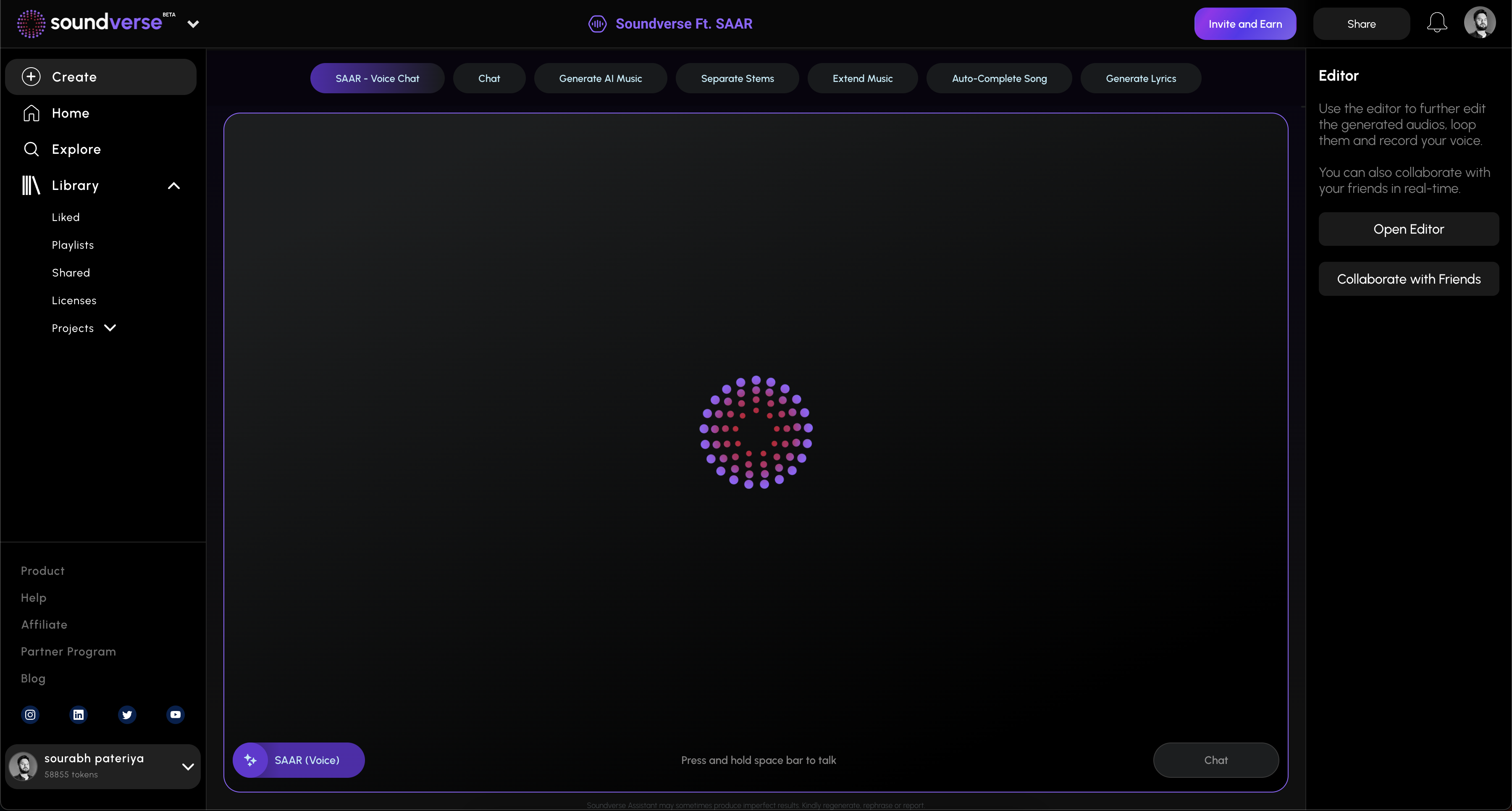
Now that you understand how voice-first music creation redefines music production, here is how to experience it instantly using Soundverse Agent.
The Soundverse Agent overview
The Soundverse Agent is the platform’s conversational AI assistant acting as a centralized controller for all music creation features. It recognizes natural language requests and carries out complex workflows, orchestrating various tools to perform multi-layered tasks automatically.
Key capabilities
- Multi-step tool orchestration: You can issue extended, detailed instructions combining generation, separation, or remixing.
- Contextual memory: The Agent remembers previous user inputs, maintaining continuity throughout your creative conversation.
- Voice input support: Speak commands directly to initiate composition, transformation, and arrangement actions.
- Cross-tool automation: Integrates with Soundverse’s AI Song Generator, AI Singing Generator, and Voice to Instrument tool.
Primary use cases
- Beginners: Create music without needing technical expertise.
- Producers: Automate multi-step creative operations — generate, separate, extend.
- Education: Learn music theory interactively.
- Rapid prototyping: Explore multiple variations efficiently.
Example workflow in Soundverse
Imagine saying: “Create a pop song, remove the drums, extend the chorus.” The Agent interprets this and coordinates internal modules accordingly. You could then use the AI Singing Generator to produce compelling acapellas, or Voice to Instrument to convert your hummed melody into instrumental performances.
No real-time preview is required; users record or upload audio, the Agent processes it asynchronously, then delivers generated tracks for review and refinement. This ensures precise rendition and professional audio quality every time.
For additional insight into related Soundverse capabilities, explore articles like Soundverse Assistant: Your AI Music Co-Producer and Generate AI Music with Soundverse Text-to-Music.
The future of voice-first music creation
By mid-2026, voice-first production environments are evolving into standard studio tools. Creative AI assistants are being taught stylistic interpretation, meaning they can distinguish between subtle genre-specific cues such as swing timing in jazz or syncopation in hip hop. These advances promise reduced setup friction and elevated precision alongside expressive freedom.
Soon, conversational creation won’t just help compose; it will serve collaborative roles alongside visual AI systems, motion designers, and virtual reality composers. Voice-first is propelling us toward an entirely new dimension of creative interaction — one where communication itself becomes the studio interface.
Start Creating Music with Your Voice Today
Experience seamless, voice-first music creation powered by Soundverse AI. Transform your spoken ideas into rich musical compositions — faster than ever before.
Try Soundverse Free
Related Articles
- Soundverse SAAR: AI Voice Assistant — Discover how Soundverse SAAR brings voice-powered production to life, helping creators generate music effortlessly through spoken commands.
- Soundverse AI Revolutionizing Music Creation for New Age Content Creators — Explore how AI-driven tools are reshaping how musicians and creators produce unique tracks across genres and platforms.
- AI Music Generator and Human Composers: A Future Together — Learn how collaboration between AI tools and human creativity is redefining the boundaries of musical expression.
- Soundverse Assistant: Your AI Music Co-Producer — Meet your next digital studio partner — an assistant that understands your workflow and helps turn vocal commands into polished music.
Here's how to make AI Music with Soundverse
Video Guide
Here’s another long walkthrough of how to use Soundverse AI.
Text Guide
- To know more about AI Magic Tools, check here.
- To know more about Soundverse Assistant, check here.
- To know more about Arrangement Studio, check here.
Soundverse is an AI Assistant that allows content creators and music makers to create original content in a flash using Generative AI. With the help of Soundverse Assistant and AI Magic Tools, our users get an unfair advantage over other creators to create audio and music content quickly, easily and cheaply. Soundverse Assistant is your ultimate music companion. You simply speak to the assistant to get your stuff done. The more you speak to it, the more it starts understanding you and your goals. AI Magic Tools help convert your creative dreams into tangible music and audio. Use AI Magic Tools such as text to music, stem separation, or lyrics generation to realise your content dreams faster. Soundverse is here to take music production to the next level. We're not just a digital audio workstation (DAW) competing with Ableton or Logic, we're building a completely new paradigm of easy and conversational content creation.
TikTok: https://www.tiktok.com/@soundverse.ai
Twitter: https://twitter.com/soundverse_ai
Instagram: https://www.instagram.com/soundverse.ai
LinkedIn: https://www.linkedin.com/company/soundverseai
Youtube: https://www.youtube.com/@SoundverseAI
Facebook: https://www.facebook.com/profile.php?id=100095674445607
Join Soundverse for Free and make Viral AI Music
 We are constantly building more product experiences. Keep checking our Blog to stay updated about them!