Voice Cloning Settlement Amounts: What to Expect in 2026
Learn what to expect from voice cloning settlement amounts and lawsuit payouts in 2026.
Voice Cloning Settlement Amounts: What to Expect
Voice cloning settlement amounts have become one of the most discussed legal topics in 2026, as the growing use of artificial intelligence (AI) to replicate voices has created new challenges for intellectual property and privacy laws. For creators, public figures, and businesses alike, understanding the expected compensation amounts and settlement values is essential to navigating this emerging field.
What are voice cloning settlement amounts?
Voice cloning settlement amounts refer to the compensation paid to individuals or rights-holders whose voices were imitated, used, or modified by AI systems without consent. These amounts typically result from legal settlements between creators or victims and AI developers or companies that used cloned voices in commercial contexts.

Since 2024, voice cloning lawsuits have surged, prompting courts and regulators to establish clearer guidelines about ownership and usage rights. Now, in 2026, settlement value discussions incorporate not only the unauthorized use of voice likeness but also data sourcing, attribution records, and technical evidence from AI audio generation systems.
How are voice cloning compensation amounts typically calculated?
Settlement amounts depend on factors like the type of voice used (celebrity, performer, broadcaster, or private individual), commercial usage scope, emotional distress, and potential damage to reputation. Legal professionals often assess three domains when negotiating payouts:
- Direct commercial exploitation: If the cloned voice was used in advertising, voiceovers, or music recordings that generated profit, the claimant may receive a share of revenue.
- Emotional or reputational impact: Public figures or artists whose voice was used deceptively can claim compensation for reputational harm.
- Data attribution failure: When an AI model fails to log or disclose which voice samples influenced a generated output, it can increase settlement value due to lack of transparency.

In 2026, average voice cloning lawsuit payouts range broadly—from a few thousand dollars for small-scale infringements to multi-million-dollar settlements for well-known personalities. For instance, high-profile voice disputes involving recognizable public figures often end with settlements exceeding seven figures.
Why are these settlement values rising in 2026?
There are several reasons that voice cloning compensation amounts continue to rise in 2026:
- Legal precedent accumulation: Between 2024 and 2025, courts worldwide began recognizing voice and vocal timbre as personal intellectual property.
- Consumer advocacy: Rights organizations have pushed for fairer compensation for artists impacted by AI-generated impersonations.
- Corporate accountability: Legislation now mandates that AI developers maintain full attribution trails and usage logs, ensuring provable accountability in disputes.
Recent trends resemble earlier copyright settlement patterns in music AI cases—such as those discussed in music-industry-trends—but voice cloning is uniquely personal and emotional, often leading to higher valuation per violation. Market observers emphasize that the global voice cloning industry is growing quickly, with projected values exceeding $2.64 billion in 2025.
What factors determine lawsuit payouts for voice cloning cases?
Voice cloning lawsuit payouts are not uniform across jurisdictions. Yet, most legal settlements account for a mix of tangible and intangible damages, including:
1. Economic damages
This covers direct financial losses resulting from unauthorized use, such as unpaid licensing fees, lost advertising contracts, or unfair market competition.
2. Emotional and moral damages
If a cloned voice was used in misleading or controversial content, claimants may receive damages for emotional distress or reputational harm.
3. Attribution failure
The absence of data attribution or licensing metadata strengthens the case for higher payouts. Transparent AI pipelines, such as those powered by rights-preserving technologies, can minimize these disputes.
4. Jurisdiction and precedent
Different countries have varying levels of voice protection under privacy or personality rights. In the U.S. and parts of Europe, individual voice identity is treated as a proprietary asset, whereas other regions may frame it under broader copyright frameworks.
How to prevent costly voice cloning disputes in 2026
Businesses and creators can proactively minimize voice-related legal risk by adopting technologies that maintain attribution and licensing compliance throughout the AI audio creation process. Proper documentation ensures that even AI-generated content honors consent and copyright values—whether in music, advertising, or film. According to Speechmatics, deepfake-related fraud is expected to surge significantly by 2025, underlining the need for robust AI voice verification tools.
To learn how AI integrity standards evolved, check out how-ai-generated-music-is-transforming-the-music-industry. For a deeper dive into Soundverse’s creative workflows, watch our tutorial on how to make music.
How Soundverse Trace protects against voice cloning legal exposure
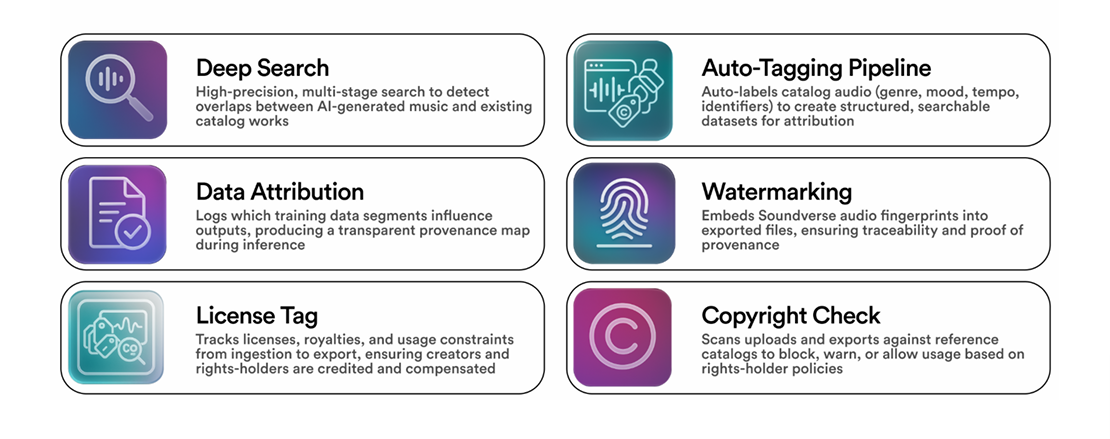
Soundverse Trace is designed specifically to safeguard AI-driven audio creation by embedding rights protection mechanisms directly into the production process. As a comprehensive trust layer for AI music, Soundverse Trace enables creators and businesses to maintain full ownership transparency and compliance.
Key capabilities of Soundverse Trace
- Deep Search: High-precision scanning (1:1 and 1:N) instantly detects overlap between AI-generated voices and existing datasets, helping identify unauthorized use cases before they spread.
- Data Attribution: Every generated output is logged, showing which training data contributed to the result. In legal cases, this evidence drastically simplifies attribution claims.
- Audio Watermarking: Robust, inaudible fingerprints embedded in audio exports ensure traceability, allowing rights-holders to verify provenance and automate takedowns or payouts.
- License Tagging: Metadata containing license and consent information is preserved from ingestion to export, providing durable audit trails.
These features make Soundverse Trace an invaluable compliance companion for organizations adopting AI audio systems in 2026. Whether generating custom voice content or localizing brand campaigns, Trace creates a defensible audit record. For hands-on insights, explore our tutorial on the “Explore” tab.
Creators participating in the Content Partner Program benefit directly, earning recurring royalties each time their licensed audio segments are used within AI models. Combined with the Ethical AI Music Framework, Soundverse builds a transparent, end-to-end infrastructure—bridging innovation with artist integrity and replacing outdated black-box workflows.
For comparable use cases in creative AI production, explore soundverse-introduces-stem-separation-ai-magic-tool, where similar attribution principles are applied in musical stem management.
What should you expect from voice cloning settlements moving forward?
By late 2026, voice cloning litigation is expected to stabilize, with more standardized payout metrics and clearer categorization of rights violations. Here’s what professionals can anticipate:
- Structured compensation tiers: Voice type, commercial scale, and proof of consent will determine payout ranges, standardizing settlement expectations.
- Automated attribution-based royalty systems: With frameworks like Soundverse’s rights-tracking infrastructure, voice contributors can receive recurring payouts automatically rather than waiting for court settlements.
- International harmonization: Cross-border voice rights protection is improving, reducing forum-shopping and procedural delays.
- Industry adoption of compliance layers: Companies integrating features like Soundverse Trace will avoid major lawsuit risks and demonstrate ethical AI governance.
To see how these trust infrastructures align with broader creative trends, visit ai-music-generator-and-human-composers-a-future-together and learn how ethical collaboration defines the next stage of AI artistry.
Start Creating Ethically with Soundverse AI
Experience cutting-edge AI music and voice generation built for creators who value originality and compliance. Soundverse gives you powerful, copyright-safe tools to generate professional-quality audio in minutes.
Create with Soundverse Now
Related Articles
- How AI-Generated Music Is Transforming the Music Industry: Discover how artificial intelligence is reshaping the future of music, production, and creative opportunities for artists worldwide.
- Navigating the World of Royalty-Free and Copyright-Free Music Using Soundverse AI: Learn to create and use royalty-free music confidently with AI tools designed to keep your content legally sound and original.
- Copyright-Free vs. Royalty-Free Music: What Creators Should Know: Understand the difference between copyright-free and royalty-free music to protect your work and navigate the legal audio space.
- The Role of AI Music in Film and Television: Explore how AI-generated soundtracks are revolutionizing audio production for film, TV, and digital media projects.
Here's how to make AI Music with Soundverse
Video Guide
Here’s another long walkthrough of how to use Soundverse AI.
Text Guide
- To know more about AI Magic Tools, check here.
- To know more about Soundverse Assistant, check here.
- To know more about Arrangement Studio, check here.
Soundverse is an AI Assistant that allows content creators and music makers to create original content in a flash using Generative AI. With the help of Soundverse Assistant and AI Magic Tools, our users get an unfair advantage over other creators to create audio and music content quickly, easily and cheaply. Soundverse Assistant is your ultimate music companion. You simply speak to the assistant to get your stuff done. The more you speak to it, the more it starts understanding you and your goals. AI Magic Tools help convert your creative dreams into tangible music and audio. Use AI Magic Tools such as text to music, stem separation, or lyrics generation to realise your content dreams faster. Soundverse is here to take music production to the next level. We're not just a digital audio workstation (DAW) competing with Ableton or Logic, we're building a completely new paradigm of easy and conversational content creation.
TikTok: https://www.tiktok.com/@soundverse.ai
Twitter: https://twitter.com/soundverse_ai
Instagram: https://www.instagram.com/soundverse.ai
LinkedIn: https://www.linkedin.com/company/soundverseai
Youtube: https://www.youtube.com/@SoundverseAI
Facebook: https://www.facebook.com/profile.php?id=100095674445607
Join Soundverse for Free and make Viral AI Music
 We are constantly building more product experiences. Keep checking our Blog to stay updated about them!