Voice Cloning for Music: Ethical and Legal Considerations in 2026
Explore ethical and legal issues in AI voice cloning for music and how Soundverse ensures artist integrity in 2026.
Voice Cloning for Music: Ethical and Legal Considerations
Voice cloning for music has become one of the most transformative—and debated—innovations in audio creation. By 2026, synthetic voice technology is capable of generating realistic vocals almost indistinguishable from human performances. However, with this power comes a growing responsibility to address ethical AI voice usage, music industry ethics, and the complex legal issues surrounding ai-generated vocals.
What does voice cloning for music mean in 2026?
Voice cloning for music refers to the use of artificial intelligence to replicate, synthesize, or generate human-like singing or speaking voices. This can range from creating new vocal performances that capture an artist’s tone and style to replicating voices for covers or mashups. The technology relies heavily on machine learning models trained on recordings of human voices—often large datasets derived from singers, voice actors, or publicly available performances.

In 2026, the integration of these tools into mainstream music production pipelines has changed how both independent and commercial creators produce content. Yet the rapid adoption has also pressed creators, developers, and lawmakers to revisit concepts such as consent, authorship, and remuneration in music ethics.
Why are ethical AI voices critical in AI-generated vocals?
Ethical AI voice practices ensure that artists maintain control and agency over their likeness and sound identity. Without proper consent and licensing, training AI on an artist’s voice can lead to unauthorized reproductions, confusion in attribution, and even impersonation. Proper governance of voice cloning models upholds the principle that innovation should not undermine artist integrity.

The global conversation around ethical AI voice systems intensified after several high-profile cases in 2025, where vocal likenesses were used without consent for viral ai-generated vocals. These disputes set the stage for new legal frameworks emphasizing consent-driven model training, proper attribution, and shared monetization.
What are the main legal issues in AI music and synthetic voice technology?
Legal professionals across jurisdictions are working to clarify how copyright, likeness rights, and performance royalties apply to synthetic voice technology. Some of the main legal concerns include:
- Right of Publicity: In many countries, artists have a legal right to control commercial use of their voice. Unauthorized AI replicas may infringe on this right.
- Copyright in AI Outputs: Determining who owns ai-generated vocals—the model creator, user, or original voice source—remains an ongoing debate.
- Dataset Legality: Training AI on unlicensed data can expose companies to copyright infringement claims if songs or isolated vocal stems are scraped from the web without permission.
- Label Agreements: Record labels now integrate AI clauses into contracts, ensuring clarity around who can use artist data in model training.
These legal questions form the backbone of current regulatory discussions in 2026, as the music industry pushes toward transparent, licensed approaches to AI innovation.
For readers interested in how AI tools are reshaping production, check out How AI-Generated Music is Transforming the Music Industry and Music Industry Trends for deeper context.
How can artists and developers navigate music industry ethics in AI?
The balance between creativity and responsibility hinges on three principles:
- Consent: Voices and performances used for model training must be explicitly licensed.
- Attribution: Every AI vocal generation should trace back to the creator or data source that shaped it.
- Compensation: Artists must receive fair royalties when their voice data contributes to an AI output’s success.
Through these ethical practices, musicians and engineers can build systems that enhance musical innovation without undermining the rights of human creators. For a deeper dive into workflow responsibility, watch our guide on creating Deep House music.
Are current industry solutions addressing these challenges?
While some platforms have made progress toward ethical ai voice management, few have implemented a complete system that connects licensing, traceability, and monetization. Many tools still operate as black-box models where training sources, permissions, and output ownership remain opaque. This opacity fuels mistrust and limits large-scale collaboration between labels, developers, and artists.
In contrast, transparency-first infrastructures—such as Soundverse’s Ethical AI Music Framework—are leading a paradigm shift.
How to make ethical and transparent voice cloning for music with Soundverse The Ethical AI Music Framework
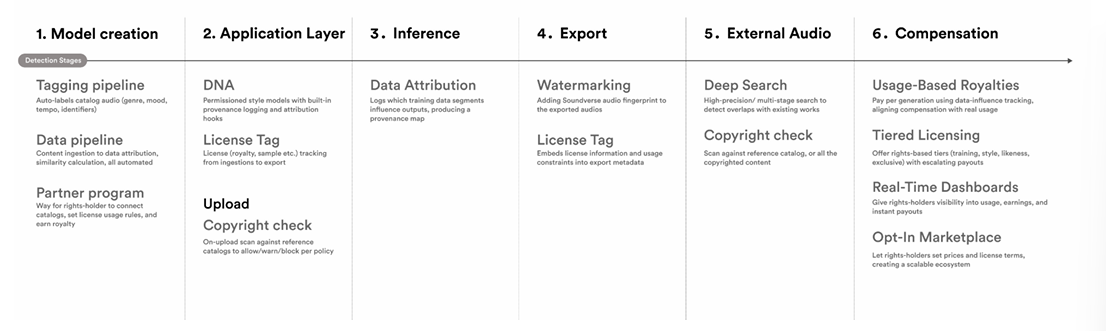
Soundverse’s Ethical AI Music Framework is a comprehensive end-to-end infrastructure that bridges the gap between innovation and artist integrity in the era of voice cloning for music. It introduces a six-stage transparent pipeline replacing traditional black-box models.
1. Stage 1: Licensed Data Sourcing (No Scraping) – Data is acquired exclusively through authorized licenses, preventing unauthorized voice usage.
2. Stage 2: Permissioned Models (DNA) – Each model is tied to explicit performer consent through the Soundverse DNA structure. Artists can train unique voice profiles while maintaining control over who uses their digital likeness.
3. Stage 3: Explainable Inference (Attribution) – Every generation is traceable. Users know whose data shaped the output and how attribution should be displayed.
4. Stage 4: Traceable Export (Watermarking) – AI-generated vocals include invisible watermarking to identify origin and verify responsible use.
5. Stage 5: Deep Search (External Scanning) – Detection tools like Soundverse Trace continuously identify misuse or unauthorized distribution.
6. Stage 6: Recurring Compensation (Partner Program) – Rights-holders enrolled in the Content Partner Program receive micro-royalties each time their data contributes to a new work.
This structured pipeline establishes a transparent standard supporting music producers, AI developers, and labels in tracking ethical voice-cloning activity while complying with emerging global regulations.
Learn more about complementary innovations such as Soundverse Trace, a trust layer embedding attribution, protection, and external scanning into music creation.
How does Soundverse promote sustainable collaboration across the creative ecosystem?
For producers and engineers, Soundverse ensures the assurance that every vocal or instrumental source used in AI training is licensed and auditable. Developers benefit from clear permission metadata and explainable AI outputs that can withstand legal scrutiny. Labels and publishers gain new monetization streams through automatic attribution and recurring micro-payments every time synthetic voice technology based on their catalog is used.
This infrastructure nurtures a new type of ethical AI voice ecosystem—one where technology enhances artistry instead of exploiting it.
What does the future of ethical AI voice cloning look like beyond 2026?
By late 2026, we are seeing governments and organizations formalize AI transparency standards, pushing the music industry closer to universal compliance networks. With systems like Soundverse’s Ethical AI Music Framework leading adoption, the next frontier will likely involve cross-platform attribution registries. These systems could unify licensing, tracking, and royalty administration for every ai-generated vocal created worldwide.
For creators seeking ways to ethically engage with AI music tools, explore tutorials such as How to Create Country Music with Soundverse AI and How to Make AI-Generated Music to understand AI workflows responsibly.
Start Creating Ethically with AI Voices Today
Unlock the power of responsible voice cloning for music and produce high-quality tracks effortlessly. With Soundverse, you can explore innovation while protecting artistic integrity.
Try Soundverse Free
Related Articles
- Soundverse Saar: AI Voice Assistant: Discover how Soundverse Saar helps creators generate realistic vocals and streamline voice-based music production.
- Enhancing YouTube Content with Royalty-Free and Copyright-Free Music Using Soundverse AI: Learn how to integrate ethical and royalty-free music into your YouTube projects with the help of Soundverse.
- Navigating the World of Royalty-Free and Copyright-Free Music Using Soundverse AI: Explore the difference between royalty-free and copyright-free music and make confident choices for ethical music creation.
- Copyright-Free vs Royalty-Free Music: What Creators Should Know: Understand the legal aspects of music ownership and ensure compliance when working with AI-generated tracks.
Here's how to make AI Music with Soundverse
Video Guide
Here’s another long walkthrough of how to use Soundverse AI.
Text Guide
- To know more about AI Magic Tools, check here.
- To know more about Soundverse Assistant, check here.
- To know more about Arrangement Studio, check here.
Soundverse is an AI Assistant that allows content creators and music makers to create original content in a flash using Generative AI. With the help of Soundverse Assistant and AI Magic Tools, our users get an unfair advantage over other creators to create audio and music content quickly, easily and cheaply. Soundverse Assistant is your ultimate music companion. You simply speak to the assistant to get your stuff done. The more you speak to it, the more it starts understanding you and your goals. AI Magic Tools help convert your creative dreams into tangible music and audio. Use AI Magic Tools such as text to music, stem separation, or lyrics generation to realise your content dreams faster. Soundverse is here to take music production to the next level. We're not just a digital audio workstation (DAW) competing with Ableton or Logic, we're building a completely new paradigm of easy and conversational content creation.
TikTok: https://www.tiktok.com/@soundverse.ai
Twitter: https://twitter.com/soundverse_ai
Instagram: https://www.instagram.com/soundverse.ai
LinkedIn: https://www.linkedin.com/company/soundverseai
Youtube: https://www.youtube.com/@SoundverseAI
Facebook: https://www.facebook.com/profile.php?id=100095674445607
Join Soundverse for Free and make Viral AI Music

We are constantly building more product experiences. Keep checking our Blog to stay updated about them!