The Difference Between a Chatbot and a Soundverse Agent One: Why It Matters for Musicians
Not all AI is the same. A chatbot answers questions. A music agent makes things happen. Here's the real difference between the two — and why it changes everything about what's actually possible for creators.
When most people hear "AI music tool," they picture one of two things. Either a generator, type a prompt, get a song, done or a chatbot with a music theme.
Something that answers questions about music, maybe suggests some chords, perhaps writes lyrics if you ask nicely. Both of those things exist. Neither of them is what Agent One is.
The difference between a chatbot and a music agent isn't cosmetic. It isn't about which one has a better interface or more features. It's a fundamental difference in what the AI is actually doing and understanding it changes what you think is possible when you sit down to create.
What a Chatbot Actually Does A chatbot is a conversational system designed to respond. You send a message. It sends one back. The exchange is the product. At its best, a chatbot is genuinely useful, it can explain concepts, suggest ideas, answer questions, help you think through a problem. Some chatbots are remarkably good at this. But a chatbot's relationship with the world is read-only. It processes what you give it and generates text in response. It doesn't take actions. It doesn't run tools. It doesn't produce files. It doesn't connect to external systems and make things happen.
In a music context, a chatbot might tell you what key works well with a particular chord progression. It might suggest lyrics for a chorus. It might explain what a stem separator does. What it cannot do is actually separate the stems, or change the key of your song, or generate the chorus with those lyrics in a specific vocal style and hand it back to you as an audio file. The gap between knowing what to do and doing it, that's the gap a chatbot can't close. ** What a Music Agent Does Differently** An agent is fundamentally different in one way that makes all the others possible: it takes actions in the world. Not just text responses. Real actions. Running tools. Producing files. Chaining operations together. Observing what came out and deciding what to do next. Executing a plan not just describing one.
When you tell Agent One to make a song in your voice, it doesn't tell you how that would work. It does it. It runs Voice Clone on your sample. It builds the model. It passes the model to AI Song Generator. It hands you an audio file. The action is the response. This distinction respond versus act is the entire difference between a chatbot and an agent. And in a creative context, it's the difference between a tool that helps you think and a tool that helps you make.
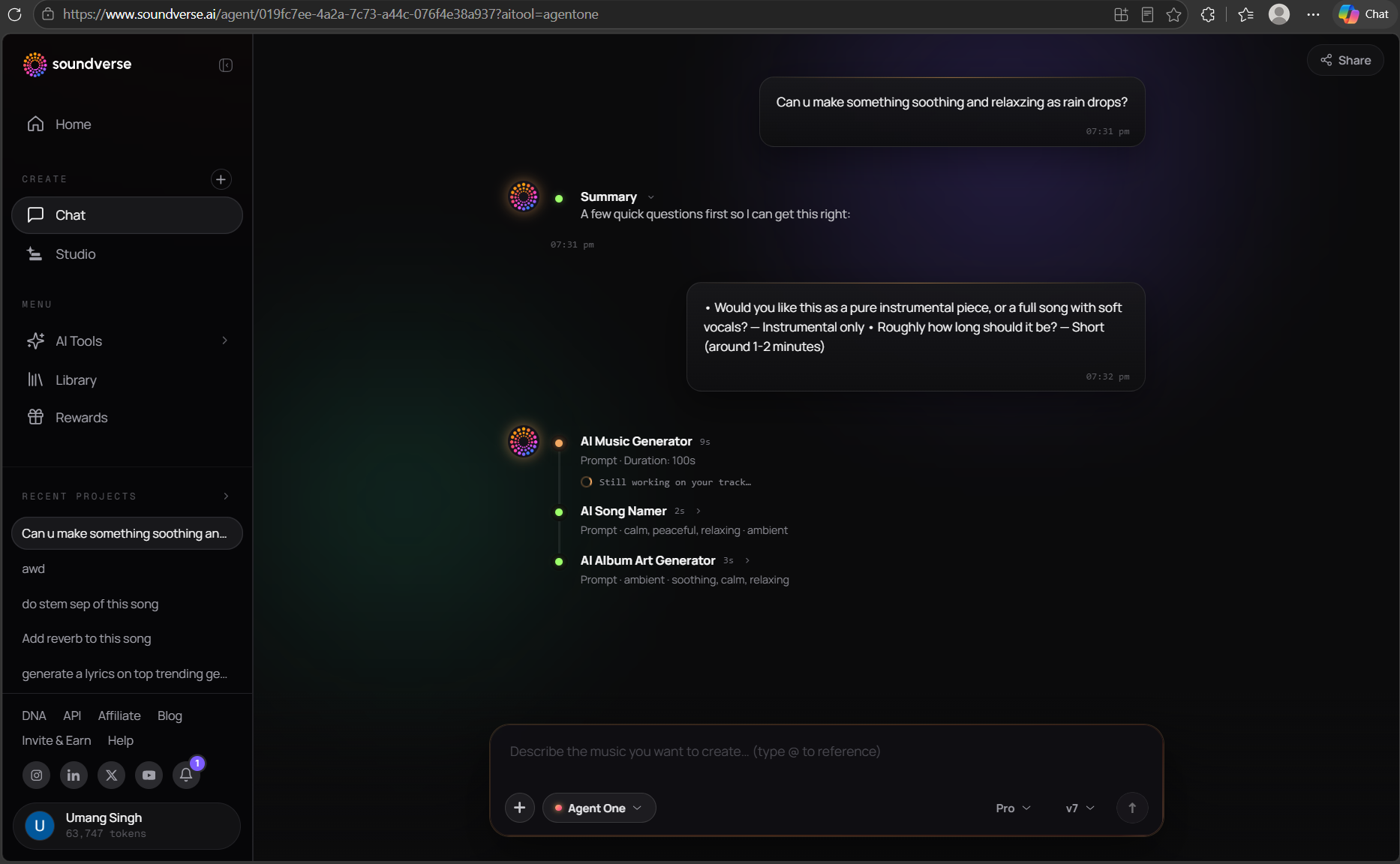
The Four Things That Make Agent One an Agent There are four specific capabilities that separate a genuine music agent from a chatbot with a generation feature attached. **
- It executes multi-step plans** A chatbot processes one message and produces one response. Agent One receives a message, builds a plan with multiple steps, executes those steps in the right order, and returns a finished result.
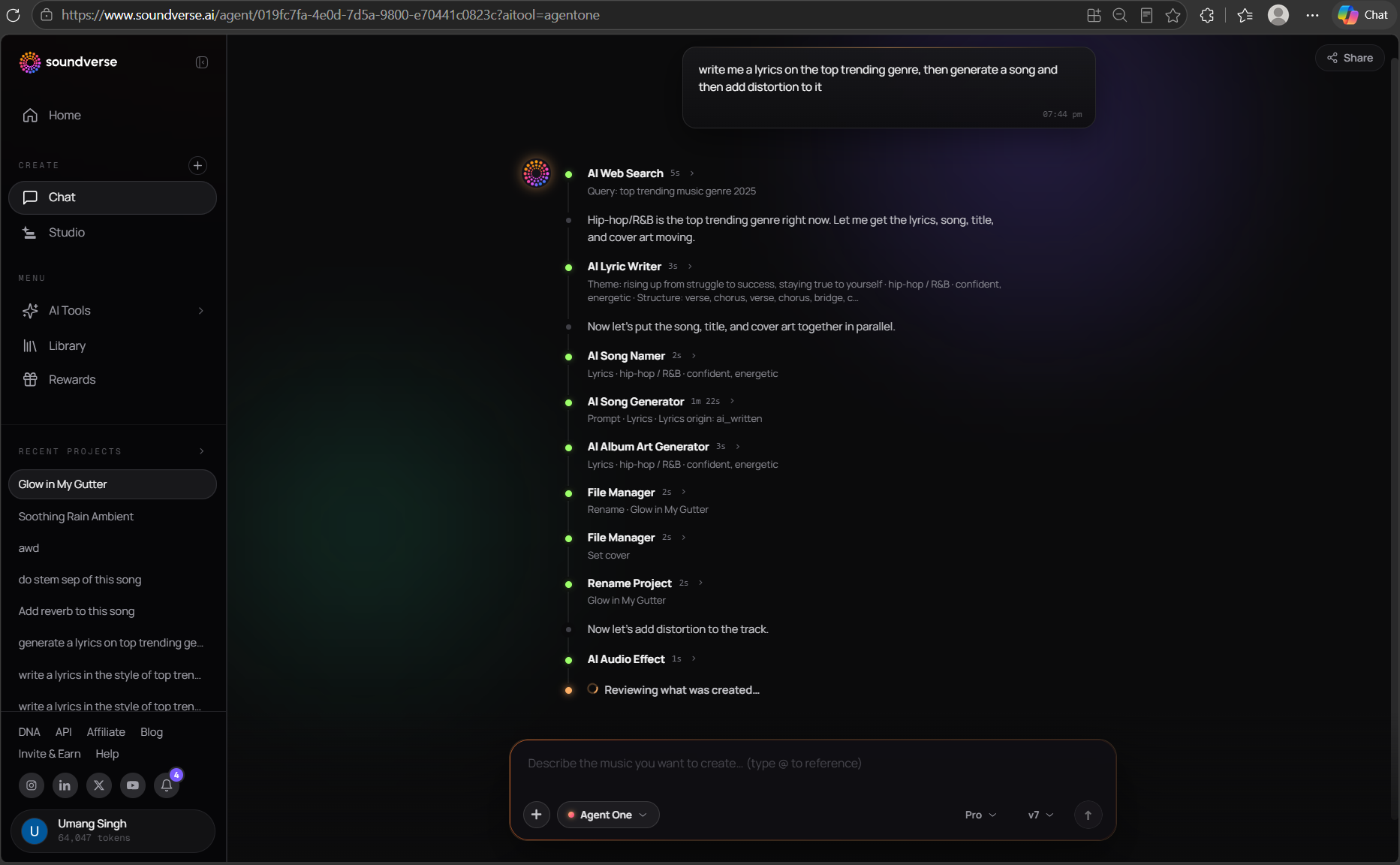
"Translate this song into Spanish, raise the key by two semitones, and make a 30-second Reels cut starting from the hook" is not one task. It's seven. Lyrics translation. Stem separation. Vocal re-rendering. Key change. Section analysis. Arrangement reorder. Trim to length. A chatbot would walk you through how to do those things. Agent One does them. ** 2. It selects the right tool for the job** A chatbot doesn't have tools. Or if it does, they're discrete options you have to consciously choose from press this button for lyrics, press that button for a song.
Agent One has access to the entire Soundverse tool surface: generation, modification, analysis, effects, web search, DNA models, voice clones, and more. And it selects the right one based on what you actually asked for, not based on which button you pressed.
You say "replace the singer." It selects Stem Separator, then Voice Swap, then Audio Merge. You say "make something like this YouTube link." It selects URL Extractor, Section Analysis, Tempo Detection, Similar Song Generator. The tool selection is invisible. The outcome is exactly what you described. ** 3. It maintains context across the conversation** A chatbot has a conversation window. An agent has a working state. There's a meaningful difference. A conversation window holds a record of what was said. A working state holds the current project: the track you're building, the region you last edited, the effects chain you've been adjusting, the reference you used three messages ago.
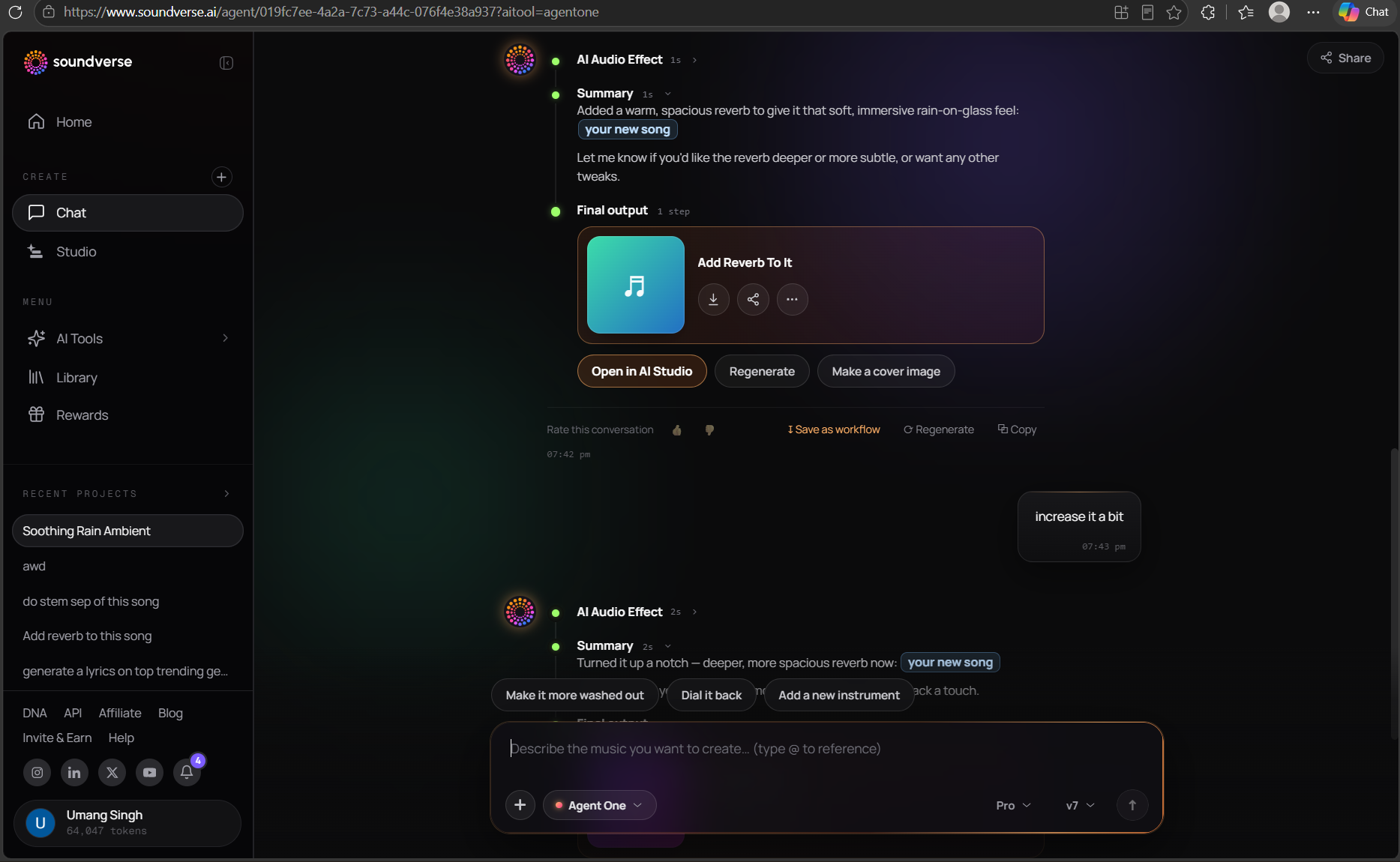
When you say "a bit more" or "same thing on the bridge" or "go back to what we had before", a chatbot without working state has no way to resolve those references. Agent One resolves them correctly every time because it isn't just tracking the conversation. It's tracking the project.
4. It observes and adjusts mid-execution A chatbot produces a response and stops. An agent produces an intermediate result, evaluates it, and decides what to do next based on what it sees. If Agent One runs Section Analysis on a track and finds an unusual structure, a long instrumental intro, an unexpected bridge placement it adjusts the rest of the plan accordingly. It doesn't fail silently or return a broken output. It reads what happened and responds to it.
This is what real-world execution looks like. Plans rarely survive contact with the material unchanged. An agent can handle that. A chatbot cannot.
Why This Matters for Creators Specifically The chatbot versus agent distinction isn't just a technical curiosity. It has direct, practical consequences for what you can actually do when you're trying to make something. With a chatbot, you're the executor. The AI advises and you act. It tells you what key to use. You figure out how to change it. It suggests lyrics. You figure out how to record them. The cognitive and technical burden stays with you.
With an agent, you're the director. You describe the outcome. The agent executes. The technical burden shifts entirely. You're not learning which tools to use or in what order. you're making creative decisions and letting the agent handle everything downstream.
For a first-time creator, this means the technical barrier to making music essentially disappears. You don't need to know how stem separation works to ask for the drums removed. You don't need to understand key transposition to ask for the song in a different key.
For an experienced producer, this means the execution speed changes completely. A workflow that used to take an hour of manual steps takes a single message and a minute of processing. The ideas per hour goes up dramatically because the gap between having an idea and hearing it shrinks to almost nothing.
In both cases the value is the same thing, more time and energy for the part that actually matters. The creative decisions. The taste. The intent. The thing you're trying to say.
The Honest Version of What's Still Developing Agents are not perfect. They make mistakes. They occasionally misread intent. They sometimes produce an output that's close to what you wanted but not exactly right. The difference is what happens next. A broken chatbot response is a dead end, you start over. A near-miss from an agent is a starting point, you correct it in the same conversation, and the agent adjusts. _ "That's close but the chorus feels too busy, can you strip it back?"_ That one follow-up message is how you get from near-miss to exactly right. The agent remembers what it made, understands what you're asking for, and makes a targeted change. The conversation continues. The project progresses.
That ability to iterate to correct and refine inside the same working context is what makes an agent genuinely useful for creative work. Not perfection on the first pass. Recovery and refinement when the first pass isn't perfect.
** The Bottom Line** A chatbot tells you what's possible. A music agent makes it happen. That distinction between responding and acting, between advising and executing, between a conversation window and a working state is what separates a useful tool from a genuine creative partner.
Agent One is built as the latter. And the difference shows the moment you stop asking it questions and start telling it what you want to make.
Find out for yourself at soundverse.ai
Social Links:
Instagram: https://www.instagram.com/soundverse.ai
TikTok: https://www.tiktok.com/@soundverse.ai
Twitter: https://twitter.com/soundverse_ai
LinkedIn: https://www.linkedin.com/company/soundverseai
Youtube: https://www.youtube.com/@SoundverseAI
Facebook: https://www.facebook.com/profile.php?id=100095674445607
## Join Soundverse for Free and make Viral AI Music

We are building more product experiences. Keep checking our Blog to stay updated about them!