Scarlett Johansson OpenAI Voice Lawsuit Explained: What It Means for AI and Celebrity Rights in 2026
Explore the Scarlett Johansson OpenAI voice lawsuit, voice cloning ethics, and how Soundverse Trace protects celebrity voice rights in AI.
Scarlett Johansson OpenAI Voice Lawsuit Explained
Introduction
The Scarlett Johansson OpenAI voice lawsuit has become one of the defining moments in AI ethics and celebrity rights. As of 2026, legal professionals, tech enthusiasts, and AI developers are closely watching how this case reshapes the landscape of voice cloning and intellectual property laws. Following controversies through 2024 and 2025, Johansson’s claim against OpenAI over alleged voice replication brought mainstream attention to how synthetic voices are created, licensed, and used.
The case is more than a celebrity-vs-corporation battle—it’s a turning point for AI voice technology. It raises crucial questions about consent, likeness rights, and the commercial use of AI-generated voices. For readers interested in AI ethics and intellectual property, understanding this lawsuit provides a window into emerging norms that could determine how future technologies are governed.
What triggered the Scarlett Johansson OpenAI voice lawsuit?
In late 2025, OpenAI unveiled an AI assistant featuring a female voice that users quickly noted sounded strikingly similar to Scarlett Johansson’s. Johansson had previously lent her voice to a film portraying an AI companion, making the resemblance particularly sensitive. She claimed that OpenAI’s “Sky” model used a tone, inflection, and expressive style nearly identical to her own, even though she had refused prior collaboration offers.

Her legal team argued this violated her rights of publicity and posed an ethical breach, emphasizing the precedent this incident could create. If a company can synthetically replicate celebrity voices without explicit consent, the boundaries between personal identity and digital mimicry blur dangerously. Legal analysts have discussed potential claims Johansson could take against OpenAI including right of publicity, trademark, and copyright violations.
Why does voice cloning matter in 2026?
Voice cloning lawsuits have become a focal point of debate in the tech industry. By using deep learning techniques and vast audio datasets, companies can reproduce an individual’s vocal identity with startling accuracy. In 2026, the sophistication of generative speech models has reached new heights, making the question of legality urgent.

The Scarlett Johansson OpenAI voice lawsuit epitomizes this issue. It asks whether voice likeness is protected similarly to a face or name. The case also highlights the growing demand for transparency—users and artists alike want assurance that AI systems respect the human origins behind their training data. As noted in UCA Insights, this lawsuit may set a precedent for how generative voice models handle identity.
What are celebrity voice rights?
Celebrity voice rights refer to a performer’s legal control over their audio likeness. In jurisdictions like California and New York, publicity rights protect individuals from unauthorized commercial use of their persona—including voice. However, the global nature of AI introduces complexity. An AI dataset may include recordings scraped from online sources outside these regions, making enforcement unclear.
Legal professionals tracking the AI voice case in 2026 stress that clearer cross-border regulations are necessary. As AI-generated content circulates globally, musicians, voice actors, and influencers risk losing control over how AI reproduces their expressions.
How has the lawsuit influenced AI ethics and brand trust?
The Johansson case has forced developers to outline consent frameworks before deploying voice technology. Many platforms now require documented authorization or use licensed datasets for voice models. Ethical AI initiatives have accelerated, with developers prioritizing watermarking and attribution as preventive measures.
For AI brands, the lawsuit emphasized trust as a market differentiator. Transparency is no longer optional—it’s essential. Companies unwilling to disclose training sources or rights policies risk severe reputational damage. Johansson’s legal filings, covered by TechCrunch, brought receipts that highlighted concerns around secretive AI practices.
What legal precedents could emerge from this case?
Lawyers believe that this lawsuit could set new benchmarks in how courts define likeness and consent in artificial voices. If Johansson’s case succeeds, it may confirm that voice is an inseparable part of one’s identity and commercially protected under rights of publicity laws.
In addition, a ruling in her favor may push AI regulation to require proactive verification systems. Tools capable of tracing dataset contributions and detecting overlaps will likely become mandatory for compliance. This was echoed in Georgetown Law’s AI ethics analysis, which underlined the publicity rights questions at the lawsuit’s core.
How are voice cloning lawsuits shaping AI regulation?
In 2026, policymakers worldwide continue drafting legislation addressing AI identity replication. Europe’s Digital Likeness Directive and new U.S. amendments to intellectual property codes aim to prevent unlicensed use of celebrity voices. The Scarlett Johansson case is often cited in parliamentary discussions as evidence of the urgent need for oversight.
The broader implication extends beyond celebrities. Everyday users now face risks of having their voices cloned for commercial content without permission. AI voice cases highlight how every person’s digital presence could be reproduced unless transparent protection is built into generation pipelines.
How does Soundverse Trace address ethical challenges revealed by this lawsuit?
The Johansson lawsuit underscores the importance of accountability in AI generation. This is exactly where Soundverse Trace enters the conversation.
How to make AI voice technology transparent with Soundverse Trace
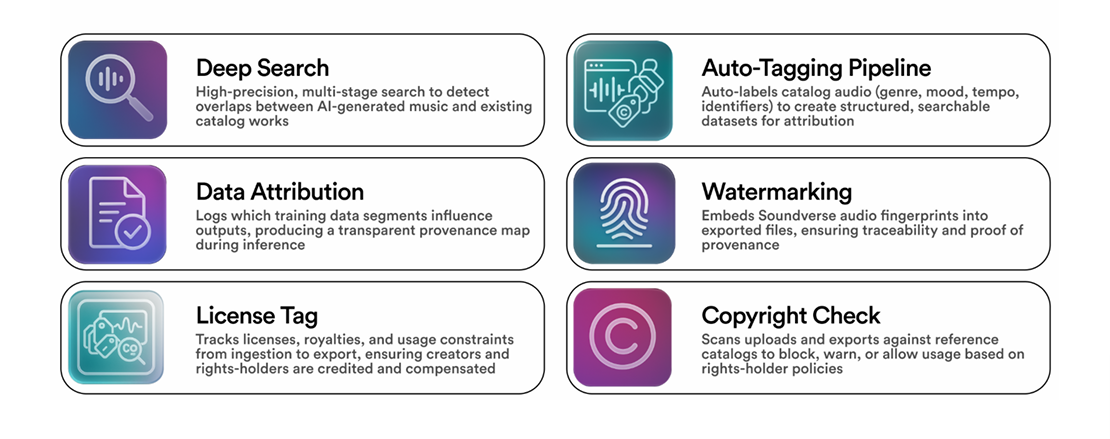
Soundverse Trace is a comprehensive trust layer for AI music and audio designed to preserve transparency and ensure rights protection throughout the entire creative lifecycle—from dataset creation to final export. Its architecture introduces attribution, watermarking, and metadata tagging that collectively combat unethical voice usage.
- Deep Search: High-precision scanning (1:1, 1:N) detects overlaps between generated audio and training data, allowing publishers to confirm no unauthorized likeness was used.
- Data Attribution: Logs precisely which training sources influenced the output, giving creators and rights-holders a verifiable trail of contribution.
- Audio Watermarking: Embeds inaudible yet robust fingerprints, making it possible to identify AI-rendered voices even after export.
- License Tagging: Preservation of rights metadata ensures that licensing details accompany every produced audio file.
In this way, Soundverse Trace becomes a central infrastructure element for ethical AI voice generation and music creation. By enforcing provenance verification, it bridges the gap between innovation and consent. For creators wanting practical demonstrations of ethical workflows, watch our Soundverse Tutorial Series - 8. "Explore" Tab or Tutorial Series - 9. How to Make Music.
The bigger picture: redefining creative integrity in 2026
The outcome of the Scarlett Johansson OpenAI voice lawsuit will likely cement moral boundaries for artificial voices. Just as the 2024 music copyright debates reshaped licensing in generative audio tools like Mubert alternatives, this lawsuit now redefines what authenticity means in vocal AI.
Artists can utilize systems such as Soundverse DNA, an artist-trained AI that ensures models are based solely on licensed catalogs. By combining Trace’s verification with DNA’s consent-based model training, Soundverse creates a dual-layer defense against exploitation.
For creators exploring new forms of AI-generated music—such as those highlighted in music industry trends or learning how to make AI-generated music—copyright-safe generation is becoming standard rather than experimental.
Could Soundverse tools help prevent future voice disputes?
Yes. With Soundverse’s integrated Ethical AI Music Framework, developers gain immediate access to a six-stage pipeline that prioritizes consent and compensation. When creative projects employ Voice Swap, celebrity vocal identities can be substituted only after confirmed licensing. Users must upload an audio track and allow asynchronous AI processing—there is no live filter effect, which further aligns with data transparency standards.
Deploying such tools ensures compliance and ethical integrity, minimizing the risk of lawsuits similar to Johansson’s. The framework’s consistent monitoring of rights throughout ingestion, transformation, and export enables creators to demonstrate that their workflow meets both artistic and legal responsibility.
Experience the Future of AI-Driven Audio Creation
Turn inspiration into studio-quality music or voice tracks instantly using Soundverse's intelligent creative tools. Get started today and see how AI can elevate your content production.
Related Articles
- Soundverse SAAR: AI Voice Assistant: Discover how Soundverse SAAR streamlines voice creation with cutting-edge AI assistance for your projects.
- AI Music Generator and Human Composers: A Future Together: Explore the harmony between human creativity and AI innovation in shaping the next era of music production.
- The Role of AI Music in Film and Television: Learn how AI-generated music is transforming soundtracks and storytelling across media industries.
- How AI-Generated Music Is Transforming the Music Industry: Uncover how artificial intelligence is redefining music creation, distribution, and collaboration.
Here's how to make AI Music with Soundverse
Video Guide
Here’s another long walkthrough of how to use Soundverse AI.
Text Guide
- To know more about AI Magic Tools, check here.
- To know more about Soundverse Assistant, check here.
- To know more about Arrangement Studio, check here.
Soundverse is an AI Assistant that allows content creators and music makers to create original content in a flash using Generative AI. With the help of Soundverse Assistant and AI Magic Tools, our users get an unfair advantage over other creators to create audio and music content quickly, easily and cheaply. Soundverse Assistant is your ultimate music companion. You simply speak to the assistant to get your stuff done. The more you speak to it, the more it starts understanding you and your goals. AI Magic Tools help convert your creative dreams into tangible music and audio. Use AI Magic Tools such as text to music, stem separation, or lyrics generation to realise your content dreams faster. Soundverse is here to take music production to the next level. We're not just a digital audio workstation (DAW) competing with Ableton or Logic, we're building a completely new paradigm of easy and conversational content creation.
TikTok: https://www.tiktok.com/@soundverse.ai
Twitter: https://twitter.com/soundverse_ai
Instagram: https://www.instagram.com/soundverse.ai
LinkedIn: https://www.linkedin.com/company/soundverseai
Youtube: https://www.youtube.com/@SoundverseAI
Facebook: https://www.facebook.com/profile.php?id=100095674445607
Join Soundverse for Free and make Viral AI Music

We are constantly building more product experiences. Keep checking our Blog to stay updated about them!
Image Steps: []