Is Udio Safe? What You Need to Know About the AI Music Platform
Is Udio safe to use in 2026? Explore AI music safety, Udio privacy, and data protection insights for musicians and creators.
Is Udio Safe? What You Need to Know About the AI Music Platform
In 2026, musicians and creators are constantly exploring new AI-powered tools like Udio to simplify music production. However, as AI-generated music becomes mainstream, one critical question arises: Is Udio safe? With the rise of platforms transforming text and voice into studio-quality compositions, understanding data protection, content rights, and AI ethics has never been more important.
What is Udio and Why Are Users Asking “Is Udio Safe?”
Udio is an AI music generator that helps creators produce songs and soundscapes from text prompts or uploaded audio. This revolutionary capability attracts independent musicians, producers, and even larger studios looking to accelerate creative workflows. Yet, while AI innovation offers efficiency, it also introduces issues around data usage, copyright management, and creative ownership.

The question “Is Udio safe?” typically refers to three key areas:
- Data Privacy: How the platform collects and stores your inputs.
- Content Security: Protection against plagiarism or accidental copyright overlap.
- User Trust: Whether generated outputs are truly original and ethically sourced.
These factors are shaping how AI music is perceived professionally in 2026, especially after multiple data transparency debates in 2024 and 2025.
How Safe Is Udio in Terms of Data Privacy?
When evaluating Udio’s safety, data privacy stands at the core. Most AI platforms require user inputs—such as personal music ideas, lyrics, or recorded samples—to train or fine-tune their models. In 2026, users expect platforms to handle this data securely and transparently.
However, privacy assurance depends on whether your information remains anonymous or is reused for training. Without explicit disclosure, users risk contributing to datasets without knowing how their material is processed. This uncertainty fuels the ongoing conversation around Udio privacy and whether creators’ original content is fully protected.
As creators benefit from AI efficiency, balancing transparency with innovation is essential. Choosing AI tools with verifiable privacy frameworks can greatly reduce potential risks.
What Are the Key Security Concerns for AI Music Platforms Like Udio?
AI music creation introduces unique security challenges beyond traditional app risks. Here are a few notable ones:
- Dataset Origin Verification: Without clear provenance, AI outputs could unintentionally borrow from copyrighted works.
- Unauthorized Reuse: Uploaded samples might be stored or reused for further model training.
- Lack of Attribution Systems: Most generative models historically offer minimal visibility into which datasets influence a final piece.
These factors make musicians question Udio security. In 2026, ethical transparency is becoming a measurable standard of trust. Creators want assurance that what they produce aligns with professional integrity and compliance.
If Udio or any tool fails to document where datasets originate or how user uploads are stored, safety concerns inevitably rise. Platforms adopting secure auditing or watermarking workflow—like Soundverse Trace—are setting a new benchmark for AI music safety. For example, creators can explore practical applications through Soundverse Tutorial Series - How to Make Music or learn composition techniques from Soundverse Tutorial Series - Make Deep House Music.
What Does AI Music Safety Mean for Musicians in 2026?
The concept of AI music safety has broadened dramatically since 2024. It now covers holistic trust across model transparency, digital rights, and data lineage. Musicians, producers, and content creators need tools that:
- Clearly show what audio influenced the generated output.
- Prevent unintentional infringement through automated detection.
- Protect rights-holders with verifiable royalty tracking.
Modern creators expect technological accountability, not just creativity. Safe platforms should therefore integrate watermarking, license tagging, and attribution mechanisms. These safeguard intellectual property while maintaining innovation.
For those examining alternatives, platforms like Soundverse and others outlined in guides such as Best Udio Alternative: Soundverse AI Free Sign Up emphasize trust-centric architecture designed specifically for musicians in this new AI era. To explore how creators can navigate generation transparency, check out Soundverse Tutorial Series - "Explore" Tab.
How Does Udio Handle Copyright and Rights Management?
Copyright confusion remains one of the most contentious areas of AI music generation. When you ask, “Is Udio safe?”, you’re often wondering whether it accidentally reproduces copyrighted melodies or lyrics.
In platforms lacking deep rights protection, generated audio might overlap with existing works. This overlap could expose users to infringement claims—especially in commercial use cases such as advertising, streaming, or sync licensing.
Rights management requires transparency regarding the training set: where datasets come from, how models process influences, and how generation logs are maintained. Tools that employ protective mechanisms, such as dataset attribution and fingerprinting, drastically increase compliance confidence.
Articles like Navigating the World of Royalty-Free and Copyright-Free Music Using Soundverse AI offer insights into the best practices to navigate this complex landscape.
Why Udio’s Safety Reputation Matters for Creators
Trust determines adoption. If creators lack confidence in data integrity or rights protection, they hesitate to use AI-generated music commercially.
In 2026, safety reputation is the driving factor separating ethical AI music providers from opportunistic ones. For musicians building careers through streaming or sync placements, any uncertainty in provenance can ruin credibility.
Platforms demonstrating transparent attribution—showing exactly what data fueled each generation—stand out as reliable collaborators. This trust factor influences how studios license AI-assisted material and how creators monetize output safely.
Now that you understand how AI music privacy and security shape trust, let’s explore how advanced systems like Soundverse Trace make AI audio creation safe from end to end.
How to Make AI Music Securely with Soundverse Soundverse Trace
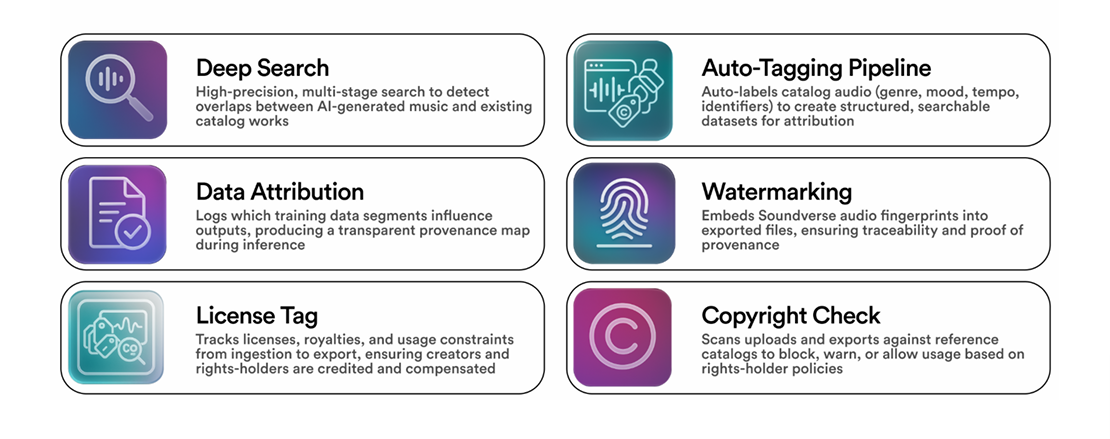
Soundverse Trace is Soundverse’s dedicated trust layer for AI music, engineered to guarantee transparency, rights protection, and ethical data use across every creation stage.
Key Components That Reinforce Safety:
- Deep Search: It offers high-precision scanning (both 1:1 and 1:N) to detect overlaps between your generated audio and known catalogs—preventing accidental infringement before export.
- Data Attribution: Every generation log includes insights into which datasets influenced outputs. This transparency empowers creators and rights-holders alike.
- Audio Watermarking: Robust, inaudible fingerprints are embedded directly into audio files to verify provenance without affecting sound quality.
- License Tagging: Rights metadata remains intact from ingestion to export, simplifying royalty tracking and takedown processes.
These features combine to ensure consistent trust throughput—from dataset creation to final distribution. For musicians seeking ethical and secure innovation, this comprehensive approach symbolizes where AI music infrastructure is headed in 2026.
Soundverse Trace integrates seamlessly with The Ethical AI Music Framework, ensuring each output adheres to consent-driven attribution and recurring compensation for contributors. The framework redefines transparency, replacing opaque black-box workflows with clear traceability.
Creators participating in Soundverse’s Content Partner Program can also earn recurring usage-based royalties when their licensed audio appears in generated outputs—a next-generation model for fairness and trust in AI music economics.
To learn more about how Soundverse promotes safer creative workflows, visit resources like AI Music Generator and Human Composers: A Future Together, How AI-Generated Music Is Transforming the Music Industry, and Soundverse AI Revolutionizing Music Creation for New Age Content Creators.
Start Creating AI Music Safely with Soundverse
Discover an AI music platform built for creators who value originality, safety, and full control. Generate professional-quality tracks with assurance and creative freedom.
- Best Udio Alternative: Soundverse AI Free Sign Up - Find out how Soundverse offers a secure and creative alternative to Udio for generating AI music effortlessly.
- How to Download Songs from Soundverse and Udio - Learn step-by-step how to download your AI-generated music safely and manage your content from both Soundverse and Udio.
- Navigating the World of Royalty-Free and Copyright-Free Music Using Soundverse AI - Understand the essentials of copyright-safe music creation and how Soundverse ensures your music remains 100% royalty-free.
- AI Music Generator and Human Composers: A Future Together - Explore how AI music tools like Soundverse can safely collaborate with human creativity for future-ready composition.
Here's how to make AI Music with Soundverse
Video Guide
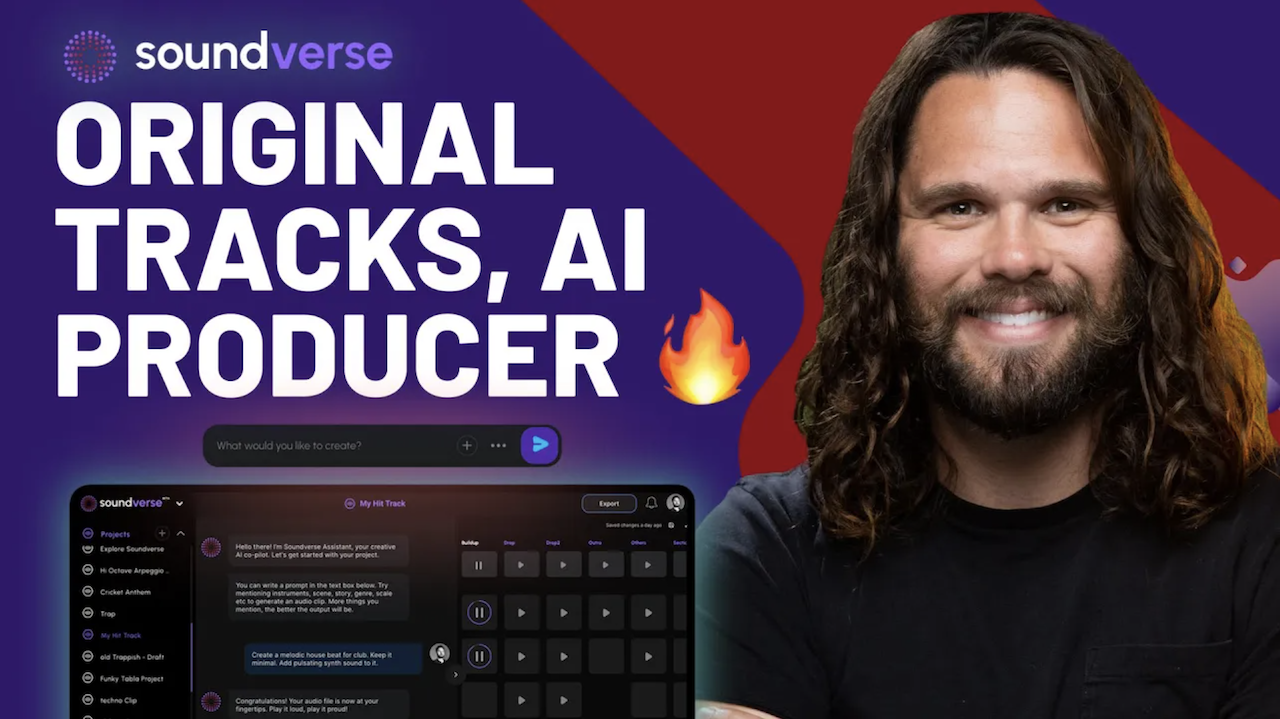
Here’s another long walkthrough of how to use Soundverse AI.
Text Guide
- To know more about AI Magic Tools, check here.
- To know more about Soundverse Assistant, check here.
- To know more about Arrangement Studio, check here.
Soundverse is an AI Assistant that allows content creators and music makers to create original content in a flash using Generative AI. With the help of Soundverse Assistant and AI Magic Tools, our users get an unfair advantage over other creators to create audio and music content quickly, easily and cheaply. Soundverse Assistant is your ultimate music companion. You simply speak to the assistant to get your stuff done. The more you speak to it, the more it starts understanding you and your goals. AI Magic Tools help convert your creative dreams into tangible music and audio. Use AI Magic Tools such as text to music, stem separation, or lyrics generation to realise your content dreams faster. Soundverse is here to take music production to the next level. We're not just a digital audio workstation (DAW) competing with Ableton or Logic, we're building a completely new paradigm of easy and conversational content creation.
TikTok: https://www.tiktok.com/@soundverse.ai
Twitter: https://twitter.com/soundverse_ai
Instagram: https://www.instagram.com/soundverse.ai
LinkedIn: https://www.linkedin.com/company/soundverseai
Youtube: https://www.youtube.com/@SoundverseAI
Facebook: https://www.facebook.com/profile.php?id=100095674445607
Join Soundverse for Free and make Viral AI Music

We are constantly building more product experiences. Keep checking our Blog to stay updated about them!
Image Steps: []