Is Suno AI Safe? Understanding Suno AI Safety and Data Protection in 2026
Explore Suno AI safety, privacy, and data protection to ensure secure AI music creation.
Is Suno AI Safe?
Artificial intelligence has transformed the creative industry, and music generation tools like Suno AI have become key players in that transformation. But as innovative as these tools are, one question remains vital for creators and businesses in 2026: Is Suno AI safe? Safety concerns around AI music generators extend beyond artistic integrity—they include data protection, privacy measures, and ethical training practices. This article explores what Suno AI safety truly means, how AI music generator security works, and how to ensure safe use of AI tools in modern creative workflows.
What does Suno AI safety mean in 2026?
Suno AI safety refers to how securely and ethically the platform manages user data, licenses training materials, and generates audio outputs. In 2026, AI models rely heavily on data training pipelines, some of which raise concerns about copyright compliance and data privacy. For musicians, producers, and enterprises, safety involves understanding whether an AI platform respects rights holders, avoids unauthorized data scraping, and ensures transparent attribution mechanisms.
Over the last two years, public awareness of AI data ethics has grown significantly. Suno AI and other music generation tools are expected to demonstrate transparency regarding their datasets, consent systems, and output traceability to minimize risk. Safe use of AI tools in this era means knowing exactly where your data goes and how AI-generated songs are created.
Why are users concerned about AI music generator security?
AI music generator security has become a focal point for content creators and labels. The risk lies in models trained on copyrighted or sensitive audio without permission, which could result in legal complications. When users input text prompts or upload recordings, they expect platforms to manage this data securely, without exposing personal files or proprietary sound samples.
These concerns intensified during the boom of AI models between 2024 and 2025. Several creators questioned how their works were used to train generative tools and whether outputs contained fragments of original works. In response, platforms focused on transparent model architectures and licensed data sourcing. Today, 2026 represents a maturity phase for AI music companies—users demand ethical frameworks instead of opaque machine learning systems.

How does Suno AI handle privacy and data protection?
Privacy and data protection are critical to Suno AI safety. When users upload descriptions or sound references, they share creative intent that could be professionally sensitive. A secure platform should employ encryption during data transit and avoid unauthorized data reuse for model training.
Well-designed AI systems now incorporate principles of ethical AI development, such as:
- Licensed data usage: Training data gathered from licensed or public domain sources ensures the model doesn’t violate ownership rights.
- Permission-based architecture: Users opt in to share specific data, enabling transparent control over what fuels the AI model.
- Attribution and watermarking: Outputs include traceable identifiers that show AI provenance—essential for commercial use.
- Opt-out mechanisms: Creators and businesses can restrict their content from being used for model training.
In comparison, platforms lacking these principles risk exposing user information or generating content that blurs ownership lines. Data protection has evolved from being a technical detail to a trust-defining factor in music technology.
For a deeper dive into creative safety practices, watch our Soundverse Tutorial - How to Make Music or Explore Tab walkthrough from the official Soundverse channel.
How can businesses and creators ensure safe use of AI tools?
Safe use of AI music tools in 2026 means adopting proper practices when interacting with generative systems. Here are key approaches:
- Verify the platform’s data sourcing methods. Choose tools that emphasize licensed audio over scraped datasets.
- Review privacy policies. Understand how the platform manages uploads, queries, and generated outputs.
- Use watermark tracking. When distributing AI-generated songs, ensure the tracks contain traceable digital signatures.
- Engage with transparent AI frameworks. Prefer companies that disclose training partners and compensation models.
- Integrate ethical tools in production workflows. Adopt services that respect consent and attribution rather than exploiting unverified material.
These steps minimize exposure to copyright disputes and ensure compliance with evolving AI art laws. You can learn more about ethical AI creation in related content, including AI music generator and human composers: a future together and how AI-generated music is transforming the music industry.
Is Suno AI safe for enterprise use?
Enterprises deploying AI-generated soundtracks must consider several security dimensions: legal compliance, dataset authenticity, and model explainability. As AI-generated music enters film, gaming, and advertising, issues around licensing have intensified. Safe enterprise adoption depends on whether AI systems can prove that outputs are free from infringing content.
Platforms designed for professional use now integrate transparent audit trails. They record every stage of training and generation to allow for post-production verification. This is especially critical for large labels or media firms that produce commercial releases.
Enterprises prefer frameworks that ensure:
- Valid licensing across training datasets.
- Auditable attribution for generated content.
- Automated royalty distribution for original rights holders.
Suno AI’s safety reputation depends on whether these measures are implemented consistently. Ethical frameworks like Soundverse’s infrastructure set benchmarks for enterprise-level compliance and transparency.
How to make Suno-safe AI music with Soundverse The Ethical AI Music Framework
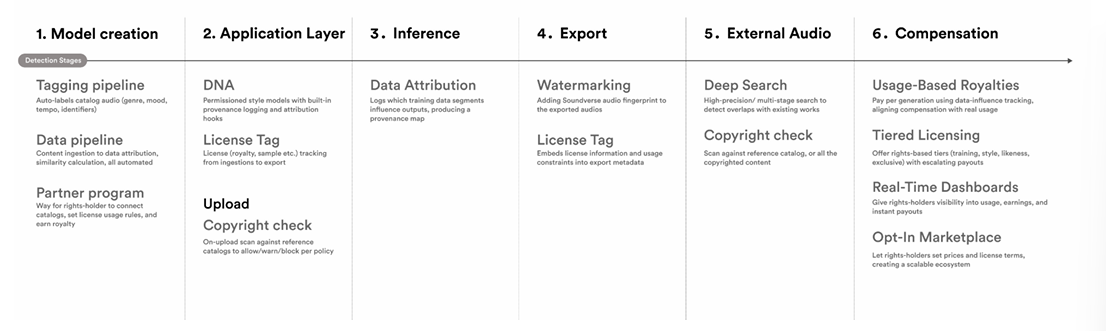
Now that you understand the importance of Suno AI safety and how privacy, data protection, and ethical modeling shape AI music, let’s explore how Soundverse ensures these values through the Ethical AI Music Framework.
Soundverse’s Ethical AI Music Framework is a comprehensive end-to-end infrastructure that bridges innovation and artist integrity. It transforms opaque AI operations into a transparent, six-stage pipeline:
- Licensed Data Sourcing (Stage 1): Soundverse uses only licensed audio datasets rather than scraped or unverified material. This guarantees that artist rights are respected and traceable.
- Permissioned Models (Stage 2): Training relies on permissioned data DNA that honors creator consent before inclusion.
- Explainable Inference (Stage 3): Every generated track can be traced back to its data lineage for clear attribution.
- Traceable Export (Stage 4): Built-in watermarking ensures that each audio export carries a verifiable identity.
- Deep Search (Stage 5): External scanning confirms that generated tracks do not unintentionally overlap with copyrighted works.
- Recurring Compensation (Stage 6): The Partner Program supports recurring royalties for rights holders when their contributions are used.
This structure ensures full transparency and ongoing ethical compliance—precisely what creators demand in 2026 when security concerns dominate digital music discussions.
Soundverse also integrates with related tools to enhance data safety:
- Soundverse Trace: A comprehensive trust layer for AI music, embedding attribution, deep search, and rights protection from dataset creation through final export.
- Content Partner Program: A royalty-based licensing network enabling artists and labels to monetize participation ethically.
Using Soundverse’s Ethical AI Music Framework, creators and companies can confidently produce music knowing that their security, privacy, and integrity remain protected. Learn how Soundverse advances these standards in insights like Soundverse introduces stem separation AI magic tool and Soundverse AI revolutionizing music creation for new age content creators.
Explore Safe AI Music Creation with Soundverse
Discover how Soundverse ensures ethical and secure AI-generated music. Create, experiment, and publish confidently with tools designed for transparency and artist protection.
- Best Suno Alternative: Soundverse AI Free Sign-Up — Learn why Soundverse is the safest and most reliable alternative for AI music generation.
- Navigating the World of Royalty-Free and Copyright-Free Music Using Soundverse AI — Understand how Soundverse helps creators produce rights-safe, royalty-free music effortlessly.
- Copyright-Free vs Royalty-Free Music: What Creators Should Know — Get clarity on copyright and royalty-free music distinctions to protect your creations.
- Enhancing YouTube Content with Royalty-Free and Copyright-Free Music Using Soundverse AI — Boost your YouTube videos with secure, AI-generated music designed for creators.
Here's how to make AI Music with Soundverse
Video Guide
 Here’s another long walkthrough of how to use Soundverse AI.
Text Guide
- To know more about AI Magic Tools, check here.
- To know more about Soundverse Assistant, check here.
- To know more about Arrangement Studio, check here.
Soundverse is an AI Assistant that allows content creators and music makers to create original content in a flash using Generative AI. With the help of Soundverse Assistant and AI Magic Tools, our users get an unfair advantage over other creators to create audio and music content quickly, easily and cheaply. Soundverse Assistant is your ultimate music companion. You simply speak to the assistant to get your stuff done. The more you speak to it, the more it starts understanding you and your goals. AI Magic Tools help convert your creative dreams into tangible music and audio. Use AI Magic Tools such as text to music, stem separation, or lyrics generation to realise your content dreams faster. Soundverse is here to take music production to the next level. We're not just a digital audio workstation (DAW) competing with Ableton or Logic, we're building a completely new paradigm of easy and conversational content creation.
TikTok: https://www.tiktok.com/@soundverse.ai
Twitter: https://twitter.com/soundverse_ai
Instagram: https://www.instagram.com/soundverse.ai
LinkedIn: https://www.linkedin.com/company/soundverseai
Youtube: https://www.youtube.com/@SoundverseAI
Facebook: https://www.facebook.com/profile.php?id=100095674445607
Join Soundverse for Free and make Viral AI Music
 We are constantly building more product experiences. Keep checking our Blog to stay updated about them!