Is Splitter.ai Safe? What You Should Know Before Using It
Learn about Splitter.ai safety, risks, and secure alternatives for AI music separation in 2026.
Is Splitter.ai Safe? What You Should Know Before Using It
In 2026, AI tools for music production are evolving faster than ever. One of the most talked-about platforms among musicians and producers is Splitter.ai — an online service that allows users to separate vocals and instruments from a full track. But with increasing concerns about data security, privacy, and copyright compliance, a common question arises: Is Splitter.ai safe to use? This article explores everything you should know about Splitter.ai safety, user experiences, potential risks, and how secure alternatives like Soundverse Trace are setting new standards for trustworthy AI music workflows.
What is Splitter.ai and How Does It Work?
Splitter.ai offers AI-powered stem separation. By uploading a song, the system isolates vocals, drums, bass, and other elements using trained neural networks. The processed tracks can then be downloaded for remixing or analysis. For independent artists and producers, such functionality saves countless hours compared to manual separation.

However, while the output quality is reasonably good, users often ask if their uploads are secure, and whether their music might be stored, reused, or analyzed for training data. This uncertainty fuels ongoing debates about Splitter.ai safety and the wider implications of cloud-based audio tools.
Why Are Musicians Concerned About Splitter.ai Safety?
The main safety concerns regarding Splitter.ai involve three areas:
1. Data Privacy and Ownership
When you upload your music, it’s sent to Splitter.ai’s servers for processing. There isn’t always a transparent disclosure about how long these files are retained or what purposes they serve beyond the separation task. In 2024 and 2025, users raised questions on forums about whether their stems could be used for training future models — a common issue among free AI tools.
2. Copyright Integrity
Musicians handling copyrighted material must think carefully before uploading. The process itself may not violate copyright laws, but if the service doesn’t guarantee full deletion and lacks rights attribution, it can create a gray zone in ownership tracking.
3. Security of Cloud-Based Processing
Like many free online services, Splitter.ai depends on cloud processing infrastructure, which exposes data to potential breaches or third-party access if not secured by encryption and robust server policies. According to Cybersecurity 2026 | The Year Ahead in AI, Adversaries, and Global Change, organizations are scrambling to reinforce cloud environments as AI-driven attacks increase rapidly.
These issues don’t necessarily mean Splitter.ai is unsafe — but they highlight why creators now demand explicit, auditable safety standards across any AI music ecosystem.
Is Splitter.ai Legit for Music Producers?
Splitter.ai is indeed functional and legit in the sense that it performs the advertised audio stem separation. Thousands of producers use it for quick isolation of vocals and instrumental parts. The results are adequate for remixing, sampling, and educational analysis.
However, legitimacy doesn’t automatically equal safety. A legitimate tool can still be risky if data handling is opaque. As discussed by PointGuard AI, even seemingly legitimate AI applications can introduce systemic risk if transparency is missing. That’s why in 2026, more professionals evaluate both the quality and ethical transparency behind AI tools they choose.
User Experience: What Do Splitter.ai Users Say?
Artists who have tested Splitter.ai typically share mixed opinions:
- Positive Feedback: The interface is simple, turnaround time is fast, and users love the free access.
- Negative Feedback: Limited control over processing quality, no clear information about file storage, and occasional artifacts in AI-separated tracks.
In other words, for non-sensitive or non-commercial projects, Splitter.ai can be convenient. But for production work that involves licensed or unreleased material, many prefer tools with verified AI music splitter security and transparent attribution. For a quick creative guide, watch our tutorial on making Deep House music and music creation basics using Soundverse.
How Safe Are AI Music Splitters in 2026?
Safety has become a defining metric for AI platforms. The music industry learned from earlier controversies in 2024–2025 when some generative systems were accused of reproducing copyrighted elements from training datasets. In response, ethical developers introduced governance layers that track dataset provenance, training data influence, and post-output attribution.
This shift has led creators to ask: What makes an AI music splitter truly safe? Modern secure systems now emphasize:
- Encrypted data processing – Uploads and outputs are transmitted securely.
- Transparent data policies – Platforms disclose how files are stored or deleted.
- Attribution traceability – AI results carry metadata detailing dataset influence.
- License tagging – Rights metadata persist across ingestion and export.
These pillars define the next generation of safe AI music tools, where trust is not optional but embedded by design. You can explore how this applies to broader physical environments in Physical Security in 2026: A Preview of Things to Come.
For creators exploring safe alternatives to Splitter.ai, Soundverse Trace leads the category.
How Soundverse Builds Trust with AI Music
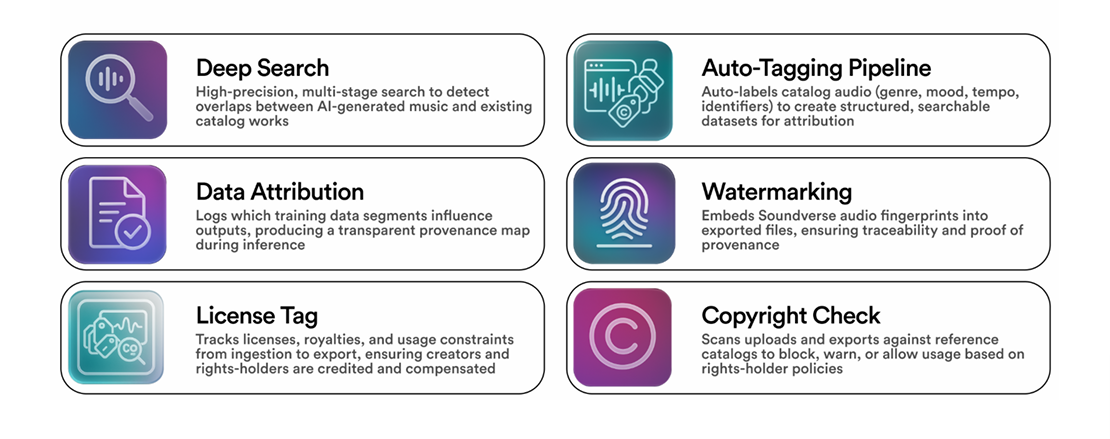
To understand how safety integrates with creativity, it’s useful to examine Soundverse’s infrastructure. The company focuses on ethical innovation rather than blind automation, ensuring that artists maintain control and attribution for every AI-assisted composition.
Key Pillar: The Ethical AI Music Framework
Soundverse’s Ethical AI Music Framework connects innovation with integrity. It eliminates the opacity of black-box AI models through a transparent six-stage pipeline where every dataset entry, transformation, and output attribution is tracked. Rights-holders voluntarily opt in through its Content Partner Program, earning recurring royalties whenever their contributions influence generated audio.
Such a model is a breakthrough for artists who need protection without sacrificing creative efficiency. It fundamentally redefines how AI participation in music respects human creators. Reasoning AI Set to Transform Physical Security Infrastructure in 2026 offers insight into how similar approaches are transforming other industries.
How to Make Safer AI Music Splitting with Soundverse Trace
Soundverse Trace is Soundverse’s dedicated trust layer that elevates AI music security beyond what conventional stem splitters offer. Here’s how it works:
- Deep Search: A high-precision scanning mechanism performing 1:1 and 1:N comparisons to identify overlaps between generated sound and existing datasets. This ensures violations are detected well before publication.
- Data Attribution: Every output carries logs revealing which training data influenced it — critical for transparency and royalty tracking.
- Audio Watermarking: The output embeds inaudible fingerprints offering traceability and authenticity verification.
- License Tagging: Metadata is preserved from dataset ingestion through export, protecting rights and simplifying automated payouts or takedowns.
Together, these technologies guarantee that no AI-generated or AI-processed track leaves Soundverse’s ecosystem without documented provenance and compliance. In contrast with Splitter.ai’s limited disclosure, Soundverse Trace offers complete auditable accountability.
For professionals seeking reliable tools beyond simple separation, read related insights on AI music trends, explore Soundverse’s stem separation magic tool, or compare alternatives in the best AI music generator review. You can also learn interface navigation tips with our Explore Tab walkthrough.
Splitter.ai vs. Soundverse Trace: Key Differences
| Feature | Splitter.ai | Soundverse Trace |
|---|---|---|
| Primary Function | Stem separation | Trust layer & data security for all AI audio |
| Data Transparency | Limited | Full attribution logs |
| Rights Protection | Not specified | License tagging and watermarking |
| Dataset Oversight | Unknown | Auditable traceability for every model |
| Ideal User | Hobbyists | Professional musicians, producers, and rights-holders |
This comparison shows why reliance on simple free tools is fading. In 2026, success in AI-assisted production demands safety-first environments where creators retain measurable ownership.
Final Thoughts: Should You Use Splitter.ai in 2026?
If you need quick, free audio stem separation for experimentation, Splitter.ai may still be convenient. But if you handle copyrighted sessions, professional releases, or sensitive recordings, you should prioritize services with verifiable AI music splitter security and rights traceability.
With data privacy becoming central to creative trust, products like Soundverse Trace represent the future — combining ethical design, deep search attribution, watermarking, and automated licensing workflows. This approach ensures that innovation and protection coexist.
To stay competitive and compliant in 2026, producers should embrace transparent systems such as Soundverse, where creativity comes with guaranteed safety.
For deeper dives into ethical AI composition, discover how AI-generated music is transforming the industry, and learn how Soundverse’s other AI tools like Soundverse Assistant enhance collaborative workflows.
In conclusion, Splitter.ai is a helpful tool, but Soundverse Trace sets the benchmark for trustworthy, safe AI music processing in 2026 — ensuring that your outputs are not just sonically clean, but ethically secure.
Create Music Safely with Soundverse AI
Soundverse empowers artists to generate, remix, and refine music with trustworthy AI tools—no copyright worries, just creativity. Experience high-quality, safety-focused music generation today.
Start Creating Now
Related Articles
- Soundverse Introduces Stem Separation AI Magic Tool — Discover how Soundverse’s new stem separation AI makes safe and precise audio extraction easier than ever.
- Navigating the World of Royalty-Free and Copyright-Free Music Using Soundverse AI — Learn how Soundverse helps you create and use music responsibly without running into copyright issues.
- What Are Song Stems and Why Do You Need Them — Understand song stems and how they can boost your music editing and remixing workflow safely.
- The Role of AI Music in Film and Television — Explore how AI-powered music like Soundverse ensures quality and compliance in professional content creation.
Here's how to make AI Music with Soundverse
Video Guide
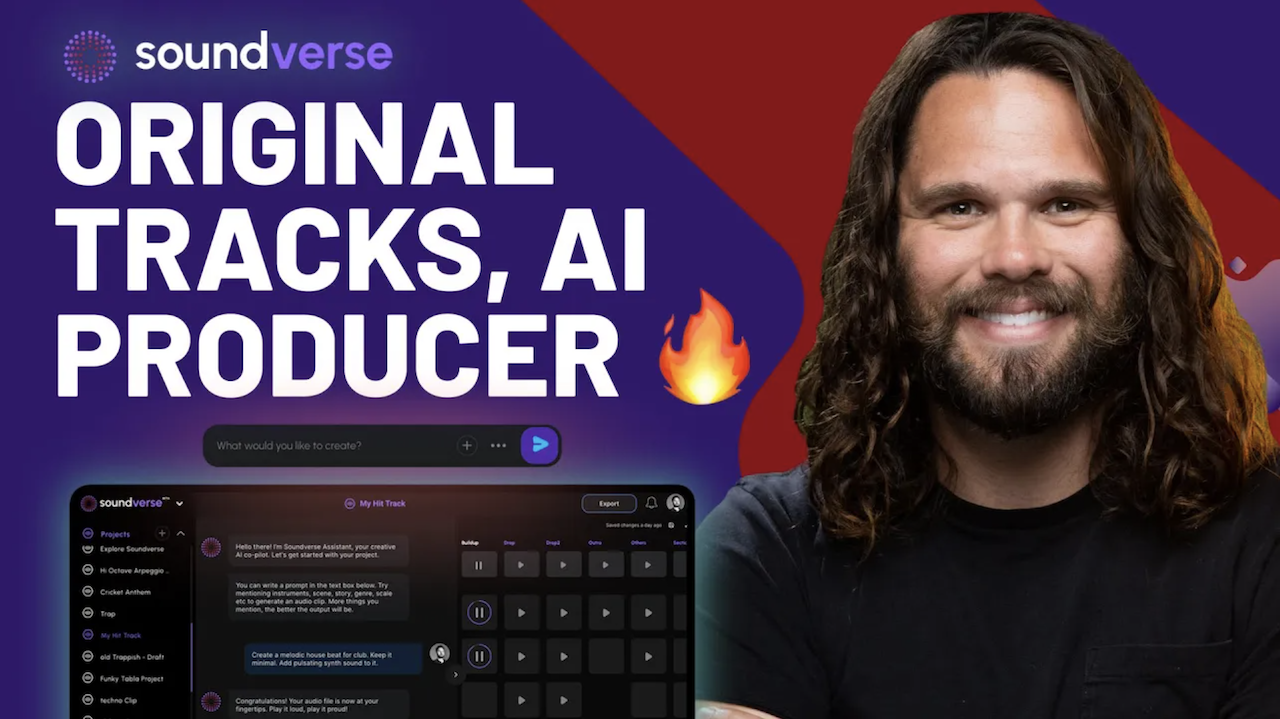
Here’s another long walkthrough of how to use Soundverse AI.
Text Guide
- To know more about AI Magic Tools, check here.
- To know more about Soundverse Assistant, check here.
- To know more about Arrangement Studio, check here.
Soundverse is an AI Assistant that allows content creators and music makers to create original content in a flash using Generative AI.
With the help of Soundverse Assistant and AI Magic Tools, our users get an unfair advantage over other creators to create audio and music content quickly, easily and cheaply.
Soundverse Assistant is your ultimate music companion. You simply speak to the assistant to get your stuff done. The more you speak to it, the more it starts understanding you and your goals.
AI Magic Tools help convert your creative dreams into tangible music and audio. Use AI Magic Tools such as text to music, stem separation, or lyrics generation to realise your content dreams faster.
Soundverse is here to take music production to the next level. We're not just a digital audio workstation (DAW) competing with Ableton or Logic, we're building a completely new paradigm of easy and conversational content creation.
TikTok: https://www.tiktok.com/@soundverse.ai
Twitter: https://twitter.com/soundverse_ai
Instagram: https://www.instagram.com/soundverse.ai
LinkedIn: https://www.linkedin.com/company/soundverseai
Youtube: https://www.youtube.com/@SoundverseAI
Facebook: https://www.facebook.com/profile.php?id=100095674445607
Join Soundverse for Free and make Viral AI Music

We are constantly building more product experiences. Keep checking our Blog to stay updated about them!
Image Steps: []