Is Sad Music a Genre? Exploring Emotion and Expression in Modern Sound
Discover whether sad music is a genre, its emotional types, and how Soundverse creates melancholic soundscapes in 2026.
Is Sad Music a Genre?
Sad music has fascinated listeners for centuries, transcending cultures and generations. Whether it’s the slow swirl of a violin, the reflective pace of a piano melody, or the haunting electronic tones now trending in 2026, emotional songs have always had the power to connect deeply with the human experience. But the question remains—is sad music truly a genre, or is it simply a mood expressed through different musical forms?
What defines the sad music genre?
When we talk about the sad music genre, we're referring to compositions that evoke feelings of melancholy, loss, nostalgia, or introspection. Unlike established genres such as Pop, Jazz, or Rock, sad music often crosses stylistic boundaries. It’s not a rigid category—it’s an emotional framework applied to various forms like orchestral music, lo-fi, indie, and ambient.
In 2026, the term “sad music genre” has evolved beyond traditional classifications. Streaming platforms and AI-powered tools often categorize tracks by mood rather than strict genre labels. Platforms now include mood tags like “melancholic music,” “reflective,” and “bittersweet.” This shift represents a blending of technical genre structure with emotional interpretation.
What are the common types of sad music?
While sadness can take many sonic forms, several distinct types of sad music have emerged:
- Classical sadness – Emotional symphonies and piano solos dominated by minor keys and slow tempos. Think of pieces designed to grieve, reminisce, or express longing.
- Acoustic melancholy – Soft guitar and voice-driven songs focusing on personal reflection and emotional vulnerability.
- Lo-fi and ambient sadness – Popular in 2026 among creators seeking introspective moods for films and podcasts. Lo-fi’s relaxed beats and textural imperfections convey solitude.
- Cinematic melancholy – Orchestral or electronic tracks used to underscore emotional scenes in film and television. These tap deeply into human empathy.
- Sad electronic music – A growing substyle blending downtempo production and ambient sound design, aligning with the growing influence of AI-assisted music generation.
Each of these types of sad music showcases unique textures, sonic arrangements, and emotional tones. To learn more about current direction in sound production, visit Soundverse’s music industry trends article.
What are the main characteristics of sad songs?
Sad song characteristics revolve around a few musical elements that consistently evoke an emotional response:
- Minor Scales: Most sad songs use minor scales or modal harmonies to create tension and introspection.
- Slow Tempo: Slower rhythms reflect human emotional pacing—grieving and reflecting often occur at subdued speeds.
- Sparse Instrumentation: Minimalist arrangements allow focus on emotional content rather than rhythmic complexity.
- Soft Dynamics: Volume dynamics tend toward quiet, emphasizing intimacy and vulnerability.
- Emotional Tone: The overall feeling targets empathy, nostalgia, and the human need for connection.
These elements are found across genres—from melancholic jazz to minimal electronic tracks—and define the architecture behind the sad music genre in 2026. For deeper insight, see The Positive Emotional Impact of Sad Music, which explores how sadness in music can evoke partially positive emotions like peacefulness and nostalgia.
How do moods shape music genres today?
As digital creation tools advance, music genres by mood have become a defining trend rather than a fringe classification. In 2024, mood tagging started appearing in major streaming services, but by 2026 it has become a core method for organizing and discovering new compositions.
Listeners often search not for “pop” or “classical,” but for “emotional songs,” “peaceful tracks,” or “melancholic soundscapes.” Producers and AI platforms match emotion-specific requests with precise sonic profiles—like how lush reverbs and minor harmonies are associated with sadness.
To see how this concept influences creators, explore related insights in how AI-generated music is transforming the music industry and most popular music genres.
Why do people enjoy listening to sad music?
Psychologically, sad music offers catharsis. It helps listeners process emotions safely by externalizing feelings within sound. Studies from past years highlight that people often feel happier after listening to emotional music—they are reminded that their experiences are universal.
Songwriters also utilize melancholic tones to convey authenticity. In 2026, emotional honesty in music is highly valued across social platforms and streaming communities. Hashtags like #melancholicmusic and #emotionalsongs dominate curated playlists for introspective listeners. According to I Asked a Music Psychologist Why Gen Z Loves Sad Songs, these tracks often use gentle melodies and low intensity, helping listeners connect more deeply.
Is sad music considered a stand-alone genre or a mood?
Experts still debate this. Technically, the sad music genre operates primarily as a mood classification rather than a strict genre framework. However, its cultural identity is now so strong that many see it as a hybrid genre blending stylistic and emotional traits.
In simple terms:
- Genre: Defines the compositional style—instrumentation, rhythm, harmony.
- Mood: Defines the listener’s emotional reaction.
Sad music often functions at the intersection of these two. Whether labeled as acoustic sorrow, ambient grief, or orchestral melancholy, it embodies consistent structural and emotional hallmarks. Sage Reference - Sad Music, Psychological Implications of also notes that what is perceived as “sad music” lies mostly in the ears of the beholder.
How is technology shaping the sad music genre in 2026?
The expansion of AI tools has redefined how sad music is composed and distributed. With text-to-music and AI composition platforms, creators can now design emotional soundscapes within minutes by describing the intended feeling, tempo, and instruments.
For example, platforms such as Soundverse allow creators to generate instrumental tracks evoking sadness or nostalgia, ideal for film scenes, wellness content, or reflective storytelling. AI models interpret phrases like “slow piano with a lonely tone” or “soft ambient pad evoking heartache” and construct fully produced instrumentals.
For a deeper dive into Soundverse’s platform workflows, watch our guide on how to make music or explore the tutorial on Deep House music creation.
Such innovation has blurred the boundary between traditional musicianship and algorithmic composition, allowing new waves of emotional experimentation.
How to make sad music with Soundverse AI Music Generator
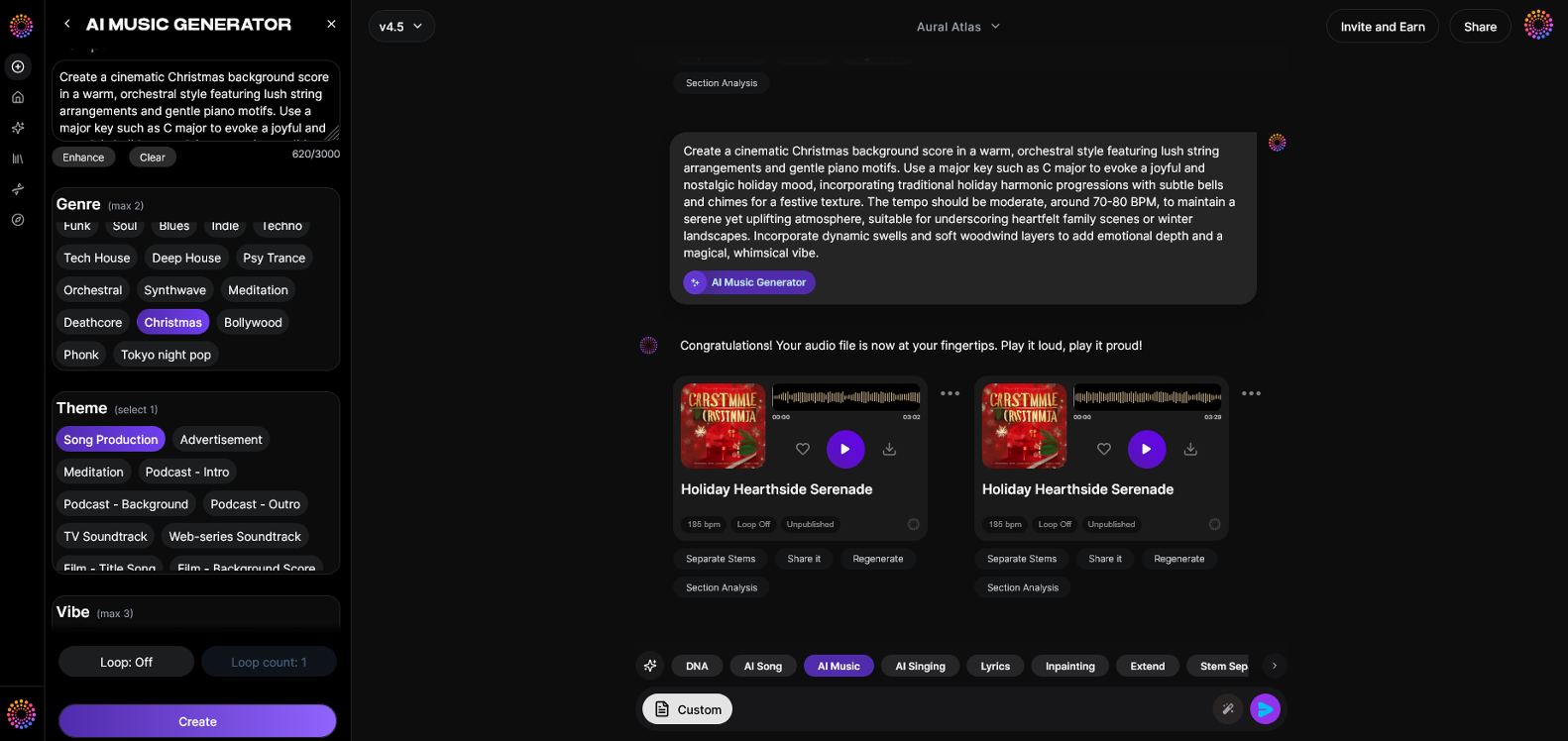
Now that you understand what makes sad music so captivating, here is how you can create melancholic instrumentals instantly using Soundverse AI Music Generator.
Soundverse’s AI Music Generator creates fully produced instrumental music from text prompts. It specializes in background tracks, ambient soundscapes, and cinematic loops—perfect foundations for emotional storytelling.
Key Capabilities:
- Text-to-Music Generation: Convert emotional text inputs into complete instrumental compositions.
- Loop Mode: Generate seamless repetitions for continuous playback, ideal for video and meditation projects.
- Detailed Genre and Instrument Control: Choose instruments like piano, cello, or ambient synth pads to shape the desired feeling.
- V4 and V5 Model Options: Different model selections for tonal and stylistic precision.
Common Use Cases:
- Video Backgrounds: Create emotional underscoring for YouTube and film.
- Game Soundtracks: Add melancholic sound loops to narrative or contemplative gameplay.
- Meditation and Wellness Tracks: Evoke calm reflection through tonal softness.
- Advertising and Commercial Scoring: Craft emotive atmospheres for storytelling-oriented advertising.
Once generated, the instrumental can be downloaded, looped, or refined using additional Soundverse tools. Pair it with lyrics written through the AI Lyrics Writer or combine it with vocals using the AI Song Generator.
For creators exploring connected topics, check related guides like generate AI music with Soundverse text-to-music, how to create healing meditation music with Soundverse AI, and Soundverse assistant as your co-producer.
Create Emotionally Powerful Music with AI
Use Soundverse to generate unique tracks that capture the essence of any mood—from melancholy to inspiration. Turn your emotional ideas into professional music instantly.
Start Creating with Soundverse
Related Articles
- Most Popular Music Genres — Explore today’s leading music genres and uncover what makes each style resonate globally.
- How to Create Healing Meditation Music with Soundverse AI — Learn how to design soothing, emotion-driven soundscapes using Soundverse’s AI music tools.
- Generate AI Music with Soundverse Text-to-Music — Discover how to turn simple text prompts into full emotional compositions with Soundverse AI.
- How AI-Generated Music Is Transforming the Music Industry — Dive into how artificial intelligence is reshaping emotion, creativity, and production in modern music.
Here's how to make AI Music with Soundverse
Video Guide

Here’s another long walkthrough of how to use Soundverse AI.
Text Guide
- To know more about AI Magic Tools, check here.
- To know more about Soundverse Assistant, check here.
- To know more about Arrangement Studio, check here.
Soundverse is an AI Assistant that allows content creators and music makers to create original content in a flash using Generative AI.
With the help of Soundverse Assistant and AI Magic Tools, our users get an unfair advantage over other creators to create audio and music content quickly, easily and cheaply.
Soundverse Assistant is your ultimate music companion. You simply speak to the assistant to get your stuff done. The more you speak to it, the more it starts understanding you and your goals.
AI Magic Tools help convert your creative dreams into tangible music and audio. Use AI Magic Tools such as text to music, stem separation, or lyrics generation to realise your content dreams faster.
Soundverse is here to take music production to the next level. We're not just a digital audio workstation (DAW) competing with Ableton or Logic, we're building a completely new paradigm of easy and conversational content creation.
TikTok: https://www.tiktok.com/@soundverse.ai
Twitter: https://twitter.com/soundverse_ai
Instagram: https://www.instagram.com/soundverse.ai
LinkedIn: https://www.linkedin.com/company/soundverseai
Youtube: https://www.youtube.com/@SoundverseAI
Facebook: https://www.facebook.com/profile.php?id=100095674445607
Join Soundverse for Free and make Viral AI Music

We are constantly building more product experiences. Keep checking our Blog to stay updated about them!