How Voice Cloning Works in AI Music: A Technical Guide (2026 Edition)
Learn how voice cloning in AI music works, from the cloning process to Soundverse Voice Swap technology.
How Voice Cloning Works in AI Music (Technical Guide)
Voice cloning in AI music has evolved into one of the most fascinating advancements in sound technology in 2026. What once sounded like science fiction — replicating a singer’s voice digitally — is now a precise, engineered process powered by sophisticated ai voice technology and ethical frameworks. For music producers, sound engineers, and AI researchers, understanding how voice cloning works is essential to mastering modern audio synthesis workflows and exploring creative possibilities responsibly.
What is voice cloning in AI music?
Voice cloning in AI music is the process of digitally replicating a voice’s tonal characteristics, emotional patterns, and expressive nuances using machine learning. Instead of recording a human singer repeatedly, you can model that singer’s vocal DNA and use it to perform new lyrics or melodies automatically. The cloning process involves advanced neural networks trained on clean vocal datasets that extract parameters such as pitch contour, formant shape, vibrato rate, and timbral qualities.
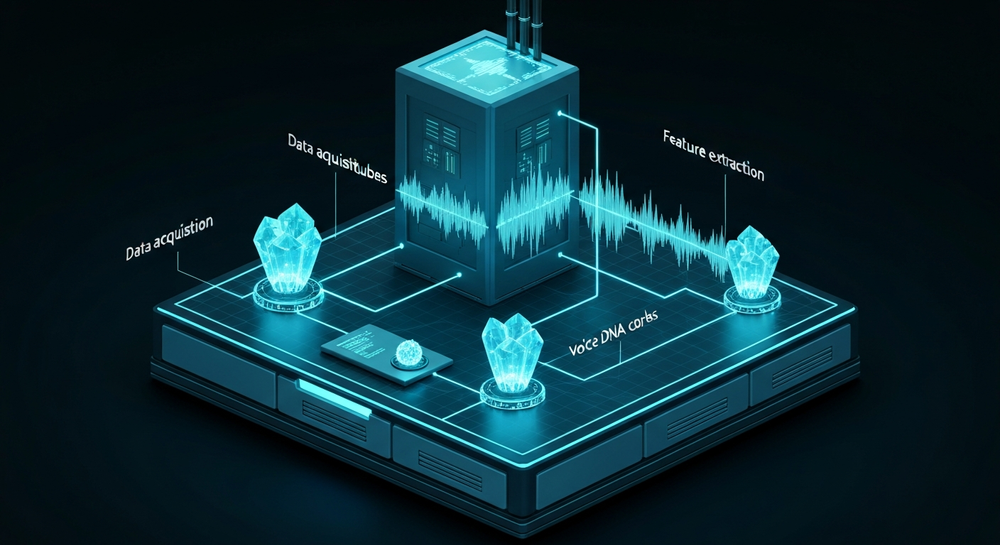
In 2026, AI vocal synthesis tools no longer merely imitate sound; they interpret performance intention. Through voice cloning, creators can preserve the emotional integrity of an original recording while mapping it to a completely different voice identity. This enables more fluid collaborations between humans and machines, while significantly reducing production time.
How does the cloning process technically work?

The technical workflow for voice cloning operates in several phases — data acquisition, training, synthesis, and rendering.
- Data Collection: To train a voice model, developers gather high-quality voice recordings with different registers, expressions, and phoneme combinations. The more diverse the training set, the more realistic the cloned output.
- Feature Extraction: Each vocal sample is converted into a numerical representation via spectral analysis and machine learning encoders. These encoders learn how a vocal performance behaves dynamically.
- Voice DNA Modeling: Modern AI systems create a latent 'Voice DNA' embedding, a vectorized representation containing all the unique features of a singer’s voice identity.
- Transfer and Synthesis: In the synthesis phase, AI re-maps the target DNA onto new melodies, or onto existing performances, allowing precise voice-to-voice transformation.
- Final Rendering: Audio is generated through vocoders and synthesis engines that reproduce the cloned timbre faithfully.
This entire process ensures consistency between performance realism and creative flexibility — something traditional studio techniques could never achieve at scale.
What is the role of AI voice technology in 2026?
AI voice technology in 2026 integrates deep learning, transformer architectures, and diffusion-based synthesis models to generate smooth, natural-sounding voices. Unlike the systems used in early 2020s, modern frameworks operate on consent-driven training sets, leading to transparent and ethical methodologies.
Platforms such as Soundverse have implemented safeguard layers ensuring attributed ownership of voice DNA models. These technologies are more than mere artistic tools; they are digital guardians preserving performer identity while enabling innovation.
You can read about how AI-generated music is transforming the industry, and see how ethical frameworks maintain balance between artistry and automation.
For a deeper dive, watch our guide on creating Deep House music and explore creative synthesis in action.
How to make voice cloning in AI music with Soundverse Voice Swap
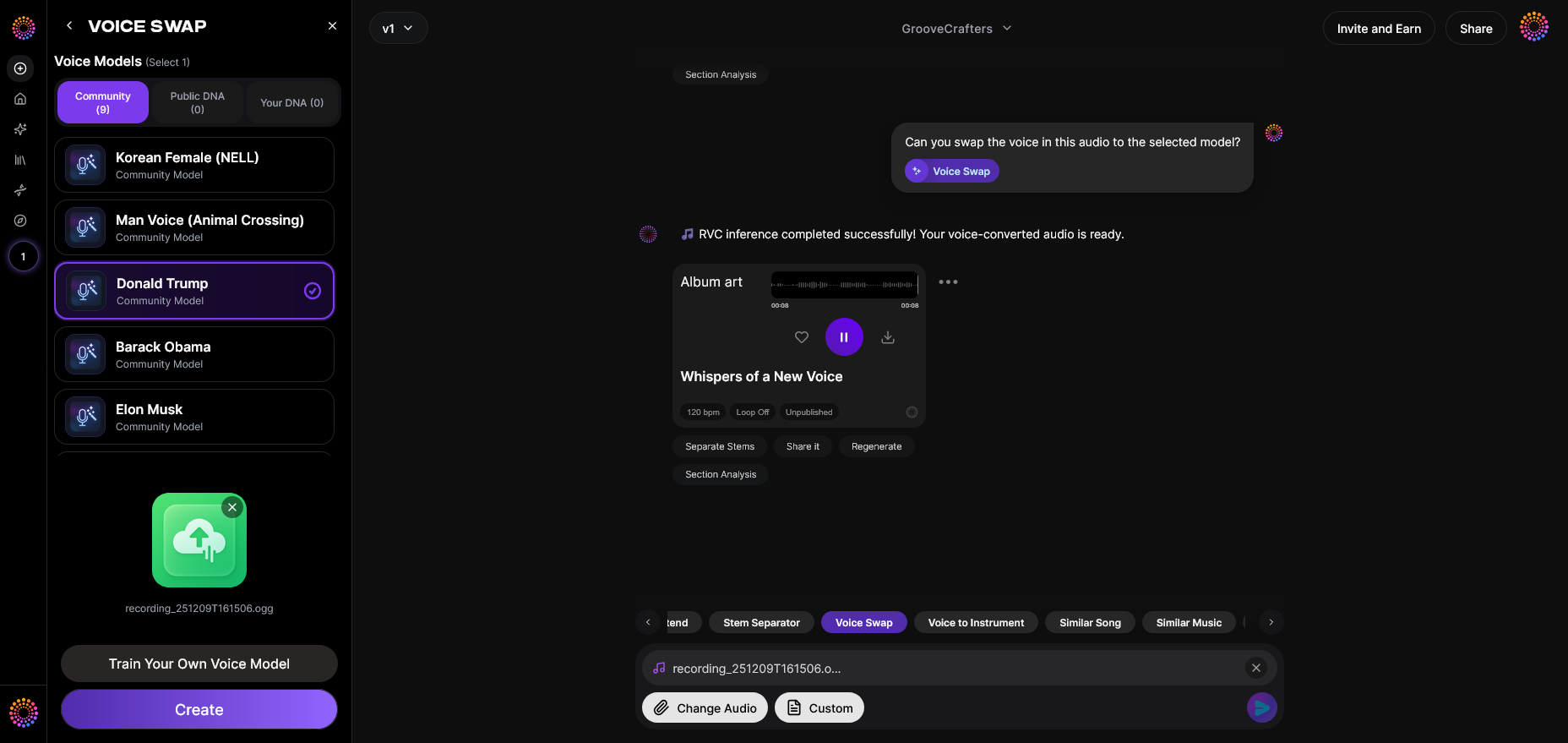
Soundverse Voice Swap is the dedicated feature designed for precise vocal identity replacement within any audio track. It allows creators to swap one voice for another while retaining the original emotional phrasing and timing. Its core mechanism involves asynchronous processing — users upload the audio, and Soundverse algorithms analyze and transform the vocal layer without live monitoring.
Core Capabilities:
- Community Voices: celebrity, character, or signature voices contributed by the Soundverse community.
- Public DNA & Personal DNA support: users can access existing DNA models or upload their own ethically trained voice data.
- Voice-to-Voice conversion: maps one performance to another voice identity seamlessly.
Primary Use Cases:
- Guide vocals for demos
- Character voices for animation or gaming
- Parody content and entertainment videos
- Experimenting with different singing styles on the same track
This system sits within the broader Soundverse ecosystem alongside tools such as the Similar Singing Generator, Soundverse DNA, and The Ethical AI Music Framework — ensuring technical precision and artist integrity throughout production.
Step 1: Feature Overview
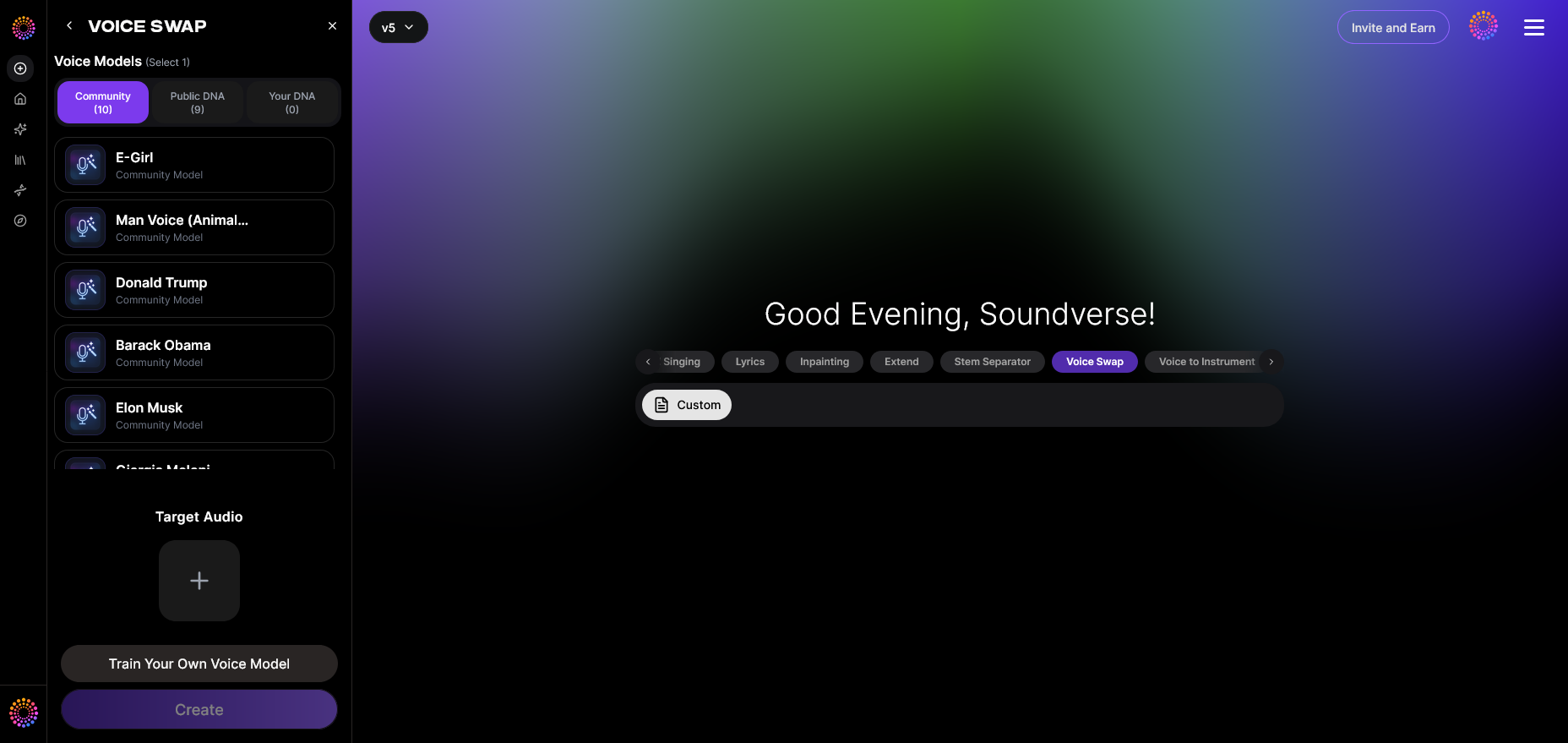
Access the Voice Swap tool inside Soundverse. This module provides a dedicated interface where you can select voice models and configure transformation settings.
Step 2: Upload Audio

Import your audio track containing clean vocals. The system requires distinct vocal parts for analysis. Soundverse’s asynchronous workflow processes the recording after upload.
Step 3: Target Voice Selection
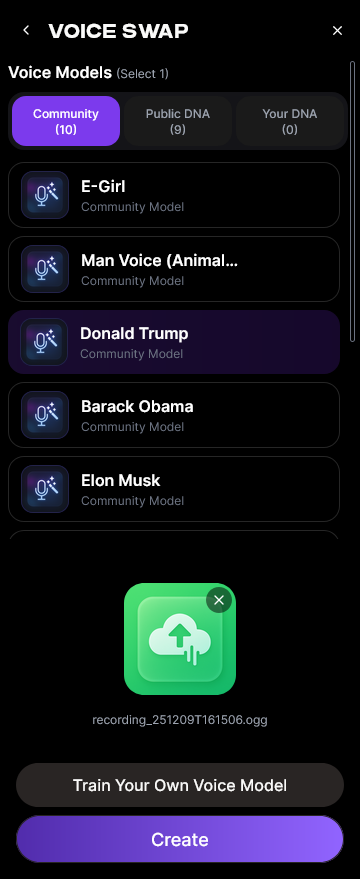
Choose the target artist, celebrity, or custom DNA template. Each model carries its distinct tone color and expressive fingerprint.
Step 4: Generation
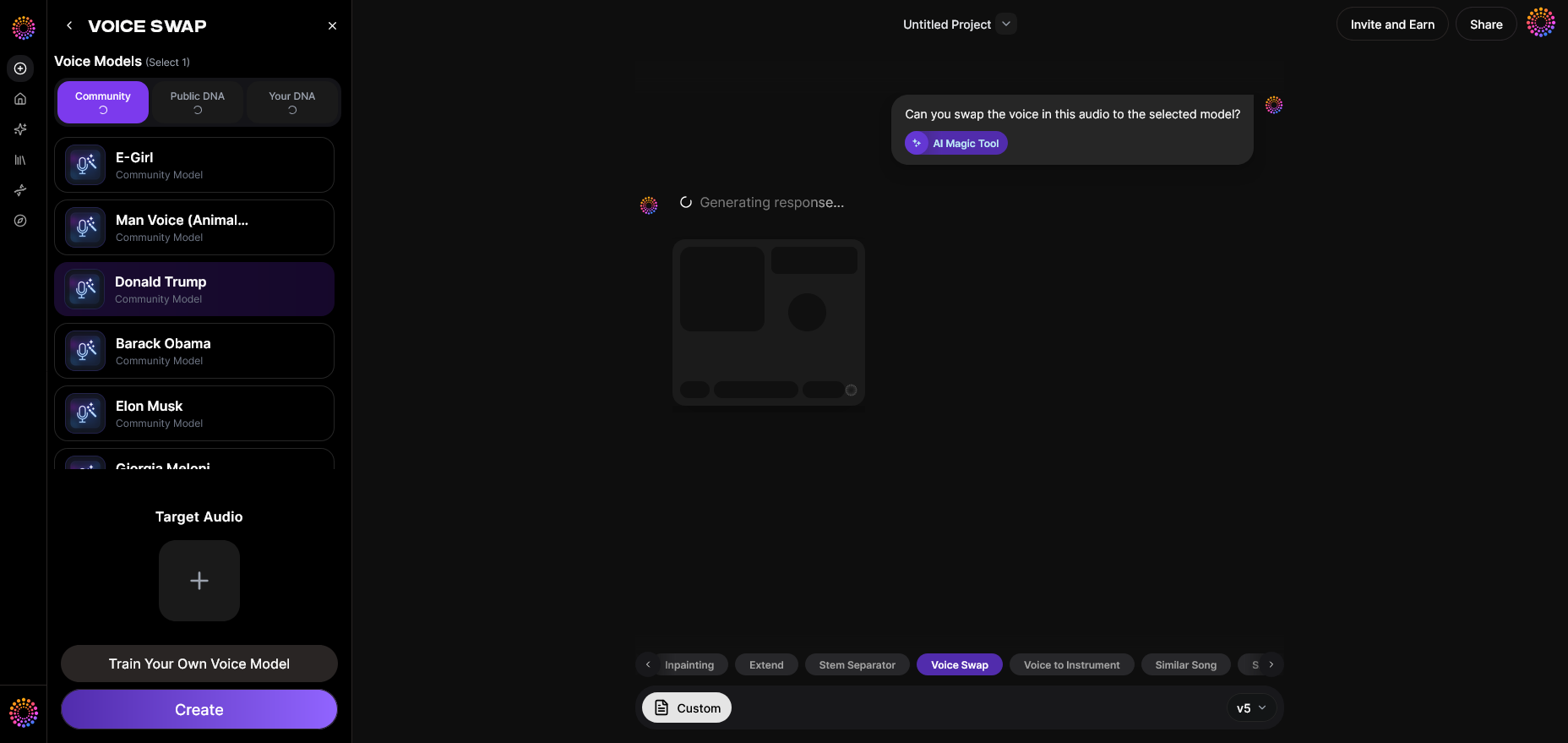
Initiate the voice swap transformation. The AI processes your performance offline, analyzing the nuanced details such as pitch inflection and timing before applying the target voice.
Step 5: Download Result
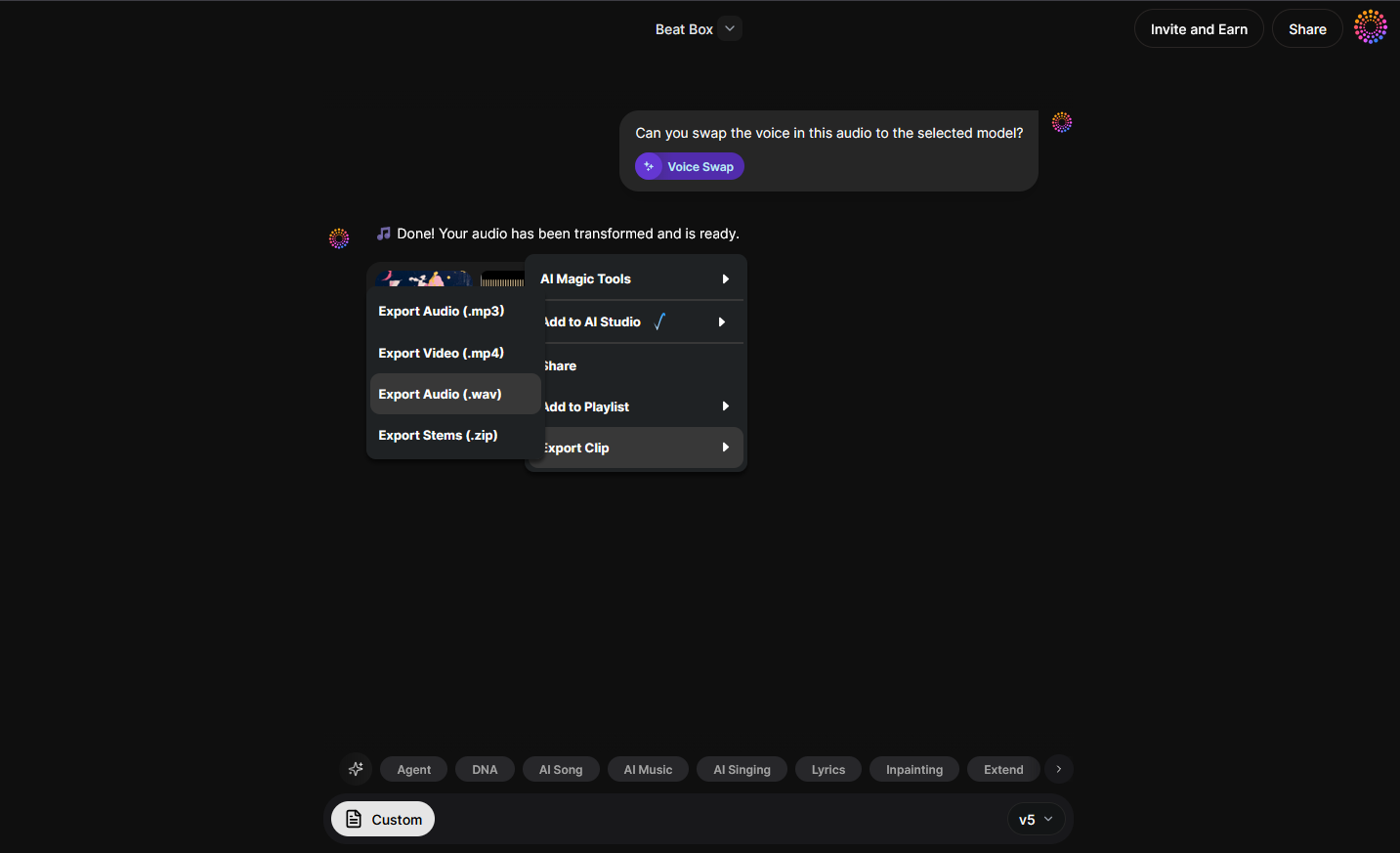
Once processed, download your newly voice-swapped audio. You can integrate it into composition workflows, film production, or demo creation.
Pro tips for mastering vocal synthesis in 2026
- Record high-quality source vocals: Clean recordings enable smoother transformation.
- Choose DNA ethically: Always opt for licensed or personal DNA models to preserve consent and authenticity.
- Blend with instrumental arrangement: Use Soundverse Stem Separation to fine-tune your mix.
- Experiment with genre matching: Pair vocal synthesis with text-to-music generation for full-length compositions (see Text-to-Music Generator).
Why ethical frameworks matter in voice cloning
With rapid progress comes responsibility. Voice cloning raises legal and moral questions about identity and ownership. Soundverse answers these challenges through The Ethical AI Music Framework — a transparent six-stage system ensuring consent, attribution, and recurring compensation. Each model inside Soundverse DNA is trained on licensed catalogs, providing a sustainable economy for artists and producers alike.
For those exploring genre experiments — whether creating AI-generated rap vocals or producing jazz tracks — ethical voice cloning enables creativity without violation.
Start Creating AI Music with Realistic Voice Cloning Today
Bring your musical ideas to life using Soundverse’s powerful AI tools. Generate vocals, experiment with styles, and clone voices seamlessly—no studio needed.
Related Articles
- Soundverse Saar: AI Voice Assistant — Discover how Soundverse Saar helps creators generate lifelike vocals and streamline AI-powered music production.
- AI Music Generator and Human Composers: A Future Together — Explore how AI tools collaborate with human creativity to redefine what’s possible in music composition.
- How AI-Generated Music Is Transforming the Music Industry — Learn how AI-generated tracks are reshaping music production, distribution, and creativity across the industry.
- Soundverse Introduces Stem Separation AI Magic Tool — See how Soundverse’s stem separation tool lets creators isolate vocals and instruments with precision using AI.
Here's how to make AI Music with Soundverse
Video Guide
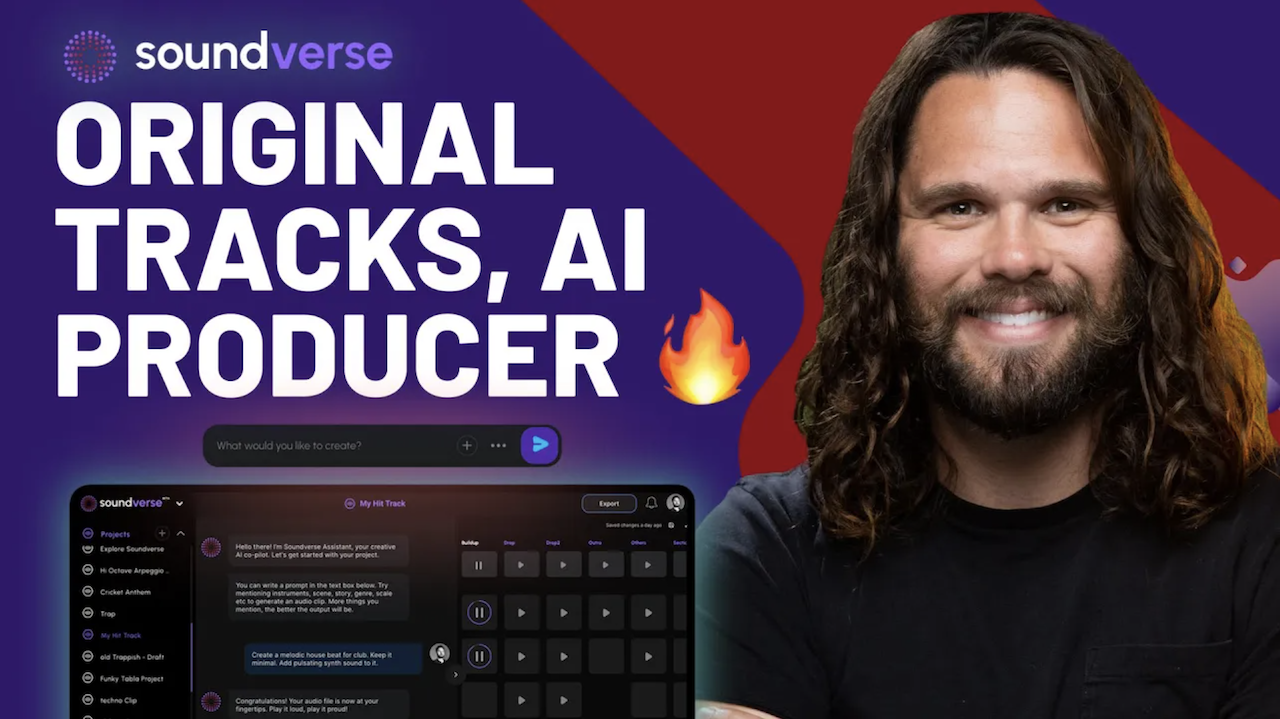
Here’s another long walkthrough of how to use Soundverse AI.
Text Guide
- To know more about AI Magic Tools, check here.
- To know more about Soundverse Assistant, check here.
- To know more about Arrangement Studio, check here.
Soundverse is an AI Assistant that allows content creators and music makers to create original content in a flash using Generative AI.
With the help of Soundverse Assistant and AI Magic Tools, our users get an unfair advantage over other creators to create audio and music content quickly, easily and cheaply.
Soundverse Assistant is your ultimate music companion. You simply speak to the assistant to get your stuff done. The more you speak to it, the more it starts understanding you and your goals.
AI Magic Tools help convert your creative dreams into tangible music and audio. Use AI Magic Tools such as text to music, stem separation, or lyrics generation to realise your content dreams faster.
Soundverse is here to take music production to the next level. We're not just a digital audio workstation (DAW) competing with Ableton or Logic, we're building a completely new paradigm of easy and conversational content creation.
TikTok: https://www.tiktok.com/@soundverse.ai Twitter: https://twitter.com/soundverse_ai Instagram: https://www.instagram.com/soundverse.ai LinkedIn: https://www.linkedin.com/company/soundverseai Youtube: https://www.youtube.com/@SoundverseAI Facebook: https://www.facebook.com/profile.php?id=100095674445607
Join Soundverse for Free and make Viral AI Music
We are constantly building more product experiences. Keep checking our Blog to stay updated about them!