How to Write a Metalcore Riff: A Complete 2026 Tutorial
Learn how to write a metalcore riff with tone, timing, breakdowns, and Soundverse Voice to Instrument.
How to Write a Metalcore Riff
Metalcore continues to dominate heavy music in 2026, blending aggressive guitar tones with melodic hooks. For guitarists eager to capture that perfect mix of heaviness and groove, learning how to write a metalcore riff is an essential skill. This guide walks you through tone setup, rhythmic ideas, breakdown creation, and shows you how to use Soundverse’s Voice to Instrument feature to turn your creative ideas into realistic guitar parts.
What makes a great metalcore riff in 2026?
Metalcore riffs are built around controlled chaos — massive low-end tuning, rhythmic precision, and emotion-driven progressions. In 2026, modern production has pushed the genre further toward hybrid tones, where analog textures meet digital precision. Bands blend influences from djent, post-hardcore, and modern prog metal, making riffs tighter, groovier, and more dynamic than ever.
A metalcore riff usually combines these elements:
- Heavy Guitar Tuning: Most commonly Drop C, Drop B, or even Drop A for those thundering breakdowns.
- Syncopated Rhythm: Emphasis on off-beat chugs and tight staccato picking.
- Melodic Layering: Leads or ambient chords that contrast the brutality.
- Breakdown Writing: Sudden tempo drops or rhythmic punches that emphasize intensity.
- Dynamic Range: Alternating between technical riffs and open low-note grooves.
Understanding these fundamentals sets the stage for exploring metalcore guitar techniques that bring precision and creativity to your playing. For an external perspective, check out HOW TO WRITE METALCORE RIFFS - Apex Audio for deeper insights into structure and timing.
How to make metalcore riffs with Soundverse Voice to Instrument
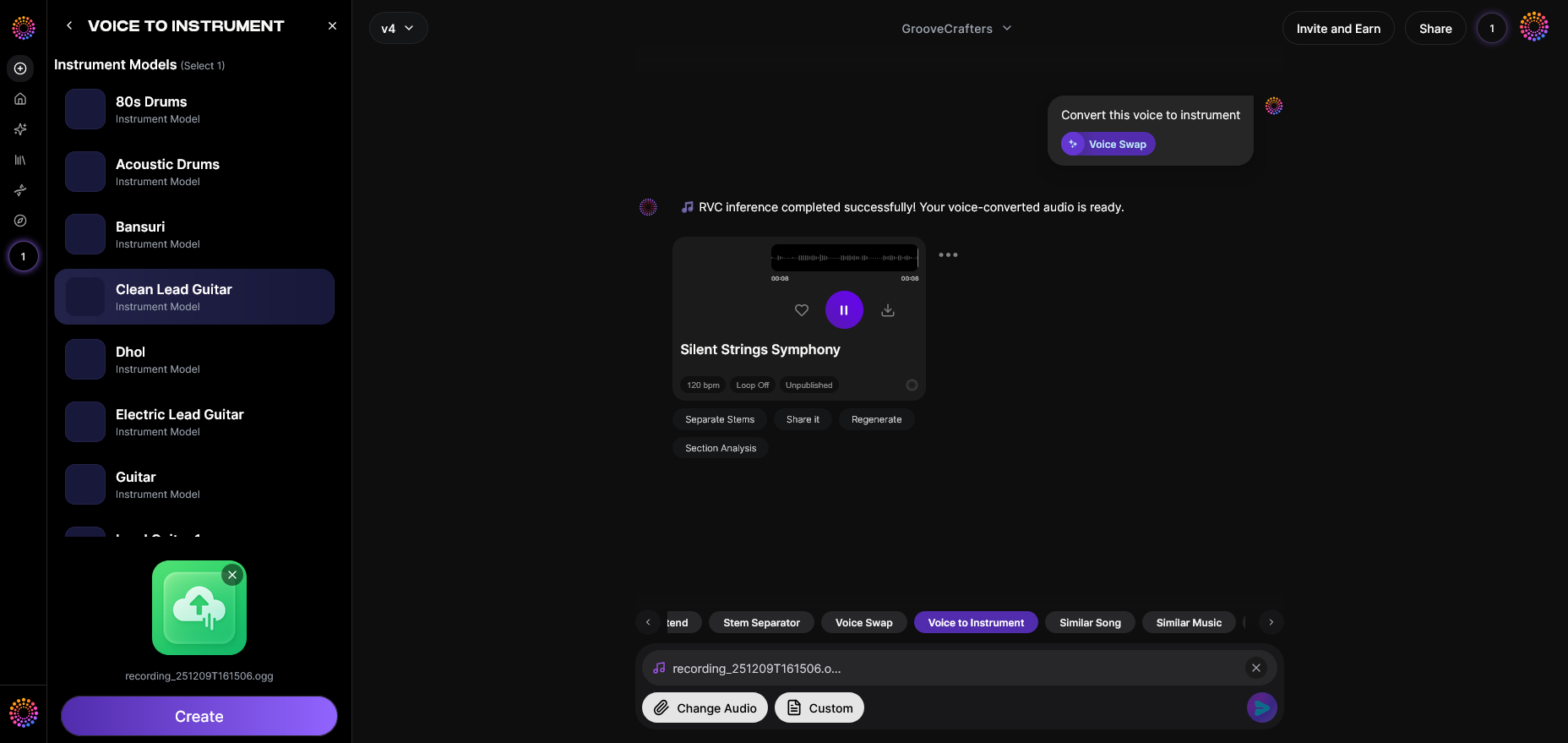
Soundverse offers innovative AI tools, and one of the most powerful for guitarists is Voice to Instrument. This feature lets you transform your vocal input — humming, beatboxing, or even singing — into realistic instrumental performances such as electric guitar, sitar, drums, or flute.
How it works:
- Timbre Transfer: The system maps your vocal tone and phrasing onto a target instrument’s sound profile.
- Wide Instrument Library: Includes both Western and ethnic instruments, perfect for hybrid genres.
- Melodic and Rhythmic Input: Translates both sustained melodies and rhythmic vocalizations.
This means you don’t need to be an advanced guitarist to start writing your own metalcore riffs. Simply hum what you imagine, and Soundverse converts your voice into a playable guitar segment.
Soundverse has previously showcased how versatile this technology is across genres like EDM creation, rap music composition, and even metal production. Now, the same AI-driven workflow can help you sketch heavy riffs for your next metalcore project.
Step 1: Feature Overview — Access Voice to Instrument

To begin, open the Voice to Instrument section inside Soundverse. This tool aims to convert recorded vocal ideas into detailed instrument tracks. You can start from scratch or access the tool through a saved project within your Soundverse account.
Step 2: Instrument Selection — Choose target instrument type
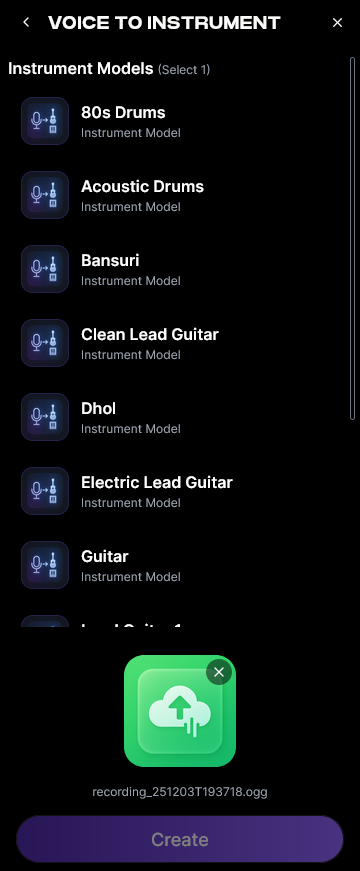
Select Electric Guitar from the instrument list. This choice determines how Soundverse interprets your pitch and timbre. You can also experiment with genre-focused guitars for metal production. The flexibility here allows you to naturally translate your humming or rhythm into authentic distortion-based tones.
Step 3: Upload Target Audio — Upload audio with vocal track
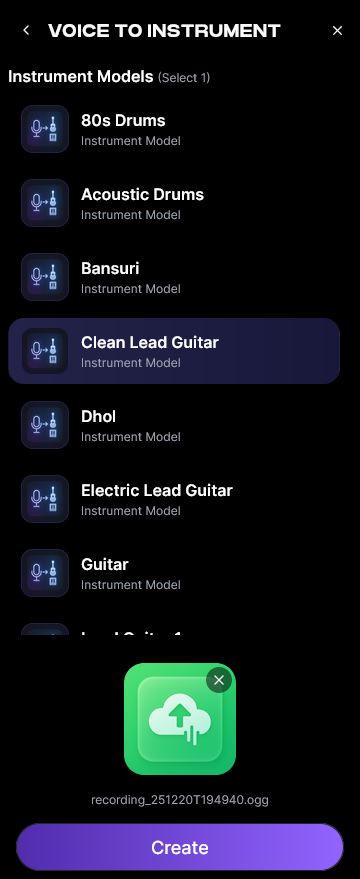
Record your riff idea — either humming a melody or beatboxing a rhythm pattern — and upload the file. Soundverse will use this recording to analyze timing, phrasing, and tonal intent. Ensure the recording is clean, rhythmic, and aligned with the tempo you want for your metalcore track.
Step 4: Generation — Convert vocals to selected instrument
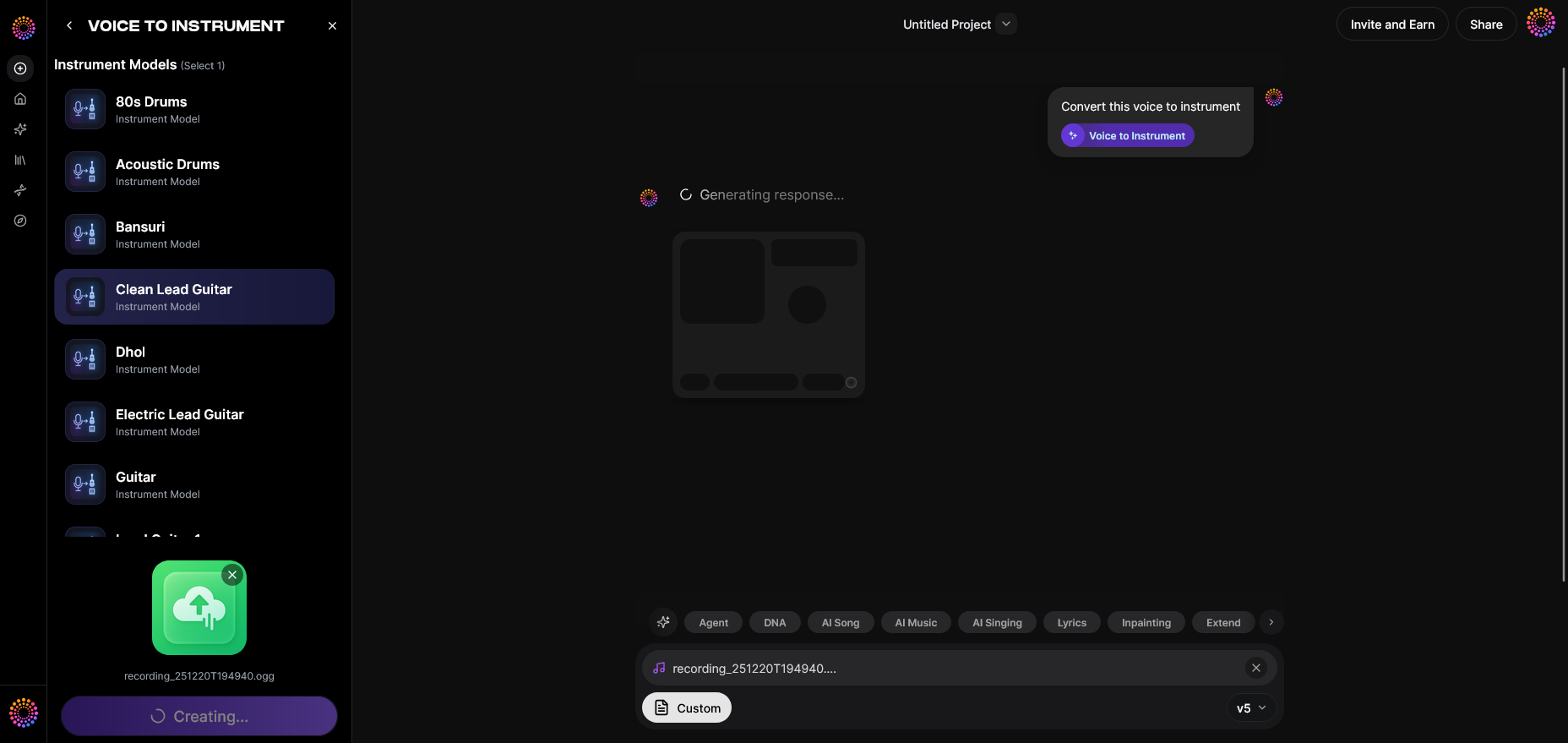
Once uploaded, Soundverse processes the vocals and converts them into electric guitar output. The system captures nuances like pick attack and sustain based on your vocal phrasing. You can then preview the generated guitar tone and tweak it through the platform’s settings if you want a thicker or cleaner sound.
Step 5: Download Result — Export instrument version

After generation, download the guitar stem and incorporate it into your DAW (Digital Audio Workstation). You can add effects like compression, distortion, or amp simulation to match your band’s tone.
This asynchronous workflow ensures top-quality results without requiring real-time monitoring or live signal processing, making it suitable for both beginner composers and experienced sound designers. For a more detailed walkthrough, watch our tutorial on the Soundverse “Explore” tab.

What guitar techniques define metalcore riff writing?
Writing effective metalcore riffs demands control over several fundamental skills:
- Palm Muting: For tight chug patterns typical of breakdowns.
- Alternate Picking: To maintain speed and clarity.
- String Dropping: Utilizing open strings to add heavy contrast.
- Syncopation: Layering rhythmic tension against the drummer’s kick pattern.
- Melodic Hooks: Introduce emotion through minor scales or chromatic riffs.
The balance of melodic and rhythmic execution determines how engaging your metalcore section sounds. Beginners can start simple — two-note progressions, palm-muted rhythms, and gradual speed increases — while intermediate players can explore hybrid picking or tapping techniques. For example, Writing Good Metalcore Riffs - Ultimate Guitar outlines hammer-ons, pedal points, and harmonic tricks that can inspire your phrasing. Also, watch our video How to Make Music for further composition flow examples.
How to structure breakdowns like a pro
Breakdowns in metalcore are strategic rhythmic drops that maximize impact. Think of them as sonic punctuation marks.
Here’s how to compose a proper one:
- Identify the pivot: Usually following a melodic chorus or intense riff.
- Simplify rhythm: Focus on low-string chugging and syncopated accents.
- Introduce silence: Brief pauses intensify the groove.
- Layer effects: Use reverb or filtered delays for transition.
- Dynamic progression: Start minimal, then build toward dissonant peaks.
If you’re shaping heavier drops, consider combining human creativity with AI assistance. Soundverse offers multiple tools like the AI Music Generator and Similar Music Generator to complement your guitar-based workflow. To learn rhythmic structuring further, you can view Make Any Metal Riff Your Own (9 Writing Techniques) for creative riff variation ideas.
Pro metalcore songwriting tips for 2026
- Use AI tools for exploration: Don’t limit your creative flow to gear; Voice to Instrument bridges inspiration and technical skills effortlessly.
- Blend textures: Combine Artificial Intelligence stems with hand-played sections for authentic production.
- Layer guitars: Double-track rhythms on left and right channels for a wide stereo wall.
- Incorporate melodic motifs: Adding a minor scale lead above heavy rhythm sustains listener interest.
- Simplify grooves: Complex phrasing isn’t always necessary; feel and precision matter more.
- Experiment with breakdown timing: 2026 trends emphasize off-grid rhythmic drops and asymmetric patterns.
- Mix classical elements: Some modern metalcore artists integrate piano, sitar, or flute overlays — achievable with Soundverse's broad instrument library.
For deeper inspiration on genre experimentation, check out how an AI music generator inspires creative fusion or learn about Soundverse Assistant — the integrated co-producer that streamlines your creative workflow. Also, you can refer to Soundverse Tutorial Series - Make Deep House Music for workflow understanding applicable to any genre creation process.
Start Creating Your Own Metalcore Tracks with AI
Unlock infinite riff ideas and textures using Soundverse’s AI Music Generator. Perfect your tone and structure faster than ever and bring your metalcore vision to life.
Related Articles
- Create Metal Music with AI — Explore how Soundverse helps metal musicians craft powerful riffs, breakdowns, and melodic leads using AI-driven composition tools.
- The Benefits of Composing with AI Music Generator — Learn how AI composition tools speed up your songwriting process while expanding creative possibilities across all genres.
- AI Music Generator and Human Composers: A Future Together — Discover how AI complements human creativity in modern music production and composition collaborations.
- Soundverse Assistant: Your AI Music Co-Producer — Meet your new virtual studio partner—an AI that helps refine your sound, structure tracks, and generate professional-quality music with ease.
Here's how to make AI Music with Soundverse
Video Guide

Here’s another long walkthrough of how to use Soundverse AI.
Text Guide
- To know more about AI Magic Tools, check here.
- To know more about Soundverse Assistant, check here.
- To know more about Arrangement Studio, check here.
Soundverse is an AI Assistant that allows content creators and music makers to create original content in a flash using Generative AI. With the help of Soundverse Assistant and AI Magic Tools, our users get an unfair advantage over other creators to create audio and music content quickly, easily and cheaply. Soundverse Assistant is your ultimate music companion. You simply speak to the assistant to get your stuff done. The more you speak to it, the more it starts understanding you and your goals. AI Magic Tools help convert your creative dreams into tangible music and audio. Use AI Magic Tools such as text to music, stem separation, or lyrics generation to realise your content dreams faster. Soundverse is here to take music production to the next level. We're not just a digital audio workstation (DAW) competing with Ableton or Logic, we're building a completely new paradigm of easy and conversational content creation.
TikTok: https://www.tiktok.com/@soundverse.ai Twitter: https://twitter.com/soundverse_ai Instagram: https://www.instagram.com/soundverse.ai LinkedIn: https://www.linkedin.com/company/soundverseai Youtube: https://www.youtube.com/@SoundverseAI Facebook: https://www.facebook.com/profile.php?id=100095674445607
Join Soundverse for Free and make Viral AI Music

We are constantly building more product experiences. Keep checking our Blog to stay updated about them!