How to Publish and Copyright Your AI-Generated Music in 2026
Learn how to copyright AI music and publish AI-generated songs legally in 2026.
How to Publish and Copyright Your AI-Generated Music
The explosion of AI-generated music has reshaped the music industry by offering creators new ways to compose, produce, and release songs faster than ever before. From independent musicians to producers experimenting with tools like Soundverse AI, the potential of artificial intelligence in music creation is unmatched. But with innovation comes responsibility — particularly around ownership, licensing, and protection. In 2026, understanding how to copyright AI music and publish AI-generated works legally has become a vital step for artists seeking to control their creative output and earn fair royalties.
What Does It Mean to Copyright AI Music in 2026?
Copyrighting AI music means identifying who owns the rights to the composition and recording that AI helped create. Legally, copyright provides creators with exclusive rights to reproduce, distribute, and monetize their work. However, when a machine assists or entirely generates a track, questions arise: Who owns the copyright — the human guiding the AI, or the AI model itself?
By 2026, most jurisdictions, including the U.S., EU, and UK, maintain that only human authors can hold copyright. This means that if you use an AI tool, such as Soundverse DNA or another composer engine, you as the user become the author — provided you exercised creative choices and contributed substantially to the final piece. According to the U.S. Copyright Office guidance, purely AI-generated songs without human creative input do not qualify for protection.

Why Is Copyright Protection Essential for AI-Generated Music?
Without proper music copyright protection, your AI song could be used without your consent or distributed under false labels. Protecting your AI-generated tracks ensures:
- Ownership clarity: It prevents disputes over who holds the rights to a track generated with AI tools.
- Monetization: By registering your copyright, you can collect royalties through licensing or streaming.
- Distribution security: Copyright ensures your music cannot be legally replicated or sold without your permission.
- Credibility: It strengthens the professional reputation of your brand as a responsible and ethical music creator.
Protecting your music isn’t just about legal defense — it’s about securing the creative identity behind what you produce, whether that is through an AI arrangement tool or manual composition.
How Do You Copyright AI Music Legally?
Publishing and copyrighting AI music involve several practical steps. Let’s break down what every AI music creator should do in 2026 to register and protect their work.
Step 1: Define Authorship and Creative Contribution
Before applying for copyright, determine your role in the creation process. If you used an AI tool to generate melody, lyrics, or arrangement, ensure your creative choices — prompts, structure, mixing, or performance — reflect substantial authorship. Copyright offices require proof of human input for registration. As noted in AI Music Copyright & Legal Guide 2026, human authorship continues to be mandatory under current U.S. guidance.
Step 2: Save and Document Your Creative Process
Keep detailed records of your creative workflow, including AI prompts, drafts, edits, and mixing sessions. This documentation serves as evidence in case of disputes and proves your authorship. Many creators are now using AI project files and export data logs to demonstrate their involvement in the creation.
Step 3: Register Your AI-Generated Music with a Copyright Office
Once your track is finalized, you can register it with your local copyright authority (such as the U.S. Copyright Office or PRS in the UK). You’ll typically need:
- The final audio (MP3 or WAV)
- Metadata (title, authorship, creation year, etc.)
- Proof of human authorship or creative direction
You may also want to register with digital rights management platforms that automate protection globally. Under recent initiatives like the TRAIN Act, rights-holders in the U.S. can also access datasets used in AI training for transparency.
Step 4: Apply Music Copyright Protection Tags
Use license tagging and watermarking technologies to embed rights metadata directly into your files. This prevents unauthorized use and helps identify ownership if the track circulates online. These tags should include your name, license terms, and the year of creation. AI watermarking systems such as Soundverse Trace employ similar fingerprinting technology for protection.
Step 5: Publish and Distribute Your AI Music Safely
Publishing your AI music involves selecting a trustworthy music distribution service or platform that respects AI music rights. In 2026, services have matured to accommodate AI compositions, allowing artists to distribute tracks across streaming platforms like Spotify, Apple Music, or specialized AI streaming networks. When publishing, clarify your rights — whether you offer exclusive, non-exclusive, or creative commons licenses. Transparency ensures that your audience and potential collaborators know your track's copyright status.
For more insight into emerging distribution models, read how AI-generated music is transforming the music industry and AI music in the USA. For a deeper dive, watch our guide on creating Deep House music or how to make music with Soundverse AI.
What Are the Current AI Music Rights Trends in 2026?
From 2024 to 2026, the conversation around AI music rights has evolved dramatically. As governments introduced clearer frameworks, creators enjoy stronger protection and simplified registration. Current trends include:
- Transparent Attribution Systems: Tools that trace which datasets influenced a composition, allowing artists to receive fair compensation.
- Ethical AI Licensing Models: The rise of opt-in frameworks ensures rights-holders are properly credited and compensated for data used in training AI models. According to Music and AI 2025 developments, nearly all surveyed artists agree AI companies should license data before training models.
- Cross-border Copyright Harmonization: More countries now recognize AI-assisted works, simplifying international distribution and royalty management.
For creators looking to understand copyright ownership nuances, see The 2026 State of AI Music.
How to Publish AI-Generated Music in Compliance with Copyright Laws
When publishing AI music, compliance means adhering not only to copyright registration but also to licensing ethics. Here’s a quick guide:
- Verify Dataset Licensing: Ensure the AI model you use is trained on legally licensed material. Platforms like Soundverse DNA offer licensed input data to produce copyright-safe outputs.
- Use Attribution Mechanisms: Permanent attribution prevents your work from being mistakenly flagged as derivative or plagiarized.
- Distribute via Ethical Platforms: Join programs or use publishing portals that honor royalty splits.
- Stay Updated: Regularly review legal updates around AI music rights to prevent errors in registration.
For inspiration, check out related guides like generate AI music with Soundverse text-to-music and how to make AI-generated music.
How Soundverse Trace Simplifies Copyright and Publishing for AI Music
Now that you understand how to publish and copyright your AI-generated music, here is how to protect and distribute it instantly using Soundverse Trace.
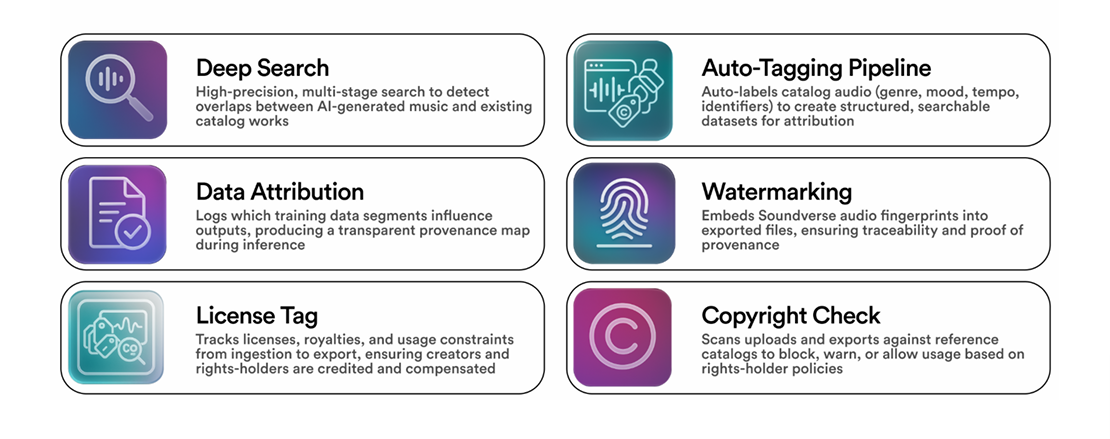
Soundverse Trace is a comprehensive trust layer for AI music designed to embed attribution, rights protection, and deep search capabilities across the entire music lifecycle—from dataset creation to final export.
Core Capabilities:
- Deep Search: Uses high-precision scanning (1:1, 1:N) to detect overlaps and prevent accidental infringement.
- Data Attribution: Logs which training data influenced your outputs, creating an immutable audit trail for compliance and royalties.
- Audio Watermarking: Embeds inaudible fingerprints into tracks, making them traceable without affecting sound quality.
- License Tagging: Preserves rights metadata and license terms from ingestion to export.
Primary Use Cases:
- Preventing copyright infringement in AI outputs.
- Tracking catalog usage for royalty payouts.
- Verifying provenance for AI-generated audio.
- Automating takedowns or payouts for rights-holders.
Soundverse Trace works seamlessly within the Ethical AI Music Framework, ensuring that creators know exactly where their data originates and how their AI compositions are secured. Combined with solutions like Soundverse DNA and the Content Partner Program, artists can generate, attribute, and distribute songs safely while earning fair recurring royalties.
Explore more about creative AI-powered workflows in our articles like Soundverse introduces Stem Separation AI Magic Tool and Soundverse Assistant: Your AI Music Co-Producer.
Protect and Publish Your AI-Generated Music Today
Secure your rights and showcase your creativity. Learn how Soundverse helps artists confidently copyright and distribute AI-generated music easily.
Start Creating with Soundverse
- Copyright-Free vs. Royalty-Free Music: What Creators Should Know — Learn the key differences between copyright-free and royalty-free music so you can protect your work and publish safely.
- Enhancing YouTube Content with Royalty-Free and Copyright-Free Music Using Soundverse AI — Discover how to enhance your videos using copyright-safe tracks generated by Soundverse AI.
- Navigating the World of Royalty-Free and Copyright-Free Music Using Soundverse AI — Master the landscape of copyright and licensing for AI-generated music to make your creative process seamless.
- The Role of AI Music in Film and Television — Explore how AI-generated music is redefining scoring and copyright challenges in visual media.
Here's how to make AI Music with Soundverse
Video Guide
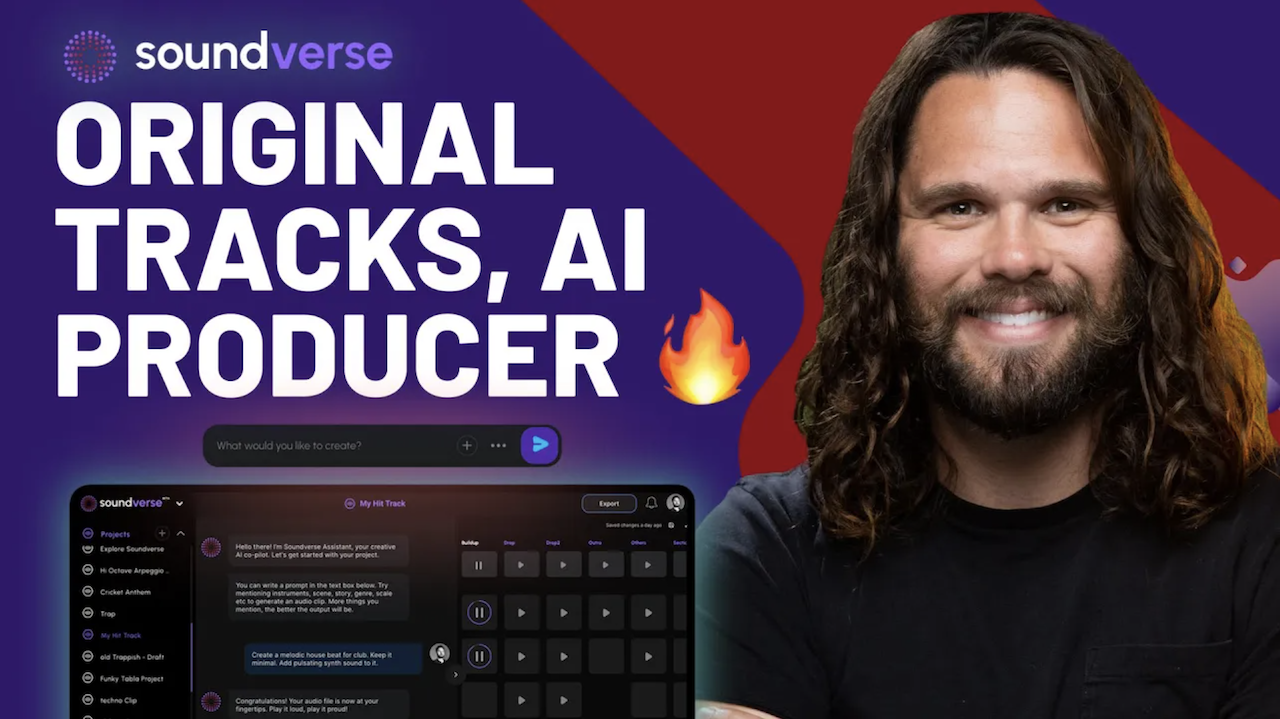
Here’s another long walkthrough of how to use Soundverse AI.
Text Guide
- To know more about AI Magic Tools, check here.
- To know more about Soundverse Assistant, check here.
- To know more about Arrangement Studio, check here.
Soundverse is an AI Assistant that allows content creators and music makers to create original content in a flash using Generative AI. With the help of Soundverse Assistant and AI Magic Tools, our users get an unfair advantage over other creators to create audio and music content quickly, easily and cheaply. Soundverse Assistant is your ultimate music companion. You simply speak to the assistant to get your stuff done. The more you speak to it, the more it starts understanding you and your goals. AI Magic Tools help convert your creative dreams into tangible music and audio. Use AI Magic Tools such as text to music, stem separation, or lyrics generation to realise your content dreams faster. Soundverse is here to take music production to the next level. We're not just a digital audio workstation (DAW) competing with Ableton or Logic, we're building a completely new paradigm of easy and conversational content creation.
TikTok: https://www.tiktok.com/@soundverse.ai
Twitter: https://twitter.com/soundverse_ai
Instagram: https://www.instagram.com/soundverse.ai
LinkedIn: https://www.linkedin.com/company/soundverseai
Youtube: https://www.youtube.com/@SoundverseAI
Facebook: https://www.facebook.com/profile.php?id=100095674445607
Join Soundverse for Free and make Viral AI Music
We are constantly building more product experiences. Keep checking our Blog to stay updated about them!