How to Create Immersive Audio Experiences With AI
Discover how AI audio design powers immersive sound experiences in 2026.
How to Create Immersive Audio Experiences With AI
In 2026, immersive sound has become the foundation of modern storytelling—from virtual reality soundscapes to next-gen games and cinematic metaverse experiences. Audio engineers, sound designers, and AI creators are now using artificial intelligence to craft multidimensional, responsive environments where sound is felt as deeply as it is heard. This transformation is driven by rapid advances in AI audio design, a discipline blending digital acoustics, machine learning, and spatial creativity.
Why immersive sound matters in 2026
Sound defines emotion, presence, and memory. As the boundaries between physical and digital spaces blur, immersive audio has become an essential design component. Whether you are building extended reality (XR) experiences, designing interactive art installations, or producing virtual concerts, the auditory layer determines how audiences perceive realism and engagement.
In recent years (2024–2025), immersive audio technologies focused on channel expansion and precision mixing. But as of 2026, creators want intelligence in their production chains—systems that understand semantic intent, analyze acoustic space, and automate 3D positioning dynamically. AI now takes a central role in this shift.
What is AI audio design?
AI audio design refers to the use of artificial intelligence to assist or automate the creation of audio elements—ambient sound, music beds, spatial scenes, and interaction-based audio logic. Instead of traditional manual arrangement, AI-driven systems interpret descriptive prompts and translate them into structured, emotionally resonant output.
Professionals leverage AI audio design for:
- 3D sound design in games, XR experiences, and installations.
- Dynamic ambient audio generation for adaptive soundscapes.
- Spatial creativity, enabling quick exploration of immersive layout options.
- Experiential audio development for branded spaces and virtual environments.
The field integrates algorithmic mixing, adaptive sound propagation models, and text-to-sound generation—allowing creators to go beyond waveform editing and directly manipulate the perceptual experience.

How to make immersive audio with Soundverse AI Music Generator
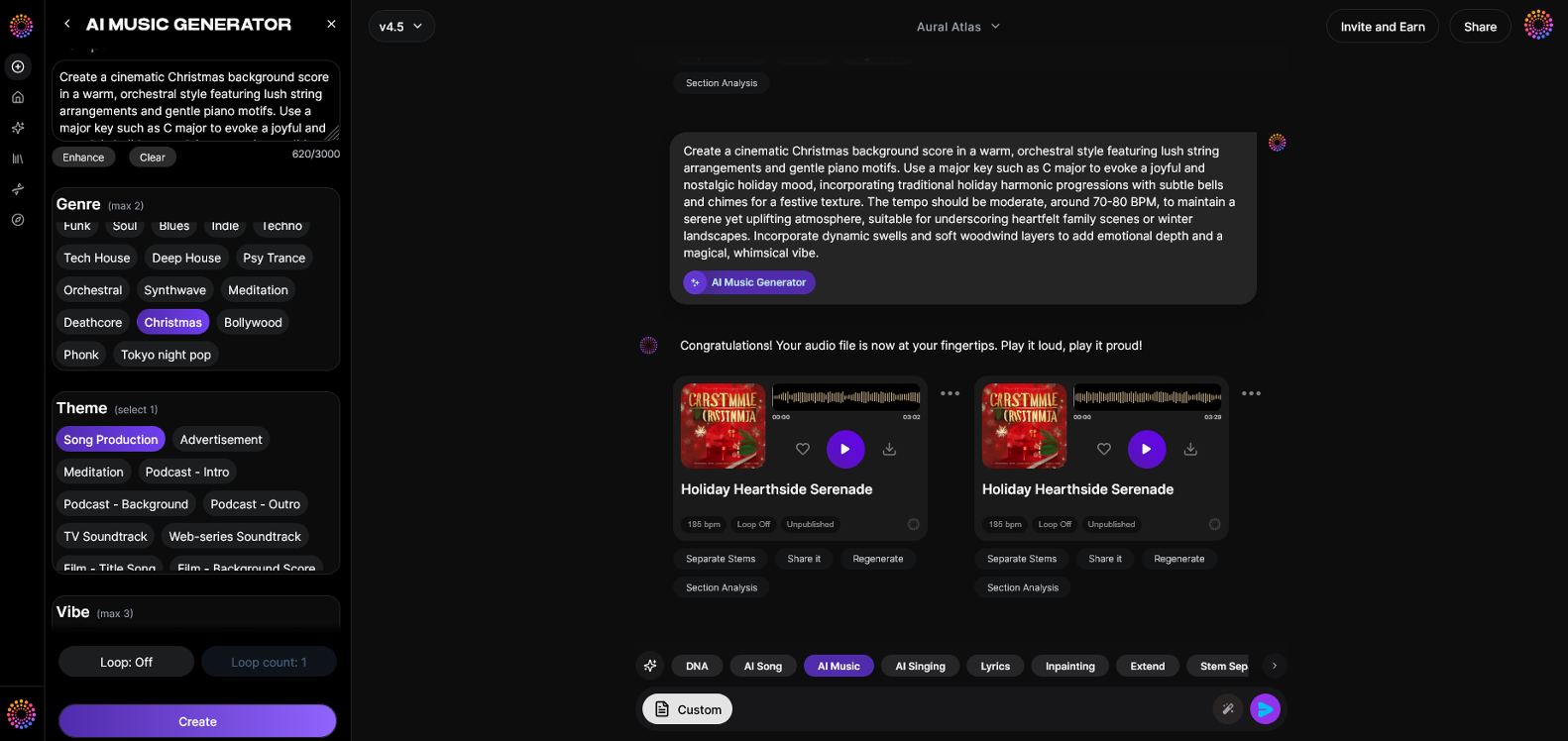
The cornerstone of AI-driven immersive production in Soundverse is the AI Music Generator—a tool designed to translate descriptive text into fully produced instrumental tracks. It removes technical barriers, allowing professionals to focus on concept and spatial execution rather than raw synthesis.
The AI Music Generator specializes in creating background tracks, beats, and evolving soundscapes without vocals. Its Loop Mode supports seamless repetition for spatial installations and gameplay sequences. Users can control genre, mood, and instrumentation, selecting between versions trained on different vibe models (V4 and V5) to suit the desired intensity or texture.
Core capabilities include:
- Text-to-music generation responsive to creative intent.
- Loop Mode for continuous playback in experiential settings.
- Flexible genre, mood, and instrument control.
- High-quality model variations (V4/V5) for stylistic depth.
For a deeper dive into the platform’s workflow, watch our Soundverse Tutorial - How to Make Music or explore the Explore Tab walkthrough on YouTube.
This makes it ideal for immersive content such as video background scores, interactive game loops, wellness or meditation experiences, and advertising audio environments.
Step 1: Feature Overview
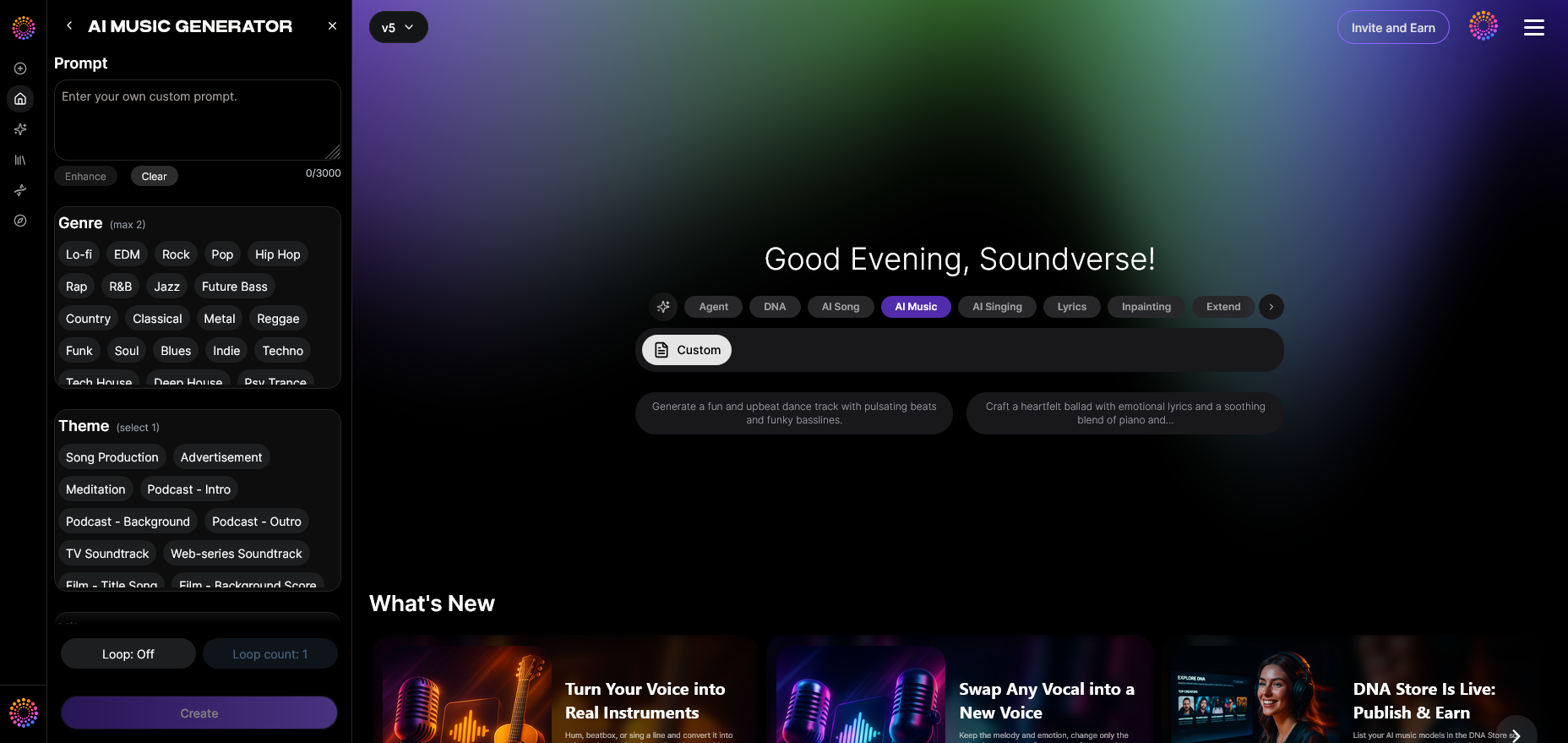
Access the AI Music Generator from the Soundverse main menu. This serves as your entry point into text-to-music composition—where you can initiate a new track and begin building the immersive foundation.
Step 2: Description Input
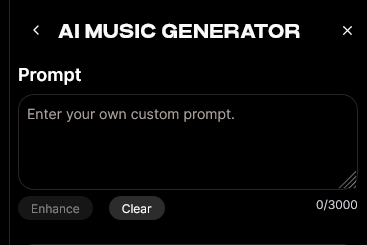
Enter a descriptive prompt of the desired sonic environment. For example, you could type: "a drifting ambient soundscape that evolves over time with soft percussion and ethereal pads." The AI interprets conceptual adjectives like drifting or ethereal to shape spatial distribution and texture.
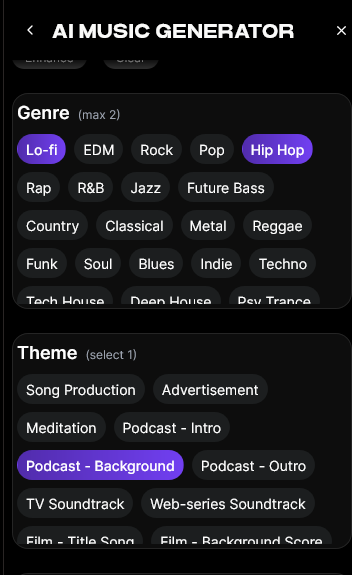
Step 3: Style & Duration
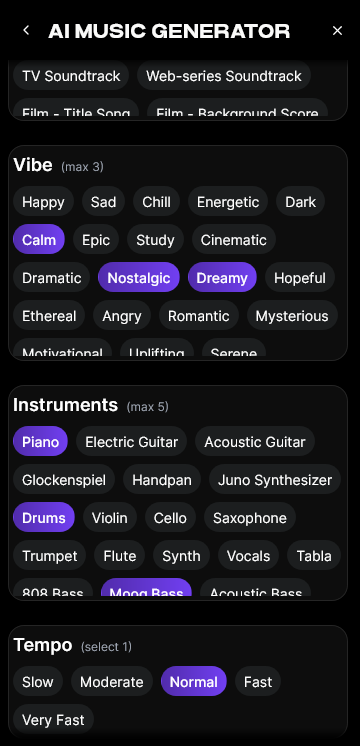
Select music style, genre, and track duration. This allows precise design for both short interactive scenes and extended installations. Combining micro loops and evolving segments creates an impression of motion that enhances spatial immersion.
Step 4: Generation
Once your description is set, click Generate. The system processes your input asynchronously—transforming text into structured instrumental audio aligned with your prompt’s emotional and spatial tone. It uses trained models that encapsulate genre behavior, ambient intensity, and spectral balance specific to immersive work.
Step 5: Export Options

Download the generated instrumental music and integrate it into your DAW, immersive engine, or audio middleware. You can create multi-layered spatial scenes by combining several generated tracks—bass or rhythmic loops for grounding, ambient textures for depth, and melodic elements for narrative direction.
For deeper learning, check out our advanced video guide Soundverse Tutorial - Make Deep House Music.
How AI audio design enhances spatial creativity
Immersive creators have traditionally used 5.1 or 7.1 surround systems, but AI redefines how spatial dynamics are built. Instead of manually plotting every source point, AI interprets intent: if a designer describes a scene as "a forest with distant thunder approaching," the generator can approximate distance decay, low-end intensity, and reflective tone balance automatically.
Soundverse’s architecture connects AI audio design directly with creative experimentation. A designer can now rapidly prototype hundreds of ambient beds—testing how each interacts with dynamic lighting, motion, or environmental simulation.
For deeper creative use, integrating Soundverse with scene-based platforms (Unreal, Unity, or proprietary XR systems) allows adaptive layering—looped outputs can shift intensity based on user proximity or narrative triggers.
Linking AI audio design to experiential audio
Experiential audio encapsulates both emotional resonance and environmental logic. AI enables sound designers to access expansive sonic palettes instantaneously. Need a transition between serenity and chaos in an art exhibit? Soundverse can generate both moods as distinct loops that blend seamlessly.
Spatial creativity thrives when iteration is effortless. AI audio design eliminates bottlenecks in asset production, freeing professionals to focus on acoustic storytelling rather than manual mixing. Through intelligent generation, creators can personalize audio experiences for each listener—enhancing immersion in real time.
For related guides on how AI transforms creative workflows, explore:
- AI music generator and human composers: a future together
- Soundverse AI revolutionizing music creation for new age content creators
- How to create healing meditation music with Soundverse AI
Pro tips for mastering immersive sound design with AI
- Design for layers. Every generated track can serve a unique function—ambience, rhythm, or emotional motif.
- Use Loop Mode strategically. Continuous loops provide consistency for large spaces like museums or VR worlds.
- Experiment with genre blending. Combine electronic textures with organic recordings for tactile depth.
- Maintain mood coherence. Use consistent prompt vocabulary to keep tonal transitions smooth between AI-generated segments.
- Integrate rights-safe generation. When using commercial outputs, rely on systems like Soundverse DNA and Trace to ensure dataset licensing and attribution integrity.
Ethical and creative evolution in 2026
AI-driven sound has faced issues regarding originality and rights. In 2026, Soundverse solved this through ethically trained models. The Soundverse DNA system supports artist monetization while granting users copyright-safe production environments. Collaboratively, Soundverse Trace embeds attribution and metadata, protecting creators throughout the content lifecycle.
This alignment between creativity and responsibility defines the new standard of immersive audio. Professionals can now generate, iterate, and distribute sound confidently—knowing their workflows maintain artistic and legal integrity.
Start Creating Immersive Audio With AI Today
Transform your sound into a captivating experience using Soundverse AI. Generate custom, high-quality audio that connects with your audience and elevates your content in minutes.
- The Role of AI Music in Film and Television: Discover how AI music tools are reshaping soundtracks and sound design for film and TV creators.
- How an AI Music Generator Inspires Creative Fusion: Explore how AI-powered composition tools inspire creativity and unconventional musical blends.
- Soundverse AI Revolutionizing Music Creation for New Age Content Creators: Learn how Soundverse AI empowers creators to produce professional-quality music faster than ever.
- AI Music Generator and Human Composers: A Future Together: Find out how AI and human creativity can collaborate to compose more expressive, immersive music.
Here's how to make AI Music with Soundverse
Video Guide
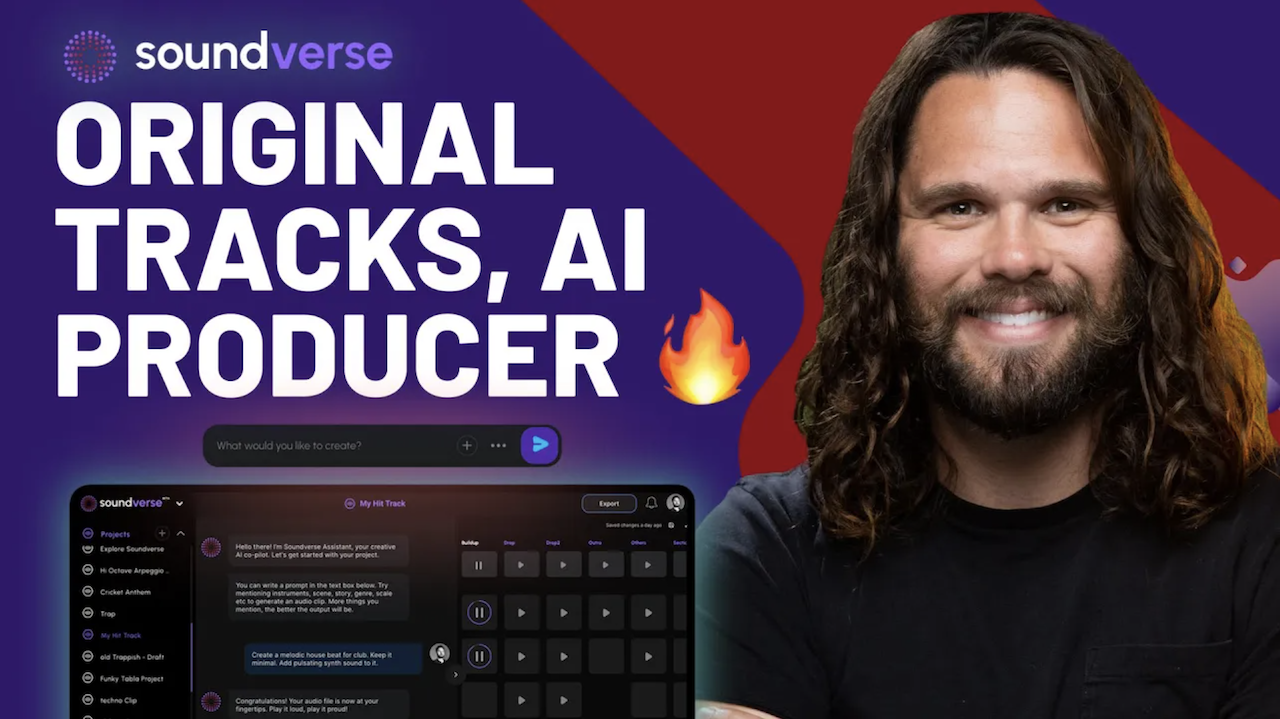
Here’s another long walkthrough of how to use Soundverse AI.
Text Guide
- To know more about AI Magic Tools, check here.
- To know more about Soundverse Assistant, check here.
- To know more about Arrangement Studio, check here.
Soundverse is an AI Assistant that allows content creators and music makers to create original content in a flash using Generative AI.
With the help of Soundverse Assistant and AI Magic Tools, our users get an unfair advantage over other creators to create audio and music content quickly, easily and cheaply.
Soundverse Assistant is your ultimate music companion. You simply speak to the assistant to get your stuff done. The more you speak to it, the more it starts understanding you and your goals.
AI Magic Tools help convert your creative dreams into tangible music and audio. Use AI Magic Tools such as text to music, stem separation, or lyrics generation to realise your content dreams faster.
Soundverse is here to take music production to the next level. We're not just a digital audio workstation (DAW) competing with Ableton or Logic, we're building a completely new paradigm of easy and conversational content creation.
TikTok: https://www.tiktok.com/@soundverse.ai Twitter: https://twitter.com/soundverse_ai Instagram: https://www.instagram.com/soundverse.ai LinkedIn: https://www.linkedin.com/company/soundverseai Youtube: https://www.youtube.com/@SoundverseAI Facebook: https://www.facebook.com/profile.php?id=100095674445607
Join Soundverse for Free and make Viral AI Music

We are constantly building more product experiences. Keep checking our Blog to stay updated about them!